
Introduction: escaping the Triage Trap and the crisis of fragmented care
Cohort management is the operational layer that groups patients by shared risk, need, or care opportunity and turns those insights into coordinated follow-up, routing, and intervention.
Most clinical operations leaders today are not starting from zero. They have invested in population health infrastructure. They have risk scores, dashboards, and data feeds from their EHR. They can tell you, with reasonable accuracy, which patients are headed for a crisis. And yet, preventable emergency department visits keep climbing. Readmission penalties keep landing. Care coordinators keep burning out.
This is the hardest gap in population health management: organizations can identify risk, but cannot reliably act on it at scale. Two specific problems sit at the root of this gap, and both must be solved simultaneously for any cohort management strategy to succeed.
The first is the triage trap, a chaotic operational bottleneck where accurate risk scores exist, but the process of ensuring the right patient gets the right care at the right time remains a manual quagmire. The second is the clinical risk of over-automation: fully autonomous systems that scale outreach quickly but lack the nuance of clinical judgment. For a coordination program to succeed, human intervention must be intentionally inserted at critical decision points, a human-in-the-loop model that ensures patient safety and empathy remain at the forefront of the care journey.
By 2026, more than 13 million Medicare beneficiaries are managed under accountable care arrangements, with CMS targeting universal accountable care attribution by 2030. As value-based care continues to expand, cohort management is the operational bridge that separates high-performing population health programs from those still firefighting. Within that gap between identifying risk and acting on it, blueBriX provides the operational layer that helps teams coordinate the right follow-up at the right time.
The failure of passive systems of record
In many health systems, risk scores are effectively “dead on arrival,” sitting dormant in rigid EHR systems designed for documentation rather than action. When a system identifies a high-risk patient but fails to route that insight to the specific coordinator responsible for their care, the result is an increase in staff cognitive load without any improvement in clinical outcomes.
The Agency for Healthcare Research and Quality (AHRQ) defines care coordination as the “deliberate organization of patient care activities” (AHRQ, Care Coordination Atlas), but deliberate organization is precisely what most organizations are missing. Instead, Monday mornings begin with jammed inboxes and sprawling spreadsheets filled with hundreds of alerts, each one a risk signal that arrived without a routing instruction.
The clinical risk of dehumanized workflows
Organizations often look to automation as a silver bullet for workforce shortages, yet over-automation can dehumanize the care process. Fully autonomous systems, when they fail, do so at a scale that can compromise patient safety and organizational trust.
A patient-centered coordination model must balance machine efficiency with human expertise. Technology should handle the heavy lifting of data analysis and routine task routing, while humans provide the judgment, context, and emotional intelligence that drive high patient satisfaction scores. This is not an argument against automation, it is an argument for automation with a human conscience at its center, one that recognizes when clinical nuance demands a person, not a workflow rule.
What is cohort management in healthcare?
To move beyond the identification plateau, organizations must utilize a multi-method risk stratification framework that synthesizes medical complexity with social and behavioral drivers. Relying solely on Hierarchical condition category (HCC) coding provides a retrospective view of risk that often misses the “rising risk” population, individuals who are stable today but whose clinical or social trajectories indicate impending crisis.
Effective population health management demands a three-dimensional view of every patient in the panel.
Clinical stratification and HCC capture
Clinical stratification remains the foundation of risk management, yet traditional methods often suffer from systematic revenue leakage. HCC coding accuracy directly affects risk scores, shared savings eligibility, and quality bonuses.
By utilizing real-time HCC prompts and AI-driven documentation support, organizations can materially improve HCC-eligible diagnosis capture and close the RAF score gap between what the EHR documents and what the population’s actual clinical complexity warrants.
Social stratification and SDOH integration
Non-clinical factors, access to food, stable housing, and reliable transportation, play a major role in shaping overall health outcomes. A modern stratification engine must incorporate SDOH data from the first touchpoint. By assembling a complete patient profile that includes clinical data, claims history, and social determinants, care teams can identify patients needing attention before a crisis occurs.
This real-time visibility is critical as the industry shifts from simple diagnosis capture to a focus on better care delivery. Learn more about how blueBriX integrates SDOH into population health workflows.
Behavioral stratification and patient engagement
Risk is not static, it fluctuates based on patient behavior and engagement patterns. Tracking behavioral triggers, such as three missed appointments in 60 days or rising mental health screening scores (e.g., PHQ-9), allows for the identification of patients at risk of disengaging from care before it occurs.
High-performing platforms rank their population in real-time across every data source, ensuring that disengaged patient cohorts are prioritized for outreach before they churn out of panel attribution. This is foundational to the proactive care coordination model that separates reactive health systems from genuinely outcomes-driven ones.
From risk scores to proportional cohorts
A risk score is a diagnostic indicator, not an operational care plan. To move from identifying risk to organizing delivery, organizations require a proportional cohort model, one that matches the intensity of care management resources to the complexity of the patient population.
Proportional resource allocation
In this model, the goal is to ensure that the highest-risk cohort reflects a proportional distribution of empaneled patients who are most likely to benefit from intensive interventions. A validated approach involves a two-step process: utilizing an algorithm to segment the population based on clinical data, and then applying the care team’s clinical judgment to refine those tiers.
This human review layer is not optional. It is the safeguard that ensures AI-generated prioritization reflects clinical reality, catching the nuances that algorithms miss and building the trust that makes care managers actually use the system. When coordinators trust the cohorts they are working from, they spend their time on patients rather than questioning data.
Workflow as a primary defense
A structured workflow is the primary defense against staff friction. When care coordination is organized into cohorted worklists, such as “High-risk CKD progression” or “Post-acute with transportation barriers,” tasks are automatically routed to the right team member based on pre-defined, intelligent rules. This is the operational core of unified care coordination.
Automation within this model is always paired with human oversight. Routine tasks, post-discharge follow-up reminders, wellness visit scheduling, care gap alerts, are handled automatically to free coordinator capacity. The clinical judgment calls, determining whether a patient needs physician escalation, reviewing an SDOH flag before triggering a referral, or assessing whether a behavioral change signals a medication issue, remain in human hands. This rules-based routing eliminates guesswork and ensures consistency, dramatically reducing the time between risk identification and active engagement.
Adoption friction: why care coordination programs stall in the Triage Trap
Leaders must account for the practical barriers that often derail population health initiatives. Understanding these hurdles is essential for operationalizing a sustainable coordination strategy.
Workflow logic vs. workflow load
One of the primary concerns for leadership is alert fatigue. However, by implementing rigorous workflow logic, organizations can prevent staff from experiencing information overload. When a platform automates routine administrative tasks and only surfaces high-priority, contextualized actions, it clears the noise from the clinician’s inbox.
Without automated routing, staff are left in a state of manual prioritization, an exhausting cycle that leads to burnout and the fear of missing a critical patient. The solution is not fewer alerts; it is smarter routing that ensures every alert is relevant, actionable, and assigned to the right person. Even when that routing is automated, the clinical response to the alert remains a human act, a call, a visit, a judgment about what the patient actually needs.
Eliminating shadow IT and data silos
Fragmented records across incompatible systems lead to “Shadow IT,” where teams rely on ad hoc Excel reporting to manage populations. Data silos prevent accurate stratification and lead to incomplete records, causing clinicians to lose faith in the accuracy of risk models. A unified platform eliminates these silos, ensuring every care team member accesses the same comprehensive, real-time patient view.
Unclear ownership and care gaps
Without defined role-based routing, critical handoffs fail because no individual is clearly accountable for the next step in a patient’s journey. Cohort management identifies care gaps in real time and assigns an “owner” to each task, ensuring the full loop is closed. This level of accountability is essential for correct reporting and for preventing the revenue loss associated with unfulfilled referrals and missed screenings.
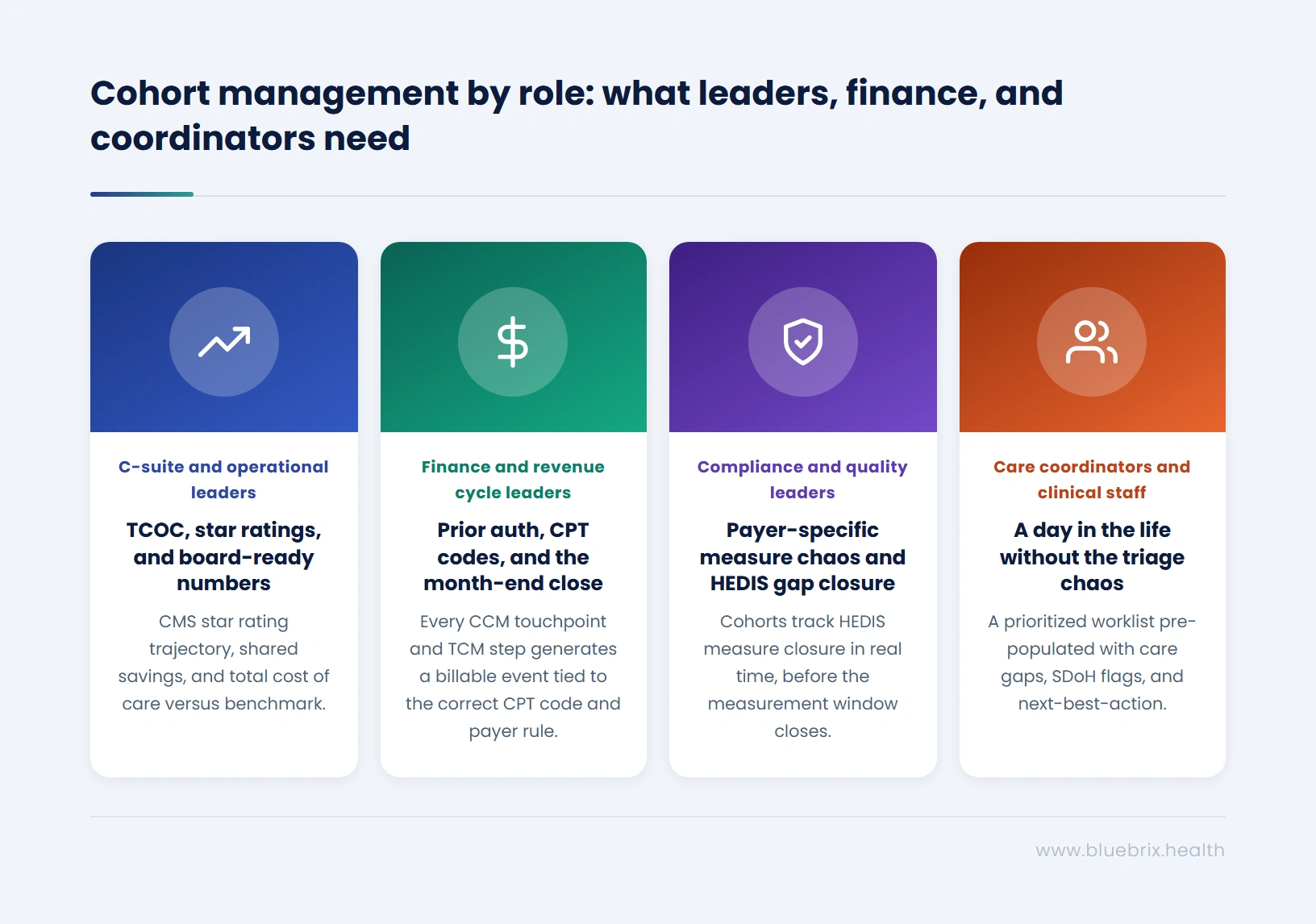
For the C-suite and operational leaders: TCOC, Star Ratings, and board-ready numbers
For C-suite leaders, the question is not whether care coordination matters, it is whether the investment produces measurable returns visible at the board level. The answer lives in three numbers: CMS Star Rating trajectory, shared savings performance, and Total Cost of Care versus benchmark. A single Star Rating point can determine Quality Bonus Payment eligibility, which affects both benchmark bonuses and the rebate percentages available to fund member benefits and enrollment growth.
Imagine the October board meeting, six weeks before annual contract renegotiation. The quarterly board slide shows shared savings performance tracking hundreds of thousands below benchmark. The underlying cause is not care complexity, it is the high-risk patients whose post-discharge follow-ups were not completed within the measurement window. That gap is invisible until the claims cycle closes, unless the platform surfaces it in real time, before the window expires.
Cohort management is not a clinical workflow preference, it is a revenue protection mechanism. Organizations that close care gaps systematically across their attributed population move the underlying HEDIS measures that drive Star Ratings. Those that rely on coordinators working from color-coded spreadsheets do not close them fast enough.
For finance and revenue cycle leaders: prior auth, CPT codes, and the month-end close
Finance leaders know the month-end close for care management programs as “Excel gymnastics”: pulling CCM minutes from one system, TCM documentation from another, prior authorization status from a third, and reconciling all of it against payer contracts that change quarterly. Cohort management platforms with automated audit trails and revenue cycle visibility eliminate this reconciliation burden.
Every CCM touchpoint, every TCM documentation step, every care gap closure generates a billable event that the platform captures automatically, tied to the correct CPT code, the correct payer rule, and the correct encounter record. Prior authorization workflows embedded in the cohort routing mean that referrals move with the documentation already attached, reducing the denial rate that currently costs systems days of follow-up per claim.
For compliance and quality leaders: payer-specific measure chaos and HEDIS gap closure
Quality and compliance leaders live in payer-specific measure chaos: NCQA’s HEDIS specifications differ from CMS Star Rating methodology. Follow-up windows vary by measure, 7 days for some, 30 days for others. Every payer contract adds its own layer of performance thresholds, and the manual registries and spreadsheets that track gap closure status are perpetually stale.
A cohort management platform configured against specific payer contracts and HEDIS measure specifications removes this chaos. Cohorts are built around measure specifications, “Patients due for colorectal cancer screening by October 15”, and the platform tracks closure status in real time, so quality leaders have an accurate picture of measure performance before the measurement window closes, not after the HEDIS submission deadline has passed.
For care coordinators and clinical staff: a day in the life without the triage chaos
For the care coordinator who opens that Monday inbox, cohort management changes the entire texture of the workday. Instead of a generic alert queue, she sees a prioritized worklist: “High-risk CKD, post-discharge” at the top, pre-populated with the patient’s longitudinal timeline, outstanding care gaps, SDOH flags, and the next-best-action already determined. The system has already routed the 48-hour follow-up reminder to the right team member. The TCM documentation checklist is pre-attached to the discharge record. She does not hunt for data. She makes clinical decisions.
This is what coordinator retention actually looks like: not perks, but a system that respects clinical judgment by removing the administrative noise that buries it.
How does cohort management improve HCAHPS scores?
The link between cohort management and patient experience is defined by specific operational behaviors. CMS has introduced an updated HCAHPS survey, effective for discharges as of January 1, 2025, which includes a new Care Coordination composite. This measure, which focuses on whether staff “worked well together” and stayed “informed and up-to-date” about care, is set for public reporting beginning in October 2026. Organizations without automated routing and shared longitudinal records will struggle to move these measures consistently across a full attributed panel.
Improving communication and responsiveness
Cohort management changes clinical behaviors to improve the patient’s lived experience. Organizing patients into cohorts allows for pre-visit preparation, enabling clinicians to enter the room with a shared agenda, making patients feel heard and improving perceptions of doctor and nurse communication.
Automated routing ensures that a team member is notified of a patient’s needs immediately, directly impacting scores for staff responsiveness and team collaboration. When coordination is deliberate and system-driven rather than ad hoc and individual, patients experience the difference, in shorter response times, in consistent follow-up, and in a care team that appears to actually know their story.
Standardizing information about symptoms
Standardizing follow-up for specific cohorts, for example, post-surgical recovery patients, ensures every patient receives written guidance on what symptoms to watch for after discharge. This is a standalone HCAHPS priority aimed directly at preventing avoidable readmissions. This consistency is difficult with manual processes but structurally guaranteed with cohorted workflows, which ensure that no patient is discharged without the information required to manage their recovery safely.
Measurement for success: high-level KPIs for leadership
For clinical operations leaders, measuring the success of a cohort management program means tracking the organizational performance indicators that directly influence revenue, contract standing, and competitive positioning, not just the activity metrics of individual staff members. Daily coordination work matters because it drives the outcomes that boards, payers, and CMS actually evaluate.
Medicare star ratings and quality bonus payment eligibility
For Medicare Advantage plans, one of the most important organizational KPIs is the CMS star rating, specifically whether the plan reaches the four-star threshold that affects Quality Bonus Payment eligibility. Plans that earn four or more stars can qualify for benchmark bonuses and higher rebate percentages, which may then be reinvested into benefits that support enrollment growth.
A single Star Rating point can separate an organization that earns bonus-eligible status from one that does not. Cohort management is one of the operational mechanisms that moves those underlying measures. When a care coordination team closes care gaps systematically across a population, each closed gap contributes to a HEDIS measure rate. When post-discharge follow-up happens reliably, readmission-related measures improve. In CMS’s 2025 Star Ratings methodology, the Part C Plan All-Cause Readmissions measure carries a weight of 3, reflecting the agency’s greater emphasis on transitions of care (42 CFR 423.186).
HEDIS composite performance: transitions of care and chronic condition management
Within the Star Ratings framework, certain HEDIS measures carry disproportionate influence on overall performance, and they are exactly the kinds of measures cohort management is designed to improve. Transitions of Care measures require timely post-discharge follow-up, while chronic condition measures depend on structured, recurring engagement across large patient cohorts.
NCQA Health Plan Ratings use HEDIS and CAHPS results plus accreditation status, while CMS Star Ratings are a separate Medicare quality system that also uses HEDIS measures and are the ratings displayed on Medicare Plan Finder. The reason to track how quickly post-discharge calls are completed, or how many CCM touchpoints occur each month, is because those activities move HEDIS performance before the measurement window closes. Follow-up windows vary: for example, NCQA’s Follow-Up After Emergency Department Visit for Mental Illness measure tracks follow-up at both 7 and 30 days. Cohort management makes the connection between daily activity and HEDIS outcomes visible, traceable, and manageable in real time.
Total cost of care and shared savings performance
For organizations operating under value-based contracts, Total Cost of Care is the key financial KPI. It shows whether population-level spending is staying below benchmark, which determines whether the organization earns shared savings or takes on shared risk. Cohort management supports Total Cost of Care performance by making sure the interventions most likely to reduce cost, transitional care follow-up, chronic care management enrollment, and social-barrier resolution, are completed consistently rather than sporadically.
An AJMC study of 424,115 Medicare beneficiaries found TCM billing was associated with $2,803 lower 90-day episode spending per patient and a reduction of 28.7 readmissions per 1,000 beneficiaries (Lin et al., 2024). Results vary by population, program design, and setting, but at scale, consistent transitional care completion translates directly into shared savings performance.
Attribution stability and panel growth
Panel attribution, who is assigned to your organization under value-based contracts, is the denominator for quality measures and the basis for per-member-per-month revenue. Attribution is not static. Patients disengage, change providers, and fall off the panel. When that happens, the organization loses not only revenue but also continuity of care and the ability to manage future utilization.
Rising-risk patients who are not proactively engaged between visits are the most likely to churn, and the least likely to churn if they experience coordinated, continuous outreach. Tracking disengagement signals at the cohort level and monitoring retention by risk tier gives clinical operations leaders an early warning system for attribution loss that would otherwise not appear until the next claims cycle. Structured touchpoints between visits help keep patients engaged and attributed, while documentation completeness and payer mix shape the exact revenue impact.
High-value patient cohorts in value-based care: TCM, CCM, and referral leakage
In the complex landscape of value-based care, significant revenue is lost to preventable breakdowns in coding, referral management, and attribution. By applying deliberate organization to high-value cohorts, leaders can focus on plugging these specific leaks before they compound.
Transitional care management (TCM)
TCM represents one of the most underutilized revenue and quality opportunities in population health. An AJMC study of 424,115 Medicare beneficiaries found TCM billing was associated with $2,803 lower 90-day episode spending per patient, yet only 17.9% of eligible Medicare beneficiaries received TCM billing in 2019, the most recent year with comprehensive data (ASPE). Automating post-discharge alerts and guiding teams through strict documentation requirements ensures that organizations capture this revenue while simultaneously preventing high-cost readmissions. No discharge should move through the system without triggering the TCM workflow; no TCM workflow should close without meeting the documentation requirements for billing.
Rising risk and chronic care management (CCM)
Rising-risk patients are the “movers” in a population trending toward higher-cost events. Chronic Care Management (CCM) programs create a steady source of reimbursable revenue while also supporting ongoing engagement between visits. Keeping in touch with these patients reduces the risk of attribution loss, which happens when members drift to other providers because they do not feel consistently connected to care.
SDOH and referral leakage control
Referral leakage, where patients seek care outside the preferred network, is a significant and well-documented source of revenue loss for health systems. Industry estimates suggest hospitals lose between 10% and 30% of their annual revenue to referral leakage, with HealthLeaders Media estimating the industry-wide cost at $150 billion annually. By filtering for patients with social barriers like transportation insecurity and providing coordinated community referrals, organizations can keep more care within their network. This not only protects revenue but also ensures continuity of care, as fragmented records are a primary driver of duplicate testing and care gaps.
What should I look for in a care coordination platform?
When evaluating a cohort management platform, move beyond feature checklists and focus on whether the solution can support operational execution at scale. The five pillars below separate platforms that strengthen performance from those that add complexity.
| Pillar | What to evaluate |
|---|---|
| Workflow fit | Does the platform prioritize tasks and next-best actions within your existing care team flow, or does it sit outside it, requiring coordinators to switch systems? |
| Interoperability & integration | Does it support standards-based, bi-directional data exchange built on FHIR R4, HL7 v2, and REST APIs, in real time, not nightly batch? |
| Configurability | Can clinical leaders modify cohort rules, care pathways, and assessment forms without IT development cycles or vendor tickets? |
| Auditability | Does the system auto-capture and timestamp every care management activity to verify CCM and TCM billing time for payer compliance? |
| Reporting & revenue visibility | Does it connect care delivery to quality reporting, CPT billing, and Total Cost of Care performance under one roof, not three point solutions? |
Get the full platform evaluation checklist
Most platform selection processes stall because the right questions were never asked. This checklist walks your selection committee through every capability that matters: workflow fit, interoperability, configurability, auditability, and reporting. It includes a per-pillar scorecard and a red flag guide for vendor responses that should give you pause. Formatted for your clinical ops lead, CFO, and compliance officer to evaluate together.
Operationalizing population health with blueBriX
The blueBriX platform is structured as an execution layer between risk stratification and care delivery, organizing population data into structured workflows across three functional areas: risk and quality intelligence, care coordination and patient engagement, and reporting and compliance.
Risk and quality intelligence
This pillar focuses on multi-dimensional scoring and dynamic prioritization. By utilizing an AI orchestration layer that runs HCC coding and validates actions against specific payer contracts, blueBriX ensures that teams know exactly who needs attention before a crisis occurs. It blends data from EHRs, claims, and social determinants into a unified risk score, allowing for the precise grouping of populations into actionable risk tiers.
Care coordination and patient engagement
The blueBriX care team workbench serves as the centralized execution surface that unifies clinical views and longitudinal timelines. It enables efficient, coordinated care delivery by automating referral routing and patient touchpoints across settings. Its clinical decision rule engine standardizes decision-making, automatically segmenting the population based on medical history and triggering interventions like 48-hour post-discharge follow-up tasks.
Automation is embedded throughout, but designed specifically to escalate to human decision-making at every point where clinical judgment is required. Patient engagement is not a separate module, it is woven into the coordination workflow, ensuring that engagement data feeds directly back into the risk and behavioral stratification engine. This design is intended to reduce the administrative load on coordinators so that panel capacity can expand without adding headcount; results will vary by organization, program maturity, and implementation approach.
Actionable triage: the intelligence engine
blueBriX uses an event-driven architecture to instantly route flags into prioritized task queues for the appropriate team member. Whether it is an abnormal vital from a remote device or a missed high-priority follow-up, the system pushes actionable insights directly into the clinician’s existing workflow, ensuring a seamless transition from identification to intervention.
Reporting and compliance
To solve the administrative burden of value-based care, blueBriX auto-captures encounters, assessments, and transition-of-care steps. The platform’s Reporting and Compliance engine provides revenue visibility that starts with care delivery, connecting clinical activity to payer rules and billing workflows. This automated audit trail is essential for proving care management time for reimbursement and ensuring that no rightfully earned revenue is lost to coding or documentation gaps.
Interoperability: the standards-based foundation
Population health management requires reliable interoperability, not just data integrations, but bi-directional, standards-based exchange that works in real time. blueBriX is built on FHIR R4, HL7 v2, and REST APIs to connect with existing technology stacks like Epic, Salesforce, and athenahealth without requiring a full system replacement. This ensures data liquidity, the ability for patient information to flow securely and in real time across providers, labs, and imaging systems, which is the foundational requirement for effective care coordination.
See what a purpose-built cohort management platform looks like
blueBriX is designed specifically for value-based care organizations, from single-site practices to multi-site health systems managing complex payer contracts and population health programs. Come with your checklist results and your toughest coordination questions. Leave with a clear picture of what is possible for your organization.
Schedule a personalized demo