
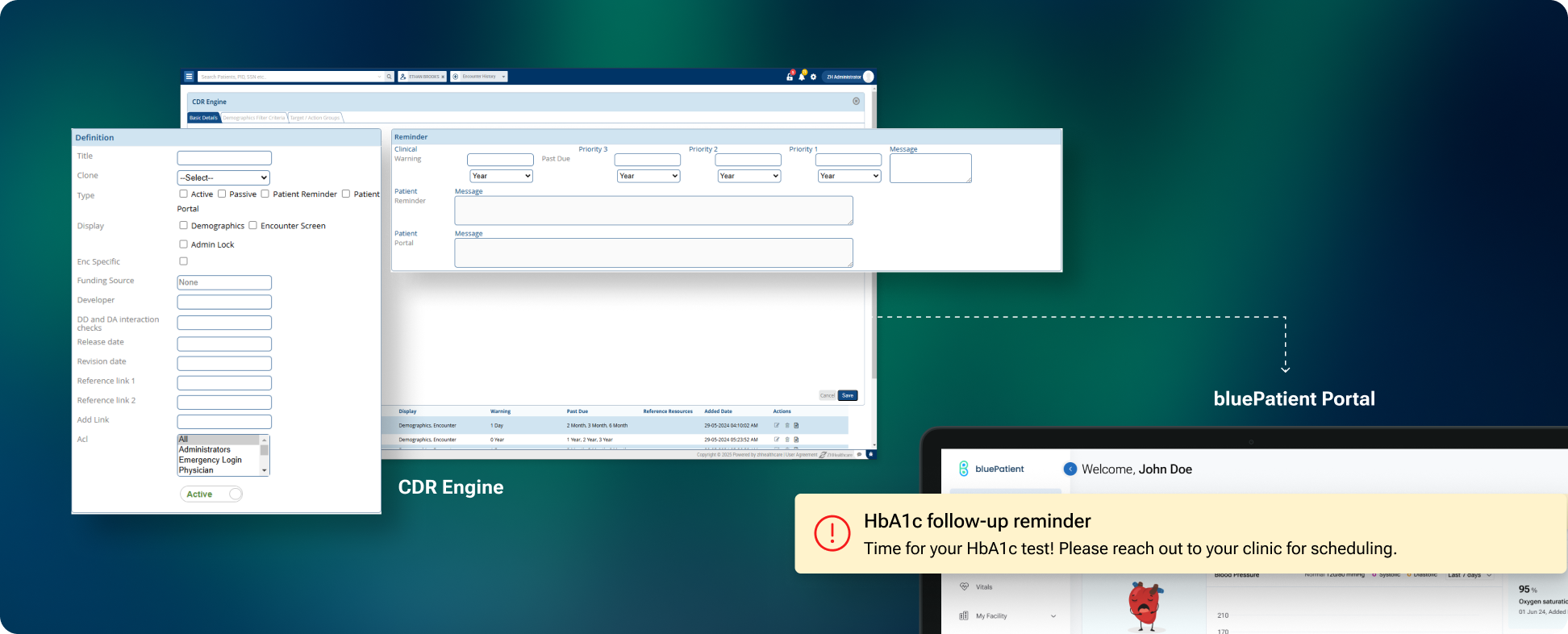
A patient discharged after a psychiatric hospitalization misses their first follow-up appointment. There is no alert. No flag fires in the EHR. The care team does not know. Two weeks later, the patient returns through the emergency department.
This is not a rare scenario in behavioral health. It is a structural gap that exists wherever patient data is collected but not acted on automatically. The interval between appointments, between a lab result and a prescription review, between a screening score and a care plan update, is where deterioration begins. A clinical decision rule engine closes that interval.
A clinical decision rule (CDR) engine is a configurable software layer inside an EHR that evaluates patient data against predefined clinical rules and triggers alerts, reminders, or automated workflow actions at the point of care. In behavioral health settings, where caseloads are high, documentation is complex, and the population is at elevated risk for gaps in follow-through, CDR engines are not optional infrastructure. They are the mechanism through which proactive care becomes operationally real.
In this article, we’ll explore how the blueBriX CDR engine is transforming value-based care by supporting clinicians in delivering timely, personalized, and efficient care.
The role of clinical decision rule engine in healthcare
A clinical decision rule (CDR) engine is a powerful tool designed to assist healthcare providers in making accurate, evidence-based proactive decisions by leveraging clinical guidelines, patient data, and real-time analytics.Acting as a bridge between vast medical knowledge and daily clinical practice, the CDR engine helps streamline decision-making, reduce errors, and improve the overall quality of care, supporting value-based care.
By automating the application of pre-defined clinical rules, the CDR engine ensures consistency in diagnosis and treatment, optimizing both care delivery efficiency and patient outcomes.It empowers providers to focus on delivering patient-centered proactive care while minimizing administrative burdens, making it a vital component in value-based healthcare ecosystems.
The blueBriX CDR Engine standardizes decision-making, reducing variability in diagnoses and treatments, while improving diagnostic accuracy, especially in complex or high-risk scenarios.Real-time data analysis streamlines workflows,saving time and providing actionable insights when they’re needed most.Tailored to individual patient factors such as medical history and comorbidities, the engine ensures personalized care recommendations that align with evidence-based guidelines.Beyond enhancing care quality,the blueBriX CDR engine reduces costs by eliminating unnecessary tests and procedures, making it a valuable asset for value-based care models.With its ability to optimize resource utilization and promote better patient outcomes, the blueBriX CDR engine bridges the gap between clinical expertise and data-driven insights, redefining healthcare decision-making for today’s fast-paced environments.This is not a theoretical benefit. ONC notes that when properly implemented, clinical decision support can reduce errors, improve care quality, reduce cost, and ease the cognitive and administrative burden on providers.[1]
Key benefits of CDR engine for providers and patients
With its ability to simplify complex clinical decisions while improving the quality of care, the blueBriX Clinical Decision Rule Engine is an indispensable tool in advancing both provider workflows and patient outcomes.
| Providers | Patients |
|---|---|
| Enhanced Diagnostic Accuracy | Personalized Care |
| Proactive Care | Prevents Complications & Comorbidities |
| Time Efficiency | Improved Outcomes |
| Standardized Care | Reduced Unnecessary Tests |
| Reduced Cognitive Load | Enhanced Trust |
| Compliance with Guidelines | Better Value-Based Care |
The blueBriX clinical decision rule engine
The blueBriX Clinical Decision Rule Engine is designed to streamline clinical decision-making processes by allowing healthcare providers to create and configure rules. This facilitates the management and automation of clinical workflows, improving proactive patient care and operational efficiency. The engine supports customization to meet specific healthcare practice needs which makes it adaptable and scalable. It can also communicate seamlessly with 3rd party digital health applications. Federal research investment reflects this direction. AHRQ’s Clinical Decision Support Innovation Collaborative has spent four years advancing patient-centered, interoperable decision support, producing more than 70 resources and five real-world demonstrations across care settings.[2]
Core functionality
The core functionality of the blueBriX Clinical Decision Rule Engine is to automate tasks within healthcare settings.It reduces repetitive tasks and saves time for healthcare providers by enabling the creation and configuration of clinical and patient reminders, thereby enhancing efficiency and supporting better decision-making.
The three sections of rule management

Effective rule management is essential for optimizing patient care and ensuring that interventions are both relevant and impactful. This process can be divided into three key sections:
- Rule definition
In this section, we define the parameters of each rule. This includes establishing clear guidelines that outline the conditions under which the rule applies, the expected outcomes, and any relevant thresholds or limits. By setting these foundational details, we ensure that rules are actionable, measurable, and aligned with overall healthcare objectives. - Demographics filter
Tailoring rules based on patient demographics is crucial for enhancing the effectiveness of interventions. This section involves creating filters that consider various demographic factors such as age, gender, ethnicity, and socio-economic status.By customizing rules to reflect the unique characteristics of different patient populations, healthcare providers can ensure that interventions are more relevant and can address specific needs effectively. - Target/action groups
This section focuses on identifying specific patient groups for targeted interventions. By analysing data and segmenting patients into action groups based on shared characteristics or health conditions, healthcare providers can implement more precise and effective strategies. This targeted approach not only improves patient outcomes but also enhances resource allocation by directing efforts where they are most needed.
By understanding and implementing these three sections of rule management, healthcare providers can create a more structured and effective framework for patient care, ultimately leading to improved health outcomes and greater satisfaction among patients.
Key features of the blueBriX clinical decision rule (CDR) engine
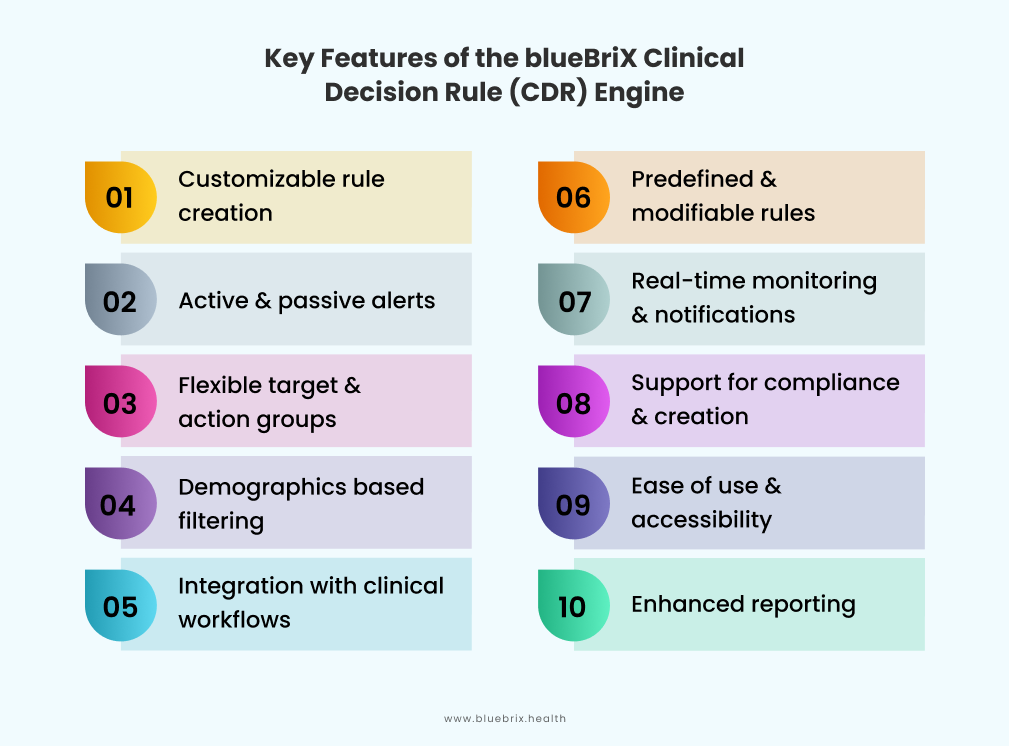
The blueBriX CDR Engine stands out as a highly flexible and effective tool for streamlining clinical workflows,improving compliance, and enhancing patient care outcomes.It comes with the following features:
1.Customizable rule creation
- Allows clinicians or administrators to set up rules based on patient demographics, vitals, medical history,medications,and diagnostic procedures.
- Rules can be tailored for specific conditions like hypertension or diabetes, triggering timely alerts and reminders.Active and passive alerts
- Active alerts: Display as pop-up notifications that must be acknowledged before proceeding with tasks,ensuring critical actions are not missed.
- Passive alerts: Appear as notifications that do not interrupt workflow but provide important reminders when needed.
Example: For an active rule, an alert notifies clinicians that a prescribed medication exceeds the recommended dosage for a pediatric patient, prompting immediate adjustment. For a passive rule, a notification reminds staff that the patient is due for a routine vaccination before discharge. It does not hinder the user’s tasks, but the reminder stays on the screen until it is cleared.
3.Flexible target and action groups
- Supports creating multiple target-action combinations, such as scheduling lab tests, documenting vitals, or completing diagnostic evaluations.
- Targets can be based on predefined criteria, lifestyle factors (e.g., smoking, alcohol use), or custom tables for specific workflows.
4. Demographics-based filtering
- Enables rules to be filtered by patient demographics like age, gender, medical conditions, or lifestyle habits to ensure context-specific care delivery.
5. Integration with clinical workflows
- Seamlessly integrates into healthcare systems like blueEHR, offering reminders within demographic screens, encounter screens, or via patient communications.
6. Predefined and modifiable rules
- Comes with a set of predefined rules for clinical and patient reminders, which can be edited or cloned to suit specific organizational needs.
7. Real-time monitoring and notifications
- Alerts providers of overdue actions (e.g., a missed follow-up test or medication review) with configurable timelines such as daily, weekly, or monthly intervals.
8. Support for compliance and certification
- Adheres to standards required for ONC certification and other regulatory guidelines, ensuring compliance with clinical and operational requirements.
9. Ease of use and accessibility
- User-friendly interface allows easy rule creation, modification, and deletion. Permissions can be assigned to specific roles like clinicians or administrators.
10. Enhanced reporting
- Generates detailed reports on rule compliance, showing completed and pending tasks, with options to export as PDFs or Excel files for further analysis.
blueBriX CDR engine integration with EHR systems
Integrating a Clinical Decision Rule (CDR) Engine with Electronic Health Record (EHR) systems represents a transformative step in modern healthcare. This integration bridges the gap between advanced decision-support tools and the data-rich environments of EHRs, enabling healthcare providers to deliver precise, timely, and evidence-based care.By seamlessly embedding clinical rules into the existing workflows, blueBriX ensures that providers have access to actionable insights at the point of care.Beyond enhancing efficiency, such integration minimizes manual tasks, reduces errors, and drives better patient outcomes.
Seamless access and permissions
The seamless integration between the blueBriX Clinical Data Repository (CDR) Engine and EHR systems ensure that healthcare providers can securely access patient data with precise permission settings. By leveraging advanced access control mechanisms, this integration allows authorized users to retrieve and manage sensitive health information efficiently while maintaining compliance with regulatory standards such as HIPAA.
Display options across demographics and encounters
blueBriX CDR Engine works with EHR systems to provide tailored display options that adapt to diverse patient demographics and clinical encounters. Whether managing paediatric, geriatric,or specialty care or other disparate cases, the system dynamically adjusts data visualization and reporting to suit the specific needs of care providers and patients alike. This ensures accurate, actionable insights regardless of the complexity of the care settings.
Benefits of the blueBriX CDR engine
Enhanced decision support
The rule engine utilizes patient data and clinical guidelines to assist healthcare providers in making informed, evidence-based decisions.This integration of medical knowledge helps identify the best interventions for patients, reducing the risk of errors and improving overall care quality.AHRQ’s own 2024 evidence review on this question found moderate-certainty evidence that computerized provider order entry paired with clinical decision support reduces medication errors, with additional gains when the underlying decision support rules are well-designed and properly targeted.[3]
Real-time alerts
The system generates real-time alerts based on patient data,enabling timely interventions for critical conditions.This feature is crucial in acute care scenarios where immediate action can significantly impact patient outcomes.
Automated compliance
blueBriX ensures adherence to healthcare regulations and standards by automating compliance checks.This reduces the risk of penalties associated with non-compliance and enhances patient safety by promoting standardized care practices.
Improved patient outcomes
By systematically applying clinical guidelines to patient data, the rule engine helps ensure that care recommendations are personalized and evidence-based, ultimately leading to better health outcomes for patients. The clinical evidence supports this. A 2024 meta-analysis of 10 randomized controlled trials covering more than 18,000 patients found that clinical decision support systems were significantly associated with a decreased incidence of hyperkalemia and improved kidney function markers, underscoring the value of real-time alerts in preventing downstream complications.[4]
Looking ahead: the future of clinical decision rule engine
The future of Clinical Decision Rule Engines lies in their seamless integration with evolving technologies like artificial intelligence (AI), machine learning (ML), and predictive analytics. These engines are expected to transition from static rule-based systems to dynamic, adaptive frameworks capable of learning from vast datasets and tailoring decisions to individual patients.
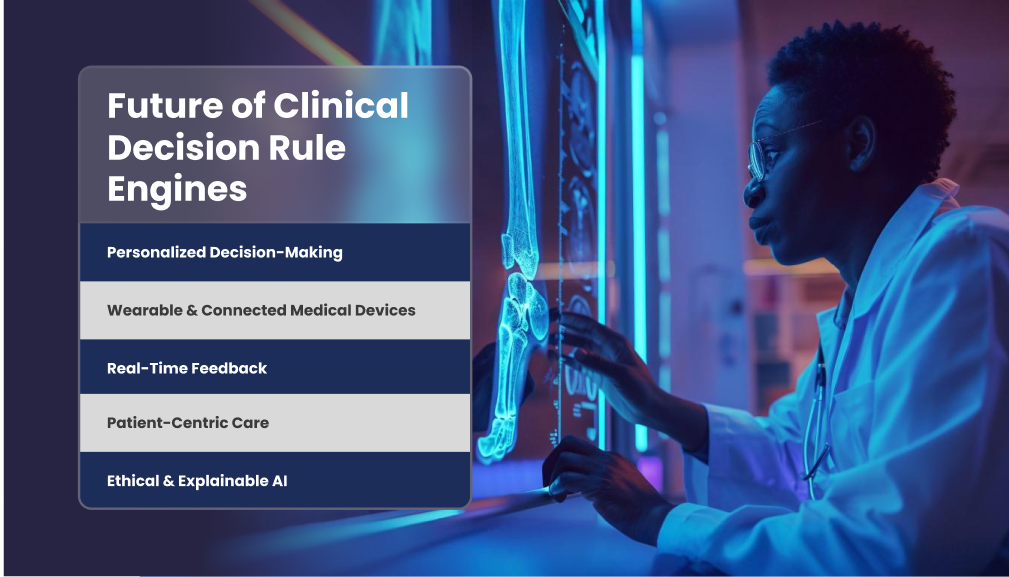
Key advancements include:
- Personalized decision-making: By leveraging AI, CDR Engines will process patient-specific data,such as genetic information, social determinants of health, and real-time monitoring, to offer precise, individualized recommendations.
- Real-time feedback: The incorporation of IoT devices and wearables will provide CDR Engines with continuous patient data streams, ensuring real-time decision-making for acute and chronic conditions.
- Patient-centric care: Future CDR Engines will focus not only on clinician support but also on empowering patients by providing them with actionable insights, improving engagement and adherence.
- Ethical and explainable AI: Transparency in decision-making will be crucial. Engines will need to provide clear justifications for their recommendations, fostering trust among providers and patients.
As healthcare embraces value-based care and precision medicine, CDR Engines will play a pivotal role in improving outcomes, optimizing costs, and ensuring equitable, high-quality care.