

Why are we losing behavioral health clinicians faster than we can recruit them?
More than 122 million Americans live in Mental Health Professional Shortage Areas. Wait times average 48 days. Research from the Federal National Center for Health Workforce projects that the United States will face a shortage of 42,130 psychiatrists by 2036.
The problem isn’t just recruitment. It’s retention. Virtual behavioral health platforms promised to expand access and reduce clinician burden. Instead, they’ve created new pressures: back-to-back sessions with no recovery time, administrative work absorbed by providers, and technology that fragments care rather than coordinating it.
What follows is an honest look at where virtual behavioral health platforms are falling short, what better design looks like, and how organizations like those working with blueBriX are already closing that gap.
Smart platform design that makes virtual behavioral health practice sustainable
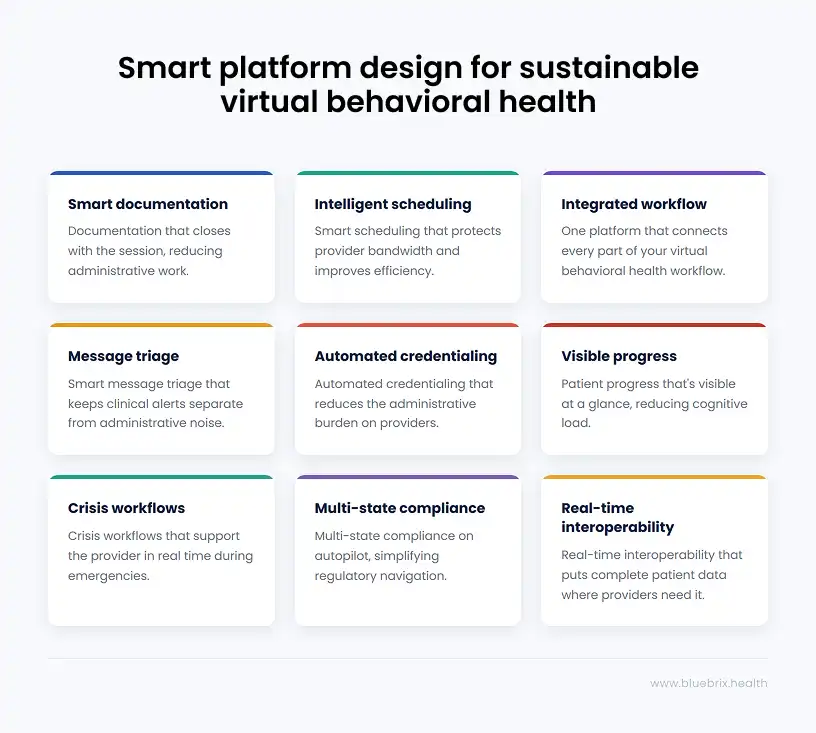
Behind every burnt-out virtual behavioral health provider is an EHR platform that was never built for them. The right platform design directly addresses the structural friction that makes virtual behavioral health practice harder than it needs to be. Below is what that looks like across every layer of the provider experience.
EHR documentation that closes with the session
Two to three hours of after-session administrative work is not an unavoidable cost of virtual care. It’s a platform design failure. Generic EHR templates, no smart assistance, and documentation systems built for general medicine rather than behavioral health are what turn a seven-patient day into a ten-hour one.
When the EHR is built right, this changes. Ambient note-taking captures session content in real time. DSM-compliant, condition-specific templates mean providers aren’t building notes from scratch. For group sessions, shared session context with individual note generation means a provider who just facilitated eight patients writes with the platform — not eight times over without it.
blueBriX helped a mental health services provider reduce documentation burden through intuitive note-taking and a purpose-built EHR designed for faster, more flexible clinical documentation, significantly cutting the after-hours administrative work that was exhausting their providers.
Smart EHR scheduling that protects provider bandwidth
High no-show rates, back-to-back sessions with no mental reset, and empty slots that could have been filled are not just operational inefficiencies. They are the daily conditions that make an already demanding job unsustainable.
A purpose-built behavioral health EHR fixes this at the system level. Automatic waitlist matching ensures cancelled slots are offered to waiting patients before they become lost hours. Buffer enforcement between sessions gives providers the transition time that emotional regulation actually requires. Acuity-based load balancing prevents days where every session is high-intensity with no recovery built in. No-show prediction helps practices plan ahead rather than react after the fact. Visit-type based scheduling allows practices to block hours specifically for intake assessments, crisis sessions, or group therapy, ensuring the right time is protected for the right type of care.
When scheduling is designed around provider sustainability alongside patient access, it stops being a daily source of friction and starts being a protective factor.
One platform that connects every part of your virtual behavioral health workflow
Most virtual behavioral health providers aren’t working on one platform. They’re managing five, one for video, one for scheduling, another for billing, a separate one for notes, and yet another for patient messaging. The cognitive cost of constant context switching in a field where focused presence is the entire clinical instrument is significant.
The right platform design eliminates this entirely. Scheduling, telehealth, clinical documentation, billing, and patient communication sit in a single integrated environment. But integration alone isn’t enough; what’s surfaced and where it’s surfaced matters just as much. Key patient details are highlighted within the workflow itself, so providers aren’t scanning for what’s relevant before a session. And when something needs action, it can be handled right there, no navigating to another screen and no breaking focus mid-session.
A leading behavioral health organization in Pennsylvania, reduced operational costs by 15% and cut administrative workload after consolidating their workflows with blueBriX.
Smart message triage that keeps clinical alerts separate from administrative noise
Patient communication in virtual behavioral health doesn’t follow clinical hours, and without smart inbox management, everything lands on the provider equally. A Saturday crisis check-in alongside a routine appointment question from Tuesday afternoon, with no distinction between them.
The workbench changes what providers see and when. Clinical messages that need immediate attention surface first. Administrative queries are routed to support staff automatically. Routine requests get auto-responses. Providers engage with what matters clinically, and the platform handles the triage burden.
Automated credentialing that reduces the administrative burden on providers
License verifications, insurance contracts, and payer enrollments before a single virtual session are largely manual and largely unsupported by most platforms. For virtual behavioral health providers practicing across states, every jurisdiction, every Medicaid telehealth program, and every commercial payer comes with different portals, telehealth-specific requirements, and timelines.
Group therapy adds another layer. A single virtual group session with patients joining from different states means meeting licensing and Medicaid requirements for every state represented in that session simultaneously.
A platform built for virtual behavioral health manages this at the system level. Centralized tracking gives visibility into application statuses across all payers. Automated reminders flag renewals and expirations before they become compliance risks. A unified dashboard shows exactly where every credentialing process stands across every state.
The right platform turns multi-state credentialing from a recurring administrative burden into a background process, so the focus stays on patient care, not paperwork.
Patient progress that’s visible at a glance
Managing 25 to 40 patients weekly across back-to-back video sessions means every minute spent reconstructing a patient’s story before the call is a minute of invisible, unbillable labor. Without physical charts or environmental context cues, that cognitive load compounds across a full caseload and across a full week.
The care coordinator dashboard reduces that burden. A unified patient timeline surfaces trends automatically like progress, deterioration, and key milestones visible without opening individual records. Care coordinators walk into each session already oriented, rather than spending the first few minutes catching up with the chart.
Less time recovering context. Less mental overhead carried between sessions. More capacity to stay present with the patient.
Crisis workflows that support the provider in real time
When a patient expresses suicidal ideation mid-session, the platform needs to support an immediate response. Verifying location, identifying local emergency services, and coordinating a response in real time while staying clinically present is not manageable without the right infrastructure behind it.
A crisis-aware platform builds that infrastructure in. Automated location verification at session start removes the need to ask under pressure. Integrated one-click access to local emergency contacts based on patient GPS data means the right resources are always within reach. Reliable connection infrastructure reduces the risk of a dropped call at the most critical moment.
Multi-state compliance on autopilot
A provider seeing patients across three states is operating under three regulatory realities such as different Medicaid rules, different telehealth requirements, different billing modifiers — with most EHR platforms offering no support for any of it. Denied claims, delayed payments, and low-grade compliance anxiety are the results.
The right platform takes this entirely off the provider’s plate. State-specific billing rules apply automatically. Licensing jurisdiction alerts fire when a patient’s location falls outside a provider’s licensed states. Built-in compliance logic handles multi-state complexity at the system level, so providers can focus on care delivery instead of regulatory navigation.
Real-time interoperability that puts complete patient data where providers need it
Mid-session gaps in patient data such as a recent hospitalization, a medication change, a crisis event managed elsewhere directly affect clinical decision-making in virtual behavioral health. Without interoperability built into the platform, that missing information has no way to reach the provider when it matters most.
FHIR-compliant data exchange and USCDI V3-ready infrastructure bring external clinical data directly into the session workflow, without the provider having to leave it. Consent-aware workflows ensure this happens within the bounds of HIPAA and the revised 42 CFR Part 2 requirements, keeping organizations compliant with the 2026 deadlines while giving providers the complete picture every session requires.
blueBriX: purpose-built to reduce provider cognitive load in virtual behavioral health
Fifteen years in behavioral health have taught us that burnout is about the cognitive tax of navigating fragmented data while trying to remain clinically present. blueBriX is engineered to eliminate that burden. At its core is a unified orchestration layer that synchronizes intelligent scheduling, clinical documentation, and real-time interoperability. Where other platforms leave providers acting as their own data integrators, manually reconciling hospital discharges, medication changes, and external records, blueBriX automates that flow entirely. The right clinical context surfaces at the exact moment of the encounter. That precision is what protects a provider’s mental bandwidth across a full caseload day.
A rule engine sits on top of this clean data foundation, handling the complex administrative logic that defines a modern virtual practice. The if-then scenarios that would otherwise fall on the provider are resolved at the system level, quietly and automatically.
The result is a provider who can focus entirely on the therapeutic relationship, which is what the work has always been about.
The business case for getting EHR platform design right
Replacing a behavioral health provider carries costs that go beyond the visible. Recruitment, credentialing, onboarding, and the revenue gap during transition consistently exceed what organizations budget for.
According to a National Council for Mental Wellbeing survey, 48% of behavioral health workers say workforce shortages have caused them to seriously consider other employment options. Every departure widens a shortage that is already structurally difficult to close.
The patient impact is equally direct. When provider continuity breaks mid-treatment, care outcomes suffer. Therapeutic progress stalls, early warning signs get missed, and not every patient finds their way back into care after a disruption.
For organizations operating under value-based care arrangements, this creates a clear financial risk. Provider experience affects patient outcomes. Patient outcomes determine reimbursement. The link between an unsustainable provider workflow and a weakened payer contract is direct, even when it isn’t explicitly drawn.
Platform design is no longer just a technology decision. For virtual behavioral health organizations, it is a workforce retention and financial sustainability strategy.
Rethink Your Platform: Reduce Provider Burnout and Build Sustainable Virtual Care
See how blueBriX is helping behavioral health organizations reduce provider burden and build more sustainable care delivery.
Schedule a demo