

The current state of behavioral health revenue cycle management
The fiscal viability of behavioral health practices in 2026 is increasingly dictated by a landscape of paradoxes. Demand for mental health and substance use disorder (SUD) services has never been higher. Yet the operational ability to capture and retain revenue is under significant strain from escalating regulatory requirements and aggressive payer behavior. In the current market, behavioral health billing is uniquely difficult. Denial rates consistently outpace those seen in other medical specialties, a gap that compounds across every service line in a practice.
The real cost of revenue leakage
The consequences of these systemic inefficiencies are profound. Revenue leakage is no longer an operational nuisance; it is a structural threat to the sustainability of the practice. High no-show rates cause major disruptions in cash flow, yet the administrative burden of managing those gaps often prevents providers from implementing robust scheduling and collection strategies. Furthermore, a pervasive culture of undercoding exists within the clinician community. Many therapists perceive family therapy billing rules, specifically for CPT codes 90846 and 90847, as too nebulous or risky, leading them to bill lower-complexity individual codes or, in some cases, to not bill for family involvement at all. This defensive coding behavior, while intended to avoid scrutiny, actually creates its own set of risks, including significant underpayment and the potential for recoupment audits when payers identify a mismatch between the clinical presentation and the billed level of service.
Why denied claims go unresolved in behavioral health
Administrative costs are rising as payers deploy sophisticated artificial intelligence to automate the denial process. According to MGMA, the average cost to rework a single denied claim is $25.20, and many of the denials are never worked at all. That means more than half of every dollar lost to a denial disappears permanently. This failure to pursue legitimate reimbursement often comes down to capacity: in-house billing teams lack the specialized expertise or the time required to navigate complex appeal paths.
The regulatory and economic landscape of 2026
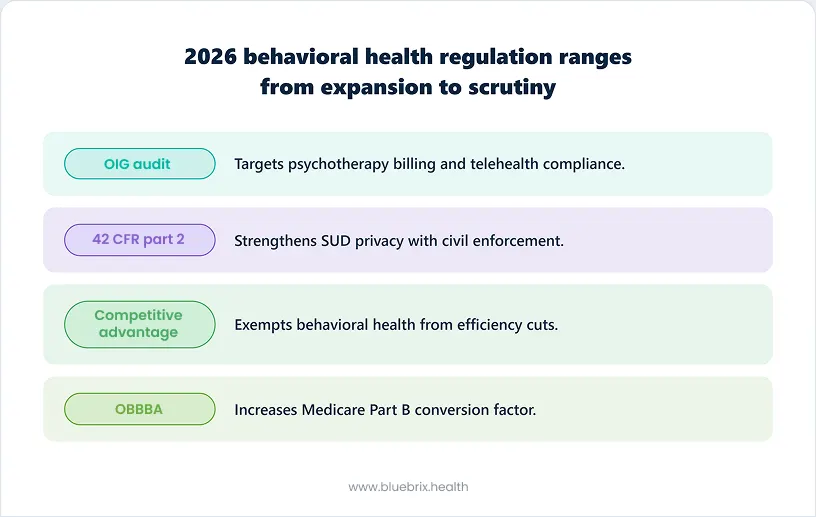
The year 2026 represents a watershed moment for behavioral health regulation, driven by several major policy shifts that redefine the financial and legal obligations of practices. The Centers for Medicare & Medicaid Services (CMS) released the Calendar Year (CY) 2026 Medicare Physician Fee Schedule (PFS) Final Rule, which introduced several updates aimed at expanding access to behavioral health while tightening documentation standards.
The OBBBA boost and conversion factor changes
The One Big Beautiful Bill Act (OBBBA), signed into law on July 4, 2025, statutorily required a one-year +2.5% payment adjustment that contributed directly to the 2026 Medicare Part B conversion factor calculation. CMS finalized two separate conversion factors for 2026: $33.5675 for qualifying alternative payment model (APM) participants and $33.4009 for non-qualifying practitioners. This statutory adjustment, combined with a 0.49% budget neutrality modification, results in a net increase that offsets inflationary pressures for many practices.
Why behavioral health got a competitive exemption
Critically, behavioral health services have been granted a unique competitive advantage in the 2026 fee schedule. While most non-time-based medical services were subjected to a negative 2.5% efficiency adjustment aimed at capturing productivity gains from technology, time-based codes and behavioral health services were explicitly exempted from these cuts. CMS determined that the human-centric nature of psychotherapy and psychiatric diagnostic evaluations does not currently allow for the same level of automated efficiency as other medical disciplines, thereby preserving the value of these services.
42 CFR part 2: the SUD privacy overhaul
Simultaneously, the regulatory environment regarding substance use disorder records has undergone its most significant transformation in decades. The compliance deadline for the 42 CFR Part 2 updates was February 16, 2026, marking the first time civil enforcement mechanisms are available to protect the confidentiality of SUD patient records.
Simultaneously, the regulatory environment regarding substance use disorder records has undergone its most significant transformation in decades. The Office for Civil Rights (OCR) now holds enforcement authority. Penalties are aligned with HIPAA and vary by culpability tier, with annual inflation adjustments. The new rules also impose stricter SUD consent protocols. Providers may use a single consent covering future treatment, payment, and operations (TPO), but breach reporting requirements are significantly heavier than before.
OIG 2026 audit focus: behavioral health, psychotherapy billing, and telehealth compliance
The Office of Inspector General (OIG) has included behavioral health prominently in its 2026 Work Plan, with specific items targeting the accuracy of psychotherapy billing and the medical necessity of telehealth services. Audit activity is expected to concentrate on statistical outliers, such as providers who exclusively bill high-level individual codes (90837) or who cannot demonstrate the required time thresholds for family therapy sessions. Practices should review their billing patterns against the OIG Work Plan items directly and take a data-driven approach to documentation and coding to mitigate audit risk.
Core definitions: decoding CPT 90846 and 90847
A nuanced understanding of CPT codes 90846 and 90847 is essential for accurate charge capture and compliance. These codes are designed to reflect the systemic work performed when treating a patient within the context of their family or support system. Misunderstanding the distinction between them is not just a clinical error, it is a direct financial liability. A session billed under the wrong code creates audit exposure, recoupment risk, and underpayment that compounds across an entire patient panel over time.
CPT 90846: family therapy without the patient present
CPT 90846 is defined as family psychotherapy without the patient present. This code is applicable when the clinician meets with one or more family members to support the treatment of the identified patient. A classic clinical scenario for 90846 involves coaching the parents of a child with Attention-Deficit/Hyperactivity Disorder (ADHD) or educating a spouse on the management of their partner’s bipolar disorder. The fundamental requirement for billing 90846 is that the session remains focused on the patient’s care. If the focus shifts to the family members’ personal psychological issues unrelated to the patient’s treatment plan, the code is no longer appropriate and billing it under those circumstances creates a documentation mismatch that payers actively flag.
CPT 90847: family therapy with the patient present
CPT 90847 is used for family psychotherapy with the patient present, often referred to as conjoint psychotherapy. This code covers sessions involving the patient and at least one other family member or significant other. The clinical objective is to observe and improve the family dynamics and communication patterns that directly impact the patient’s recovery. This is the standard code for couples therapy, provided one of the individuals is the identified patient with a clinical diagnosis. Failure to bill 90847 when the modality warrants it, defaulting instead to individual therapy codes, represents direct revenue loss on every qualifying session.
The 26-minute threshold and the single-unit structure
Both 90846 and 90847 are subject to a 26-minute billing threshold. AMA and CMS guidelines allow for them to be billed once the session passes the midpoint of 26 minutes; any session lasting less than 26 minutes is considered non-billable as psychotherapy. Importantly, both codes are single-unit (typical 50-minute) codes, payment is per unit, and most payers will not reimburse additional units for extended session time without documented exception and prior authorization. Neither code can be reported alongside add-on code 90785 (interactive complexity); per APA and CPT guidance, 90785 is not to be billed with 90846 or 90847 as the systemic family work is already reflected in the base code valuation. Understanding this single-unit structure is critical for revenue forecasting: practices that assume they can capture additional reimbursement for extended family sessions without prior authorization will encounter consistent payer rejections.
The "identified patient" and clinical medical necessity
In the behavioral health landscape of 2026, insurance coverage is predicated on the treatment of a specific member’s diagnosable condition. Insurance plans do not cover families or couples as a collective unit; they cover individual members. Therefore, every family psychotherapy session must be anchored to a single designated Identified Patient (IP) who possesses a clinical diagnosis that warrants family involvement for successful treatment. When this anchor is absent or poorly documented, the financial consequence is predictable: denial at the first pass, with no clear pathway to appeal.
The marriage counseling exclusion
One of the primary causes of denial is the marriage counseling exclusion. Most major insurers explicitly exclude coverage for relationship counseling or marital distress as a standalone service. If a claim is submitted with a primary diagnosis from the ICD-10 Z-code category, such as Z63.0 (Problems in relationship with spouse or partner), it is often rejected by automated payer systems before a human reviewer even sees it. To ensure reimbursement the documentation must demonstrate that family involvement is a medically necessary component of treating that specific disorder. For practices running high volumes of couples’ work, an unaudited Z-code habit can represent a significant and recurring source of clean-claim failures.
What payers actually expect in 2026
Payers in 2026 expect a high level of specificity in documenting medical necessity. It is no longer sufficient to state that a family member was present to support the patient. The clinical record must explain why the patient’s recovery specifically requires family involvement, how the interventions performed during the session are actively addressing the symptoms of the IP’s diagnosis, and how the session connects to a measurable treatment goal. This includes assessing the patient’s cognitive and emotional readiness to participate in a conjoint session and documenting how the therapy is improving functional status or preventing a higher level of care. A compliant documentation strategy also requires that all session participants be listed by name and relationship to the patient. The direct financial link is straightforward: notes that do not meet this specificity threshold fail medical necessity review, and those denials, if not appealed with supporting clinical evidence, convert directly into uncollected revenue.
Comparative analysis: individual vs. Family psychotherapy coding
The choice between billing an individual psychotherapy code versus a family psychotherapy code is frequently where revenue cycle errors occur. A common mistake in behavioral health practices is coding by habit, where a therapist consistently bills a high-level individual code such as 90837 even when the session modality has shifted to family work, or conversely, billing 90847 for a session that only involved the patient. Both directions carry risk: one creates audit exposure through upcoding, the other creates revenue loss through undercoding.
The 53-minute rule and the upcoding risk
The most significant technical difference lies in the time thresholds. While 90847 (family therapy) can be billed after 26 minutes, the most common high-level individual code, 90837 (60-minute individual therapy), does not apply until the session reaches 53 minutes. Billing a 45-minute family session as an individual session (90837) constitutes upcoding, a practice that has become a prominent target for OIG audits and payer recoupment efforts in 2026. Based on 2026 Medicare national average rates, 90837 pays approximately $57 more per session than 90847 ($167.00 versus $109.55), a gap that can tempt practices to default to individual codes even when the session modality does not justify it. However, this short-term gain is far outweighed by the long-term risk of recoupment, where payers can demand the return of entire payments years after the service was rendered.
The “brief cameo” rule
Practices must also adhere to the brief cameo rule. If a family member joins an individual session for a short period, typically less than 15 minutes, to provide a quick update or receive brief guidance, the session should still be billed as individual psychotherapy. Family therapy codes (90846/90847) are reserved for instances where the primary intent of the session is the conjoint, systemic work between multiple parties. Documentation must clearly reflect this intent; otherwise, the session may be downcoded during a retrospective audit, converting previously collected revenue into a recoupment liability.
2026 medicare physician fee schedule (PFS) and reimbursement trends
The 2026 Medicare Physician Fee Schedule reflects a period of stabilized, albeit modest, growth for behavioral health reimbursement. After years of facing potential cuts, the final rule for 2026 provides a net increase in rates for the majority of core behavioral health procedure codes. This growth is primarily driven by the statutory +2.5% adjustment under the OBBBA and the administration’s focus on mental health parity and access.
The 2026 rate increases across core codes
The following illustrative national average reimbursement levels for 2026 are derived from the Centers for Medicare & Medicaid Services Medicare Physician Fee Schedule using relative value units (RVUs) and the applicable conversion factor. These figures represent estimates based on CMS methodology; actual reimbursement varies by geographic location and site of service.
- 90791 (Psychiatric Diagnostic Evaluation): ~$173
- 90832 (30-min Individual Therapy): ~$86
- 90834 (45-min Individual Therapy): ~$114
- 90837 (60-min Individual Therapy): ~$167
- 90846 (Family Therapy without patient): ~$106
- 90847 (Family Therapy with patient): ~$110
- 90853 (Group Therapy): ~$30
These figures represent national estimates for non-facility settings. Payments are adjusted using geographic practice cost indices (GPCI), meaning reimbursement levels are typically higher in urban areas than in rural regions.
The 2026 rule also maintains relatively favorable positioning for behavioral health services, as time-based psychotherapy codes were largely insulated from broader efficiency adjustments applied to many procedural services, and office-based (non-facility) services continue to benefit from relatively higher practice expense valuations compared to facility-based care.
The growing divide between FFS and APM payments and why it matters long-term
Another key trend in 2026 is the growing delta between traditional fee-for-service payments and those tied to Alternative Payment Models. CMS has finalized a conversion factor for qualifying APM participants ($33.5675) that is higher than the rate for non-participants ($33.4009), creating an immediate financial incentive for behavioral health practices to participate in value-based care initiatives. But the more significant implication is structural, not just rate-based.
Under APM arrangements, including shared savings models, bundled payment programs, and emerging capitated structures, practices are rewarded not just for the volume of sessions delivered, but for measurable improvements in patient outcomes. For behavioral health, this means that documentation of treatment progress, functional improvement, and symptom reduction is no longer just a compliance requirement: it becomes the financial record on which performance bonuses and risk-adjusted payments are calculated. Practices without the infrastructure to track and report these outcomes are effectively leaving performance incentives on the table.
The trajectory is clear. As payers, both Medicare and commercial, continue to shift reimbursement weight toward value-based contracts, behavioral health practices that invest now in measurement-based care tools, outcome tracking, and integrated RCM infrastructure will be better positioned to negotiate stronger contracts and access higher payment tiers. Those that remain purely in fee-for-service will face compounding rate pressure as the market migrates away from volume-based payment models. The conversion factor differential in 2026 is a financial signal, not just a billing detail.
The evolution of telehealth and remote service modalities
By 2026, the temporary telehealth flexibilities introduced during the pandemic have matured into permanent regulatory frameworks for behavioral health. However, this permanence has come with a high degree of technical specificity. Errors in telehealth coding have become a leading cause of claim denials and administrative audits.
Getting place of service and modifiers right
The most critical development for 2026 is the standardization of Place of Service (POS) codes and telehealth modifiers. POS 02 applies when the patient is at a clinic; POS 10 was introduced for home-based sessions, reflecting lower provider overhead when the patient is not in the office. Modifier 95 signals synchronous audio-video telehealth services. However, modifier and POS requirements are payer specific. Providers should verify current guidance directly with their MAC or individual payer before submission.
For audio-only sessions, Modifier 93 is used to report synchronous audio-only services for CPT codes listed in Appendix T. In Medicare, alternative modifiers (such as FQ) may apply in certain settings. Audio-only services are generally permitted when the patient cannot access or does not consent to video technology, and documentation should clearly reflect the circumstances of the encounter.
Virtual supervision: A scalability win for larger practices
CMS has also made the virtual presence of supervising practitioners a permanent feature for 2026. This allows supervisors of interns and residents to be virtually present via real-time audio-video communication during the key portions of a service, rather than requiring physical co-location in the same building. This change is a significant operational boon for larger practices and those operating in rural areas, removing the geographic constraints that previously hindered training programs and clinical expansion. Documentation remains paramount; the medical record must explicitly state whether the supervisor was physically present or present via telehealth technology.
Strategic documentation: the "golden thread" and audit prevention
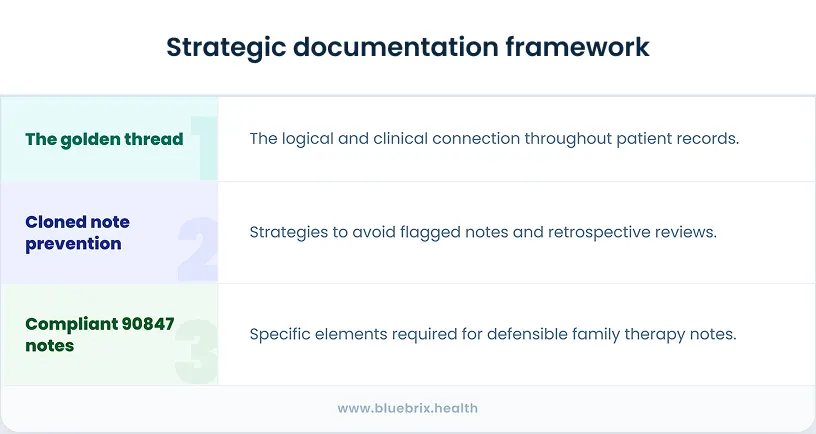
Auditors in 2026 do not merely check for the existence of a clinical note; they evaluate the Golden Thread, the logical and clinical connection that weaves through the entire patient record from intake to discharge. Maintaining this thread is the most effective defense against cloned note flags and recoupment efforts. It is also the most direct link between clinical practice and financial performance: every note that fails the Golden Thread test is a potential denial, and every denial that goes uncontested is permanent revenue loss.
What a compliant 90847 note must contain
A compliant family therapy note (90847) must include several specific elements to be considered defensible. First, exact start and stop times are required; a generalized statement of 50 minutes is often flagged as insufficient during an audit, and a time discrepancy between the note and the claim is one of the most common triggers for recoupment review. Second, the note must document active clinical interventions, generic phrases like discussed communication are frequently rejected. Clinicians must instead describe the specific therapeutic technique used, such as utilized role-play to practice non-violent communication techniques or facilitated circular questioning to explore family connections. Third, the note must include a description of the patient’s response to the family interaction and how session progress relates back to the master treatment plan. Each of these elements is not administrative overhead, it is the clinical evidence that transforms a submitted claim into a collectible one.
Preventing the cloned note flag
Prevention of the cloned note flag is a major documentation priority with direct financial consequences. Payer software can now easily detect notes that are copy-pasted between sessions or across different patients. When a cloned note is flagged, payers do not stop at the individual claim, they typically initiate a retrospective review of multiple sessions, converting what may have been a single billing error into a multi-claim recoupment demand. Every session note must contain unique, patient-specific details. If the treatment plan only lists individual therapy goals but the provider bills for family sessions, it creates a documentation red flag that can trigger precisely this kind of expanded audit. Ensuring that the treatment plan is updated to reflect the clinical necessity of family work is a critical, yet often overlooked, step in protecting the revenue cycle from systematic exposure.
AI and automation: redefining the behavioral health workspace
By 2026, Artificial Intelligence has moved from novelty into a core operational consideration for behavioral health revenue cycle management. For practices billing family therapy, this shift is particularly consequential. The denial patterns on CPT codes 90846 and 90847 are highly predictable ,Z-code diagnosis errors, missing F-code anchors, incorrect telehealth modifiers, and predictable errors are exactly what AI is designed to intercept before submission. The primary applications are ambient documentation and predictive claim scrubbing.
Ambient AI and automated charting
Ambient AI tools, often called clinical scribes, use advanced listening technology to record sessions and auto-draft clinical notes in real time. Many vendors now offer speaker-diarization and multi-speaker transcription capabilities that are particularly relevant for 90847 conjoint sessions, where capturing the interaction between multiple parties is clinically significant. However, accuracy in these tools varies by vendor, recording conditions, and patient population, and human review of AI-generated notes remains essential before they are treated as final documentation. Practices should evaluate ambient tools carefully and build a structured clinician review step into their workflow. When implemented with appropriate oversight, these tools can meaningfully reduce the after-hours documentation burden that contributes to clinician burnout and note quality degradation.
Predictive denial management at scale
On the administrative side, AI-powered claim scrubbers are transforming denial management by catching errors before they reach the payer. For family therapy claims, this means intercepting the most common 90846 and 90847 failure patterns at the source. For example, AI scrubbers flag missing F-code diagnoses on family therapy claims before submission, preventing the automated Z-code rejection that would otherwise never reach a human reviewer. These tools also catch missing telehealth modifiers, incorrect diagnosis-to-CPT pairings, and expired prior authorizations. The financial case is direct: according to MGMA, a reworked denial costs $25.20 per claim on average, a cost that pre-submission correction eliminates entirely. That clean claim rate also determines how quickly payers process every future submission.
The hybrid “human-in-the-loop” model
The most effective RCM model in 2026 remains a hybrid human-in-the-loop approach. AI handles pattern recognition and rote rule-checking well. Human experts remain essential for nuanced clinical appeals and complex payer adjudication. The two working in concert, not one replacing the other, is the standard that high-performing behavioral health practices are building toward.
Denial management and strategic A/R optimization
Accounts Receivable management in behavioral health is notoriously slow, often due to the time-based nature of the codes and the subjective nature of medical necessity. In 2026, the difference between a thriving practice and a struggling one is often found in their Days in A/R and Net Collection Rate metrics. High-performing practices target Days in A/R significantly below the broader industry average, a gap that reflects the cumulative effect of front-end accuracy, authorization management, and proactive denial follow-through working together rather than in isolation.
The top denial triggers for 90846 and 90847
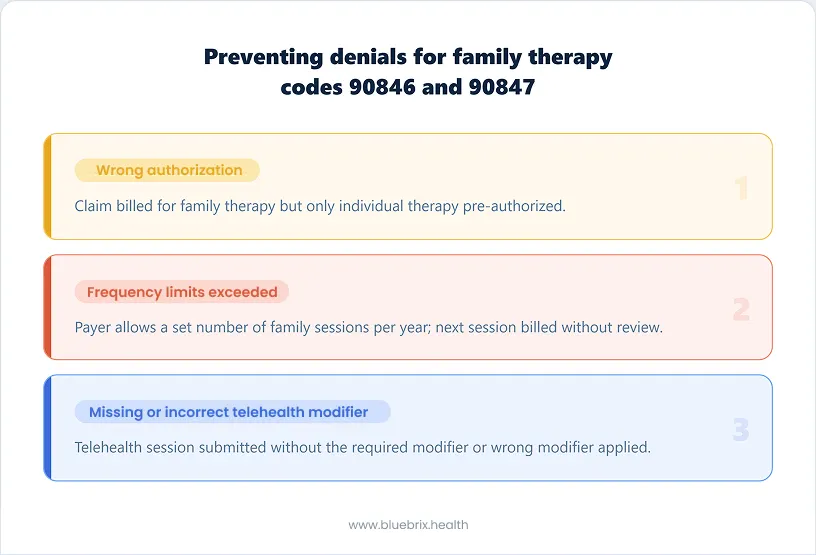
The most common denial triggers for family therapy codes 90846 and 90847 include the following:
- Wrong authorization: the claim was billed for family therapy but only individual therapy was pre-authorized.
- Frequency limits exceeded: the payer allows a set number of family sessions per year and the next session was billed without a new utilization review.
- Missing or incorrect telehealth modifier: a telehealth session was submitted without the required modifier, or the wrong modifier was applied for the payer in question.
Each of these is a preventable failure, but prevention requires front-end processes, not back-end corrections.
Front-end clearance as the primary defense
Optimization of the A/R requires a proactive front-end strategy. This means verifying insurance eligibility and securing necessary authorizations before the patient’s first session. It also involves moving toward proactive patient financial engagement, providing cost estimates upfront to improve collection of high-deductible patient responsibilities. Practices that wait until the back end to address these issues face significantly higher bad debt write-offs and lower net collection rates. In 2026, the revenue cycle must be viewed as a continuous loop starting at the point of patient intake, not a downstream activity that begins after the session is over.
What an integrated behavioral health RCM service model looks like in 2026
The documentation, coding, and compliance requirements covered in this whitepaper are not generic medical billing challenges. They are behavioral health-specific problems that require behavioral health-specific expertise. The distinction between 90846 and 90847, the Identified Patient requirement, the 42 CFR Part 2 consent workflow, the OIG’s psychotherapy audit focus, and the telehealth modifier complexity are not problems that a general-purpose billing team, or a self-managed software tool, is positioned to handle with the consistency that 2026’s regulatory environment demands.
Practices that have historically managed billing in-house often do so effectively until audit exposure, payer policy changes, or staff turnover reveal the gaps. The question for most behavioral health organizations in 2026 is not whether to improve their RCM infrastructure, it is how to do so without adding administrative headcount or capital expenditure that offsets the revenue gains they are trying to capture.
The category: outsourced RCM services built for behavioral health
The market for outsourced revenue cycle management services has matured considerably, but not all RCM partners are equal for behavioral health. Practices evaluating RCM service partners should look for several specific capabilities: certified coders with demonstrable behavioral health CPT expertise, real-time eligibility and mental health parity verification across a wide payer network, dedicated denial management with structured appeal workflows, active 42 CFR Part 2 and HIPAA compliance management, and transparent performance reporting that tracks the metrics, Days in A/R, clean claim rate, payer-specific denial yields, that reflect actual revenue cycle health rather than activity volume.
The operational model matters too. Effective outsourced RCM in behavioral health is not a software subscription that the practice manages. It is a service relationship in which a dedicated team takes ownership of the revenue cycle end-to-end, from eligibility verification before the first session through denial appeals and A/R recovery. This distinction, between a tool you operate and a team that operates on your behalf, is the clearest differentiator between RCM vendors that reduce administrative burden and those that simply move it to a different screen.
blueBriX: an example of the integrated service model
blueBriX is one example of this integrated service model, built specifically for behavioral health and integrated care settings. With over two decades of domain expertise across 50-plus medical specialties, the blueBriX team covers the full revenue cycle, from real-time eligibility and parity checks across more than 600 payers, to certified behavioral health coding, to dedicated denial management and appeal handling. The team also manages the 42 CFR Part 2 and HIPAA consent workflows operationally, reducing the compliance risk exposure that the 2026 penalty framework has made a board-level concern. Based on internal client cohort data, blueBriX targets a 98% clean claim rate and a 30% reduction in A/R days; individual results vary based on practice size, payer mix, and baseline billing maturity.
Note: Performance figures are internal targets based on client cohort data. Individual results may vary.