North Carolina behavioral health providers navigate a complex reporting landscape that extends far beyond regulatory boxes to check. From documenting critical incidents to tracking clinical outcomes, managing financial operations, and meeting state and federal requirements, these reports form the backbone of quality care delivery and sustainable practice management. This guide breaks down the five essential reporting pillars every NC behavioral health practice must master—whether you’re a clinician documenting progress, an administrator overseeing operations, a biller managing claims, or a compliance officer ensuring standards are met. Understanding how these reports interconnect creates a foundation for both excellent patient care and operational efficiency.
Understanding the NC behavioral health ecosystem
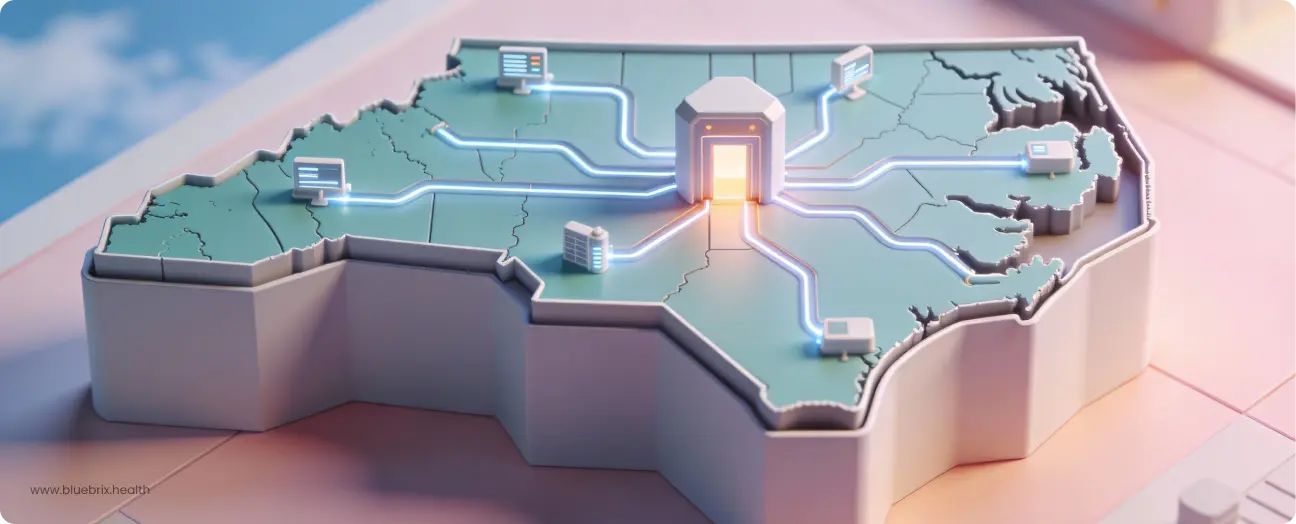
The three-tier structure – North Carolina operates through a unique three-layer system: NC DHHS at the top, seven regional Local Management Entities/Managed Care Organizations, in the middle coordinating care and authorizing Medicaid services, and providers at the ground level delivering care through either Tailored Plans (complex needs) or Standard Medicaid Plans.
Four stakeholders, one data flow – Patients, providers, payers, and regulators form an interconnected network where reporting serves multiple purposes—clinical documentation drives treatment decisions, quality measures prove outcomes, utilization data justifies authorizations, and compliance reporting maintains standards. Effective reporting creates seamless information flow supporting both patient care and operational efficiency.
NC healthconnex: the mandatory connection – Managed by the NC HIE Authority, NC HealthConnex functions as the state’s Health Information Exchange, linking disparate systems statewide. For providers, it’s not optional—it’s a required reporting channel ensuring patient data accessibility across North Carolina’s healthcare network, advancing the state’s whole-person care vision.
With North Carolina’s behavioral health ecosystem mapped from DHHS oversight through LME/MCO coordination to NC HealthConnex connectivity—let’s dive into the five reporting pillars. Each carries specific requirements and common pitfalls that can jeopardize compliance, funding, and care continuity when mishandled.
The five essential reporting pillars for NC behavioral health providers
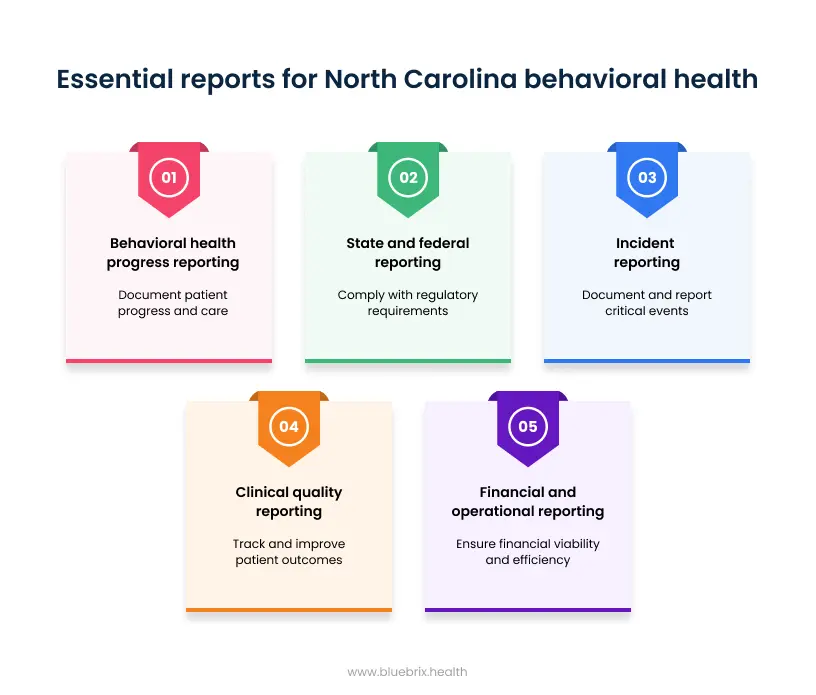
Every NC behavioral health practice must master five interconnected reporting categories to maintain compliance, demonstrate quality, and ensure sustainable operations. These aren’t isolated requirements—they form an integrated system where excellence in one area supports success in the others. Let’s explore each pillar in detail.
Incident reporting
The critical role of incident reporting in North Carolina
Incident reporting in North Carolina carries heightened significance following state reforms that prioritized patient safety oversight. The LME/MCO model creates dual reporting pathways that set NC apart from most states—you’re accountable to both your managed care entity and DHHS depending on incident severity. Beyond compliance, proper reporting provides legal liability protection through qualified immunity, while lapses directly jeopardize your licensing status, accreditation standing, and Medicaid contracts. Compared to neighboring states like South Carolina or Tennessee, North Carolina enforces tighter timelines and more granular categorization, making state-specific knowledge non-negotiable for practice operations.
Incident reporting requirements: what you must report and when
North Carolina providers operate under 10A NCAC 27G .0602-.0604, which mandates incident reporting through IRIS (Incident Response and Improvement System):
- Level III (Critical): Events resulting in death, substantial risk of death, sexual assault, permanent physical/psychological impairment, or significant community concern. Requires immediate verbal notification followed by IRIS submission within 72 hours to LME/MCO, DHHS, licensing boards, and law enforcement as applicable
- Level II (Non-Critical): Events involving threats to health or safety of member or others due to member behavior, and member deaths from terminal illness or natural causes (when official documentation provided). Require IRIS reports within 72 hours
- Level I: Events that in isolated numbers don’t significantly threaten health/safety but could indicate systematic problems if frequent. Require internal tracking only with aggregated quarterly reporting to LME/MCO (though many LME/MCOs have obtained waivers of the quarterly Form QM-11 requirement and instead rely on provider internal documentation available upon request)
- Documentation workflow: 24-hour internal reviews, 72-hour IRIS submissions, ongoing updates as investigations progress
- Root cause analysis and CAPs: Required when patterns emerge or serious incidents repeat
Incident reporting challenges
- Confusion on reportable events: Struggle to differentiate Level III incidents (e.g., abuse, elopement) from routine clinical notes, risking under- or over-reporting.
- Missing deadlines: Unclear workflows lead to delays in 72-hour IRIS submissions or immediate verbal alerts to LME/MCOs.
- Multiple systems navigation: Switching between IRIS, LME portals, and internal logs creates errors and extra admin time.
- Incomplete documentation: Gaps in details trigger compliance audits, RCA demands, or CAP requirements.
- No standard templates: Varying formats slow drafting and increase inconsistencies in reports.
Clinical quality reporting
Push for clinical quality: why it’s non-negotiable
North Carolina’s Medicaid Transformation marked a fundamental shift from fee-for-service to value-based care, tying reimbursement to performance rather than volume. Quality reporting now directly influences your contract renewals with LME/MCOs, who are themselves accountable for HEDIS measures and Star ratings that depend on your individual provider performance. The state’s emphasis on evidence-based practices means demonstrating measurable clinical outcomes—symptom reduction, functional improvement, reduced hospitalization—not just service delivery.
This shift reflects broader federal quality reporting trends and comes with financial stakes. North Carolina’s quality incentive programs tie bonuses and rate adjustments directly to your performance metrics, making quality reporting a material factor in your revenue stream and long-term sustainability.
Clinical quality reporting requirements in North Carolina
North Carolina’s clinical quality framework requires comprehensive data capture across multiple domains:
- HEDIS measures: FUH (follow-up after hospitalization), FUM (follow-up after ED visit for mental illness), ADD (antidepressant medication management), AMM (antidepressant medication adherence), and others specific to behavioral health
- Patient outcomes: PHQ-9, GAD-7, CANS, and other validated symptom reduction scales tracked over time
- Treatment documentation: Quality treatment plans with measurable goals, progress notes demonstrating medical necessity and clinical improvement
- EBP fidelity: Documentation that you’re implementing evidence-based practices as designed
- Patient experience: Satisfaction surveys and experience measures feeding into quality scores
- QAPI programs: Structured quality assessment and performance improvement initiatives with data collection, analysis, and action
- Accreditation reporting: Submissions to Joint Commission, CARF, or other accrediting bodies aligned with NC standards
Clinical quality reporting challenges
- Inconsistent documentation: When clinicians document outcome measures differently—some using discrete fields, others writing narrative notes—you end up with incomplete data that makes even good clinical outcomes invisible to reporting systems.
- Longitudinal tracking difficulties: You can’t prove patient improvement without baseline and follow-up measures captured systematically. Missing data points mean you can’t demonstrate the progress that’s actually happening.
- EHR limitations: Most systems store clinical data but can’t automatically generate the quality reports you need, forcing manual calculations and spreadsheet exports.
- Lack of real-time visibility: You discover problems months after they occur—missing follow-ups, overdue assessments—when it’s too late to fix them before reporting deadlines.
- Translating clinical work into metrics: Real therapeutic progress (improved functioning, stronger relationships, better coping) doesn’t always show up in standardized scores, requiring extra effort to document what measures miss.
- Missing patient follow-up data: No-shows and patients who stop engaging affect your quality scores even when you’ve provided excellent care during the appointments they attended.
Financial and operational reporting
The business case for financial reporting in North Carolina
Financial and operational reporting in North Carolina isn’t just about accounting—it’s about contract compliance and organizational viability. NC Medicaid reimbursement hinges on accurate reporting, while your LME/MCO contracts mandate financial transparency as a condition of participation. Grant funding from SAMHSA and state sources requires detailed accountability on utilization and outcomes. Investors and boards expect operational data to assess sustainability and growth potential, and benchmarking against other NC providers gives you competitive intelligence for strategic positioning.
Financial and operational reporting requirements
The operational reality involves multiple reporting streams that feed different stakeholders:
- Revenue cycle: Claims submission rates, denial tracking and appeals, AR aging, revenue versus collections analysis
- Productivity metrics: Billable hours per clinician, no-show rates, staff utilization percentages, caseload ratios
- Operational performance: Wait times for intake, access to care measures, bed or capacity utilization
- Cost analysis: Cost per patient, cost per episode of care, budget variance reports
- Grant reporting: Utilization reports, budget narratives, outcome deliverables tied to funding requirements
- Leadership dashboards: KPIs for executive oversight, monthly board packets, strategic planning data
- Benchmarking: Performance comparison to state and national standards
Key financial reporting challenges
- Fragmented data sources: Your billing system holds claims data, your EHR has clinical documentation, and your scheduling platform tracks appointments—but they don’t talk to each other. When it’s time to report revenue performance or productivity metrics, you’re manually pulling from three systems and reconciling mismatched numbers, delaying reports and introducing errors.
- Spreadsheet dependency: Critical financial reports live in Excel files where formulas break unnoticed and multiple people create conflicting versions. One wrong cell reference means your board packet shows inaccurate revenue projections, and you don’t discover the error until someone questions the numbers.
- No clear denial patterns in reports: Denials get tracked individually as they come in, but your reports don’t aggregate them by denial reason or payer. You’re reporting denial totals without the pattern analysis that would show 30 denials all stem from the same fixable documentation issue.
- Flying blind between reporting cycles: Monthly or quarterly financial reports tell you where you were weeks ago, not where you are now. You’re making operational decisions based on outdated data because your reporting process can’t deliver real-time visibility into financial performance.
- Knowledge walks out the door: When the person who builds your monthly reports leaves, nobody else knows which data sources to use, how calculations work, or why certain numbers are excluded. Report generation stops or produces unreliable numbers until someone reverse-engineers the process.
- Reports steal time from revenue-generating work: Your billing manager spends three days each month manually compiling reports instead of working denials or improving collections. The time spent creating reports directly reduces the time available to fix the problems those reports reveal.
- Grant tracking disconnection: Grant reports require proving you spent funds appropriately while achieving outcome targets, but your budget tracking lives separately from clinical outcome data. Each grant report becomes a manual data-matching exercise pulling from disconnected sources, risking inaccurate reporting to funders.
State and federal reporting
North carolina’s state and federal reporting landscape
North Carolina’s Medicaid Transformation expanded reporting requirements significantly as the state moved toward managed care and value-based payment models. Beyond state mandates, you’re simultaneously accountable to federal entities—SAMHSA for grant-funded programs, CMS for Medicaid compliance, and DEA for controlled substance prescribing. North Carolina leverages this data for policy and funding decisions, making accurate reporting directly tied to future resource allocation. Non-compliance triggers audits, payment recoupment, and potential contract termination. As a NC provider, you’re navigating dual accountability—meeting both state-specific requirements and federal standards—with new mandates emerging, including 988 Suicide and Crisis Lifeline data reporting requirements rolling out nationally.
State and federal reporting requirements
NC state requirements:
- DHHS annual provider surveys
- LME/MCO network adequacy and service utilization reports
- NC Tracks Medicaid claims and authorization data
- State licensing and certification renewals
Federal requirements:
- SAMHSA grant reporting (Mental Health Block Grant, SABG, SOAR)
- CMS quality measures (MIPS for behavioral health)
- DEA controlled substance inventory and dispensing logs
- NPDB (National Practitioner Data Bank) reporting
SUD-specific:
- TEDS (Treatment Episode Data Set)
- NSDUH participation
- Opioid Treatment Program (OTP) federal compliance
- PDMP (Prescription Drug Monitoring Program) reporting
Mental health block grant:
- Client-level data submissions
- Demographic and service penetration data
- Evidence-based practice implementation reports
State and federal reporting challenges
- Portal chaos: You’re juggling logins for NC Tracks, SAMHSA’s SPARS system, CMS quality portals, TEDS, PDMP, and various LME/MCO platforms—each with different credentials, interfaces, and submission formats. Simply accessing the right system to submit the right report becomes a logistical headache that wastes time and creates frustration.
- Almost identical, but not quite: Federal agencies want client demographics one way, the state wants them slightly differently, and your LME/MCO has its own format. You’re reporting essentially the same information three times but can’t simply copy-paste because field definitions, date ranges, or required data elements don’t align. Each report needs custom formatting.
- Deadline compression: Federal grant reports arrive with two weeks’ notice. State surveys hit during your busiest clinical period. LME/MCO quarterly reports overlap with annual licensing renewals. There’s no coordination between entities on timing, so reporting demands pile up simultaneously, forcing you to choose which deadline to prioritize and which to risk missing.
- Knowledge gaps: Your clinical staff understand treatment, but TEDS admission codes or SAMHSA’s Government Performance and Results Act (GPRA) tools are foreign territory. Nobody on your team has formal training in federal reporting systems, so you’re learning requirements through trial and error while deadlines approach—and errors on submissions mean starting over.
- Audit anxiety: One miscoded TEDS submission or incorrect MIPS quality measure could trigger an audit, and you’re uncertain whether your interpretation of reporting requirements matches what auditors expect. The fear of financial penalties or contract consequences makes every submission stressful, yet you lack clear guidance on what constitutes compliance versus violation.
- Redundant data entry: Client demographics you’ve already entered in your EHR get manually re-entered into NC Tracks. Treatment data documented clinically gets re-entered into TEDS. Medication logs in your system get transcribed into DEA reports. You’re maintaining the same information in multiple places because systems don’t integrate, multiplying both workload and error potential.
- Moving targets: Federal reporting requirements change with new legislation or agency guidance. State requirements shift with Medicaid policy updates. What you reported last quarter isn’t necessarily what’s required this quarter, but notification of changes is inconsistent. You discover new requirements when submissions are rejected or during audits, forcing retroactive corrections to historical data that’s already been reported.
- The HealthConnex connectivity gap: Unlike simple portal entries, NC HealthConnex requires a technical “handshake” between your EHR and the state’s HIE. Many providers struggle with the initial legal agreements (Participation Agreements) and the ongoing technical burden of ensuring data flows correctly without interrupting clinical workflows.
Behavioral health progress reports
Why progress reporting is the foundation of everything else
Progress reports are what LME/MCOs review for utilization management, auditors examine for medical necessity, and licensing boards scrutinize during site visits. They’re the source data for quality measures like HEDIS, federal grant outcome reporting, DHHS compliance reviews, and accreditation assessments. When incidents occur, these reports provide clinical context for investigations. Essentially, your progress reporting accuracy directly determines whether downstream reporting to multiple entities succeeds or fails.
Requirements for behavioral health progress report
Progress note standards:
- DAP, SOAP, BIRP formats accepted in NC
- Frequency requirements by service type
- Medical necessity elements in every note
- Progress toward treatment goals documentation
Treatment plan reviews:
- 30, 60, 90-day review requirements
- Collaborative documentation with patients
- Barrier identification and problem-solving documentation
- Discharge and transition planning
Care coordination documentation:
- Communication with PCPs, psychiatrists, schools, specialists
- Child and Family Team meeting summaries
- Multidisciplinary team coordination notes
- Referral and follow-up tracking
Family/guardian reporting:
- Parent/guardian progress updates
- School collaboration (IEP integration)
- Court-ordered reporting for legal guardians
- Minor consent and confidentiality considerations
Behavioral health progress reporting challenges
- Missing clinical data points in reports: Templates that don’t prompt for specific outcome measures mean your quality reports are incomplete. When HEDIS requires PHQ-9 scores at specific intervals but your documentation doesn’t consistently capture them, your reported performance underrepresents actual clinical outcomes.
- Reports that don’t reflect clinical reality: When clinicians write vague progress notes, the data extracted for quality reporting doesn’t demonstrate the improvement that’s actually occurring. Your LME/MCO sees flat outcome scores in reports even when patients are genuinely progressing, affecting contract ratings.
- Inconsistent data across reporting periods: Different clinicians documenting the same patient differently means your longitudinal outcome reports show inconsistent patterns that raise red flags during audits. One quarter shows detailed symptom tracking, the next shows none—making legitimate progress look like documentation failure.
- Compliance gaps in incident reports: When progress notes lack signatures or dates, and an incident occurs, your incident report to DHHS references clinical documentation that’s technically non-compliant. This turns a clinical incident into a documentation violation during investigations.
- Invisible services in utilization reports: Care coordination activities that aren’t documented in standard progress note formats don’t appear in service utilization reports to LME/MCOs. You’re underreporting the breadth of services provided, potentially affecting network adequacy assessments and contract renewals.
- Can’t prove goal achievement: When treatment goals aren’t systematically tracked in progress documentation, your outcome reports to funders can’t demonstrate goal attainment rates. Grant reports ask “what percentage of clients achieved treatment goals” and you have no data to provide because goal progress isn’t captured in a reportable format.
- Outcome measures buried in narrative text: Clinical observations documented narratively can’t be extracted for automated reporting. When it’s time to generate quality reports showing symptom reduction or functional improvement, you’re manually reading through hundreds of notes trying to find evidence that should be in discrete, reportable fields—delaying submissions and introducing errors.
Here we come to an end, but beyond these individual battles, universal challenges cut across every report type, compounding complexity and creating systemic vulnerabilities that no single solution can ignore.
Common reporting challenges across all types
You’ve seen how each reporting type—incident, quality, financial, state/federal, and progress—creates its own set of challenges. But some obstacles cut across everything you report, compounding the complexity regardless of which form you’re filling out or which portal you’re logging into. Let’s look at the universal pain points that make comprehensive reporting feel impossible.
Data privacy and security
Every report you generate carries HIPAA compliance obligations around protecting patient information. Substance use disorder records add 42 CFR Part 2 requirements, which historically have been stricter than HIPAA and restricted even internal information sharing without specific patient consent.
Important update: The final rule aligning 42 CFR Part 2 more closely with HIPAA took effect April 16, 2024, with a compliance deadline of February 16, 2026. This modernization allows single consent for treatment, payment, and healthcare operations (TPO), aligns breach notification with HIPAA requirements, and updates enforcement to match HIPAA penalties. However, Part 2 still provides enhanced protections for SUD records, including restrictions on use in legal proceedings and separate consent requirements for SUD counseling notes.
North Carolina layers on additional state privacy laws, particularly around mental health records and minor consent. Before sharing data with LME/MCOs, DHHS, law enforcement, or other entities, you need proper consent documentation—and different reporting types require different consent specificity.
The challenge isn’t just knowing privacy rules; it’s applying them correctly across five distinct reporting streams while maintaining audit trails proving you did so.
Technology interoperability: the real game-changer
While basic EHR integration connects systems superficially, true interoperability enables intelligent, standards-based data exchange across platforms—transforming fragmented workflows into cohesive reporting ecosystems.
Forget hunting clinical notes in one system, billing data in another, scheduling in a third. True interoperability means:
- PHQ-9 score entered once auto-populates HEDIS dashboards, IRIS incident context, SAMHSA grant outcomes, and LME/MCO quality reports—simultaneously
- IRIS Level III incident flagged instantly notifies LME/MCO portals, triggers NCTracks prior auth updates, and populates your internal RCA template—no manual cross-posting
- Progress note goal attainment flows directly into financial productivity metrics, federal GPRA tools, and board-level KPIs without retyping a single outcome
- 988 Lifeline handoff data appears in your quality dashboard AND the state’s crisis response report—proving your BHUC diversion impact
Semantic interoperability ensures each system interprets clinical data contextually, eliminating manual reformatting. One authoritative patient record satisfies clinical, financial, compliance, federal, and state stakeholders without redundant documentation—aligning care delivery with regulatory demands efficiently and accurately.
Preparing for audits
Audit readiness isn’t type-specific—it’s about accurate, timely reporting becoming standard practice regardless of who’s asking for data.
NC audits commonly find missing signatures, late incident reports, unverifiable quality measures, financial reports that don’t reconcile, and inconsistent federal submissions. These are reporting process failures, not clinical quality issues.
Successful audit outcomes depend on complete, verifiable documentation with clear audit trails from source data to final reports. That’s intentional infrastructure, not luck.
These universal challenges—privacy tightropes, interoperability gaps, audit anxieties—don’t exist in isolation. They compound across all five pillars, creating systemic friction that drains time, risks compliance, and obscures your clinical excellence. Providers need a purpose-built behavioral health EHR solution that tackles every reporting type simultaneously, not piecemeal fixes.
Achieving behavioral health reporting excellence in North Carolina
As you navigate these five pillars, a clear theme emerges: North Carolina’s reporting landscape is no longer manageable through spreadsheets and manual data entry. The sheer volume of “dual accountability”—balancing LME/MCO requirements with federal 2026 mandates—requires a shift from reactive reporting to a proactive, unified infrastructure.
The goal for a modern NC practice is “Data Liquidity”: the ability for a single clinical observation to flow effortlessly into an IRIS report, a HEDIS dashboard, and an HL7 message for NC HealthConnex without being re-typed.
Bridging the report gap
This level of interoperability is exactly why we built blueBriX. Rather than acting as a simple digital filing cabinet, blueBriX serves as the intelligent engine underneath your reporting workflow. Let’s see how.
Pre-built templates for every North Carolina reporting requirement
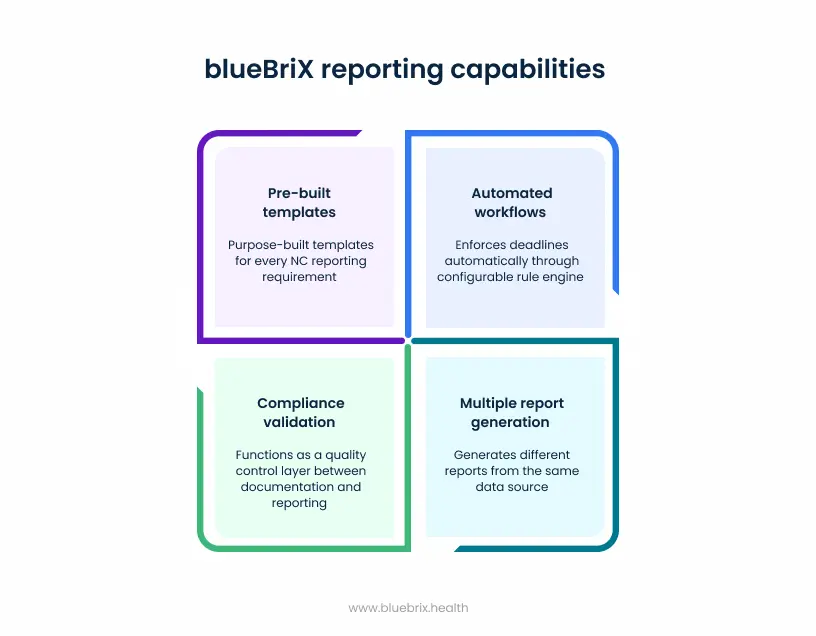
blueBriX provides purpose-built templates for every report North Carolina requires. Click “Incident Report” and a properly formatted IRIS submission appears with patient demographics already populated. Beyond forms, blueBriX simplifies NC HealthConnex integration, managing the technical data exchange so you remain compliant with state HIE mandates without needing an IT degree. Whether it’s HEDIS quality measures or SAMHSA grant outcomes, the system structures your data exactly how regulators require it.
The templates are fully flexible—you can modify existing report templates or create custom ones as requirements evolve, all without depending on technical staff. When reporting mandates change or your LME/MCO introduces new formats, you adapt the templates yourself rather than waiting for vendor updates or paying for customization.
Automated workflows that enforce reporting timelines
blueBriX enforces deadlines automatically through its configurable rule engine that monitors activities and triggers actions based on conditions you define. When a critical incident occurs, the system immediately alerts designated staff and generates the initial IRIS report template pre-populated with incident details for review and submission. The rule engine schedules follow-up documentation at 72-hour intervals, triggers treatment plan review reminders at 30, 60, and 90 days, flags patients due for quality measure reassessments, and generates financial reports on predetermined schedules.
Built-in compliance validation for reports
blueBriX functions as a quality control layer between your documentation and your reporting. When generating an incident report, it verifies all required fields are complete, checks that clinical documentation supports the incident narrative, and flags missing signatures or dates. For quality reports, it validates that outcome measures have baseline and follow-up data points before calculating improvement rates. Financial reports get checked for internal consistency—revenue figures must reconcile to claims data. Federal submissions are validated against agency-specific requirements before you see the final report.
Generate multiple reports from the same data
Different entities want data in different formats, and blueBriX handles that translation automatically. The system generates incident data for IRIS submission, internal quality review, and licensing board notification—all from one source record. Clinical outcome data produces HEDIS-compliant reports for LME/MCOs, GPRA-formatted reports for SAMHSA grants, and leadership dashboards. Financial data creates NC Tracks Medicaid submissions, grant budget narratives, and board presentation packets. You review and approve each report before submission—blueBriX eliminates the manual reformatting work, preventing burnout while you maintain professional oversight.