

If you’re running or managing a behavioral health practice, you are operating in one of the most financially pressured billing environments in the entire healthcare industry. And the numbers make that very clear. That disparity is not an accident. Behavioral health sits at the intersection of the most complex billing requirements in healthcare; time-based CPT codes, session-by-session medical necessity justification, multi-tier prior authorization structures, federal confidentiality regulations specific to substance use disorders, and a parity law that insurers frequently violate. Add to this the volatility of 2026: shifting federal enforcement of the Mental Health Parity and Addiction Equity Act, the One Big Beautiful Bill Act, signed into law on July 4, 2025, which cut federal Medicaid funding by nearly $1 trillion over ten years, with the Congressional Budget Office estimating 11.8 million Americans will lose Medicaid coverage as a result. Since
, these are not distant policy shifts for behavioral health providers, they are already reshaping payer mix, patient access, and reimbursement across the country.
What makes this especially frustrating is that the vast majority of these denials are preventable. The problem is rarely the quality of care being delivered. It is the gap between how that care is documented, coded, and submitted, and what payers expect to see. That gap is what this guide is designed to close.
Why are behavioral health claims getting denied so often?
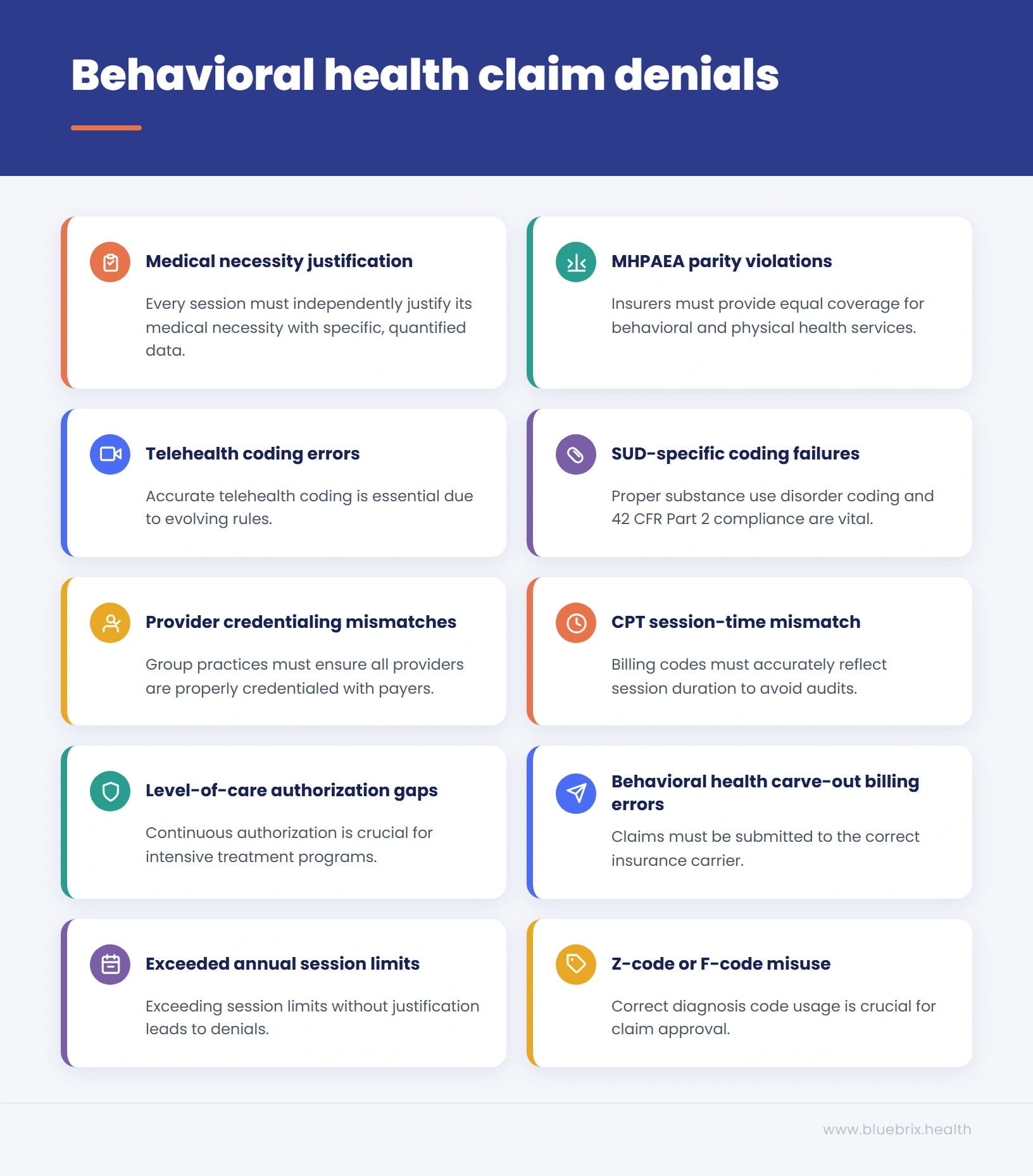
These are triggers that exist because of how mental health and substance use disorder services are uniquely structured, coded, authorized, and reviewed. Understanding them by revenue impact gives you the clearest possible roadmap for where to focus your denial prevention efforts in 2026.
1. Per-session medical necessity justification
In behavioral health, every single session must independently justify its own medical necessity. This is unlike any other medical specialty, where a diagnosis drives a treatment plan and individual visit documentation is far less scrutinized. Payers have dramatically escalated their utilization review cycles in 2026. Insurers are now deploying AI-driven claims analysis to flag notes that lack measurable symptom severity, functional impairment data, and documented progress toward goals. A single weak progress note can trigger a retro-denial across an entire treatment episode, not just one session.
What payers want to see:
- Specific, quantified symptoms (e.g., ‘panic attacks 4x/week disrupting work attendance’ — not ‘anxiety present’)
- Functional impairment levels tied to a validated scale (GAF, PHQ-9, PCL-5)
- Explicit statement of medical necessity and clinical decision-making
- Progress toward measurable treatment goals or documented reasons for lack of progress
Note: Payers have shortened authorization review cycles and raised documentation thresholds simultaneously. Practices without standardized note templates tied to medical necessity language are being hit hardest.
2. Psychotherapy session-time CPT mismatch (90832 / 90834 / 90837)
Behavioral health is one of the few specialties where billing codes are determined exclusively by session duration. CPT 90832 covers 16–37 minutes, 90834 covers 38–52 minutes, and 90837 covers 53+ minutes. This time-based structure has no equivalent in general medical billing and in 2026, it has become the single most-audited coding area in behavioral health. CPT 90837 carries the highest reimbursement rate and therefore draws the most scrutiny. Payers are now using automated analytics to flag providers who bill 90837 at rates significantly above their peer group even when individual sessions are clinically appropriate. The combination of high reimbursement and easy measurability makes this an ideal audit target.
Common triggers:
- Documenting ’60-minute session’ without recording exact start and stop times
- Notes that describe 45 minutes of content while billing 90837 (53+ minutes)
- Consistently billing 90837 across 90%+ of sessions without clinical variation
- Telehealth sessions billed as 90837 without consent documentation
3. MHPAEA parity violations by payers
The Mental Health Parity and Addiction Equity Act (MHPAEA) requires insurers to cover behavioral health services under terms no more restrictive than comparable medical/surgical benefits. When payers impose stricter visit limits, higher prior authorization burdens, or narrower medical necessity criteria on behavioral health than on equivalent physical health services, those denials are illegal and appealable. This denial reason is legally the most powerful to challenge appeals citing MHPAEA violations succeed 3.2x more often than those citing medical necessity alone. However, the federal enforcement landscape has shifted dramatically in 2026.
The non-enforcement policy follows a lawsuit filed by the ERISA Industry Committee (ERIC) in January 2025 challenging the validity of the 2024 Final Rule’s NQTL requirements. The 2013 MHPAEA baseline regulations and the CAA 2021 NQTL comparative analysis requirements remain in force and enforceable. Employer-sponsored health plans continue to have fiduciary obligations to comply with MHPAEA’s statutory requirements regardless of the 2024 Final Rule pause. Providers should continue to document and pursue parity-based appeals under the 2013 regulations.
Critical 2026 development: The Trump administration announced it will not enforce the 2024 MHPAEA final rule updates, putting enhanced parity protections in limbo at the federal level. The 2013 MHPAEA baseline regulations remain in effect, but stricter 2024 provisions including outcome data requirements and ‘meaningful benefits’ standards are currently unenforced federally. State-level enforcement varies significantly: Washington, Oregon, and West Virginia are actively enforcing, while others have paused.
4. IOP / PHP / residential level-of-care authorization gaps
Intensive outpatient programs (IOP), partial hospitalization programs (PHP), and residential treatment are behavioral health-exclusive levels of care. They require prior authorization not just at admission but at every step up or down the care continuum, often weekly or biweekly as patient acuity changes. No equivalent tiered authorization structure exists in general medicine. Payers do not allow retroactive authorizations in most cases, a missed renewal window means permanent revenue loss. A single lapsed authorization in a residential program can result in thousands of dollars in non-reimbursable days.
High-risk scenarios:
- Weekend or holiday admissions where authorization teams are unavailable
- Step-up from outpatient to IOP without a pre-authorized clinical review
- Continuing residential placement beyond the initially authorized period without renewal
5. Telehealth CPT & modifier errors
Behavioral health adopted telehealth more broadly than any other specialty and in 2026, telehealth billing has become one of the most technically complex areas in the entire revenue cycle. Medicare telehealth rules are actively being updated, and payer-specific policies diverge significantly. The volume of telehealth sessions in behavioral health means that even a small error rate in modifier or place-of-service coding produces a large absolute number of denied claims. Practices billing 80–100% of visits as telehealth are now flagged for enhanced payer review.
Most common 2026 errors:
- Missing modifier -95 (synchronous telehealth) on behavioral health CPT codes
- Using POS 02 (telehealth, patient not at home) when POS 10 (patient at home) is correct
- Billing 90837 via telehealth without documented patient consent for virtual care
- Failing to comply with updated 2026 Medicare in-person visit requirements for ongoing telehealth therapy
6. Behavioral health carve-out billing errors
A behavioral health carve-out occurs when a member’s mental health and substance use disorder benefits are managed by a separate insurance company from their primary medical plan. This structure is exclusive to behavioral health as no other medical specialty operates within a framework where a completely different payer is responsible for a subset of a patient’s care. Billing the medical insurance carrier instead of the carve-out behavioral health plan results in an automatic denial. These are often hard denials, the claim cannot simply be corrected and resubmitted to the original payer; it must be filed with the correct entity, which may have its own timely filing window that has already passed.
Prevention: At intake, always ask specifically: ‘Do your mental health and behavioral health benefits go through a different company than your medical benefits?’ Verify separately from the primary medical plan.
7. SUD-specific coding failures & 42 CFR part 2 non-compliance
Substance use disorder claims carry a layer of compliance complexity that mental health claims do not: 42 CFR Part 2, the federal regulation governing the confidentiality of substance use disorder patient records. Providers submitting SUD claims without proper consent documentation or using incorrect SUD-specific CPT and ICD-10 codes face denials that can carry additional regulatory exposure. Dual-diagnosis presentations (SUD + a primary mental health diagnosis) require precise code pairing. Using a general mental health CPT code with an SUD diagnosis, or vice versa, triggers a code/diagnosis mismatch denial. These errors are disproportionately common because SUD-specific coding is less familiar to billing staff trained primarily in outpatient mental health.
Critical compliance check:
- All SUD claims requiring disclosure of substance use records must have a signed 42 CFR Part 2-compliant release on file
- Dual-diagnosis claims should use the primary diagnosis that drove the encounter, with the secondary coded appropriately
- Confirm payer-specific SUD telehealth coverage before billing virtual SUD services
8. Exceeded annual session limits without documented justification
Many behavioral health insurance plans impose hard caps on the number of covered visits per year, a coverage design feature that does not exist in the same form for physical health conditions. A patient with chronic depression may require ongoing weekly therapy, but their plan may authorize only 20–30 sessions annually. Continuing treatment beyond that limit without documented clinical justification and a formal exception request results in automatic denial. These denials are predictable and therefore almost entirely preventable, yet they remain common because practices lack automated tracking of remaining authorized sessions.
Prevention:
- Implement automated alerts at 75% and 90% of annual session utilization.
- Prepare a medical necessity exception letter template before the limit is reached — not after.
9. Provider credentialing & NPI mismatch in group practices
Behavioral health providers disproportionately operate within structures where individual clinicians work under a group practice NPI multi-therapist group practices, community mental health centers, telehealth platforms, and federally qualified health centers. When a rendering provider is individually credentialed but claims are billed under a group NPI that is not enrolled with a specific payer, the result is a denial coded as ‘provider out-of-network’ even when the individual provider is in-network. This type of denial is particularly frustrating because the service was rendered correctly and the provider has a valid payer relationship. The error is purely administrative. However, it is also systemic: when a group practice adds a new payer contract or brings on a new clinician, the NPI enrollment process must be completed for every payer for every provider, creating ongoing administrative risk.
Most at-risk settings:
- Multi-state telehealth practices adding new state payer enrolments
- Group practices that onboard new clinicians without completing full payer credentialing before they begin seeing patients
- Practices operating under a fiscal agent or billing entity with a different group NPI
10. Z-code / F-code diagnosis misuse
Behavioral health uses a specific set of ICD-10 diagnosis codes that do not exist in other medical specialties. F-codes represent diagnosable clinical mental and behavioral health disorders. These are the codes payers expect to see as primary diagnoses on behavioral health claims. Z-codes represent factors influencing health status (life stressors, social determinants, family history) and using them as primary diagnoses on therapy claims is a frequent denial trigger. This is the most stable denial reason on this list. However, it remains a persistent source of preventable denials, particularly in integrated care settings where clinicians may be documenting social determinants as the primary concern rather than the underlying clinical diagnosis.
Common misuse patterns:
- Billing Z63.0 (relationship distress with spouse) as primary for couples therapy instead of a clinical F-code
- Using Z71.89 (counseling, NEC) instead of the appropriate F-code for individual therapy
- Listing Z-codes first in claim submission when they should appear as secondary to the primary clinical diagnosis
How blueBriX prevents behavioral health claim denials
Every denial reason on this list is preventable with the right systems, expertise, and support in place. But for most behavioral health practices the reality is that denial management competes with clinical care for the same limited hours in the day. blueBriX exists to close that gap, and specifically to close it at the points in the billing cycle where behavioral health claims are most at risk.
blueBriX is a dedicated behavioral health revenue cycle management service provider. We understand that behavioral health billing is not a subset of general medical billing. It is a discipline of its own, with its own code families, authorization structures, parity obligations, and regulatory layers. Our team works exclusively in this space, which means we catch the denials that generalist billers miss and recover the revenue that most practices quietly write off.
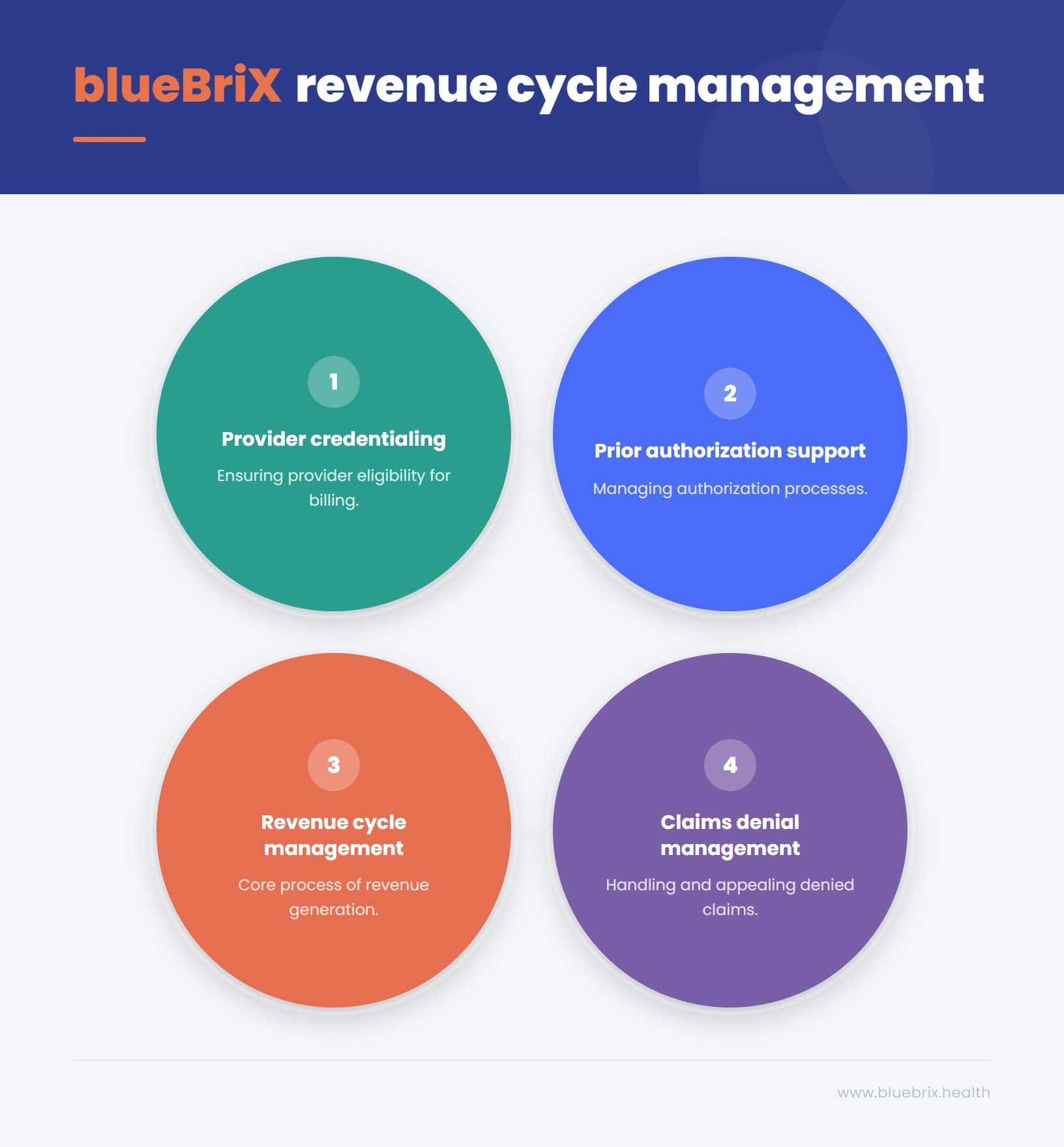
- Front-End Denial Prevention : Before the claim is filed – from eligibility verification, including behavioral health benefit checks run separately from medical benefits and carve-out payer identification at intake, through clean claim submission and payment posting, blueBriX manages the full billing cycle for behavioral health providers. At intake, our team runs a carve-out identification check alongside standard eligibility verification: asking specifically whether a patient’s behavioral health benefits are administered by a separate company from their primary medical plan. This single step prevents the hard denials caused by filing with the wrong payer, denials with no resubmission path and a separate timely filing window that is often already closing. blueBriX also track annual session authorization utilization against each payer’s plan limits, sending alerts at 75% and 90% of the covered visit threshold so that medical necessity exception requests are prepared and in queue before the limit is reached, not scrambled for after the denial lands. Claim scrubbing is calibrated for behavioral health-specific requirements: exact start and stop time documentation for time-based CPT codes (90832, 90834, and 90837), modifier -95 for synchronous telehealth, place-of-service code accuracy (POS 02 versus POS 10), and SUD consent documentation compliance with 42 CFR Part 2. blueBriX target a first-pass claim acceptance rate above 95%, the industry standard minimum threshold for efficient billing, in a specialty where most practices operate between 75% and 85%.
- Claims Denial Management & Appeals – When denials do occur, every rejected claim is first categorized as a hard denial or a soft denial before any work begins. Hard denials, where the claim cannot be resubmitted to the original payer, require a formal appeal or write-off decision. Soft denials require correction and resubmission. We do not spend staff time pursuing hard denials through a resubmission process that will never result in payment. Our denial management team reviews every rejection, identifies the root cause, and builds an evidence packet that includes clinical documentation review, MHPAEA parity arguments citing the 2013 baseline regulations, and where documentation disputes require it, peer-to-peer scheduling with the payer’s medical director. When internal appeals are exhausted, we escalate to Independent Review Organizations, the stage at which behavioral health denial overturn rates range from 47% to 78% depending on the payer, and the stage that most practices never reach because the claim aged out without anyone working it. We pursue every recoverable dollar because the claims abandoned without appeal are the single biggest source of avoidable revenue loss in behavioral health billing.
- Prior Authorization Support – We track authorization windows, initiate renewals proactively, and manage the step-up and step-down authorization cycles unique to IOP, PHP, and residential levels of care. No more missed renewal windows. No more retroactive denials on clinically appropriate care.
- Provider Credentialing Services – Our credentialing team manages payer enrollment and NPI verification for individual and group providers including multi-state telehealth credentialing. We make sure your providers are billing correctly under the right NPI before the first claim goes out the door.
What Our Clients Experience
Practices that partner with blueBriX typically see denial rates drop significantly within the first 90 days along with faster payment cycles, fewer write-offs, and a billing team that proactively flags issues rather than reacting to them.
You get a team that knows your payer mix, flags your risk before it becomes a denial, and reports to you by name — not by ticket number.
Blackbird Health, a pediatric and young adult mental health provider serving Pennsylvania and Virginia, partnered with blueBriX to address RCM inefficiencies that were affecting cash flow and provider capacity. Through automated billing and claims processing, proactive insurance verification at intake, and a denial management workflow built on a pre-submission checklist and real-time eligibility verification, Blackbird Health achieved an 83% year-over-year improvement in claim payments, alongside 40% faster patient intakes and a 150% increase in total appointments as billing infrastructure scaled with the practice rather than limiting it.
Laurel Life, a behavioral health organization providing outpatient therapy, school-based programs, and crisis intervention across seven locations in Pennsylvania, used automated eligibility verification and real-time claim scrubbing to cut claim rejections by 20% and accelerate payment cycles by 40%. The result: a 20% increase in reimbursements and revenue, a 20% reduction in administrative workload, and a 15% drop in operational costs, time and money that went back into patient care rather than billing rework.