

How patient registration errors sabotage value-based reimbursement
Patient registration and patient enrollment are often used interchangeably across healthcare organizations, and for good reason. They describe the same foundational moment in patient relationships. Yet in most organizations, that moment sits in the operational background, grouped alongside scheduling as an administrative step, evaluated on speed, and rarely examined for what it actually sets in motion.
At blueBriX, we view registration differently. Registration and enrollment are not just scheduling with more fields. It is where the care pathway takes shape, the right programs are identified, financial risk is surfaced, and every downstream system receives the data it will depend on. When that moment is treated as a data collection exercise, the consequences don’t show up at registration. They show up at billing, at the care gap report, and at the first missed appointment.
In this blog we explore what modern registration and enrollment demands from healthcare organizations and what a workflow built for today’s care environment looks like when it is working the way it should.
Operational integrity: why clinical accuracy is the bedrock of the revenue cycle
By the time the error is visible, its origin is invisible. The billing team is managing a rejected claim without knowing it started with a typo during a busy registration call.
The cost of this invisibility is staggering. Research shows that healthcare organizations face massive revenue cycle challenges due to misidentification, costing the average healthcare facility $17.4 million per year in denied claims and lost revenue.
The clinical team is working from an incomplete record without knowing the intake form, and the registration entry was never reconciled. Leadership is looking at revenue cycle metrics without a clear line of sight to where the leak began.
A registration error doesn’t create a billing problem. It reveals one that was already there, waiting for the right moment to surface.
The financial exposure compounds quietly: incorrect demographics trigger claim rejections, duplicate records fragment clinical history, and missed program enrollments mean eligible patients never enter the care structures designed for them. Beneath all of this is the capacity cost that rarely gets measured: the administrative time consumed by rework that should never have existed.
The problem isn’t isolated to data accuracy. It’s compounded by the fact that registration workflows were built for one type of patient, and that patient is no longer the only one walking through the door. So, what does a registration workflow build to prevent all of this actually look like? It starts with understanding that registration is not one step. It is two.
What does modern patient registration need to capture?
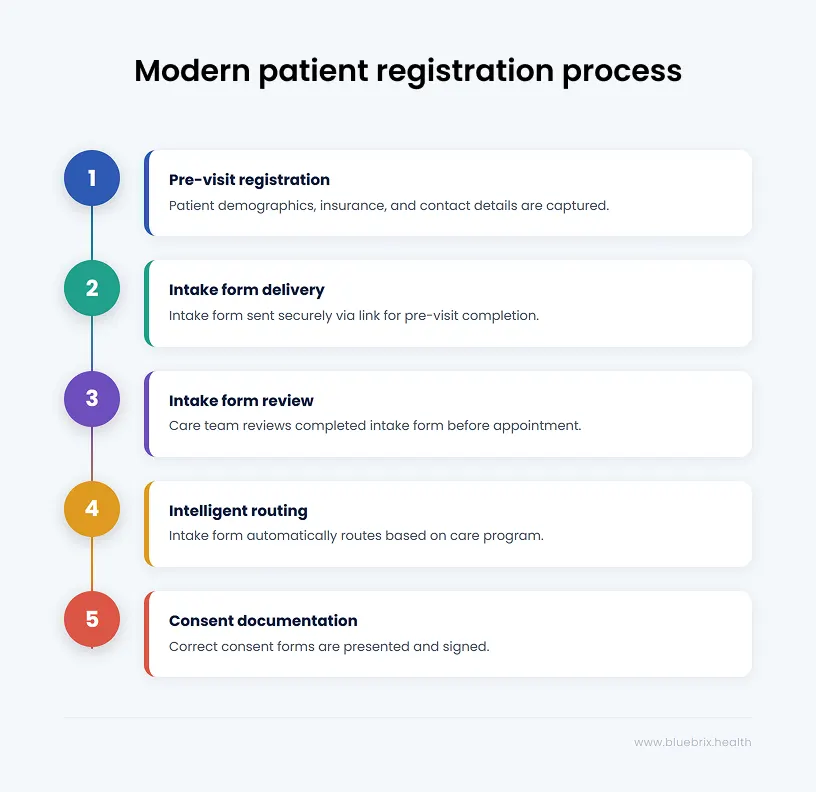
Patient registration is a sequence that has two distinct layers: what gets established before the patient arrives, and what gets captured before the first appointment begins. When each layer is designed to do its own job well, and the two are connected rather than duplicated, the care team walks into the first appointment with a complete picture. Here is what that looks like in practice.
The registration layer
Patient registration that starts with what you already know
When a patient arrives through a referral or surfaces through a population health flag, meaningful data already exists before the first call is made. Referral documentation, diagnosis context, risk flags, prior encounter history: it is in hand. The question is whether the registration platform can receive it.
When it can, the admin isn’t starting with a blank screen. Through connections to QHINs, national data exchanges, internal platforms, or uploaded rosters, the record is pre-populated before the conversation begins. The call shifts from conducting an interview to confirming what is already there. That shift saves time and removes transcription errors, but more importantly it means clinical context travels with the patient into the registration record rather than being left behind in a system the front desk never sees.
And because that context is surfaced at registration, details that would otherwise be deferred, like which program the patient qualifies for, get captured in the right moment rather than discovered weeks later during a clinical appointment or flagged during billing.
No duplicate patient records, by design
Before any of that context loads, the workflow needs to establish whether the patient already exists in the system. As the admin begins entering a name, the platform searches against existing records in real time. If a match exists, it surfaces before the entry is completed, not as a duplicate to untangle after submission, but as the starting point for the registration that follows.
Information enters once, from the most reliable source available, and flows to wherever it is needed downstream.
Language and communication preferences
A preferred language field captured correctly at registration propagates through every downstream touchpoint: the intake form itself, appointment reminders, care instructions, portal invitations, and post-visit follow-ups. It does not require anyone to flag it manually at each subsequent step.
For practices serving diverse populations, this is where care equity moves from an organizational value to a design decision. Multilingual access built into registration ensures that everything the patient receives from that point forward was designed for them.
SDOH screening: the coordination window that closes
SDOH screening belongs at registration for the same reason language preferences do: the information needs to be in hand before the care coordination response can begin, not after.
A transportation barrier identified at registration is a coordination opportunity. The care team can connect the patient with a resource before the first appointment happens. The same barrier identified after a missed appointment is a recovery problem. The data is identical. The moment of capture determines everything about what can be done with it.
Housing stability, food security, transportation access: when these are captured as structured, actionable fields at registration, the window for meaningful intervention stays open.
Financial transparency at the right moment
The financial conversation belongs to registration. Verifying whether a patient’s insurance covers the specific service they are coming in for, flagging a high-deductible patient before they arrive unaware of their out-of-pocket exposure, identifying a self-pay patient who needs counseling on available options: these are all conversations that are productive at registration and expensive everywhere else.
A patient who arrives knowing what is covered, what isn’t, and what their financial responsibility looks like is a different interaction than one who finds out at checkout or receives a surprise bill weeks later. The difference isn’t in the information. It’s in when it was shared.
The intake form
Where the patient layer begins
Once registration is complete, the intake form picks up where it left off. It arrives pre-populated with everything registration already confirmed: demographics, insurance, contact details, language preferences, SDOH responses. None of that gets asked again.
What the intake form adds is the clinical layer on top: medical history, current medications, allergies, symptoms, and the condition-specific detail the care team needs before the appointment. The patient or admin confirms what is already there, corrects if needed, and fills in what registration wasn’t designed to capture.
A well-designed intake form is accessible on any device via a secure link, with no app to install and no login to manage. It can be sent ahead of the visit for completion before arrival, or walked through at the front desk on a tablet when needed. Either way, the care team reviews it before they walk in.
Intake routing that reflects the care program
Not every patient is completing the same intake, and a single general form treats them as though they are. Behavioral health intake carries distinct consent and confidentiality requirements. Telehealth consent differs from in-person consent across most states. Minor patient registration requires structured guardian verification. Annual wellness visits carry their own clinical intake profile.
A workflow with intelligent routing configures once and delivers consistently. Based on the care program the patient is entering, the right forms surface automatically. The compliance risk that lives in manual judgment calls is removed before anyone has to make one.
Consent: surfaced at the right moment, for the right care
Consent documentation varies by care type, and a single general form doesn’t cover it. Because intelligent routing has already identified the care program, the right consent forms surface automatically as part of the intake process. Behavioral health, telehealth, minor patient: the correct forms for the correct context, without relying on anyone to remember the distinction.
The question at this point isn’t whether this approach makes sense. It’s whether your current platform is built to deliver it.
Automating patient registration: how blueBriX solves the infrastructure gap
blueBriX is built on a low-code, no-code platform, which means the registration and intake forms are not fixed templates that practices have to work around. They are configurable to the way a specific organization operates, the populations it serves, and the care programs it runs.
The interoperability layer connects to QHINs, external risk platforms, and referral sources so that data flows in rather than gets typed in. And because registration, scheduling, care coordination, and revenue cycle sit within the same platform, this seamless flow makes scheduling a natural next step rather than a separate coordination effort. The data that enters at registration doesn’t need to be re-entered, re-reconciled, or manually pushed to the next system. It travels.
For organizations managing complex or chronic populations, that connectivity is what turns registration from an administrative checkpoint into the starting point of a coordinated care relationship.
Stop the cycle of manual re-entry and administrative rework
When the infrastructure is right, data flows in, workflows guide automatically, and every care journey starts without friction. See how the blueBriX orchestration layer eliminates manual re-entry and administrative rework.
Contact us