

For most healthcare organizations, revenue cycle management has become a constant balancing act. Leaders are expected to reduce administrative costs, get paid faster, and keep up with shifting payer rules, all while teams are understaffed and stretched thin. Denials rise quietly. A/R ages. Manual work piles up. Something eventually has to give.
This pressure has fueled growing interest in AI-driven RCM tools. On paper, the promise is compelling. Automate repetitive tasks. Catch errors earlier. Reduce rework. Create a more proactive, data-driven revenue cycle. For organizations dealing with fragmented systems and exhausted teams, the idea of relief through automation is understandably attractive.
But while AI can accelerate individual tasks, software alone cannot manage payer nuance, documentation gaps, or accountability when claims go wrong. Complex denials, medical-necessity disputes, and payer-specific exceptions still require experienced human judgment. Revenue integrity ultimately depends on people who understand how clinical context, payer behavior, and operational workflows intersect.
This is why outsourcing revenue cycle management to a human-led RCM partner continues to deliver stronger results than relying on AI in isolation. Not because AI lacks value, but because sustainable improvement comes from teams who actively manage workflows, intervene in complex cases, and take ownership of outcomes, with AI supporting their work rather than replacing it.
Why is the “AI-only RCM” narrative so appealing?
For revenue cycle leaders who have spent years wrestling with denials, aging A/R, staffing gaps, and ever-changing payer rules, the idea of an “AI-only” RCM model can feel like a reset button. Not another workaround. Not another tool layered on top of broken workflows. But a chance to finally simplify what has become overwhelming.
That emotional pull matters. The AI-only story is not just about technology. It speaks directly to the day-to-day frustrations of running revenue operations in today’s healthcare environment.
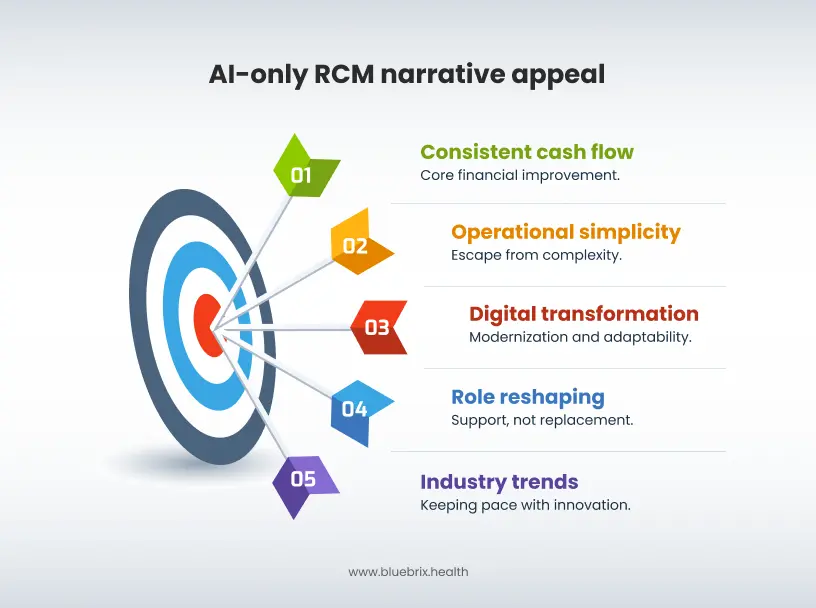
AI in RCM helps build consistent cash flow
RCM teams are constantly under pressure to show results. Recover lost revenue. Reduce days in A/R. Bring down cost to collect. AI platforms frame themselves as a direct answer to these pain points. The pitch is straightforward: use data and pattern recognition to catch errors before claims go out, flag denials before they happen, and accelerate follow-up without adding headcount. For CFOs and executive teams, this translates into clean, defensible ROI stories. Fewer rejections, faster reimbursement, and more predictable cash flow are outcomes that are easy to understand and hard to ignore. But can AI handle complex scenarios? That’s a catch as AI relies too much on patterns and will not be able to handle a one-off complex situation with dexterity as expert humans can.
It offers an escape from operational complexity
Most organizations are not struggling because they lack tools. They are struggling because they have too many. Eligibility systems, billing engines, clearinghouses, collections vendors, analytics platforms, and manual spreadsheets often coexist in fragile balance. Instead of promising a single, all-in-one fix, most AI RCM platforms focus on optimizing specific parts of the revenue cycle. They may improve eligibility checks, denial prediction, or follow-ups, but they rarely replace the broader ecosystem of billing systems, clearinghouses, and payer workflows. Fragmentation often persists. The real value comes when AI is paired with intentional integration, aligned processes, and operational ownership. For leaders exhausted by interface sprawl and workflow patching, progress depends less on adding another AI tool and more on creating cohesion across existing systems. But simplifying tools does not automatically simplify operations. Without clear ownership across workflows and payer touchpoints, AI can reduce surface friction while deeper process gaps continue to slow collections behind the scenes.
It fits neatly into the digital transformation story
At the executive level, there is growing pressure to modernize. Boards want to hear that the organization is becoming data-driven, future-ready, and capable of adapting to change. AI-only RCM fits cleanly into that narrative. As regulatory requirements evolve and payer policies shift, the idea that AI can continuously adapt without manual rule updates is reassuring. It creates the impression of a revenue cycle that keeps up with change on its own, rather than one that constantly needs human intervention just to stay compliant. Still, adaptation is not fully autonomous. When payer policies shift or regulatory nuances emerge, human interpretation is often what bridges the gap between model outputs and compliant execution.
It reshapes roles but doesn’t eliminate fear
One reason the AI-only message gains traction is how vendors frame it internally. AI is rarely positioned outright as a replacement for people. Instead, it is presented as support: repetitive work is automated, while humans focus on exceptions, appeals, and strategy. But in practice, AI is often introduced alongside pressure to reduce headcount, which creates understandable anxiety among teams. Adoption is not just a technology challenge, it is a trust challenge. For leaders navigating burnout and retention, success depends on transparency about workforce impact and a clear plan for how AI augments roles rather than quietly shrinking them. And while automation promises relief, uncertainty grows when teams do not understand where human judgment still fits. Without intentional change management, productivity gains risk being offset by disengagement and operational hesitation.
It feels like the inevitable next step
When peers are investing in AI, vendors are talking about AI-native platforms, and industry conversations increasingly frame automation as table stakes, standing still can feel risky. Choosing an AI-only approach can feel less like making a bold move and more like keeping up. In that environment, the AI-only RCM narrative becomes compelling not because it promises perfection, but because it promises progress. But keeping pace with industry trends is not the same as improving outcomes. Real progress depends on how thoughtfully AI is integrated into existing workflows, not simply on adopting it because everyone else is.
Taken together, this is why the AI-only RCM story resonates so strongly. It bundles financial improvement, operational simplicity, and digital credibility into a single, confident message. And for revenue cycle leaders under constant pressure, that message can be hard to resist, even when real-world execution is more complex than the promise suggests. In practice, AI-driven RCM tools fall short when they are treated as stand-alone solutions. They work best as augmentation layers, supporting experienced teams operating on solid data foundations and well-designed workflows. When those elements are missing, AI tends to amplify existing problems rather than solve them.
How different RCM models handle the same complexity
To understand the difference between AI-only RCM, outsourced RCM, and AI-augmented outsourcing models, it helps to evaluate how each handles the same real-world scenario. Before we walk through the case, it is important to define what “success” looks like in revenue cycle management. In this comparison, each model will be evaluated based on:
- Speed: How quickly claims move from submission to reimbursement
- Accuracy: Whether documentation, coding, and payer requirements are handled correctly the first time
- Accountability: Who owns the outcome when something goes wrong
- Long-term prevention: Whether the model reduces repeat denials and strengthens workflows over time
True success in RCM is not just getting a claim paid eventually. It means clean submission, minimal rework, predictable reimbursement, and continuous improvement that reduces future leakage.
The scenario
A mid-sized multi-specialty hospital treats a patient admitted through the emergency department with chest pain. The patient undergoes diagnostic imaging, cardiology consults, a short inpatient stay, and follow-up outpatient services. The payer is a Medicare Advantage plan with payer-specific authorization and documentation rules.
On the surface, this looks routine. In reality, it is exactly the kind of case where revenue leakage quietly happens.
There are multiple touchpoints:
- Emergency services and inpatient admission criteria
- Medical necessity documentation for imaging
- Prior authorization requirements tied to length of stay
- Coding complexity across departments
- Payer-specific appeal behavior
Now let’s look at how each model handles it.
How an AI-only RCM setup handles the case
In an AI-only model, automation kicks in early. Eligibility is verified. Claims are scrubbed. Codes are suggested based on clinical notes. The system flags no immediate errors, and the claim is submitted. From a speed perspective, this looks efficient. Claims move quickly through the system, and early-stage automation reduces manual effort.
Weeks later, the payer issues a partial denial, citing insufficient documentation for medical necessity related to imaging and length of stay. The AI system flags the denial and auto-generates a standard appeal draft based on historical patterns. Accuracy begins to break down at this stage.
What it cannot do is interpret nuance. It does not understand that the attending physician documented clinical justification in progress notes rather than the discharge summary. It does not recognize that this payer has recently tightened its interpretation of observation versus inpatient criteria.
The appeal is submitted but denied again. At that point, the case ages. Manual intervention is required, but ownership is unclear. Accountability becomes fragmented. The system surfaces the problem, but no one actively owns the clinical judgment required to resolve it. The system did what it was designed to do. The revenue is partially lost, not because AI failed technically, but because no one owned the judgment call. From a long-term prevention standpoint, nothing changes. The same documentation gaps are likely to recur because the root cause was never addressed upstream.
How a traditional outsourced RCM partner handles the case
With an outsourced RCM partner, the denial is reviewed by an experienced analyst. They identify the documentation gap and work with clinical staff to locate supporting notes. They understand the payer’s behavior and submit a targeted appeal.
The claim is eventually paid. Accuracy improves because human expertise fills in where automation falls short. Accountability is clear, the analyst owns the appeal outcome.
However, the process is slow. Much of the work is manual. Denial trends are reviewed retrospectively, not in real time. Speed suffers as recovery happens after revenue has already aged. The same issue may recur in future cases because feedback loops to front-end workflows are limited.
Long-term prevention remains weak. The organization fixes individual denials but does not systematically eliminate the underlying causes. The revenue is recovered, but the organization pays for it in staff time, delayed cash flow, and repeated effort.
How a tech-led, AI-augmented, outsourced RCM model handles the case
In a modern outsourced model that uses AI as support rather than a replacement, the outcome looks different.
At blueBriX, with our 18+ years of expertise in RCM services, we developed our native RCM solutions a decade back which has been our strongest back-engine support. With our latest AI-augmented model, our RCM analysts use AI to predict high-risk cases early based on payer behavior, length of stay, and documentation patterns.
Here, speed and accuracy improve simultaneously. Risk is identified before claims are submitted, not after denials occur. Our RCM team works with the providers to correct documentation and ensure payer-specific criteria are met before submission. The claim goes out clean. Accountability is embedded in the workflow. Our team owns both prevention and resolution.
If for some reason, denial occurs, our denial management specialists handle the appeal, applying clinical context and current payer enforcement guidelines. AI supports the process by surfacing similar successful appeals and tracking outcomes, but the strategy remains human-owned.
Just as importantly, the issue is fed back into workflows. Future cases with similar characteristics are flagged earlier. Documentation practices improve. Denial volume drops over time. This creates long-term prevention, not just short-term recovery.
Why this difference matters
All three models use technology. The difference is not whether AI is present. It is who owns the outcome.
- AI-only models move fast but struggle when reality does not match patterns, delivering speed without accountability or prevention.
- Traditional outsourcing recovers revenue but often reacts after the damage is done. They typically work on denial management, improving accuracy but sacrificing speed and repeat-error prevention.
- AI-augmented, human-led models prevent leakage, shorten A/R, and reduce repeat errors by combining speed, accuracy, accountability, and continuous improvement in one operating model.
This is why many organizations find that the most resilient revenue cycles are not powered by AI alone, but by experienced partners who know when to trust automation and when to step in.
Why outsourcing an RCM partner still works better
For all the progress AI has brought to revenue cycle management, most organizations eventually discover the same thing: software alone cannot run a revenue cycle, especially when payer rules and policies keep changing faster than AI models trained on past conditions can adapt. What works better in practice is a model that combines technology with people who understand payers, policies, and the realities of healthcare operations.
This is where outsourcing to an experienced RCM partner continues to deliver stronger, more consistent results than relying on AI tools in isolation.
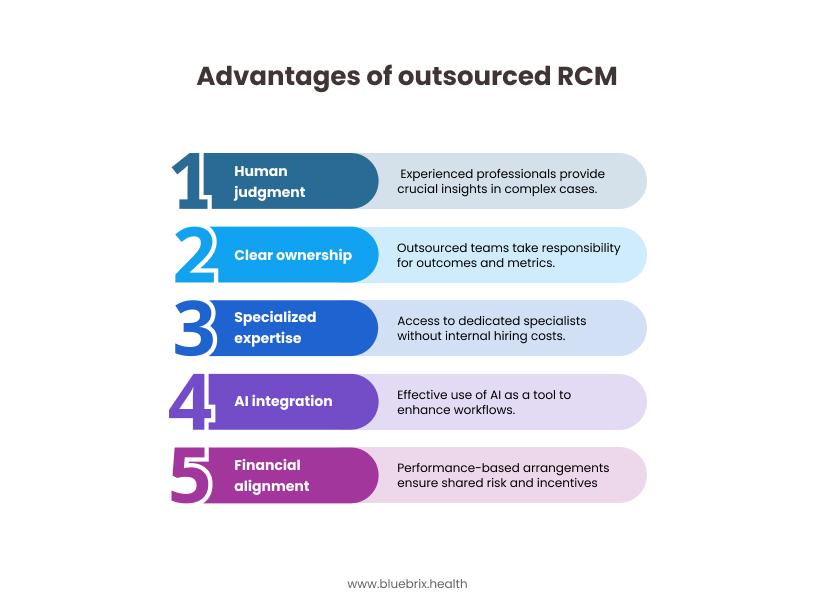
Human judgment still matters in the hardest cases
Not all RCM work is routine. Some of the most financially meaningful moments happen in edge cases. Complex denials. Medical-necessity disputes. Appeals that hinge on clinical context, documentation nuance, or payer-specific interpretation. These are areas where experienced RCM professionals add real value. They know when a denial is worth appealing, how to frame an argument, and how to navigate payer relationships in ways no model can replicate. AI can flag issues and surface patterns, but judgment, negotiation, and contextual decision-making still require human expertise.
Clear ownership changes outcomes
One of the biggest differences between AI-only setups and outsourced RCM partnerships is accountability. A strong RCM partner takes ownership of outcomes, not just workflows. Metrics like days in A/R, denial rates, and net collections are not abstract dashboards. They are shared goals. When something goes wrong, an outsourced team audits, corrects, and escalates. In contrast, AI-only tools can fail quietly. A mis-coded claim or a missed documentation gap may not surface until weeks later, at which point responsibility is harder to trace and fix.
Specialized expertise without internal overhead
Outsourced RCM partners bring depth that is difficult to maintain internally. Dedicated coding specialists. Compliance experts tracking regulatory changes. Teams focused on payer contracts and reimbursement trends. Because this expertise is spread across multiple clients, organizations gain access to it without bearing the full cost of hiring, training, and retaining specialized staff. Outsourcing also allows teams to scale up or down as volumes change, whether due to seasonality, growth, or acquisitions, without the disruption of constant workforce adjustments.
Better integration of AI into real workflows
The most effective RCM partners do not sell AI as a magic solution. They use it as one tool among many. They help redesign workflows, train teams, and decide where automation genuinely adds value and where human oversight is essential. This approach reduces friction. AI supports the work instead of reshaping it in ways that confuse or overwhelm staff. Governance, reporting, and continuous improvement become part of the operating model, not afterthoughts.
Financial alignment and shared risk
Outsourcing can also make financial sense in ways software alone cannot. Many organizations see meaningful reductions in administrative cost alongside improvements in collections and cash flow. More importantly, many RCM partners are willing to share risk through performance-based arrangements. When outcomes matter, incentives align. Pure software vendors rarely put their revenue at risk if automation underperforms.
In practice, outsourcing works better because it blends AI-enabled efficiency with human oversight, payer expertise, and shared accountability. Instead of betting everything on automation, organizations gain a more resilient, adaptable, and outcome-driven revenue cycle, one that can handle both routine volume and real-world complexity.
What a modern outsourced RCM model looks like today
When people hear “outsourced RCM,” many still picture a billing vendor working in the background, processing claims and sending monthly reports. That model is quickly becoming outdated.
Today, a modern outsourced RCM model looks much closer to an extension of the provider’s own operations. It blends experienced people, selective automation, and shared visibility into one coordinated way of running the revenue cycle. The goal is not just to get claims out the door, but to keep revenue predictable, accountable, and easier to manage over time.
- One of the biggest shifts is how responsibility is defined. Instead of outsourcing isolated tasks like coding or follow-up, many organizations now hand over the full revenue cycle.
- In modern outsourced models, AI is not treated as the solution. It is treated as support. Automation is applied to repetitive, high-volume work like eligibility checks, claim scrubbing, denial pattern identification, and parts of prior authorization.
- Another defining change is how performance is monitored. Providers no longer want to wait for month-end summaries to find out what went wrong. Modern outsourced RCM models rely on real-time dashboards, shared KPIs, and clear service-level expectations.
How blueBriX’s RCM Team Delivers Visibility and Accountability
A modern outsourced RCM model only works when teams have consistent visibility across clinical documentation, billing activity, payer responses, and operational performance. Our RCM specialists operate from a shared system that gives them a complete view of each patient’s revenue journey, allowing issues to be identified and corrected early rather than after claims have aged.
Our outsourced analysts use this shared environment to validate documentation, monitor denial trends, and coordinate follow-ups across departments. Automation supports high-volume tasks such as eligibility checks and claim scrubbing, but our specialists remain accountable for appeals strategy, compliance oversight, and workflow improvements. The technology does not replace the RCM partner. It enables our teams to work with fewer blind spots, faster response times, and clearer ownership, so revenue operations stay proactive instead of reactive.
Why waiting comes at a cost
Revenue cycle problems rarely announce themselves all at once. They build quietly. A few more denials than usual. Slightly older A/R. Extra manual follow-up that becomes “normal.” Because the impact is gradual, it is easy to postpone action and assume things will stabilize on their own. In reality, delay is expensive.
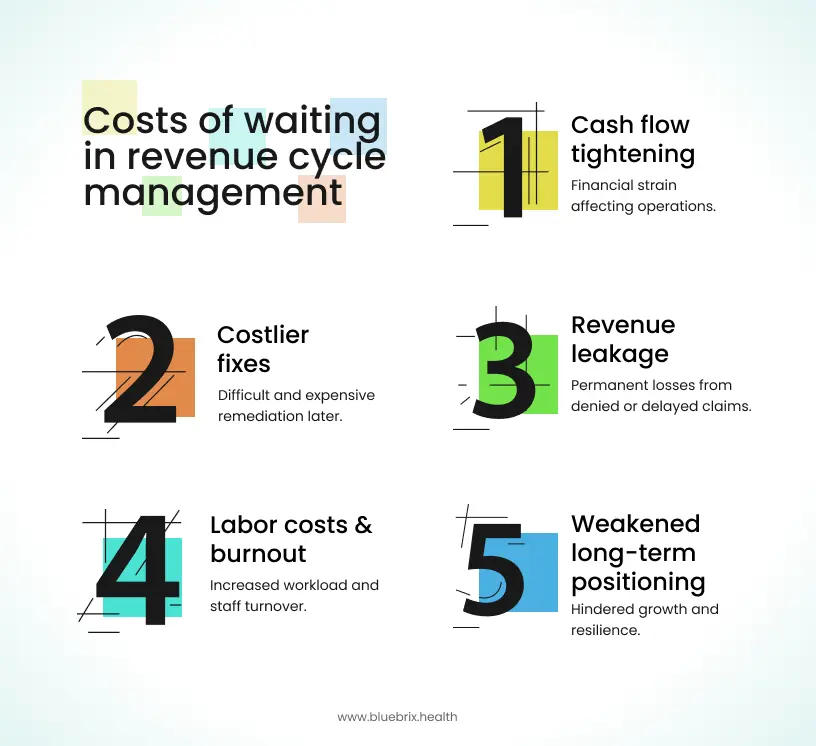
Revenue leakage compounds over time
Every denied or delayed claim represents money that should have been collected but was not. When follow-up is slow or inconsistent, those delays often turn into permanent losses. Many denied claims are never resubmitted or appealed, not because they are invalid, but because teams are overwhelmed or lack clear ownership. Over months and years, this leakage adds up. What starts as a manageable issue becomes a structural drain on revenue that is difficult to reverse.
Cash flow tightens in ways that ripple across the organization
When reimbursement slows down, the effects are felt far beyond the billing office. Payroll becomes harder to plan. Investments in technology or facilities get delayed. In some cases, organizations turn to short-term financing just to maintain day-to-day operations. These pressures limit flexibility and force leadership into reactive decisions, often at the worst possible time.
Labor costs and burnout increase quietly
As backlogs grow, so does manual work. Staff spend more time chasing aging claims, correcting preventable errors, and reworking denials that could have been avoided earlier in the process. This increases overtime, raises administrative costs, and accelerates burnout in already strained RCM teams. Turnover then compounds the problem, creating knowledge gaps and further slowing recovery.
Small issues become harder and costlier to fix later
Revenue cycle inefficiencies do not plateau. They compound. Gaps in eligibility checks, coding accuracy, or prior authorization workflows create downstream congestion that is far more difficult to clean up once claims have aged. Early intervention, by contrast, is both cheaper and more effective. Fixing root causes at the front end reduces denial volume, shortens days in A/R, and minimizes the need for expensive remediation later.
Waiting weakens long-term positioning
Organizations that address RCM weaknesses early gain more than short-term relief. They create margin stability and operational resilience. That stability makes it easier to invest in care delivery, adapt to payer changes, and absorb regulatory shifts without constant financial disruption. Those that wait often find themselves stuck in catch-up mode, reacting to problems instead of shaping their revenue strategy.
In short, delaying action on revenue cycle weaknesses turns manageable friction into ongoing financial drag. Addressing these issues early is not about urgency for urgency’s sake. It is about protecting cash flow, preserving team capacity, and maintaining the flexibility needed to operate and grow in a changing healthcare environment.