
What "the best EHR for psychiatry" actually means
A psychiatry EHR is an electronic health record system designed around the clinical, regulatory, and billing realities of psychiatric care: medication management for complex regimens, controlled substance prescribing, structured mental status exams and rating scales, psychotherapy documentation with the extra privacy protections psychiatric records require, and billing that combines evaluation and management codes with psychotherapy add-on codes. The “best” system is the one that supports those functions with the least friction for your specific practice size, patient population, and payer mix.
That definition matters because the EHR market is crowded with tools built for other specialties. Hospital-grade enterprise systems bury psychiatric workflows under menus designed for surgical scheduling. Therapy practice platforms handle counseling notes well and struggle with e-prescribing, lab orders, and medical decision-making documentation. Somewhere between the two sits the small set of systems built for psychiatric practice.
You are evaluating fit, and fit has to be measured against your practice.
Why psychiatry practices cannot afford a poor EHR choice
The pressure on psychiatric practices is structural. The Health Resources and Services Administration projects a national shortage of 50,440 full-time equivalent psychiatrists by 2037, based on current service use alone, with the gap widening further once unmet need is counted.[1] Every hour a psychiatrist spends fighting with documentation software is an hour of capacity the system cannot replace.
At the same time, the regulatory environment tightened in 2026. The revised 42 CFR Part 2 rule reached its compliance date on February 16, 2026, and the HHS Office for Civil Rights now has enforcement authority over substance use disorder record confidentiality, with penalties aligned to HIPAA.[2] Practices that treat co-occurring substance use disorders, which describes most psychiatry practices, now carry a compliance exposure that lives inside their EHR.
On the payment side, the CY 2026 Medicare Physician Fee Schedule made virtual direct supervision permanent, expanded digital mental health treatment coverage, and added new integration codes that reward psychiatric practices working with primary care.[3] An EHR that cannot code, document, and bill for these services leaves money on the table.
The combination of workforce scarcity, expanding compliance obligations, and evolving reimbursement means your EHR choice determines how much of your clinical capacity actually reaches patients.
A ten-step framework for evaluating psychiatry EHR software
With those stakes in view, the question becomes how to run the evaluation itself. The steps below follow the order in which most psychiatry practices encounter risk: they begin with the work your team does every day, move through the clinical, prescribing, and privacy functions that are unique to psychiatry, then cover billing, data exchange, and outcomes, and finish with the vendor relationship that will outlast any single feature. You can work through them in sequence or jump to the areas where your current system hurts most.
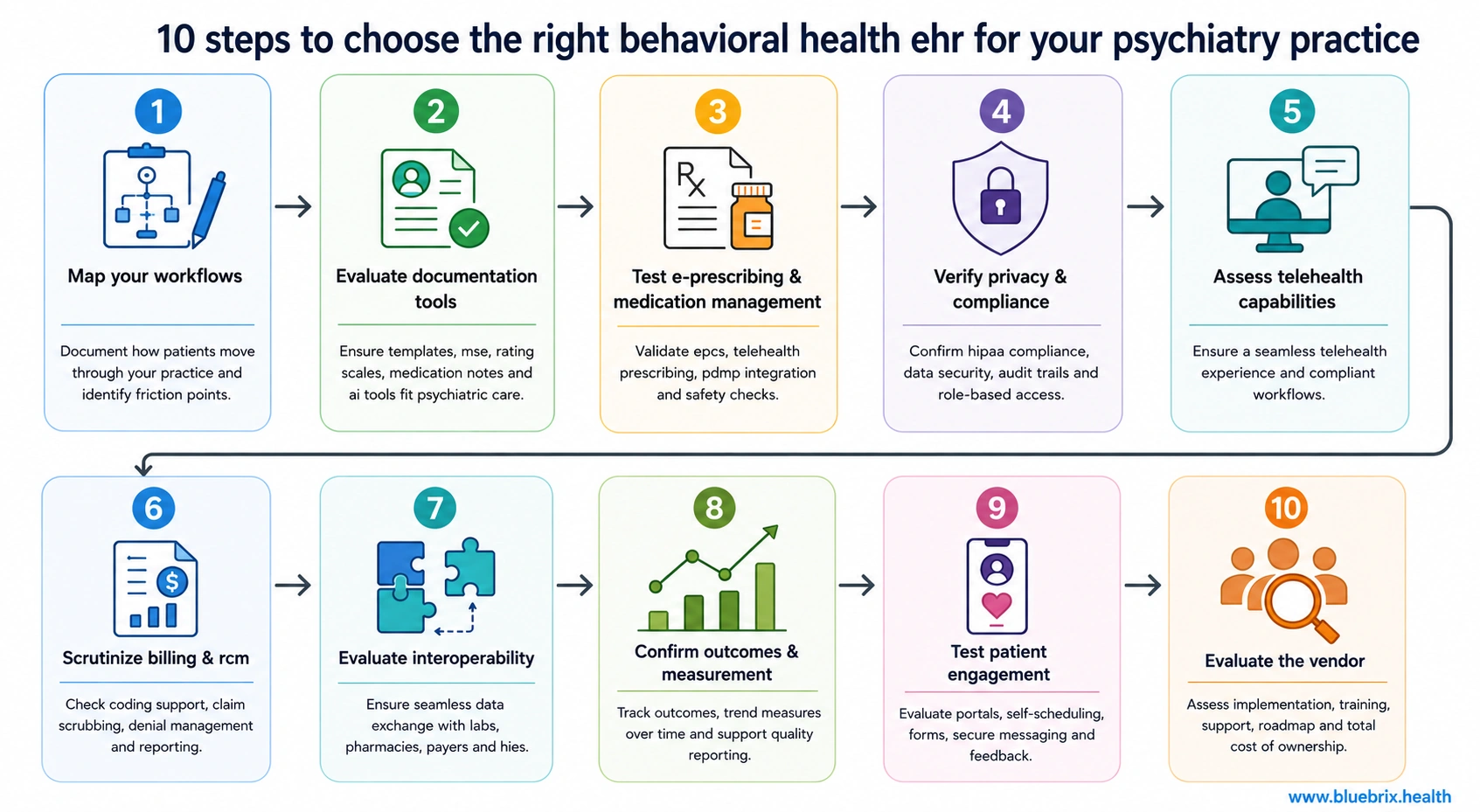
Step 1: Map your workflows before you look at a single demo
Most EHR evaluations start backwards. A vendor schedules a demo, walks through their strongest features, and your team leaves impressed by capabilities that may never touch your daily work.
Start with your own practice instead. Document how a patient moves through your clinic today:
- How does a new patient get scheduled, and what intake paperwork do they complete?
- What does a psychiatric evaluation look like in your practice, and how long does documentation take?
- How do medication follow-ups get documented and billed?
- Who handles prior authorizations, and where does that information live?
- How do you track outcome measures like PHQ-9 or GAD-7 scores over time?
- How does a claim move from the encounter to the payer, and where do denials get worked?
Write down the friction points in each step. These become your evaluation criteria. When a vendor demonstrates their system, ask them to walk through your workflows, using your scenarios, with realistic patient complexity.
This exercise also surfaces a critical question: are you a solo psychiatrist, a group practice with prescribers and therapists, or a multi-site behavioral health organization with psychiatry as one service line? The right answer differs for each.
Step 2: Evaluate psychiatric documentation tools
Documentation is where psychiatrists spend the most time in an EHR, so it deserves the most scrutiny.
Psychiatric evaluation templates
Look for structured templates for initial psychiatric evaluations (CPT 90791 and 90792) that capture history of present illness, psychiatric history, substance use history, family history, mental status exam, risk assessment, diagnosis with DSM-5-TR and ICD-10-CM coding, and treatment plan. The template should adapt to the encounter. A medication management follow-up should not force you through fields designed for a 90-minute intake.
Mental status exam and rating scales
A psychiatry EHR should have a structured mental status exam with click-to-document options for appearance, behavior, speech, mood, affect, thought process, thought content, perception, cognition, insight, and judgment. It should also embed standardized rating scales such as PHQ-9, GAD-7, MDQ, Y-BOCS, AIMS for tardive dyskinesia monitoring, and C-SSRS for suicide risk. Scores should auto-calculate, trend across visits, and feed directly into your outcomes reporting.
Medication management notes
Medication follow-up visits are the highest-volume encounter in most psychiatry practices. The documentation should pull the current medication list, show recent changes, prompt for side effect review and adherence, and support the medical decision-making language that justifies your E/M code level. The note should let you document the psychotherapy portion separately if you bill an add-on code like 90833 or 90836.
AI-assisted documentation
Ambient documentation and AI-generated clinical notes are now standard offerings. Evaluate them with caution. Ask how the AI handles psychiatric terminology, whether it distinguishes between patient statements and clinical assessment, how it documents risk assessment, and where the audio and transcripts are stored. Ask specifically whether AI-generated content can be edited before signing and whether the system flags what the AI drafted versus what the clinician wrote. Psychiatric documentation carries legal weight in involuntary commitment proceedings, disability determinations, and custody cases. You need to trust every sentence.
Step 3: Test e-prescribing and medication management under realistic conditions
Prescribing is where general-purpose EHRs and therapy platforms both fail psychiatry practices. Test this area in every demo, using your own scenarios.
Electronic prescribing of controlled substances
Your EHR must support electronic prescribing of controlled substances (EPCS) with DEA-compliant two-factor authentication and identity proofing. Federal law already requires EPCS for Schedule II through V prescriptions covered under Medicare Part D, and a majority of states have enacted their own mandates. State requirements vary considerably: some cover only Schedule II, some only opioids, and others all controlled substances or all prescriptions, each with different exemptions for outages, emergencies, and dispensing prescribers. Confirm the scope of the mandate in every state where you prescribe before evaluating EHR support. Whatever the local rule, stimulants, benzodiazepines, and sedative-hypnotics form a significant share of psychiatric prescribing, so the workflow should be fast. A two-factor authentication process that takes 45 seconds per prescription becomes a daily tax on a prescriber who writes 40 scripts a day.
Telemedicine prescribing
The DEA and HHS extended telemedicine flexibilities for prescribing Schedule II through V controlled substances through December 31, 2026, while permanent rules are finalized.[4] Your EHR should document the telehealth modality, patient location, and the clinical basis for the prescription in a way that will hold up when permanent rules arrive. Ask vendors how they plan to adapt to the DEA special registration framework if it is finalized.
PDMP integration
Prescription drug monitoring program checks should happen inside the prescribing workflow, with the PDMP report retrievable in one click and the check automatically documented. Manual PDMP lookups in a separate browser tab add minutes to every controlled substance prescription and create compliance gaps when staff forget.
Drug interaction and dosing support
Psychiatric patients often take multiple psychotropics alongside medications for chronic conditions. Interaction checking should be meaningful, with severity tiers that let you suppress trivial alerts while preserving warnings about serotonin syndrome risk, QT prolongation, or metabolic interactions. The system should also support lab ordering and result tracking for medications that require monitoring, such as lithium levels, clozapine absolute neutrophil counts, and metabolic panels for atypical antipsychotics.
Prior authorization support
Psychiatric medications face heavy prior authorization burdens. Look for electronic prior authorization within the prescribing workflow, formulary checking at the point of prescribing, and tracking of pending authorizations so nothing falls through.
Step 4: Verify privacy, compliance, and record segmentation
Psychiatric records carry protections beyond standard HIPAA, and your EHR has to enforce them structurally.
HIPAA psychotherapy notes
HIPAA defines psychotherapy notes as a special category that must be kept separate from the rest of the medical record and requires specific patient authorization for most disclosures. Your EHR should let clinicians designate psychotherapy notes as a distinct record type with separate access controls, and exclude them automatically from record releases, continuity of care documents, and patient portal views unless explicitly authorized.
42 CFR Part 2
The revised Part 2 rule allows a single patient consent for treatment, payment, and health care operations, permits HIPAA-consistent redisclosure by covered entities that receive records under that consent, and adds breach notification requirements aligned with HIPAA. Your EHR should be able to tag Part 2 records, manage consent at the record level, track disclosures for the patient’s right to accounting, and generate the required notice of privacy practices updates. Ask the vendor to show you how a Part 2 record behaves when you send a referral, run a report, or release records to a third party.
Role-based access and audit trails
Psychiatric information is a frequent target of inappropriate access, including by staff who know the patient. Verify that the system supports granular role-based access, break-the-glass logging for sensitive records (emergency access overrides that require a stated reason and create an automatic audit entry), and audit reports you can actually read without vendor assistance.
State-specific requirements
Minor consent rules, mandatory reporting workflows, duty-to-warn documentation, and involuntary commitment forms vary by state. Ask how the system handles the requirements in every state where you practice.
Certified health IT
If you participate in Medicare quality programs or plan to, confirm the system holds current ONC health IT certification and supports the information blocking requirements that govern how patients and other providers access records.[5] Certification also signals that the vendor invests in staying current with federal standards.
Step 5: Assess telehealth as a native capability
Telepsychiatry has moved from a pandemic workaround to a permanent care model. Medicare permanently removed geographic and originating site restrictions for mental health telehealth, and the CY 2026 fee schedule cemented virtual supervision and expanded digital mental health treatment coverage.
Your EHR should include integrated video visits that launch from the schedule, document the modality and patient location automatically, apply the correct place of service code and modifiers, and support the in-person visit requirements that still apply to some Medicare telehealth scenarios. A bolted-on third-party video tool that requires manual documentation of every telehealth detail creates billing errors and compliance gaps.
Test the patient experience too. Can a patient join a video visit from a text message link without downloading an app? Can they complete a PHQ-9 before the session starts? Can a caregiver join a session for a pediatric patient with appropriate consent documentation?
Step 6: Scrutinize billing and revenue cycle management
Psychiatry billing has its own logic, and many EHRs treat it as an afterthought.
Psychiatric code support
Your system should handle the full range of psychiatric CPT codes: 90791 and 90792 for evaluations, 90832 through 90838 for psychotherapy and psychotherapy add-ons with E/M, 90839 and 90840 for crisis psychotherapy, 90846 and 90847 for family therapy, 90853 for group therapy, and 90785 for interactive complexity. It should also support E/M coding based on medical decision-making or time, with documentation prompts that map to the code level you select.
Beyond core codes, check for support of collaborative care management codes (99492 through 99494), general behavioral health integration (99484), and digital mental health treatment codes if you plan to prescribe FDA-cleared digital therapeutics. If you work alongside primary care practices billing Advanced Primary Care Management, confirm the system handles the behavioral health add-on codes CMS introduced for 2026: G0568 and G0569 for psychiatric collaborative care (initial and subsequent months) and G0570 for general behavioral health integration. These are billable only when the same practitioner reports an APCM base code for the same patient in the same month, so the claim scrubber should enforce that pairing.
Eligibility and benefits verification
Behavioral health benefits are often carved out to separate managed behavioral health organizations with different authorization rules, visit limits, and payer IDs. Real-time eligibility checks should identify the correct behavioral health payer and flag authorization requirements before the visit.
Claim scrubbing and denial management
Ask for the vendor’s first-pass acceptance rate and average days in accounts receivable for behavioral health clients. Look for claim scrubbing rules built for psychiatric billing, such as add-on code pairing validation, session time documentation checks, and modifier logic for telehealth. The denial workflow should assign, track, and report on denials by reason and payer, so you can fix root causes rather than resubmit the same errors.
Integrated RCM services
Some vendors offer revenue cycle services alongside software. For smaller practices that cannot justify dedicated billing staff, this combination can outperform a separate billing company that does not understand the EHR. Evaluate the service level agreement, reporting transparency, and whether the RCM team has behavioral health specialization.
Step 7: Evaluate interoperability and data exchange
Psychiatric care rarely happens in isolation. Your patients see primary care physicians, receive labs, fill prescriptions at pharmacies, and sometimes move between outpatient, crisis, and inpatient settings.
Ask about FHIR API support, health information exchange connectivity, bidirectional lab interfaces, pharmacy connectivity beyond basic e-prescribing (including medication history and fill status), and referral management with closed-loop tracking. If you work in a collaborative care model with primary care, ask how the systems share registries and treatment plans.
Then ask the harder question: how does the system honor Part 2 and psychotherapy note protections when data leaves through these interfaces? A system that shares everything through an HIE without consent-based segmentation creates a compliance problem that will be difficult to detect until an audit.
Step 8: Confirm outcomes reporting and measurement-based care
Payers and quality programs increasingly expect psychiatric practices to demonstrate outcomes. Measurement-based care, the systematic use of rating scales to guide treatment, has moved from best practice to expectation in many value-based contracts.
Your EHR should trend standardized measures at the patient level, roll them up to the population level, and produce reports for MIPS quality measures, payer quality programs, and internal quality improvement. Look for dashboards that flag patients with worsening scores, missed follow-ups, or medication monitoring labs that are overdue.
If your practice is moving toward value-based arrangements, ask how the system supports risk stratification, care gap identification, and cost and utilization reporting.
Step 9: Test the patient engagement layer
No-show rates in psychiatry run higher than in most specialties, and every missed visit costs revenue and delays care. Your EHR’s patient-facing tools directly affect both.
Evaluate the patient portal, digital intake with consent forms and rating scales, appointment reminders across text, email, and voice, self-scheduling with rules that fit psychiatric practice (new patients cannot self-book a 20-minute follow-up slot, for example), secure messaging with routing rules, and payment collection. Ask whether the portal respects psychotherapy note protections and whether patients can see their own outcome measure trends.
Step 10: Evaluate the software as well as the vendor
The best software from a struggling vendor becomes a liability within three years.
Implementation and data migration
Ask for a detailed implementation plan with timeline, staffing, and responsibilities. Data migration from your current system is where most implementations go wrong. Ask exactly what data migrates (demographics, medication lists, allergies, problem lists, historical notes, outcome scores, billing history) and in what form. Ask for references from practices that migrated from your current system specifically.
Training and support
Ask about training formats, ongoing support hours, response time commitments, and whether support staff understand behavioral health workflows. Call the support line during your evaluation and see what happens.
Configurability
Practices evolve. Ask how much you can configure yourself, including templates, workflows, forms, reports, and integrations, versus how much requires paid vendor services. Platforms built on low-code or configurable architectures let you adapt without a change request queue.
Contract terms
Read the contract for data ownership language, exit provisions and data export formats, price escalation caps, uptime commitments, and what happens to your data if the vendor is acquired. Behavioral health EHR vendors have been consolidating for years, and acquisition frequently means a forced migration to the acquirer’s platform.
Financial stability and roadmap
Ask about the vendor’s ownership, funding, client retention, and product roadmap for the next 18 months. Ask specifically how they plan to handle the DEA permanent telemedicine rules, ongoing Part 2 enforcement, and annual fee schedule changes.
A weighted scoring framework for psychiatry EHR evaluation
Feature checklists give every capability equal weight. A weighted framework forces you to decide what matters most for your practice. Here is a starting point you can adjust.
| Evaluation area | Suggested weight | What to score |
|---|---|---|
| Psychiatric documentation | 20% | Template quality, MSE, rating scales, note efficiency, AI documentation controls |
| E-prescribing and medication management | 20% | EPCS speed, PDMP integration, interaction checking, lab monitoring, prior auth |
| Privacy and compliance | 15% | Psychotherapy note segregation, Part 2 handling, audit trails, certification |
| Billing and RCM | 15% | Code support, eligibility, scrubbing, denial management, reporting |
| Telehealth | 10% | Native video, automated documentation, patient experience |
| Interoperability | 5% | FHIR, HIE, labs, pharmacy, consent-aware exchange |
| Outcomes and reporting | 5% | Measurement-based care, MIPS, population dashboards |
| Patient engagement | 5% | Intake, reminders, portal, self-scheduling, payments |
| Vendor viability | 5% | Implementation, support, configurability, contract, roadmap |
Score each vendor from 1 to 5 in every area based on what you observed in your scenario-based demo, then multiply by the weight. A solo prescriber might shift weight toward e-prescribing and away from interoperability. A multi-site organization with therapists and prescribers might weight billing and configurability more heavily.
Red flags that should end an evaluation
Some findings are disqualifying regardless of how well the rest of the system performs:
- The vendor cannot demonstrate psychotherapy note segregation or Part 2 record tagging live.
- EPCS requires leaving the EHR or takes more than a few clicks per prescription.
- The demo uses a scripted patient and the vendor resists running your scenarios.
- References cannot name a practice similar to yours in size and specialty.
- The contract does not specify data export format and timeline at termination.
- The vendor cannot explain how they handle annual CPT and fee schedule updates.
- Support is offshore-only with no behavioral health specialization, or response times are undefined.
Seeing the gaps in your current system?
blueBriX builds behavioral health EHR, revenue cycle, and care coordination tools specifically for organizations like yours. Bring your own patient scenarios. We will show you how they run, start to finish.
Schedule a demoWhere blueBriX fits in a psychiatry EHR evaluation
blueBriX was built for behavioral health organizations that need clinical documentation, revenue cycle management, and care coordination working together rather than stitched across separate vendors. For psychiatry practices, that shows up in a few specific ways.
Psychiatric documentation templates, embedded rating scales, and medication management workflows are configurable to your practice without vendor change requests. E-prescribing with EPCS and PDMP integration lives inside the clinical workflow. Record-level privacy controls support psychotherapy note segregation and Part 2 consent management. Integrated RCM, including optional revenue cycle services from a team that works exclusively in behavioral health, connects the encounter to the claim without a handoff between systems.
For organizations that combine psychiatry with therapy, case management, or integrated care, blueBriX’s care coordination layer keeps the whole team working from a shared plan while respecting the access controls each record type requires.
The right way to evaluate blueBriX is the same as the right way to evaluate any vendor: bring your workflows, run your scenarios, and score what you see.