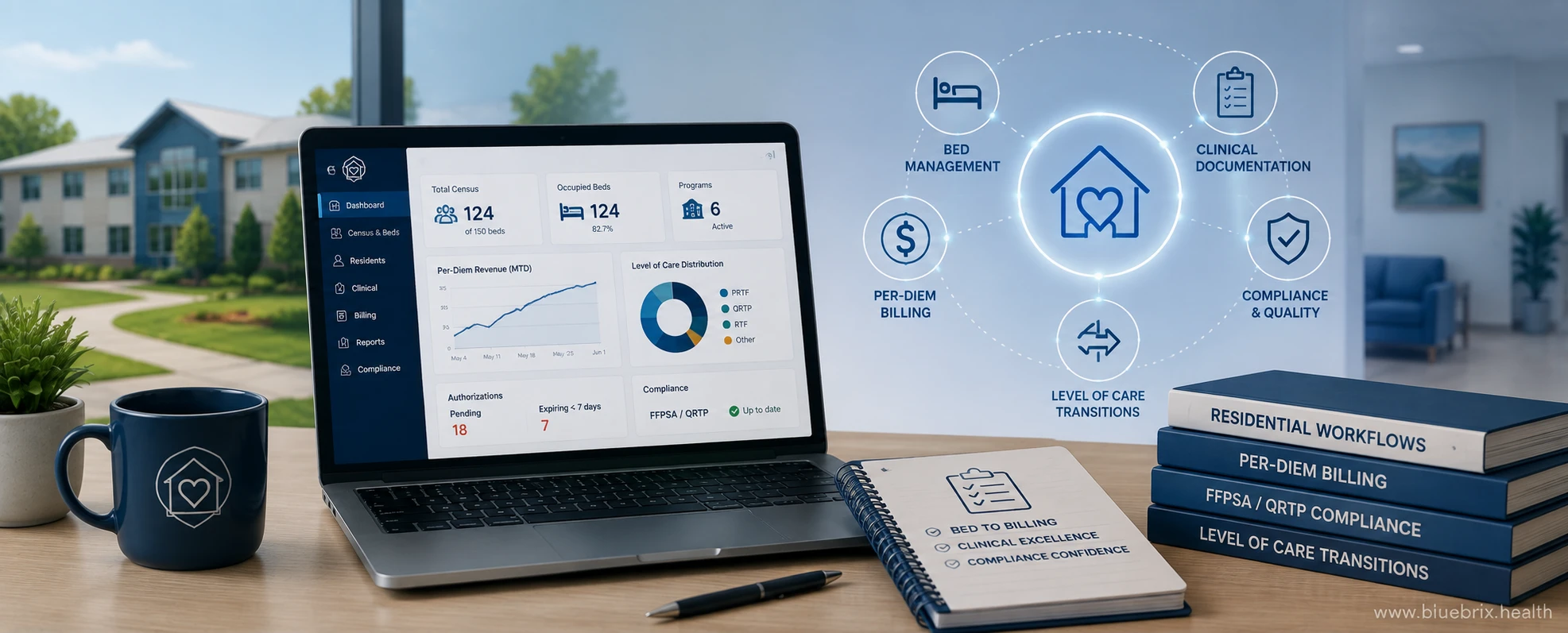
blueBriX psychiatric residential treatment facility EHR is an electronic health record system designed for the operational, clinical, and billing complexity of residential psychiatric care — specifically bed and census management, UB-04 institutional per-diem billing, treatment planning tied to level-of-care determinations, FFPSA/QRTP compliance documentation, and level-of-care transitions across programs within a single organization. Unlike outpatient behavioral health EHRs that are designed around scheduled encounters and CMS-1500 professional claims, a PRTF EHR must support 24/7 residential operations where the bed log drives billing, clinical documentation follows shift cycles rather than appointment slots, and compliance evidence accumulates continuously across a stay that can span months. This requires a dedicated residential architecture, not a reconfigured outpatient system.
This guide evaluates the EHR systems that PRTF and QRTP operators actually shortlist — not a reshuffled list of outpatient behavioral health tools. The six EHR systems evaluated in this guide were selected because they are the systems PRTF operators actually consider when they begin an evaluation. No outpatient-only tools are included, regardless of their market share in broader behavioral health. For a broader behavioral health EHR comparison across all practice types, see our complete guide to behavioral health EHRs.
Top 6 psychiatric residential EHRs to consider for PRTF and QRTP facilities
Use this table to identify the systems that match your organization type and residential complexity, then read the detailed evaluation below.
| EHR | Best suited for | Key PRTF/QRTP strength | Key factors |
|---|---|---|---|
| blueBriX | Multi-program PRTFs, QRTPs, group homes, organizations running residential + community program | FHIR R5-native; per-diem billing from bed logs; FFPSA/QRTP compliance in workflow; Trust Engine human-in-the-loop AI; multi-model billing | Best fit for mid-to-large multi-program residential organizations |
| Netsmart (myAvatar) | Large state-funded PRTFs, public-sector BH agencies, multi-site residential enterprises | Largest installed base in public-sector residential BH; closed-loop medication management; CareFabric HIE network | Capterra 2.3/5[1] ; steep learning curve; 9–24 month implementation; high total cost of ownership |
| Qualifacts (CareLogic) | Enterprise CCBHCs that also operate residential beds; multi-state agencies | Serves approximately one-third of US CCBHCs per vendor reporting; admission/discharge/bed management; iQ AI in production; ASAM, CANS, DLA-20 | Three-platform portfolio creates consolidation risk; residential not the primary design focus; 9–18 month implementation |
| NextGen Healthcare | Integrated care (BH + primary + oral health) with a residential component | Only unified BH + primary care + oral health EHR; bed board, eMAR, shift notes, detox monitoring | Feature-heavy for PRTF-only operators; residential is one module in a larger suite; G2 3.7/5 [2] |
| Alleva | SUD residential and addiction treatment (detox, residential, PHP/IOP) | Designed specifically for addiction treatment across levels of care; ASAM-aligned documentation; Echo AI; integrated CRM + RCM | Strongest in SUD — psychiatric PRTF (youth, Medicaid per diem, EPSDT) is not the primary focus |
| Kipu Health | Multi-site addiction and behavioral health facilities | Unified EMR + CRM + RCM; HITRUST certified; strong admissions and utilization review | SUD/addiction-focused; no managed billing service; PRTF-specific workflows not prominently documented |
How each EHR handles PRTF and QRTP workflows
1. blueBriX
blueBriX psychiatric residential EHR is built for behavioral health organizations operating residential and community-based programs simultaneously — including PRTFs, QRTPs, group homes, and BHUCs. The system is designed around the operational reality that residential psychiatric care requires a fundamentally different EHR architecture than outpatient behavioral health.
Residential workflow support
blueBriX supports bed management with real-time census tracking where the bed log directly generates per-diem billing charges. Multi-program enrollment tracking allows organizations to manage residents across PRTF, QRTP, group home, and community-based programs within a single instance — including dual-enrollment scenarios where a resident participates in multiple programs simultaneously. The treatment plan builder is configurable per program type and links treatment goals to level-of-care determinations, with age and gender configuration at the program level and enrollment status tracking across first-level and second-level statuses.
Billing and RCM
This is where multi-program residential operators face the most acute pain. blueBriX handles multi-model billing — per diem, encounter-based, capitated, and fee-for-service — running simultaneously within the same organization. UB-04 institutional billing for PRTF Medicaid per-diem claims[3] is integrated, not bolted on as a secondary billing mode. RCM services are available for organizations that want managed billing in addition to the billing engine.
What a 150-bed evaluation surfaced about billing complexity:
During a multi-session evaluation with a 150-bed, six-program residential organization, the billing lead — who was managing four billing types in parallel across disconnected systems — identified the single-workflow per-diem charge generation from bed logs as a direct replacement for their existing multi-system workaround. The billing session was one of five functional evaluations (Billing, Documentation, Admissions, Clinical/Psychiatry, and Quality) conducted with the organization’s operational and clinical leadership.
Compliance and reporting
FFPSA/QRTP compliance is built into the clinical workflow — 30-day qualified individual assessments, discharge planning documentation from admission, and judicial review evidence are part of the documentation flow rather than a separate compliance module. 42 CFR Part 2[4] compliance is supported with HITRUST certification, and guardian consent management handles the specific complexity of youth residential populations where the authorized consent party is not the patient.
Interoperability and architecture
blueBriX is built on a FHIR R5-native architecture unlike most EHRs that have an FHIR layer on top of a legacy system. For PRTF operators, this matters directly in the context of CMS-0057-F[5]: FHIR-based prior authorization for institutional Medicaid claims does not require middleware or manual workarounds. The governance layer operates in a human-in-the-loop model — AI suggests documentation, the clinician validates it, and the workflow executes only after validation. For organizations with Medicaid audit exposure and accreditation obligations, this architecture ensures AI-assisted notes are reviewed before they become part of the official record.
Implementation
60 to 90 days for residential deployments across up to three locations.
Evaluation proof point: The 150-bed residential organization evaluated blueBriX across five functional sessions with up to 27 stakeholders in a single session — the documentation demo. The moments that generated the strongest reactions were the digital consent forms eliminating a 40-page paper admission packet (described by the evaluation team as the highest-energy moment), a referral dashboard replacing a manual spreadsheet with SLA-based escalation, and predictive crisis AI capabilities that drew the clinical trainer’s response: “I’m in love with this.” The quality and compliance team responded to proactive deviation detection — the ability to flag compliance gaps before a surveyor finds them — as a fundamental shift from their existing reactive model.
Best suited for
Multi-program residential organizations running PRTF, QRTP, group home, and community-based programs. Organizations managing multi-model billing. Facilities that need FFPSA/QRTP compliance documentation built into clinical workflow[6]. Organizations stepping down residents through multiple levels of care within a single system.
Evaluating psychiatric residential EHR for your PRTF facility?
See how blueBriX handles the residential workflows covered in this evaluation — per-diem billing from bed logs, multi-program enrollment, and FFPSA/QRTP compliance — in a walkthrough configured for your facility.
2. Netsmart (myAvatar)
Netsmart’s myAvatar is a recovery-focused EHR suite with the largest installed base in public-sector residential behavioral health in the United States. The system is part of the broader CareFabric ecosystem and is designed for organizations managing complex, multi-site behavioral health operations — particularly those operating under state contracts and publicly funded programs.
Residential workflow support
myAvatar supports inpatient and residential workflows including closed-loop medication management, which is a significant capability for PRTFs managing controlled substance administration across shifts. The system supports role-based dashboards, configurable note templates, and documentation workflows across inpatient and outpatient settings. For large state-funded PRTFs and psychiatric hospitals, the system’s scale and state-agency connectivity are its primary advantages.
Billing and RCM
The billing module is designed to manage complex reimbursement environments, including institutional billing for long-term, intensive episodes of care. Automated electronic remittance processing and denial management workflows are integrated. For organizations operating under state Medicaid contracts with multiple billing models, the system’s financial infrastructure is built for that complexity.
Compliance and reporting
Netsmart serves organizations across all 50 states with compliance tooling designed for state-specific reporting requirements and public-sector accountability. Interoperability is supported through the CareFabric health information exchange network, which facilitates data sharing across provider organizations — a relevant capability for PRTFs that need to coordinate with referring agencies, courts, and community-based providers.
Implementation considerations
Implementation timelines for myAvatar are extended compared to most behavioral health EHRs. Industry sources report 9 to 24 months for enterprise deployments. The learning curve is consistently cited in user reviews — Capterra ratings stand at 2.3/5 with documented concerns about UI complexity, forced documentation sequencing, and system performance issues. For organizations with the implementation capacity and the institutional patience to manage a complex deployment, the scale and public-sector connectivity may justify the investment. For organizations seeking faster time-to-value, the timeline is a material consideration.
Best suited for
Large state-funded PRTFs and public-sector behavioral health agencies. Multi-site residential enterprises with existing Netsmart infrastructure. Organizations where state-agency connectivity and HIE participation outweigh UX concerns.
Key trade-off for PRTF evaluators: Netsmart’s scale and public-sector presence are unmatched, but the total cost of ownership — including implementation timeline, training investment, and the productivity impact of a complex UI on residential staff who document across shifts — should be evaluated against the organization’s operational capacity.
3. Qualifacts (CareLogic)
Qualifacts operates three EHR systems under one portfolio: CareLogic (enterprise), Credible (mid-market), and InSync (small practice). For PRTF evaluators, CareLogic is the relevant product — it serves enterprise behavioral health and human services organizations, including CCBHCs, CMHCs, and agencies operating residential programs alongside community-based services.
Residential workflow support
CareLogic includes admission and discharge management, bed management, patient scheduling, and real-time occupancy tracking for residential and inpatient settings. Treatment planning is configurable with access to evidence-based tools including ASAM Continuum, CANS, PHQ-9, DLA-20, and Wiley Treatment Planners. The system supports documentation across multiple programs and service lines with a self-service form builder that agencies can update without vendor involvement.
Billing and RCM
Billing infrastructure supports complex reimbursement models across multiple payers and programs. CCBHC prospective payment system (PPS) billing is a specific strength — Qualifacts states it serves approximately one-third of the nation’s CCBHCs, which means the billing engine has been tested against the specific Medicaid and PPS coding requirements that CCBHC-designated organizations face.
Compliance and reporting
CCBHC quality measure reporting is a core competency — organizations required to report on FUH, FUA, IET, and PCR-AD measures have a tested reporting infrastructure. The Qualifacts iQ AI suite, which the vendor reports is in production with over 150 organizations, offers AI-assisted documentation with clinical decision support.
| Qualifacts portfolio context for PRTF evaluators | |
|---|---|
| Relevant product | CareLogic (enterprise) |
| CCBHC market share | Approximately one-third of US CCBHCs (vendor-reported) |
| AI status | iQ in production, 150+ organizations (vendor-reported) |
| Implementation timeline | 9–18 months |
| Key consideration | Three-platform architecture means the long-term product roadmap carries consolidation uncertainty |
Implementation considerations
Implementation timelines range from 9 to 18 months for enterprise deployments. The three-platform portfolio (CareLogic, Credible, InSync) is a factor PRTF evaluators should assess for long-term roadmap clarity — platform consolidation decisions by Qualifacts could affect the product your organization is running on.
Best suited for
Enterprise CCBHCs and CMHCs that also operate residential beds. Multi-state agencies needing CCBHC quality measure reporting alongside residential workflows. Organizations where CCBHC compliance is the primary driver and residential is a secondary care setting within the same organization.
4. NextGen Healthcare
NextGen Healthcare’s Behavioral Health Suite is the only EHR that unifies behavioral health, primary care, oral health, and human services in a single system. For PRTF operators that also deliver integrated medical and dental care — or for CCBHCs with residential beds that need to report across all service lines — this integration is the primary differentiator.
Residential workflow support
NextGen includes a dedicated residential services module with specific workflows for bed board management, residential administration (documenting program enrollment, personal belongings, medications, and authorized/restricted contacts), residential shift notes, detoxification monitoring, electronic medication administration records (eMAR), and residential discharge documentation. The bed board enables real-time tracking of bed occupancy, and the eMAR supports closed-loop medication management within residential settings.
Billing and RCM
Reporting tools support compliance with UDS, CMS, PQRS, MIPS/MACRA, and value-based payment models. The billing infrastructure is designed for organizations managing multiple service types — behavioral health, primary care, and dental — with separate billing requirements flowing through a single system.
Compliance and reporting
Configurable reporting tools support evolving state and federal requirements. Ambient Assist, NextGen’s AI documentation tool, transcribes and summarizes patient encounters in real time with HIPAA compliance. Mobile documentation capabilities support field-based and community-based care teams alongside residential staff.
Implementation considerations
NextGen’s feature depth is its strength and its limitation for PRTF evaluators. An organization that operates only a PRTF — without integrated primary care or dental services — may find significant unused functionality in the system. The residential module is one component of a comprehensive integrated care suite, and the implementation scope reflects that breadth. G2 rating stands at 3.7/5.
Best suited for
Integrated care organizations that combine behavioral health residential with primary care and oral health services. CCBHCs with residential beds that need unified reporting across all service lines. Organizations where the PRTF is one part of a larger integrated care delivery model.
5. Alleva
Alleva is designed specifically for behavioral health and addiction treatment programs, spanning outpatient, IOP, PHP, and residential levels of care. The system combines clinical documentation, CRM, and revenue cycle management into a single system, with particular depth in SUD treatment workflows.
Residential workflow support
Alleva supports documentation across multiple levels of care with ASAM-aligned assessment and treatment planning embedded in clinical workflows — not configured as add-ons. Group therapy and individual progress note documentation are supported with AI-assisted note generation through Echo, Alleva’s ambient AI, supporting DAP, SOAP, and utilization review formats. The system handles admissions, treatment planning, and discharge workflows across residential settings.
Billing and RCM
Alleva Billing connects clinical and financial workflows from charge capture to claim submission within the same system. Benefit verification is integrated through a Waystar connection, and the system supports billing across IOP, PHP, residential, and outpatient settings.
Where the PRTF fit question matters: Alleva’s primary design focus is addiction treatment — SUD residential, detox, and multi-level SUD programs. The operational profile of a psychiatric PRTF serving youth under Medicaid per-diem with EPSDT requirements and FFPSA/QRTP compliance obligations is a different workflow set. PRTF evaluators should assess whether Alleva’s residential capabilities extend to the specific institutional billing, guardian consent, and FFPSA documentation requirements that psychiatric residential treatment facilities need.
Best suited for
SUD residential treatment centers and addiction programs with residential beds. Mid-size treatment centers managing multiple levels of addiction care. Organizations where SUD treatment is the primary service line and residential is part of a continuum from detox through outpatient.
6. Kipu Health
Kipu Health is a unified EMR, CRM, and revenue cycle management system built for addiction treatment centers and behavioral health facilities. The system is HITRUST certified and designed for multi-site operations with particular strength in admissions workflow and utilization review.
Residential workflow support
Kipu supports clinical documentation with customizable templates, ASAM-aligned treatment planning, and utilization review workflows. The system is designed for multi-provider and enterprise behavioral health facilities with admissions management and scheduling capabilities. Documentation templates can be configured per service type.
Billing and RCM
Kipu provides billing workflow tools but does not offer a managed billing service — organizations using Kipu maintain their own billing staff. For PRTF operators managing complex Medicaid institutional billing, this means the billing complexity stays in-house even if the EHR supports the claim submission workflow. Pricing is not publicly disclosed and varies by census, users, and module selection.
Implementation considerations
User reviews cite a learning curve during initial adoption, though satisfaction generally improves after the onboarding period. Capterra shows an overall rating based on 214 reviews with 94% positive sentiment. For PRTF-specific workflows — Medicaid per-diem institutional billing, EPSDT documentation, FFPSA/QRTP compliance — evaluators should ask for a residential-specific demonstration rather than a general behavioral health demo.
Best suited for
Multi-site addiction treatment and behavioral health facilities. SUD residential operators where admissions volume and utilization review drive the primary workflow. Organizations with existing in-house billing capacity.
Why PRTFs and QRTPs cannot rely on a general behavioral health EHR
The most common EHR evaluation mistake PRTF operators make is shortlisting systems designed for outpatient behavioral health. These are not the same category. Even a behavioral health EHR that handles therapy documentation, outpatient scheduling, and CMS-1500 billing with sophistication will fail at the operational level in a residential psychiatric setting. The is an architectural mismatch.
Census-based operations vs. encounter-based operations
An outpatient behavioral health EHR is built around scheduled encounters — a patient arrives, a session happens, a note is written, a claim is filed. A PRTF operates on census. The bed is the unit of service. Documentation follows shift cycles, not appointment slots. Billing is driven by occupancy, not encounters. An EHR that does not natively support bed-based operations forces residential staff into workarounds that create documentation gaps, billing leakage, and compliance risk.
The operational gap in numbers:
A PRTF with 100 beds running at 90% occupancy generates approximately 32,850 billable bed-days per year (calculated: 100 beds × 90% average occupancy × 365 days). Each of those days requires documentation across multiple shifts, medication administration records, treatment plan updates, and — for Medicaid — per-diem institutional claims on UB-04. An outpatient EHR processes none of this natively.
UB-04 institutional billing vs. CMS-1500 professional billing
PRTFs bill Medicaid on UB-04 institutional claim forms with per-diem rates, revenue codes, and EPSDT requirements for youth populations. This is fundamentally different from CMS-1500 professional billing that outpatient behavioral health EHRs are designed to handle. The claim structure is different. The coding logic is different. The payer adjudication rules are different. Attempting to run institutional per-diem billing through a professional billing engine consistently produces higher denial rates and longer accounts receivable cycles.
Treatment planning tied to level-of-care determination
In outpatient behavioral health, a treatment plan is a clinical document. In a PRTF, a treatment plan is also a medical necessity document that justifies continued residential placement. It must link directly to the level-of-care determination, update at 30-day intervals per CMS requirements, and document discharge planning from the point of admission — not as a late-stage activity. An EHR that treats treatment plans as standalone clinical documents, disconnected from level-of-care and discharge workflows, creates gaps that surface during utilization review and surveyor visits.
FFPSA/QRTP compliance documentation[7]
The Family First Prevention Services Act imposes specific documentation requirements on Qualified Residential Treatment Programs that do not exist in any outpatient behavioral health compliance framework:
| FFPSA/QRTP requirement | What the EHR must support |
|---|---|
| 30-day assessment | Assessment by a qualified individual within 30 days of placement, documenting whether residential treatment is the least restrictive setting appropriate for the child’s needs |
| 60-day judicial review | Evidence package for court review of the placement decision, including the qualified individual’s assessment and the organization’s ongoing treatment justification |
| Ongoing discharge planning | Documentation of active discharge planning from the point of admission, with regular updates demonstrating progress toward community reintegration |
| Family engagement | Records of family participation in treatment, family therapy sessions, and family-based aftercare planning |
An outpatient behavioral health EHR has no framework for any of this. Configuring it from scratch is a custom development project with ongoing maintenance — not a settings change.
42 CFR Part 2 in a residential context
Organizations serving patients with substance use disorder must comply with 42 CFR Part 2, which imposes stricter confidentiality requirements than standard HIPAA. In a residential setting serving youth, the consent complexity multiplies: the authorized consent party is typically a guardian, not the patient. Consent must be managed for inter-program transfers within the same organization. Re-disclosure tracking must follow residents across multiple levels of care. An EHR designed for adult outpatient behavioral health does not have the consent architecture for this scenario.
What's changed in 2026 that affects your psychiatric residential EHR decision
Five regulatory and operational developments are directly affecting what a PRTF EHR needs to do in 2026. Each should inform your evaluation criteria.
CMS-0057-F: FHIR-based prior authorization
The CMS Interoperability and Prior Authorization Final Rule required most payers to implement FHIR-based prior authorization processes by January 1, 2026[8]. For PRTF operators submitting institutional prior authorization for Medicaid stays, EHRs with native FHIR architecture can process these electronically without middleware. Systems without FHIR readiness require manual workarounds at every payer transition — a compounding operational burden as more Medicaid managed care organizations adopt the standard.
CMS-0053-F: HIPAA claims attachments rule
Effective May 2026 with a 24-month compliance window extending to 2028, this is the first-ever HIPAA-adopted standard for electronic claims attachments[9]. The rule adopts HL7[10] Consolidated Clinical Document Architecture (C-CDA) and is projected to save the industry $781 million annually according to CMS’s regulatory impact analysis, by eliminating fax-based and mailed attachments. PRTF operators currently sending clinical attachments by fax to support institutional Medicaid claims need to begin infrastructure planning with their EHR vendor now — the 2028 compliance deadline arrives faster than most operations expect.
Medicaid redetermination volatility
Medicaid coverage status is more volatile in 2026 than at any point in the program’s history. The post-pandemic redetermination unwinding period, combined with new eligibility redetermination requirements under the 2025 federal budget reconciliation, means a resident’s Medicaid coverage can lapse mid-stay without warning. For a 24/7 residential operation, eligibility verification needs to run at admission, periodically during the stay, and before claim submission — retroactive coverage lapses on a 90-day residential stay create significant revenue exposure.
CMS CRUSH initiative
CMS launched the Comprehensive Regulations to Uncover Suspicious Healthcare (CRUSH)[11] initiative in 2026, initially targeting Minnesota, California, Maine, and New York. For PRTF operators billing institutional Medicaid claims in these states — and in states likely to be added — billing pattern accuracy and documentation integrity carry heightened scrutiny. The EHR’s ability to maintain audit-ready documentation across every billable day of a residential stay is not a nice-to-have under this enforcement posture.
State-level PRTF legislative activity
Multiple states are actively revising PRTF capacity and reimbursement rules. Mississippi removed Medicaid bed limitations for PRTFs in DeSoto County in 2026 , while the state legislature mandated capacity and utilization reviews with fiscal projections. Other states are conducting rate reviews and capacity assessments. PRTF operators in growth mode or those expanding into new states should evaluate how their EHR handles state-specific Medicaid rate tables, authorization rules, and reporting requirements.
The compliance-driven question to ask every vendor:
Can you demonstrate a live implementation with a PRTF or QRTP of similar size and program complexity to ours — and can that organization speak to their experience? Reference calls with current residential clients in similar settings are the most reliable predictor of implementation success.