

What makes real-time eligibility verification different for behavioral health
For behavioral health, real-time eligibility verification means running the standard X12 270/271 transaction against session limits, prior authorization status, and benefit carve-outs, not just active-or-inactive coverage, close enough to each visit to catch what has changed since the last one. That is the part most eligibility workflows at U.S. healthcare organizations still get wrong. They are built for episodic medical care, and applied without adjustment to a specialty where the same patient may be seen weekly for months.
A general medical practice might see a patient two or three times a year. A behavioral health practice might see the same patient every week. Every one of those visits is its own exposure point: a plan lapse, an exhausted EAP session count, or a payer switch that nobody catches until the remittance advice comes back with a denial.
That’s the specific problem this article works through: what a behavioral health-aware eligibility check needs to catch, and how a platform like blueBriX is built to catch it before the claim goes out. We’ll cover this from both sides of that decision, the revenue-cycle case for making the change and the integration questions that determine whether it actually holds up once it’s live.
Why intake-only eligibility checks persist despite the known risk?
The mechanics are familiar: intake catches active coverage on day one, and nothing formally checks it again until the claim for session six or ten comes back denied. By then the service has already been delivered, the clinician has already spent the hour, and the practice is choosing between a write-off or a collections conversation with a patient who had no reason to think their coverage had changed.
What’s less obvious is why this persists in practices that know exactly what is happening. It is a math problem, and most organizations are running that math on intuition rather than their own numbers. Manual rechecks by phone or payer portal, costs staff a few minutes per patient, and that cost is visible and immediate on a Tuesday afternoon. The cost of a denial that might not surface for three weeks is deferred and easy to discount, right up until it shows up on an aging report. Intake-only verification is the rational output of a workflow built for episodic care, left unmodified for a specialty where the underlying tradeoff no longer holds.
The way to test whether that tradeoff still favors intake-only checks at your organization is to run three numbers you already have: your average cost to rework a denied claim, your current eligibility-related denial rate, and your weekly volume of recurring behavioral health visits. Multiply the denial rate against recurring-visit volume over a quarter, not a week, and compare that exposure to what a per-visit recheck would cost across the same population. Practices that have actually run this comparison, instead of estimating it from how the front desk feels on a busy day, consistently find the exposure side is larger than intuition suggests, because a single week’s staffing cost is easy to see and a quarter of accumulated denials is not.
Running that comparison only matters if you know what’s actually causing the denials in the first place. In behavioral health, the causes tend to fall into three recognizable buckets.
Three ways behavioral health eligibility changes mid-treatment
Three failure patterns account for most of the eligibility-related denials that surface mid-treatment in behavioral health.
Coverage lapses
The patient’s plan terminates, either through a missed premium payment, a Medicaid redetermination gap, or a change in employment, and nobody re-verifies until the claim bounces. Medicaid churn has been a persistent driver of this since the post-pandemic unwinding period, during which KFF found that more than 25 million people were disenrolled from Medicaid nationally, with 31 percent of people whose coverage came up for redetermination losing it.[1] Behavioral health populations carry disproportionate exposure to this kind of churn: KFF’s most recent analysis found Medicaid covers nearly one-third of all adults with mental health disorders and one-fifth of all adults with substance use disorders, a far larger share than Medicaid covers of the general medical population.[2]
Benefit exhaustion
Many plans, particularly employer-sponsored EAP arrangements and some commercial behavioral health riders, cap the number of covered sessions before requiring a new authorization or shifting the patient to standard benefits. A practice tracking session counts manually, or not at all, will not catch the exhaustion point until the payer’s system does, at which point the claim is already denied.
Plan or payer changes mid-course
Open enrollment changes, COBRA transitions, and dual-eligible status shifts between Medicare and Medicaid can all change which payer is primary without the patient realizing the billing implications. For substance use disorder treatment specifically, this intersects with the updated 42 CFR Part 2 consent requirements that took effect on February 16, 2026, which streamlined how SUD records can be used across treatment, payment, and operations but did not remove the underlying requirement for documented, valid patient consent tied to the correct payer relationship.
None of these failure modes are visible from the intake desk. They are only visible if something checks again, which is exactly what makes the case for changing the model harder to ignore.
Why is intake-only verification no longer a defensible model?
There are a financial argument and a compliance argument for moving past intake-only eligibility checks, and both have gotten stronger in 2026.
The financial argument comes down to compounding exposure. MGMA’s own polling found that 60 percent of medical group leaders reported an increase in their practices’ claim denial rates in 2024 compared to the prior year, with patient eligibility issues and incorrect identification information named directly among the leading causes behind that increase.[3] Behavioral health’s weekly-or-more visit cadence means that whatever a practice’s baseline denial rate is, eligibility-driven denials compound faster than they would in a specialty seen a few times a year, simply because there are more visits exposed to the same undetected lapse or exhausted benefit. Every denial that reaches the claim stage instead of being caught before the visit costs the practice rework time, delays cash flow, and in a meaningful share of cases is never resubmitted at all, becoming a straight write-off. For a practice running twenty or more recurring behavioral health patients a week, the arithmetic on a handful of missed exhaustion points or lapsed plans adds quickly against thin outpatient behavioral health margins.
The compliance argument is less obvious but increasingly relevant. Mental Health Parity and Addiction Equity Act enforcement has remained a stated priority for the Department of Labor’s Employee Benefits Security Administration, and the tri-agency 2025 Report to Congress on MHPAEA, released February 20, 2026, confirmed that comparative analysis reviews and noncompliance determinations against health plans are ongoing.[4] That said, the regulatory posture is not static: in May 2025 the departments issued a nonenforcement policy covering the new provisions of the 2024 MHPAEA final rule while related litigation proceeds, and in March 2026 they told a federal court they intend to propose a revised rule rather than continue defending the 2024 rule as written.
Comparative-analysis review of existing NQTL requirements continues in the meantime, which is the part that bears directly on how closely a payer scrutinizes behavioral health benefit administration. That distinction matters for a provider: the underlying documentation and comparative-analysis obligations remain in force even as the newer 2024 rule provisions are paused, so payers are still under active review for how they administer visit limits and authorization requirements, which makes accurate, current benefit data at the provider level more important, not less. A practice that can show verified eligibility and benefit details before every session, rather than assuming intake-day coverage held indefinitely, is in a stronger position operationally and in any payer dispute over a denied claim.
Both arguments point in the same direction: toward checking more often. What that looks like in practice comes down to the transaction itself, and what a tool does with the response it gets back.
How real-time eligibility verification actually works?
Solving this starts with understanding what’s actually happening at the transaction level.
At the transaction level, real-time eligibility verification runs on the same X12 270/271 standard that has underpinned electronic eligibility checks for two decades, submitted either directly to a payer or through a clearinghouse, with a response typically returned in seconds rather than the minutes or hours associated with batch verification.
What differentiates a real-time eligibility verification tool built for behavioral health from a generic one is what it does with that 271 response. A generic tool tells you that the patient has active coverage. A behavioral health-aware tool parses the response for the data points that actually matter to your specialty: remaining visit or session limits, whether prior authorization is required for the specific CPT code you are about to bill, whether the plan routes behavioral health benefits through a separate managed behavioral health organization rather than the medical carrier, and whether an EAP benefit is active and how many sessions remain under it.
For IT and integration teams, the practical questions are about where this check happens and what triggers it. A real-time eligibility check that only runs when someone manually initiates it from a separate portal adds a step that staff will eventually skip during a busy week. A check that triggers automatically from the scheduling system, ahead of every appointment, and writes the result back into the patient’s chart or billing queue, removes that dependency on human memory. That requires the eligibility tool to connect meaningfully with your EHR or practice management system, whether through a direct API, an HL7 or FHIR-based interface, or a clearinghouse integration that your existing systems already support.
Getting the transaction right is the easy half of this. The harder half, and the part most implementations get wrong, is deciding how often to run it and who acts on what it finds.
Building a recheck cadence that catches the gap
Buying real-time eligibility verification software solves part of the problem. The other part is deciding when to run it, and that decision is where most implementations either deliver value or quietly fail.
A cadence built for behavioral health’s visit frequency generally needs to account for the following:
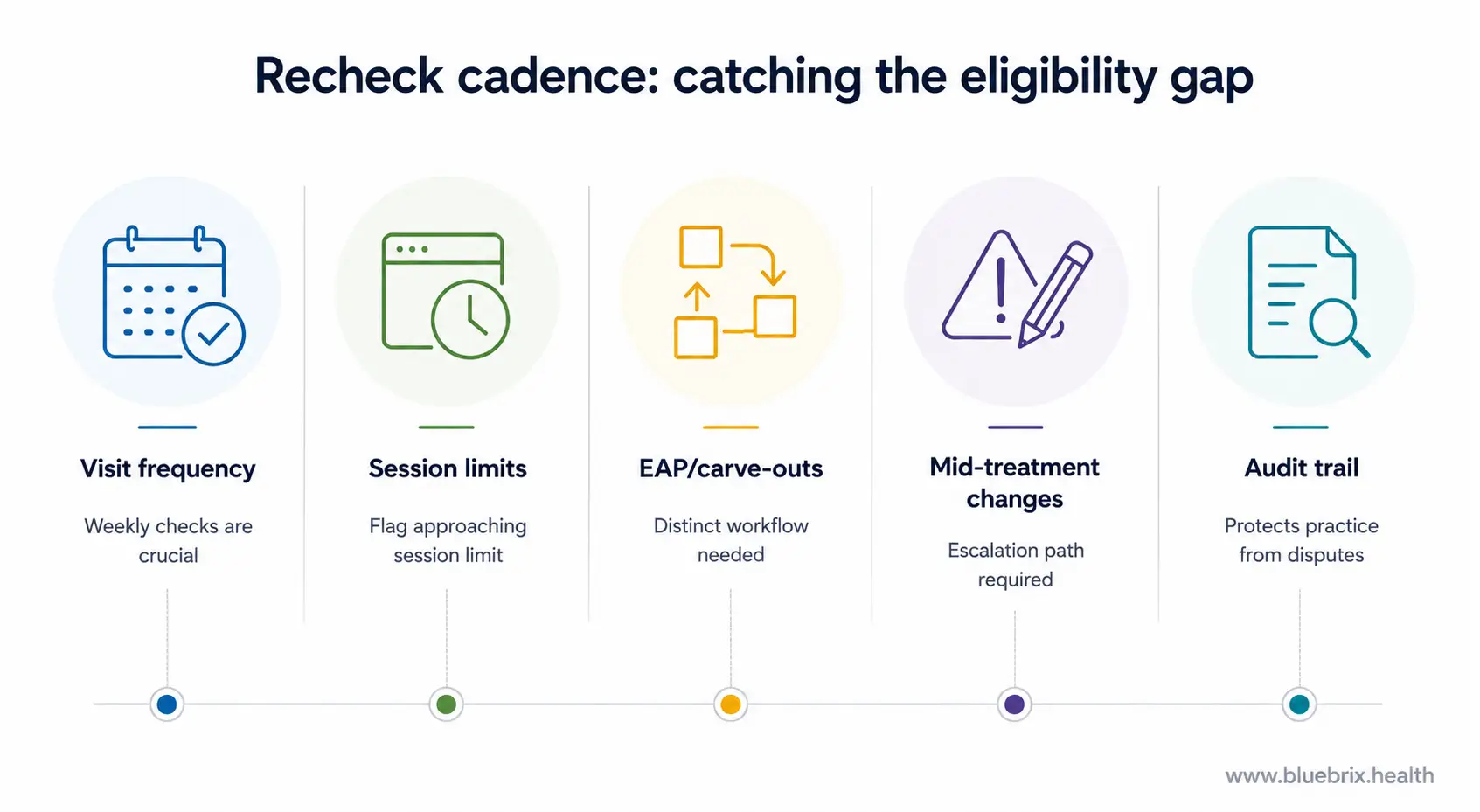
Every scheduled visit gets its own check
For weekly or more frequent care, this means the verification check runs automatically ahead of each appointment rather than on a monthly or quarterly schedule.
A specific trigger for session-limit tracking
If a payer authorizes ten sessions, the system should flag when the patient is approaching that limit, well before session eleven arrives and the claim simply comes back denied.
A distinct workflow for EAP and carve-out benefits
These typically have their own session caps and often shift the patient to a separate behavioral health benefit once exhausted. That transition needs its own alert, since a standard eligibility check may show the medical plan as active while the EAP benefit backing the current sessions has already run out.
A defined escalation path when eligibility changes mid-treatment
Someone, whether a billing specialist or a designated front desk role, needs clear ownership of what happens when a recheck flags a lapse: contacting the patient, holding the next visit for authorization, or initiating a new prior auth request before the next scheduled session.
An audit trail tied to the clinical record
Documenting that eligibility was checked, and when, protects the practice if a payer later disputes a claim on eligibility grounds, and supports the kind of documentation trail payers and auditors increasingly expect from behavioral health RCM operations.
None of this requires exotic technology, just treating eligibility verification as a recurring clinical-adjacent workflow step, the same way medication reconciliation or treatment plan updates are, rather than a one-time administrative task completed at intake and forgotten.
If your organization is currently evaluating how to build this cadence into existing scheduling and billing workflows, this is often the point where practices start comparing a standalone eligibility tool against a revenue cycle platform built to handle behavioral health’s recurring visit pattern from the ground up.
Catch coverage gaps before the claim goes out
blueBriX works with behavioral health organizations to connect real-time eligibility checks directly to scheduling triggers and billing queues, so the recheck happens automatically instead of becoming one more manual step for front desk or billing staff.
Book a demoHow blueBriX behavioral health EHR addresses real-time eligibility verification
blueBriX is a behavioral health EHR platform, with revenue cycle management built as a dedicated module within it. That RCM module is designed to also connect with the EHR or practice management system your organization is already running, for organizations that want to fix eligibility verification without switching their core system. Everything discussed above, the recheck cadence, the automatic scheduling trigger, the audit trail, maps to specific capabilities within that RCM module:
Eligibility verification fires automatically the moment a visit is scheduled
blueBriX runs the eligibility check as soon as an appointment is booked, pulling the payer response back into the same scheduling workflow your staff already use. No separate login, no manual lookup, no dependency on someone remembering to run it.
Coverage and authorization check before every visit
Verification and pre-authorization are designed to run continuously against your caseload, tied to your EHR’s own appointment data, so the check repeats automatically instead of expiring after intake.
Claims are scrubbed against payer-specific rules before they’re ever submitted
Before a claim leaves your system, blueBriX checks it against the specific rules of the payer it’s headed to, catching likely denial triggers and routing the result straight into your existing billing workflow.
Eligibility, scheduling, and billing data stay connected in one RCM layer
A flagged coverage issue surfaces inside the same system your staff already work in, not in a separate portal that someone has to check and manually relay.
A live view of insurance status across your entire caseload
Dashboards pull directly from your EHR’s appointment and claims data, surfacing coverage issues and outstanding claims before they pile up into a denial backlog.
A specialty medical practice partnering with blueBriX saw real-time, pre-visit coverage checks cut denials tied to inactive coverage, contributing to a 30 percent reduction in denial rates within 30 days and a 70 percent reduction in AR days.
What finance and revenue leaders should evaluate before choosing a solution
For the person who owns the revenue cycle, the eligibility verification decision is ultimately a cost-avoidance and cash-flow decision, and it should be evaluated with the same rigor as any other RCM investment.
A few questions worth working through with any vendor or internal build:
- What does the tool actually return, beyond active or inactive status? Ask to see a sample 271 response parsed for session limits, prior authorization flags, and EAP or carve-out identification specific to behavioral health, not a generic medical eligibility summary.
- How does the recheck cadence align with your actual visit frequency? A tool priced or designed around monthly batch checks will not solve a weekly-visit denial problem, regardless of how it is marketed.
- What is the payer connectivity footprint? Coverage gaps in payer connections mean silent blind spots. Ask specifically about your top five payers by claim volume, including any regional Medicaid managed care plans and behavioral health-specific MBHOs you work with.
- What does the reporting show your team, week over week? You want visibility into denial trends tied specifically to eligibility, not a general denial dashboard that lumps eligibility in with coding and documentation issues.
What is the actual cost avoidance case, based on your claim volume? The 2025 CAQH Index found that spending on eligibility and benefit verification transactions industry-wide rose sharply as volume and complexity increased, which underscores that this is not a shrinking cost center[5]. A credible vendor should be able to model expected write-off reduction against your current denial rate and average claim value, rather than offering only a generic industry benchmark.
The math for most behavioral health organizations tends to favor moving on this sooner rather than later. Every month spent verifying only at intake is a month of recurring-visit denials that are more expensive to fix on the back end than to prevent on the front end.
Finance can build that business case, but it only survives contact with reality if the tool actually works inside the systems your staff use every day. That’s IT’s call to make, and it comes with its own checklist.
Questions IT and integration teams should ask before signing
Finance owns the business case, but IT and integration teams own whether the tool actually functions inside the practice’s existing technology stack, and that determines whether the recheck cadence described above is realistic to operate or just a plan on paper.
- Before finalizing a vendor, integration teams should get clear answers on:
- Does the eligibility check integrate with your specific EHR or practice management system through a supported API, or does it require a separate login and manual data re-entry into the clinical record?
- Is the connection built on current interoperability standards, including FHIR-based exchange? CMS’s interoperability rule requires impacted payers to implement FHIR-based APIs by January 1, 2027. The 2025 CAQH Index found that fully electronic prior authorization adoption industrywide reached only 40 percent, up from 31 percent in the 2023 Index, meaning most of the industry still has ground to cover before that 2027 deadline.[6]
- How does the vendor handle protected health information in transit and at rest, and can they provide their current HIPAA security risk assessment posture and business associate agreement terms without hesitation?
- What happens when a payer connection goes down or a 271 response times out? Is there a fallback workflow, or does the front desk simply lose visibility until the connection is restored?
- Can the tool write results back into the scheduling system automatically, so a flagged eligibility issue blocks or flags the appointment before the patient is seen, rather than surfacing only in a separate report someone has to remember to check?
These are concrete technical concerns: a real-time eligibility tool that requires a manual workaround for every payer outage, or that cannot write results back into the scheduling workflow, will end up functioning like the intake-only process it was meant to replace, just with an extra login step.