
If you are an ops leader, a clinical workflow owner, or a CMO, there is a good chance you have arrived at a specific kind of frustration. And if you have talked to your peers lately, you already know it is not unique to your organization.
The tools are in place. The dashboards are populated. Tasks are being logged. And yet patients still fall through gaps between teams. Handoffs fail in ways that are entirely preventable. Staff are burning time chasing status updates that a system should already know.
What comes up most often in these conversations is some version of: “We have coordination. We just cannot seem to get it to hold.”
That is not a people problem. It is a systems design problem. And adding more tools to a passive coordination model does not fix it. It adds complexity to something that is already fragile.
This piece is about what the alternative actually looks like. What a modern healthcare coordination platform is built to do, how it behaves differently from what most organizations are still running, and what separates a platform that delivers real orchestration from one that is just a better-looking task board.
So, what does a system designed to actually hold look like? Here is where it starts.
The anatomy of a modern care coordination software
Not all capabilities in a coordination platform carry equal weight. Some are structural. Without them, you do not have orchestration regardless of what else the platform does. Others sharpen what a solid foundation can deliver. Worth having, but only after the non-negotiables are right. A 2025 systematic review of hospital-led care coordination interventions found that when these models fail, the root cause is almost always infrastructure gaps and unclear ownership, not clinical misjudgment[1].
One distinction before the capabilities: these are not modules. A platform that sells six separate tools under one login is a bundle, not an orchestrated system. The difference becomes visible the moment a patient’s situation changes mid-care. An orchestrated platform adapts in real time. A bundled one waits for someone to notice.
The non-negotiables
Event-driven EHR integration, not just data sync
Most platforms integrate with your EHR. The question is what that integration actually does. Read access and bi-directional data exchange are table stakes in 2026. What drives orchestration is event-driven integration — clinical events in the EHR triggering workflow actions in real time, without anyone in the middle. A discharge order fires a transition workflow. A deteriorating lab value opens an escalation path. An expired authorization surfaces before the patient reaches the discharge conversation. If the integration is a nightly sync, it is not driving coordination. It is populating a dashboard.
Accurate risk stratification with SDOH baked in
Risk stratification is the input that drives everything downstream — which pathway fires, how urgently a task escalates, who gets assigned. Get that input wrong, and the orchestration engine executes perfectly on an inaccurate picture.
A patient discharged after a CHF admission flagged as moderate risk on clinical data alone gets a standard follow-up pathway. Add in that they live alone, have no transportation, and missed both cardiac rehab sessions last admission. That is a high-risk patient who needs an intensive transition pathway, a home health referral within 48 hours, and a coordinator call on day three, not day seven.
SDOH is not a social work add-on. It is a data quality issue that sits upstream of every coordination decision the platform makes.
Real-time shared care plan visibility
One live version of the care plan, visible to everyone with a role in that patient’s care, especially when a multi-disciplinary care team is involved. The attending, the care coordinator, the case manager, the post-acute provider all working from the same updated picture at the same time.
The scale of this visibility gap is significant. A 2025 Vizient analysis of Medicare claims data found that more than 25% of hospital readmissions occur at a different hospital entirely, meaning the original care team has no visibility into what happened after the patient left. When patients return to a different hospital, those readmissions cost an average of 5% more per episode than returning to the original facility generating $21 billion in aggregate excess costs annually across the Medicare population. When the care plan stops at the facility boundary, the coordination model stops there too[2].
Without this, you are not coordinating care. You are coordinating versions of care.
Closed-loop accountability across every transition
ED to floor. Floor to discharge. Discharge to post-acute. Each of these is a point where ownership resets and gaps open. Closed-loop accountability means the platform holds the thread across every one of them. Defined owner, defined outcome, defined escalation path if it does not close. The handoff is not complete until the receiving end confirms it. That confirmation is not a courtesy. It is what closes the loop.
Real-time escalation before the window closes
A prior authorization expiring 48 hours before a scheduled discharge is not an edge case. Neither is a post-discharge check-in that has not happened by day three. These are predictable points in the care pathway where the clock matters. The platform tracks them continuously and surfaces the exception to the right person before the window closes, not after someone notices it on a worklist review.
A November 2025 systematic review and meta-analysis of 83 studies, published in JAMA Network Open, found that outpatient follow-up within 30 days of discharge was associated with a 22% reduction in 30-day readmission risk in higher-quality study populations, and a 35% reduction specifically among heart failure patients. The implication is direct: the window between discharge and first follow-up is where coordination either holds or fails[3].
Automated patient triage and adaptive care pathway logic
Not every patient needs the same level of coordination intensity. A modern platform triages patients based on their actual risk profile, not a generic admission category. A patient going home with two uncontrolled chronic conditions, no caregiver, and a transportation barrier gets triaged into a high-intensity pathway. A patient stepping down to a managed facility with full support does not. When risk stratification and SDOH data are feeding the platform accurately, triage happens automatically and the right pathway fires for the right patient without anyone having to manually make that call.
Patient engagement across the care continuum
Patient engagement is what holds the care journey together. Without it, the most well-designed coordination model still has a gap: the patient themselves. A care plan the patient does not understand, a follow-up they were not prepared for, a symptom they did not know to report. These are coordination failures that no internal workflow can catch because they happen outside the system entirely.
When engagement is built into the coordination model, patient-reported signals feed back into the workflow in real time. Risk-stratified outreach ensures the right level of follow-up reaches the right patient at the right time. And when a patient goes silent, the platform treats it as an exception, not an absence.
Unified patient view
Referral status, outstanding care gaps, authorization windows, recent clinical events, SDOH flags, pending tasks, last communication — all in one place before the coordinator opens the interaction. The time that was going to data retrieval goes to the actual work. Coordinators spending time on intervention rather than chasing data is not a minor efficiency gain. It is what the role was supposed to look like.
Continuous monitoring and adaptation
Patient needs change. Risk scores shift. A stable patient at discharge can be high-risk by day ten if the follow-up was missed, the medication was not filled, and the caregiver situation changed.
A platform that only executes the original care plan is not orchestrating care. It is following a script. Continuous monitoring means re-stratifying risk as new data comes in, flagging SDOH changes that affect the pathway, and triggering re-engagement when patient behavior signals deterioration.
This only works when everything above is connected. Event-driven EHR integration feeds the updated clinical picture. SDOH capture surfaces social changes. Shared care plan visibility means the whole team is working from the same updated reality. Closed-loop accountability ensures the new tasks that adaptation generates actually get completed.
Enhancers
Predictive analytics
Retrospective reporting tells you what happened. Predictive analytics tells you what is likely to happen next. A modern care orchestration platform should be able to identify which patients are trending toward deterioration or readmission before a clinical event confirms it, using real-time signals across clinical data, engagement patterns, and SDOH factors combined. That shifts the coordination model from responding to risk to getting ahead of it.
AI-assisted documentation and coding
Clinical documentation is one of the heaviest administrative burdens in care delivery. A modern platform should lighten that load at the point of care. As the clinician documents, AI should be surfacing suggested billing codes in real time based on what is being captured. If the documentation does not support the code being considered, the system flags the specific gap and prompts for the additional detail needed before the note is finalized. Less time on documentation. Cleaner coding. Fewer downstream denials.
Understanding what the platform is built to do is one thing. What it actually changes about how your organization runs day to day is another. Here is where that lands differently depending on where you sit.
Every capability above exists in blueBriX as a connected system, not a feature list.
blueBriX is built around every capability listed above, not as a feature set, but as an integrated architecture. If you want to see how these non-negotiables work together in a live care environment, the platform is ready to show you.
See blueBriX in actionWhat a care coordination software actually changes for operations day to day
The operational impact is not felt in quarterly reports. It is felt in how a shift runs.
Resource allocation runs on today’s picture, not yesterday’s
Beds, scan rooms, labs, OR time, therapy slots, transport — every allocation decision is only as good as the operational picture you are working from. When that picture is lagging, resources get misaligned.
A discharge that does not move on time does not just hold a bed. It backs up the ED, delays a scheduled admission, and creates a staffing mismatch by end of shift. None of that shows up as a coordination failure. It shows up as throughput variance across four different metrics.
When the coordination layer is event-driven, you are making decisions on what is actually true right now, not three hours ago.
Handoffs stop being a coordination tax
Every shift change and every transfer is currently a moment where someone manually brings the next person up to speed. In an orchestrated model the platform carries context forward automatically. The incoming team has what they need before the conversation starts. No briefing lag. No dropped thread.
Exceptions surface before they become disruptions
In a passive model, disruptions arrive without warning. In an orchestrated model they surface as visible exceptions before the window closes. The 7am huddle starts with an accurate picture of what is open, what is at risk, and what needs immediate attention. Not a reconstruction of what happened overnight.
Care teams work on care, not coordination
A significant portion of what your teams do every day is not clinical. It is figuring out what needs to happen next, who owns it, and whether the last step completed. Orchestration moves that overhead from people to the system. Your clinical team does clinical work. Your ops team manages exceptions, not status updates.
Operations feels the shift in how a shift runs. Clinical leadership feels it somewhere different — in accountability, governance, and whether the care model holds up under scrutiny.
What care orchestration means for clinical accountability and quality
Efficiency and clinical accountability are related but they are not the same conversation. Efficiency is about throughput. Accountability is about whether the right care happened for the right patient at the right time and whether you can demonstrate it did. In a value-based care environment you need both. But they require different things from a platform.
A 2025 analysis of the US healthcare system estimates that approximately 25% of total healthcare spending, around $1.4 trillion, is waste, with failure of care coordination and failure of care delivery identified as two of the primary contributing factors[4]. In a value-based environment, demonstrating that care coordination did not fail is not just a quality argument. It is a financial one.
Protocol adherence without micromanagement
The problem with protocol adherence at scale is not that your clinicians do not know the protocols. It is that there is no reliable way to know whether they are being followed consistently across teams, shifts, and settings without waiting for outcome data that arrives weeks later.
When the care pathway is built into the workflow, adherence is not a behavior you are enforcing. It is an output the system produces. At Yale New Haven Health, heart failure patients treated through an EHR-embedded pathway had 58% higher odds of receiving early diuretic therapy and more than three times the odds of being referred to comprehensive heart failure management on discharge. No mandate. No incentive. Just the right action being the easier one. Deviations surface as exceptions in real time, not as patterns in a retrospective audit[5].
Documentation as a byproduct, not a burden
HEDIS, CMS quality reporting, MIPS, ACO performance metrics — all of these require documented evidence of care process completion. In a passive model that documentation gets assembled after the fact. Incomplete, inconsistent, and expensive to produce.
In an orchestrated model every closed task, every confirmed handoff, every completed escalation path generates a record automatically. Your compliance documentation is being produced continuously as care flows through the system. The audit prep conversation becomes a much shorter one.
Value-based care readiness
The health systems best positioned for value-based care in 2026 are not the ones with the best outcome metrics in isolation. They are the ones who can show the process behind the outcomes. Which coordination steps happened, in what sequence, with what accountability at each handoff.
That standard of proof is not achievable with a passive coordination model. It requires a system that tracks ownership, completion, and escalation at every step as a natural output of how care is delivered.
The clinical and operational case is clear. The financial one is where most platform conversations ultimately land. Here is where the numbers move and why.
What an actual care orchestration does to your ROI
Under CMS’s Hospital Readmissions Reduction Program, 240 hospitals face readmission penalties of 1% or more in fiscal year 2026, the first increase in five years. With Medicare Advantage enrollees set to be included in performance calculations from 2027, the American Hospital Association estimates between 75% and 82% of hospitals will face some level of penalty[6]. The coordination model is not a clinical nice-to-have. It is directly connected to the revenue line.
The ROI is not where most people look for it. It is not in the technology cost versus savings calculation. It is in the operational capacity currently being spent on coordination overhead that produces no clinical value.
Here is where that shows up.
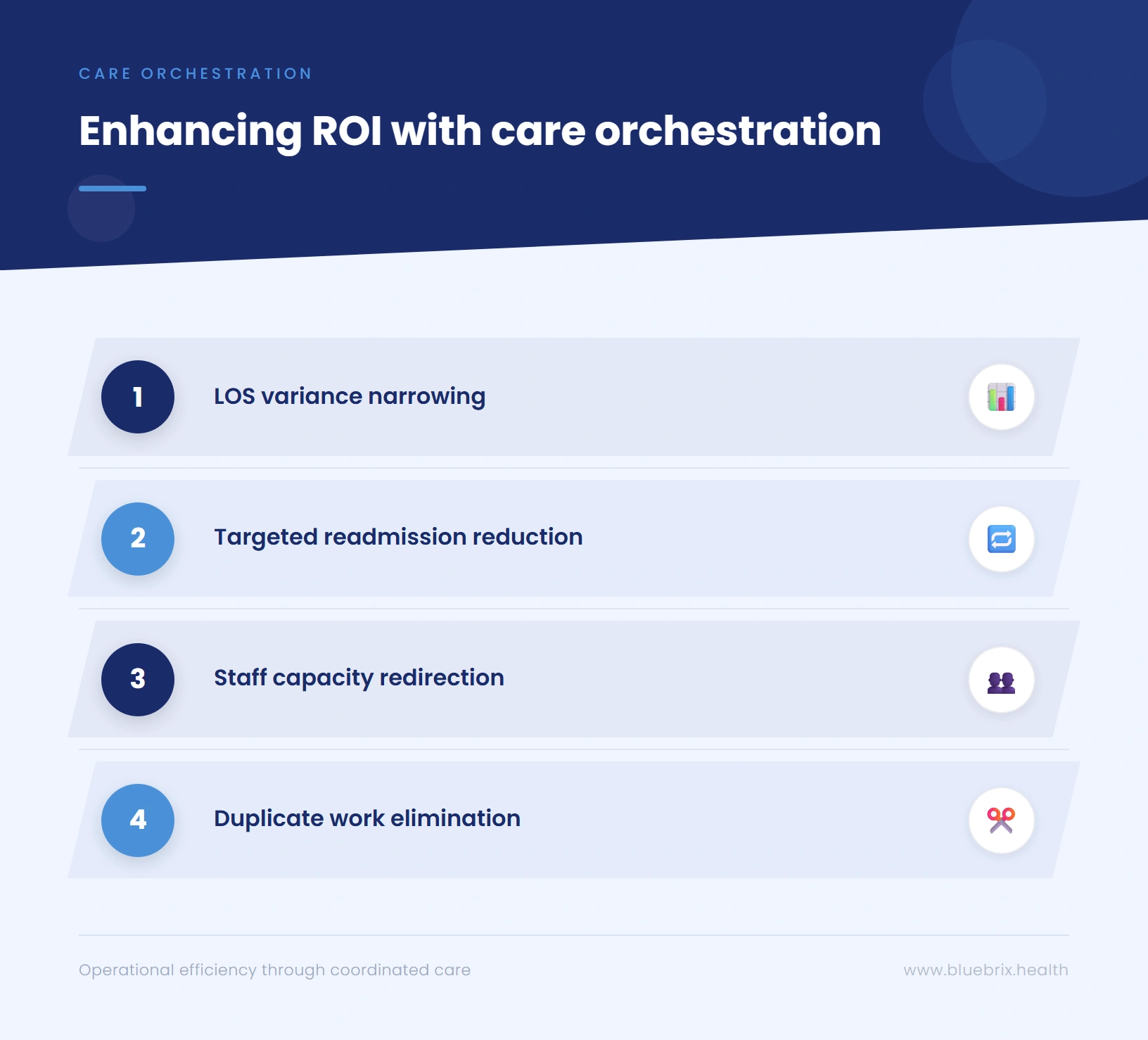
LOS variance narrows
A meaningful portion of LOS variance is not clinical. It is coordination latency sitting inside a clinical metric. Discharge decisions made at 9am that do not trigger workflows until afternoon. Authorization renewals that surface after they have already affected the plan of care.
When the coordination layer is event-driven, that latency compresses. The clinical decision and the coordination action happen on the same clock. Health systems with mature orchestration models consistently see LOS variance narrow within the first two quarters[7].
Readmission reduction becomes targeted
Most readmission programs are broad because the available data is broad. You know the rate. You rarely know which specific coordination gap in which specific part of the pathway produced it.
Step-level visibility changes that. When you can see whether your CHF readmissions are clustering around missed 72-hour follow-up calls, delayed home health starts, or incomplete medication reconciliation, you stop running broad initiatives and start fixing the specific thing that is actually broken.
Staff capacity gets redirected to clinical work
A significant portion of coordinator time currently goes to assembling the patient picture before acting on it. Checking labs. Pulling referral status. Tracking authorization windows.
A unified patient view surfaces all of that before the interaction opens. That time does not disappear. It gets redirected to the actual coordination work. At scale, across a full care coordination team, that shift is measurable in caseload capacity and care gap closure rates.
Duplicate work stops
When ownership is ambiguous, verification multiplies. The case manager follows up with the SNF. The SNF calls back to confirm what was already in the system. None of this shows up as a discrete cost. It shows up as absorbed overhead across every team member every day.
Closed-loop accountability removes the ambiguity that generates it.
The picture we have built across these sections — the architecture, the operational reality, the clinical accountability, and the financial outcomes reflect how we think about the problem ourselves. Which is why blueBriX is built the way it is.
Why blueBriX is built as a care coordination orchestration software
Every architectural decision in blueBriX traces back to the same starting point: care does not flow in a straight line, and a coordination platform that assumes it does will always leave gaps.
The platform is built around how care actually moves — across roles, settings, and payer boundaries simultaneously. A patient does not stop being a coordination responsibility when they leave the floor. A handoff does not complete because a note was written. A risk score does not stay accurate because nothing has been documented to change it.
Which is why blueBriX is built the other way around from most platforms in this space. Orchestration is not a layer we added. It is the foundation everything else sits on. Event-driven EHR integration, SDOH-informed risk stratification, real-time shared care plan visibility, closed-loop accountability across every transition, adaptive care pathways, post-discharge engagement that follows the patient past discharge. These capabilities are what the platform does today, in the cross-continuum environments where the coordination challenge is most complex and the cost of getting it wrong is highest.
The environments where blueBriX has been deployed are the ones that test a coordination platform hardest.
One of our partners, who is a leader in value-based care, manages a 350,000 patient population across five states under a value-based care model. The coordination challenge there is not just clinical. It is operational at scale — multiple states, multiple payer contracts, care teams that need to stay aligned across thousands of patient interactions every month. With blueBriX embedded in their platform, their teams spend less time on documentation and coordination overhead and more time on direct patient care. Readmissions came down. Care team alignment improved. The platform handled 4,000 virtual visits a month without the coordination layer breaking down.
Another partner, who is making a global investment in the health and well-being of children and families, took it further, thirty clinics across an international footprint, ten specialties, 450,000 patients, regulatory environments and workflows that look nothing like a standard US health system. blueBriX went live across all of it in 15 days.
The point is not the scale. It is that in both cases the coordination model held in conditions where a passive system would have fractured. That is what purpose-built orchestration infrastructure looks like in practice.
The platform is ready. The harder question is whether the organization is. That is what the final conversation is about.