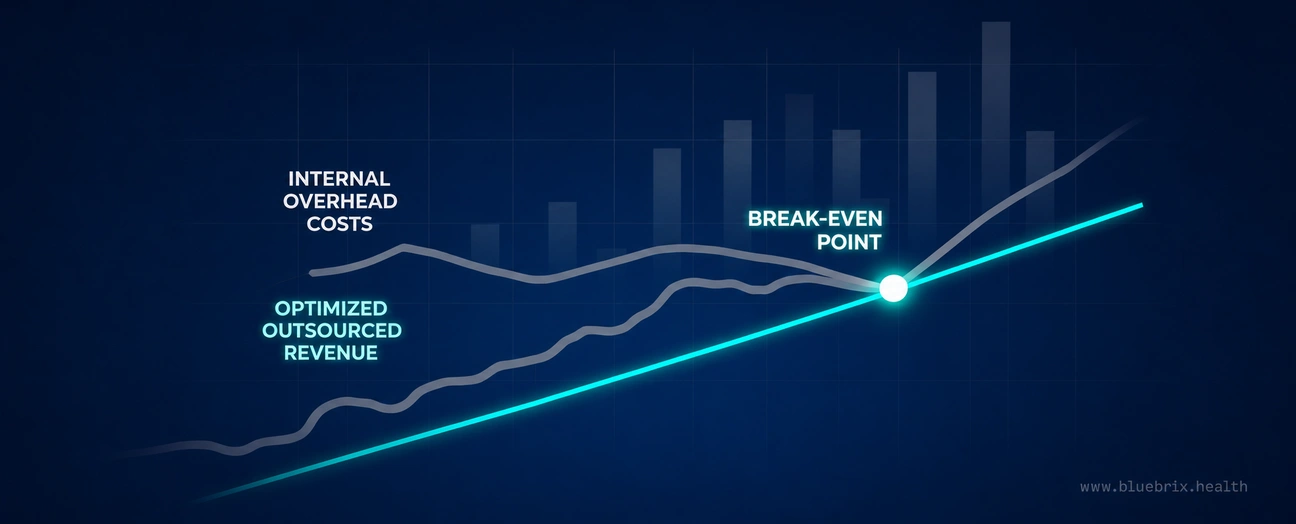

For CFOs and practice owners in behavioral health, the revenue cycle warning signs tend to look the same: revenue per visit declining, AR days climbing, a denial rate that looks manageable on paper while write-offs keep growing without a traceable root cause.
That is not a billing performance problem. That is what payer rule inconsistency looks like at the financial reporting level. Payer rule inconsistency does not produce a denial code. It produces a quiet mismatch between modifier, authorization, documentation, and filing requirements that shift by payer and plan, invisible to standard reporting until someone audits for it. The revenue is not being lost in one place. It is leaking across modifier mismatches, authorization gaps, underpaid claims that never generate a denial code, and medical necessity write-offs that age out of your AR quietly. None of it surfaces cleanly in standard reporting. All of it compounds.
This piece is for CFOs, CEOs, and practice owners who are accountable for revenue cycle performance at the organizational level and are evaluating whether their current behavioral health billing workflow is structurally capable of managing what payer complexity actually demands.
Why is behavioral health more exposed to payer rule inconsistency?
Most specialties deal with payer rule variation at the service-line level. A procedure requires prior auth with Payer A but not Payer B. One rule, one point of failure.
Behavioral health faces a higher density of payer rule variation per claim than most other specialties, driven by three structural characteristics. Medical necessity documentation must be re-established independently at every session. Unlike specialties where objective clinical measures corroborate necessity, behavioral health relies on clinician-documented symptom severity and functional impairment, criteria that payers have historically applied more aggressive utilization review standards to than comparable physical health services. Prior authorization in behavioral health is applied at a frequency and with a subjectivity of criteria that MHPAEA enforcement data indicates is disproportionate to how comparable physical health services are treated. And behavioral health’s disproportionately high telehealth volume means modifier and place-of-service variation, which exists across all specialties, carries greater financial exposure here than in practices where telehealth represents a small share of visits.
In 2026, the adjudication engines enforcing these rules have become significantly more automated, compressing the margin for configuration error across all three dimensions simultaneously. UnitedHealthcare began enforcing ICD-10 Excludes 1 rules across all outpatient and professional claims as of March 2026, a shift with disproportionate impact on behavioral health practices, where comorbidity diagnosis combinations are the clinical norm [1]. Longstanding NPI and taxonomy code alignment requirements, which previously reached human reviewers who might process them anyway, are now enforced via automated adjudication. A configuration mismatch that would once have been caught downstream now produces a silent rejection before the claim is ever seen.
The regulatory environment has compounded this further. Federal enforcement of the 2024 MHPAEA final rule was walked back by the Departments of Labor, HHS, and Treasury in May 2025, shifting parity enforcement authority to individual states[2]. Georgia issued $25 million in fines to 11 insurers over mental health parity violations in 2025 [3]. Washington fined Premera Blue Cross and Regence BlueShield $550,000 each [4]. As state-level enforcement diverges, payer documentation and utilization review thresholds are becoming more variable by geography. A practice billing across multiple states is now managing payer rules that diverge at the state level on top of all existing payer-to-payer variation.
The practices underperforming on first-pass resolution rate are largely not making skill errors. They are operating workflows that cannot keep pace with payer rule change velocity.
Where specifically the revenue is going: four categories, each with a different fix
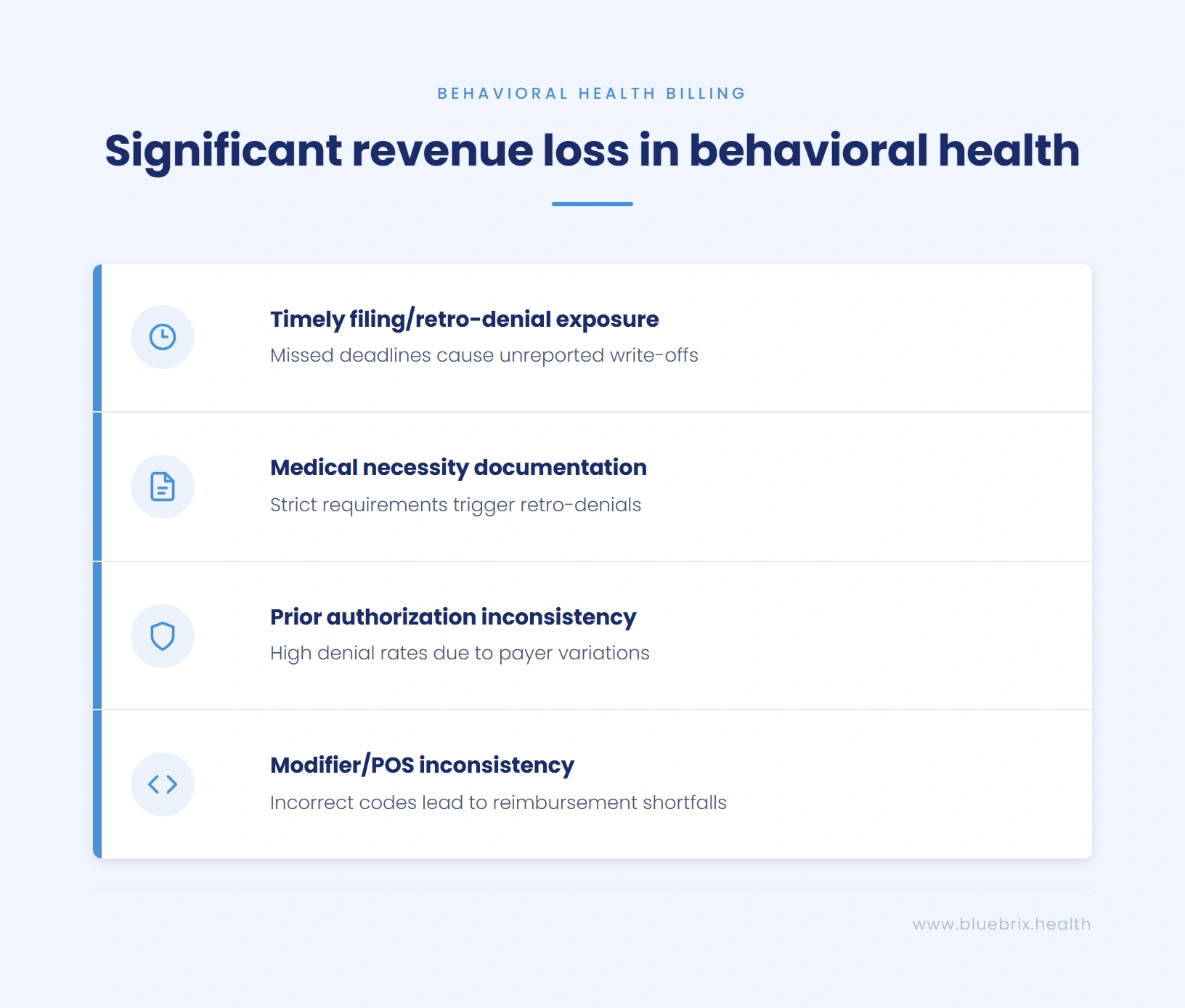
Not all payer divergence carries the same financial weight or the same remediation path. Understanding which category is driving your denial volume is the precondition for fixing it. These four account for the majority of preventable revenue leakage in behavioral health billing.
Modifier and place-of-service inconsistency
Telehealth place-of-service codes have varied by payer since CMS introduced POS 10 in January 2022 to distinguish patient-at-home sessions from clinical-site sessions [5]. Commercial payers adopted the code at different speeds and under different requirements, a divergence that remains unresolved in 2026. Modifier requirements for synchronous video services carry the same problem: Modifier 95 is standard across most commercial payers, but GT persists for certain Medicare Advantage plans and state Medicaid programs. Audio-only services add a third layer, where Modifier 93 is required under Medicare but handled differently across commercial contracts.
The financial exposure runs in both directions. Outright denials from modifier and POS mismatches are the visible problem. The less visible one is reimbursement shortfall. CMS distinguishes POS 10 from POS 02 precisely because each triggers a different fee schedule rate. POS 10, patient at home, pays at the non-facility rate. POS 02, patient at a clinical site, pays at the facility rate. For CPT 90837, the 2026 CMS Physician Fee Schedule sets the national non-facility rate at $167.00 [6]. The facility rate for the same code is lower. A system-wide default to the wrong POS setting does not generate a denial code. It pays at the wrong rate, silently, on every affected claim until someone audits the remittance variance at the contract level.
At the financial reporting level, this does not appear as a denial. It appears as revenue per visit running below contracted rate, indistinguishable from a negotiated rate variance without a deliberate remittance audit.
Prior authorization trigger inconsistency
Prior authorization requirements for higher-intensity behavioral health services, including intensive outpatient programs, partial hospitalization, and TMS, vary significantly by payer. What one payer requires authorization for, another treats as a standard covered service. What one plan requires ASAM-level documentation for, another approves with a routine clinical note. The administrative scale of this is significant: an AMA survey of 1,000 physicians in late 2024 found practices complete an average of 39 prior authorization requests per physician per week.
The revenue loss is not primarily in the denial itself. Among denied prior authorizations that are appealed in Medicare Advantage for accuracy, 81.7 percent are fully or partially overturned The problem is that only 11.7 percent of denied prior authorizations are ever appealed[7]. The gap between what is overturnable and what is actually overturned flows directly to permanent write-offs, session after session. For leadership reviewing write-off volume, this is not a coverage problem. It is a follow-through problem with a quantifiable dollar value that most practices are absorbing as a fixed cost of doing business rather than treating as recoverable revenue.
Medical necessity documentation thresholds
Unlike any other major specialty, behavioral health requires independent medical necessity justification for every session. Payers have escalated utilization review intensity in 2026, with AI-driven adjudication engines cross-referencing progress note language against measurable symptom severity, functional impairment data, and documented progress toward treatment goals. A single note that does not meet a payer’s current standard can trigger a retro-denial across an entire treatment episode, not just one session.
Across all provider types, the average dollar amount of denials tied to medical necessity rose 70 percent year over year in 2025 [8], a trend behavioral health practices face with compounded intensity given per-session documentation requirements. Medical necessity denials require the most labor-intensive remediation of any denial category, involving clinical documentation revision rather than a coding correction. That operational burden makes them the most frequently abandoned denial type in behavioral health, with the majority of affected claims never reaching resubmission. The compounded organizational cost includes lost claim revenue, clinical staff time diverted to documentation remediation, and write-off volume that does not surface as a discrete line item in financial reporting.
Timely filing and retro-denial exposure
Filing windows range from 90 days to 365 days depending on the payer and plan type. Medicare Advantage plans frequently carry shorter windows than original Medicare, and individual plan riders can narrow them further without direct notification to providers. When rework queues are managed by claim age or dollar amount rather than denial category, retro-denial write-offs from missed filing deadlines are routinely miscategorized or excluded from denial reason code reporting entirely, making them a blind spot that only surfaces during deliberate write-off audits.
For a CFO or COO, that miscategorization is a financial controls gap. The reported write-off figure understates actual write-off volume, which means the true revenue recovery opportunity is larger than what standard denial reporting shows.
Finance leader benchmark: The revenue exposure from payer rule inconsistency does not appear in a single line of your financial reporting. Outright denials show up in your denial rate. Reimbursement shortfalls from incorrect POS defaults do not generate a denial code at all. Write-offs from missed timely filing windows are frequently miscategorized. And abandoned medical necessity denials simply age out of your AR without a traceable cause. For a practice billing 200 to 250 sessions per week, each of these categories represents a separate, compounding revenue leak. The total exposure is almost always larger than what standard denial reporting shows, because standard denial reporting only captures what was formally rejected, not what was underpaid or quietly written off.
Payer rules are changing faster than most billing workflows can keep up.
blueBriX is purpose-built to handle every payer’s requirements at the contract level, so your revenue cycle does not break every time a rule changes quietly.Your payer rules are managed. Your revenue is protected.Let us walk you through what a purpose-built behavioral health billing workflow looks like in practice.
Schedule a demoBuilding a payer-resilient behavioral health billing workflow requires architecture
The instinctive response to the four failure categories above is more training, better payer portal checks, and updated reference guides. That does not scale because payer rules change faster than institutional knowledge can absorb them, and staff turnover resets whatever knowledge was built each time it happens.
A behavioral health billing workflow that survives payer rule changes without constant rework requires three structural layers working in sequence.
Payer rule mapping at the contract level
Each active payer contract needs a corresponding rule profile that lives inside the billing system as a configurable parameter set, not in a shared document folder or in a single biller’s memory. When a payer updates a modifier requirement or narrows a timely filing window, the update changes one profile rather than requiring a training session or a policy memo.
Pre-submission claim scrubbing at the contract level
Major clearinghouses maintain payer-specific edit libraries that catch format errors and code-level issues published in payer companion guides. What they cannot catch is the deeper layer of contract-level logic: modifier combinations that vary by individual contract rather than companion guide, prior authorization requirements that differ by plan type within a single payer, or documentation gaps that trigger medical necessity denials. The scrubbing that prevents those failures has to be built at the contract level, not at the clearinghouse’s published-criteria level.
Denial root-cause routing
When a denial comes back, a modifier mismatch and a medical necessity documentation gap require completely different people, different processes, and different timelines to resolve. Routing both to a single generic rework queue assigns them to the wrong remediation, misses the pattern when the same failure repeats across dozens of claims, and makes it impossible to measure whether process changes are actually working.
How blueBriX builds a behavioral health billing workflow for payer inconsistency
For a CFO or practice owner evaluating RCM infrastructure, the question is not whether payer rule inconsistency is a problem. The data in this piece makes that case. The question is whether to continue absorbing the cost of an under-built system or to treat the infrastructure gap as what it is: a capital decision with a measurable return.
blueBriX addresses the four failure categories covered in this piece through integrated operational components rather than separate tools.
Payer-specific rule profiles at the contract level
Each active payer contract has a corresponding rule profile maintained within the platform, covering modifier requirements, prior authorization triggers, timely filing windows, and documentation standards. When a payer updates a rule, one profile changes rather than requiring a training intervention across your billing team.
Contract-level claim scrubbing
Beyond standard clearinghouse edits, blueBriX applies a scrubbing layer against the actual rule set for each payer contract before submission, catching modifier combinations, plan-type-specific authorization requirements, and place-of-service configurations that companion-guide-level checks cannot reach.
Auth gap alerts at the scheduling layer
Authorization requirements are validated before sessions are delivered, not after claims are submitted. Gap alerts trigger at scheduling, eliminating the authorization exposure that produces denied sessions and forces retroactive auth requests.
Recurrence pattern tracking
Every denial is automatically categorized on arrival, routed to the right remediation path, and tracked so recurring failures by payer are visible and fixable at the system level rather than managed claim by claim
The financial case for purpose-built RCM infrastructure is not about individual denied claims. It is about the compounding effect of four separate revenue leakage categories that standard financial reporting cannot see, cannot trace, and therefore cannot recover. Practices that close this gap do not do it by working harder on denials. They do it by removing the architectural conditions that produce them. That is what blueBriX is built to do.
Every week you wait, another batch of claims gets adjudicated against rules nobody flagged.
blueBriX keeps every payer contract’s modifier logic, auth triggers, and filing windows current at the system level, so your billers aren’t relying on memory or a shared spreadsheet to catch what changed.Your claims go out clean. Your revenue stays yours.See how blueBriX would handle your specific payer mix.!
Schedule your demo