
Executive summary
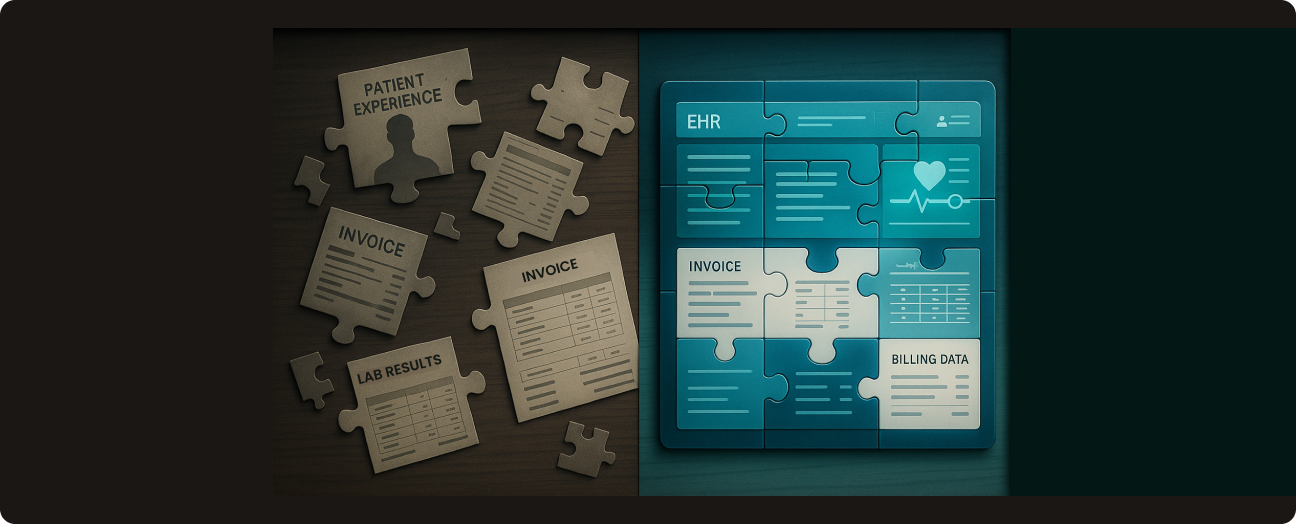
Every major EHR vendor now has an AI story, and most share the same architectural flaw: the intelligence is inseparable from the platform, which means the moment a better model emerges, you cannot use it without renegotiating your entire infrastructure. At blueBriX, we built in the opposite direction, a vendor-agnostic AI orchestration layer that sits above the EHR, connected through the Model Context Protocol, composable by design. The result is what we call the faceless EHR: a system of action that does everything it always has, but one the clinician never has to consciously navigate, because the AI already has.
At blueBriX, we have spent considerable engineering effort building toward a single thesis: the EHR should be a silent infrastructure layer, not a user interface. By integrating our AI Orchestration Platform with the Model Context Protocol (MCP), we have begun decoupling the data layer from the clinical workflow in a way that makes the system of record invisible to the provider and indispensable to the AI.
This article is a technical deep-dive into how we did it, why traditional REST-based integrations are architecturally insufficient for generative AI use cases in healthcare, and what the next generation of clinical intelligence looks like for health systems that are willing to rethink their infrastructure from first principles.
Why is the EHR interface the biggest barrier to clinical efficiency?
There is a cruel irony at the center of modern clinical care. We live in the most data-rich moment in the history of medicine. The average patient record contains structured labs, unstructured clinical notes, imaging results, medication histories, social determinants of health, billing codes, and longitudinal care plans—all digitized, all theoretically accessible.
And yet, the physician is spending more time looking at a screen than at the patient.
As per the AMA’s 2024 national physician survey (nearly 18,000 responses across 43 states), 1/3rd of the physicians are spending more than 8 hours on EHR-based documentation and order entry alone.[1] Care coordinators in value-based care programs tell us they lose 40 to 60 percent of their time to administrative workflows that a well-designed AI could handle in milliseconds. This is not a minor inefficiency. It is a structural failure of how we have designed the interface between human caregivers and medical data.
The EHR, which was architected to be the system of record, has become the system of friction.
What is a faceless EHR?
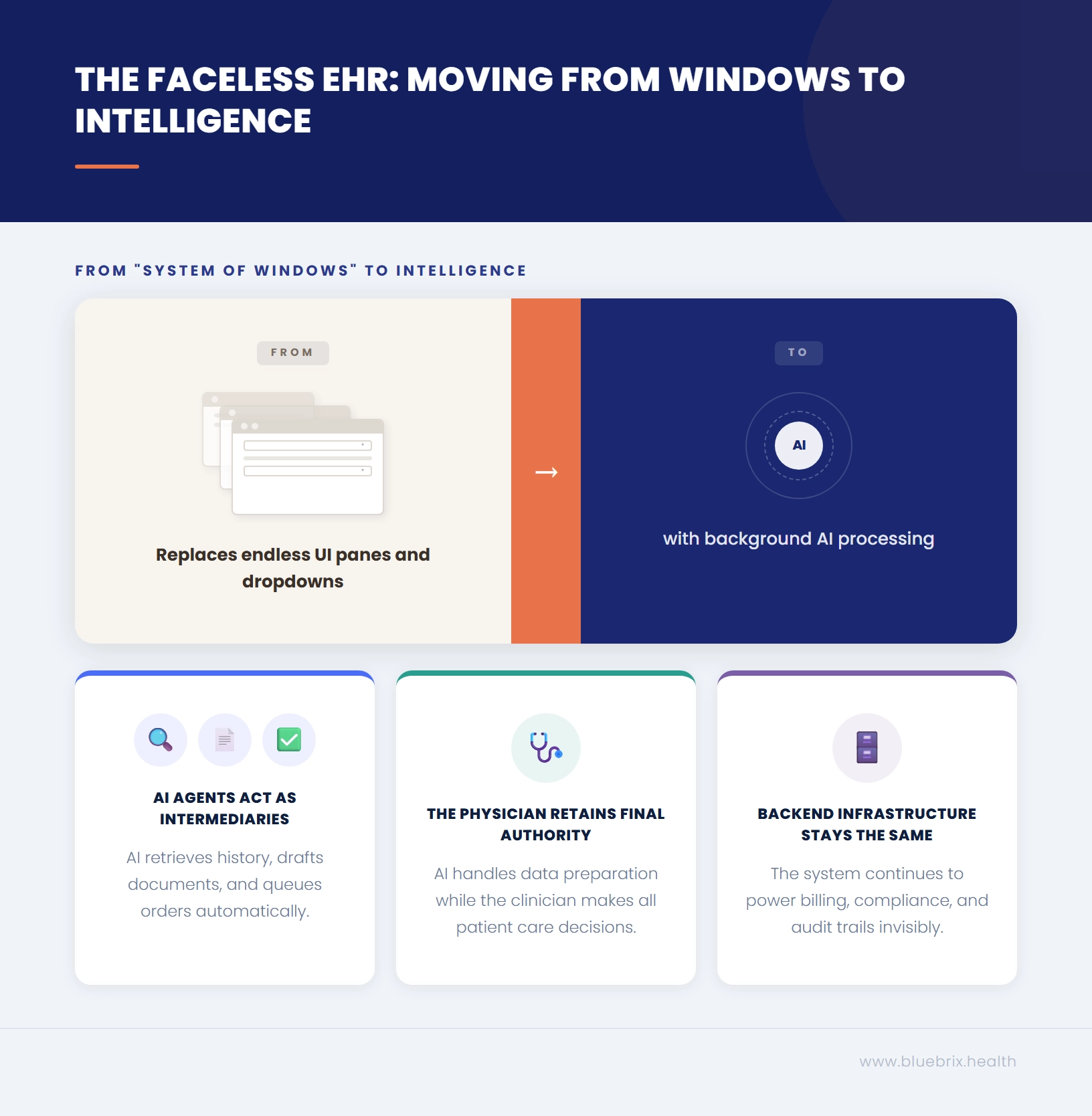
A faceless EHR is an architecture in which the electronic health record continues to store data, enforce compliance, and power billing, but does so without requiring the clinician to operate its interface directly. AI agents sit between the provider and the data, handling retrieval, documentation, and order preparation — while the physician retains full authority over every clinical decision. This represents a shift from a “system of windows” — an endless succession of UI panes and form fields — to a “system of intelligence.” The distinction matters: this is not autonomous AI acting on clinical decisions. The EHR becomes invisible in the workflow — the clinician does not.
How does blueBriX make the EHR a silent partner?
When we began designing the blueBriX AI orchestration platform, we asked a foundational question: what would it take to build an EHR that a clinician could use entirely through conversation? Not through a voice-to-text transcription layer bolted onto an existing UI, but through a genuinely conversational interface backed by a real-time, bidirectional data connection to the full clinical record.
The answer required us to rethink the architecture almost entirely. It required us to move beyond proprietary API integrations, beyond simple REST endpoints, and toward a standardized protocol for giving AI models structured access to live clinical data. It required the Model Context Protocol.[2]
How does blueBriX integrate EHR with AI orchestration?
Before explaining what MCP does in our stack, it is worth mapping the full infrastructure it sits inside.
The blueBriX technical stack
The blueBriX platform is a full-stack healthcare infrastructure comprising four tightly integrated layers:
- The data layer: A FHIR-native, HL7-compatible, API-first unified longitudinal patient record. This is the system of record—the headless backend that stores the full clinical history of every patient.
- The workflow & execution layer: The EHR, RCM, care coordination, and patient engagement modules that carry out clinically validated decisions across the care continuum.
- The governance & trust layer: The blueBriX trust engine, which validates every AI-generated suggestion against VBC contract terms, payer rules, HEDIS measure specs, and CMS compliance requirements before execution.
- The agent layer: Pre-validated partner agents and native blueBriX agents—covering risk adjustment, care gap closure, ambient documentation, denial management, and chronic care management—that plug into the governed API layer.
The AI orchestration platform sits across all four layers, managing the handshake between the LLM and the medical data. And the protocol that enables that handshake, at a fundamental level, is MCP.
Why do traditional REST APIs fail generative AI in healthcare?
Before explaining what MCP does, it is worth being precise about why the alternative fails.
Traditional EHR integrations are built on REST APIs: synchronous HTTP calls that return structured JSON payloads in response to specific queries. REST works well for deterministic, bounded requests. “Give me the last three HbA1c values for patient ID 4821.” The request is specific, the schema is known, the response is predictable.
Generative AI does not work this way. An LLM reasoning through a live clinical encounter does not know in advance which data it will need. It discovers context requirements dynamically as it processes the conversation. It may begin by needing the medication list, then pivot to wanting the last hospitalization record, then require the patient’s insurance formulary before it can complete a prescribing recommendation. The context window of a modern LLM is not a fixed query—it is an evolving, multi-turn reasoning process.
This creates three structural problems for REST-based EHR integrations:
Latency accumulation
Each discrete REST call adds network round-trip latency — typically 200ms to 800ms per call in a well-optimized healthcare API environment, and significantly higher when traversing legacy EHR middleware or HL7 translation layers. A single clinical reasoning chain for a live encounter may require 15 to 30 discrete data fetches. At a conservative average of 300ms per call, that is 4.5 to 9 seconds of sequential latency before the LLM has sufficient context to begin reasoning. MCP’s persistent connection and context-batching model reduces this to a single parallelized retrieval handshake.
Context fragmentation
REST returns data in rigid, pre-defined schemas. LLMs need narrative, relational context—not just values but the clinical meaning surrounding them. A haemoglobin result without the trend, the diagnosis context, and the current medications is clinically incomplete.
Proprietary friction
Every EHR vendor exposes a different API surface, with different authentication protocols, different data models, and different rate limits. Building and maintaining direct integrations for each is prohibitively expensive and inherently brittle.
What is the model context protocol (MCP) and why does it matter for healthcare?
The Model Context Protocol is an open standard, originally developed by Anthropic, that defines how AI models communicate with external data sources and tools. Think of it as giving an AI model a standardized “browser” for structured data, a universal interface through which the LLM can discover available data resources, request specific context, and execute actions against external systems, all through a consistent protocol that any MCP-compliant server can speak.
In practical terms, MCP works by defining a standard server interface that data sources implement once — and that any AI model capable of speaking MCP can immediately use. Instead of requiring a custom API integration for every EHR vendor, the AI needs to know only one protocol. For healthcare organizations evaluating AI infrastructure, MCP eliminates the proprietary friction that has historically made multi-vendor AI strategies prohibitively expensive.
For healthcare, this is transformative. It means an LLM reasoning through a clinical encounter can dynamically discover and query the patient’s medication history, recent labs, active diagnoses, care plan status, and outstanding quality gaps—all through a single, consistent, secured protocol layer, without proprietary API credentials for each data domain.
How does blueBriX connect AI to the clinical record
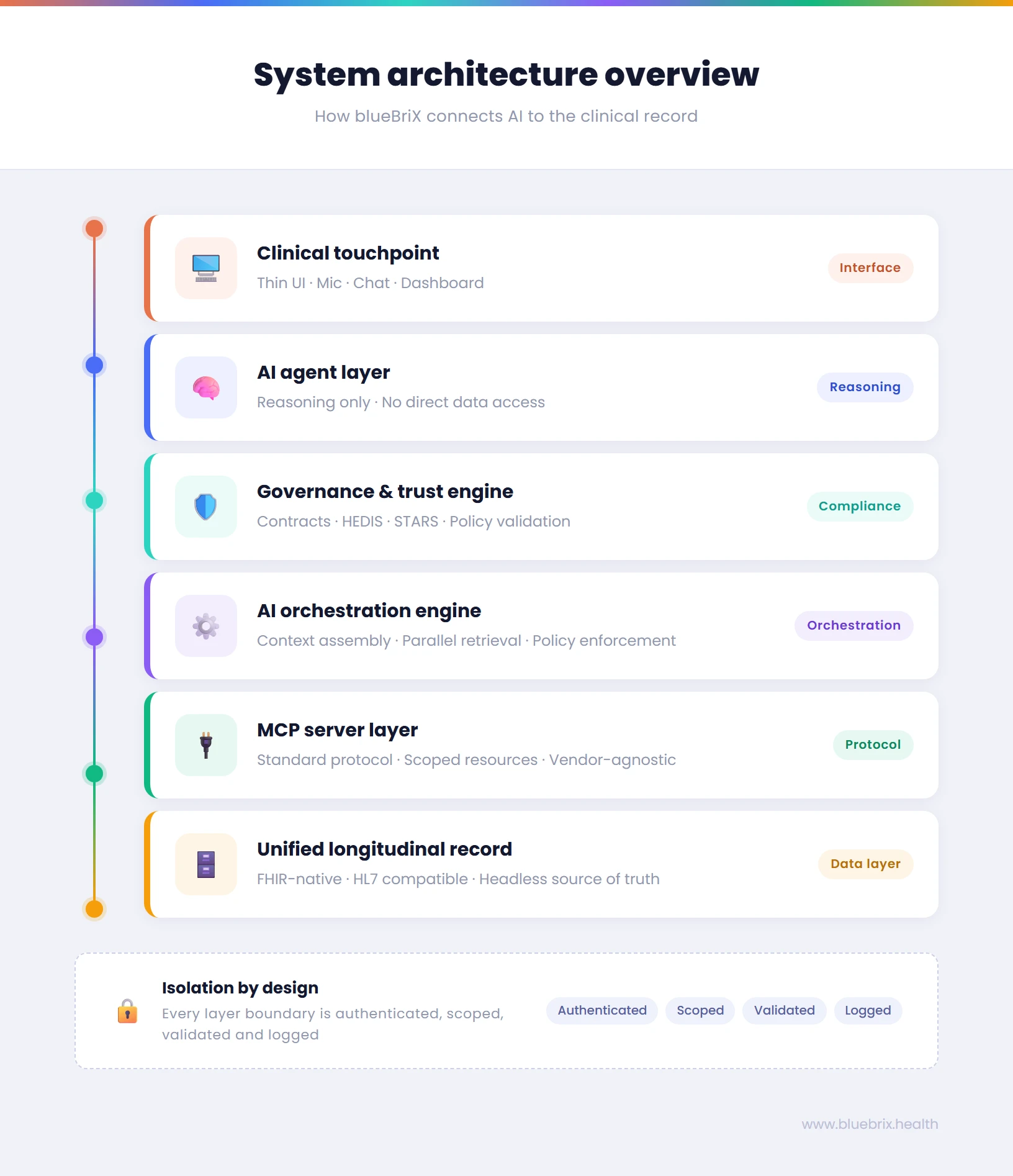
The following is a precise description of how the blueBriX MCP-based architecture is structured from the data layer at the foundation to the clinical touchpoint at the surface. Each layer has a single, clearly bounded responsibility. No layer bypasses the one below it.
Layer 1 — unified longitudinal data layer: the headless source of truth
At the foundation sits a FHIR-native, HL7-compatible, API-first unified longitudinal patient record. This is the system of record, the headless backend that stores the complete clinical, financial, and care coordination history of every patient. Critically, this layer is never accessed directly by any AI model. All queries to the data layer flow exclusively through the MCP server layer above it, ensuring that access is always authenticated, scoped, and logged before any data moves.
Layer 2 — MCP server layer: the standardized protocol interface
Sitting directly above the data layer are purpose-built MCP servers, secure, authenticated microservices that expose specific EHR data domains as MCP-compliant resources. Each server covers a defined clinical domain: labs, medications, active diagnoses, care plan status, quality gaps, and more. These servers speak a single, standardized protocol that any MCP-capable AI model can query without proprietary API credentials or custom integration code. This is the layer that makes the architecture vendor-agnostic: the data does not care which model is asking, only that the request is authenticated and within scope.
Layer 3 — blueBriX AI orchestration engine: managing the AI-to-data handshake
The orchestration engine is the operational core of the platform. It manages the multi-turn conversation between the LLM and the MCP servers — routing queries, aggregating context across data domains, enforcing data access policies, and assembling the full patient context window that the AI model needs to reason effectively. This layer is what prevents the latency accumulation problem inherent in sequential REST calls: rather than allowing the AI to issue individual queries one at a time, the orchestration engine batches and parallelizes retrieval across MCP servers, delivering assembled context in a single handshake.
Layer 4 — governance and trust layer: contract-aware validation before every action
No AI-suggested action reaches the EHR without passing through the blueBriX trust engine. This layer encodes the organization’s specific VBC contract terms, payer-specific rules, HEDIS[3] and STARS[4] measure specifications, and CMS compliance requirements[5] — and validates every agent output against them before execution is permitted. This applies equally to native blueBriX agents, third-party partner agents, and any model an organization brings through the BYOA layer. The contract is always the authority; the AI is always the proposer.
Layer 5 — AI agent layer: intelligence without direct data access
The AI agent layer is where the LLM — native or third-party — reasons over the assembled context to generate clinical outputs: documentation drafts, anomaly flags, order suggestions, coding recommendations, and care gap alerts. The defining architectural constraint of this layer is that it has no direct access to the data store at Layer 1. The AI knows only what the orchestration engine has assembled and the governance layer has permitted. This isolation is not a limitation — it is the compliance architecture.
Layer 6 — clinical touchpoint layer: the thin interface the clinician sees
At the surface sits the clinical touchpoint — an ambient microphone, a conversational UI, or a care coordinator dashboard. This is the only layer the clinician interacts with directly, and by design it is thin: no navigation, no form fields, no chart-switching. The intelligence that powers it lives entirely in the layers below. The clinician sees a surface that is simple precisely because the architecture beneath it is not.
The governing principle: isolation by design
The architecture is intentionally structured so that each layer can only communicate with the layer immediately adjacent to it. The AI agent at Layer 5 never reaches past the orchestration engine to query raw data. The clinical touchpoint at Layer 6 never bypasses the governance layer to execute an action. Every data access event is authenticated at the protocol layer, validated at the governance layer, and logged at both. This is what makes MCP-based EHR integration both clinically viable and HIPAA-defensible at scale.
See this architecture in action
If your organization is evaluating AI-native EHR infrastructure, we can walk you through the six-layer stack with your current environment as the reference point. Schedule an architecture walkthrough →
Schedule a demoHow do AI agents read, reason, and write back to the EHR through MCP?
How does contextual retrieval work during a live encounter?
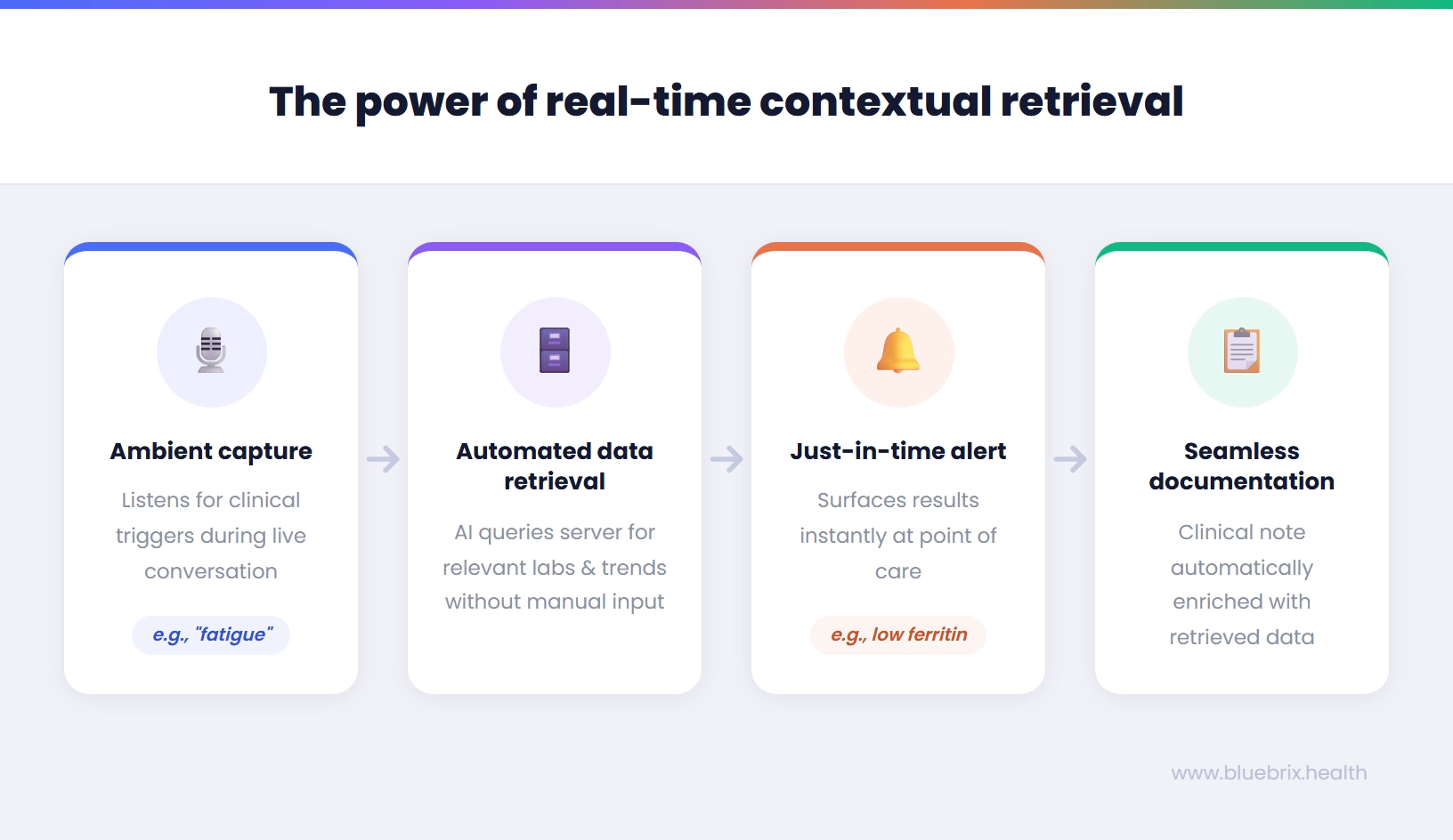
Consider a behavioral health provider mid-way through a 45-minute therapy session. The patient mentions a new physical symptom—unexpected fatigue. In a traditional EHR workflow, the clinician would need to pause, switch to the medical record view, navigate to labs, search for relevant results, and then return to the clinical conversation. That break in attention is clinically costly and relationally disruptive.
In the blueBriX faceless EHR architecture, this is what happens instead:
- The ambient microphone captures the mention of fatigue.
- The AI agent, monitoring the conversation in real time, identifies a potential clinical flag.
- The orchestration engine issues an MCP query to the labs data server: retrieve CBC, thyroid panel, and iron studies from the last 90 days.
- The MCP server authenticates the request against the provider’s access scope, retrieves the relevant results, and returns them with clinical context—trend direction, reference ranges, and co-occurring diagnoses.
- The AI assembles this into its active context window and surfaces a non-intrusive alert to the provider: “Recent labs show low ferritin. May be relevant to reported fatigue.”
- The provider acknowledges, and the clinical note is automatically enriched with the relevant lab reference—no tab-switching, no manual documentation.
This is what we call contextual retrieval — the ability for AI agents to surface relevant clinical data in real time during an encounter, driven by the AI’s interpretation of the conversation rather than a predetermined query schedule. When a patient mentions a new symptom, the AI retrieves relevant labs, medication history, and diagnosis context automatically, without the clinician leaving the conversation to search the chart.
How does the order queue write-back work?
Contextual retrieval is impressive. What is architecturally more significant—and clinically more impactful—is the write-back capability.
Traditional read-only AI integrations are, ultimately, advisory systems. They can suggest, but they cannot act. The blueBriX architecture, through MCP, enables bidirectional data flow: AI agents can not only read from the EHR but propose structured writes back to it, subject to physician approval.
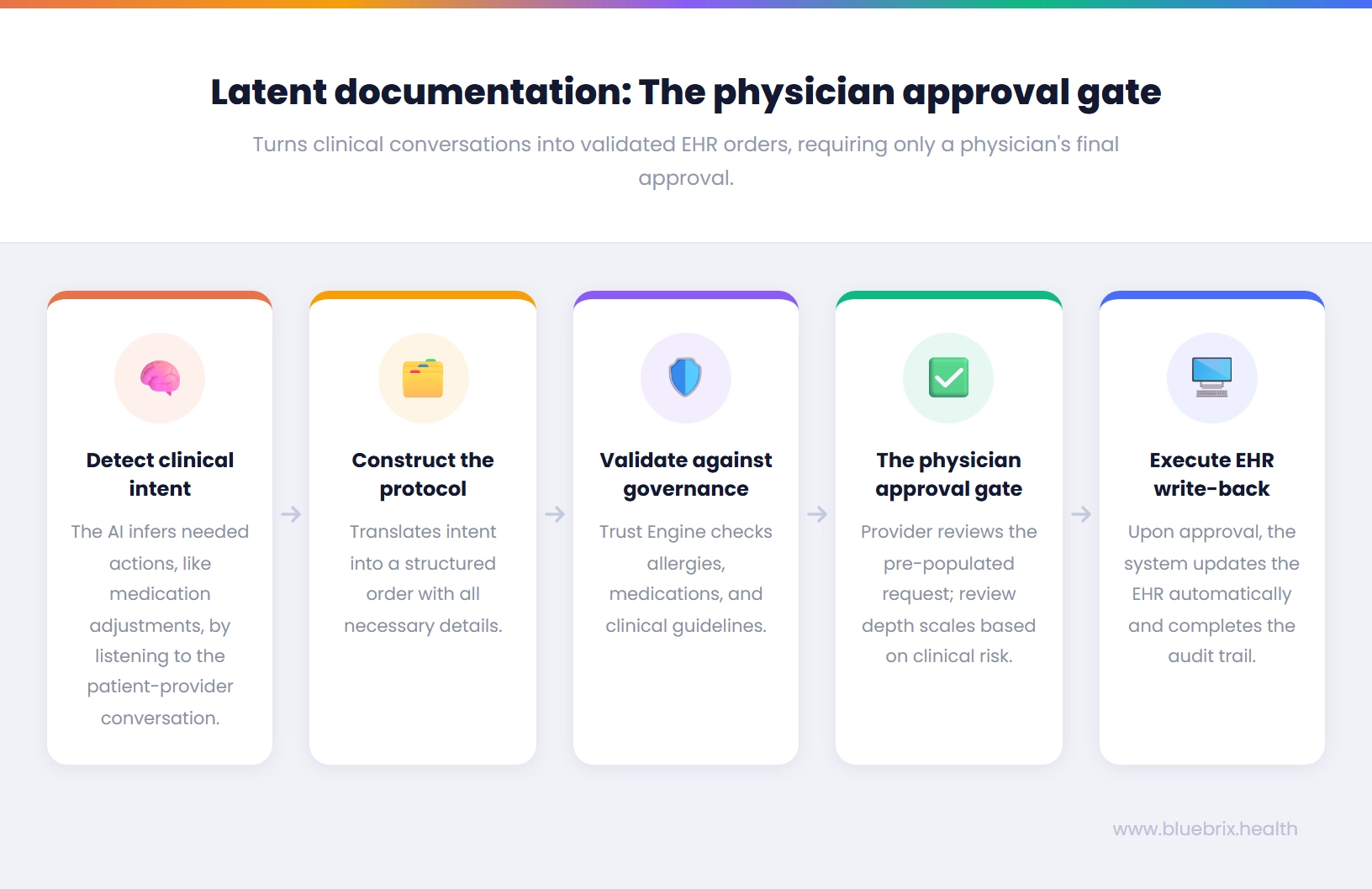
Here is how the order queue write-back flow works in practice:
- Step 1 — intent detection: The AI agent, reasoning over the clinical conversation, infers a likely clinical action. For example, the patient describes worsening anxiety and the provider mentions considering an SSRI adjustment.
- Step 2 — protocol construction: The orchestration engine translates this clinical intent into a structured MCP write request: a pending medication order for the proposed SSRI adjustment, with dosage, formulary compatibility, and known interactions pre-populated.
- Step 3 — governance validation: Before any write reaches the EHR, the blueBriX trust engine validates the proposed order against the patient’s active medication list, known allergies, insurance formulary, and applicable clinical guidelines.
- Step 4 — physician approval gate: The validated order is surfaced to the provider as a structured approval request — the complexity of which is proportional to the clinical stakes of the action. A low-risk documentation update may require a single confirmation. A new medication order requires explicit review of the pre-populated dosage, formulary check, and interaction flags before sign-off. A controlled substance prescription or a care escalation triggers a full attestation workflow. The principle is consistent across all tiers: the AI prepares and validates; the physician decides. What changes is the depth of review the system requires before execution — calibrated to risk, not to convenience.
- Step 5 — write execution: Upon approval, the MCP server executes the write to the EHR. The order is placed, the note is updated, and the audit trail is complete. All in the time it would have taken the provider to navigate to the prescribing module manually.
This is what we call latent documentation: clinical data entry that happens in the background of the patient-provider conversation, assembled and validated by AI, requiring only the physician’s final approval rather than their full administrative attention. In practice, latent documentation means the AI continuously drafts notes, suggests codes, and queues orders as the encounter unfolds — the clinician reviews and commits rather than creates from scratch.
How does blueBriX maintain HIPAA compliance in an MCP environment?
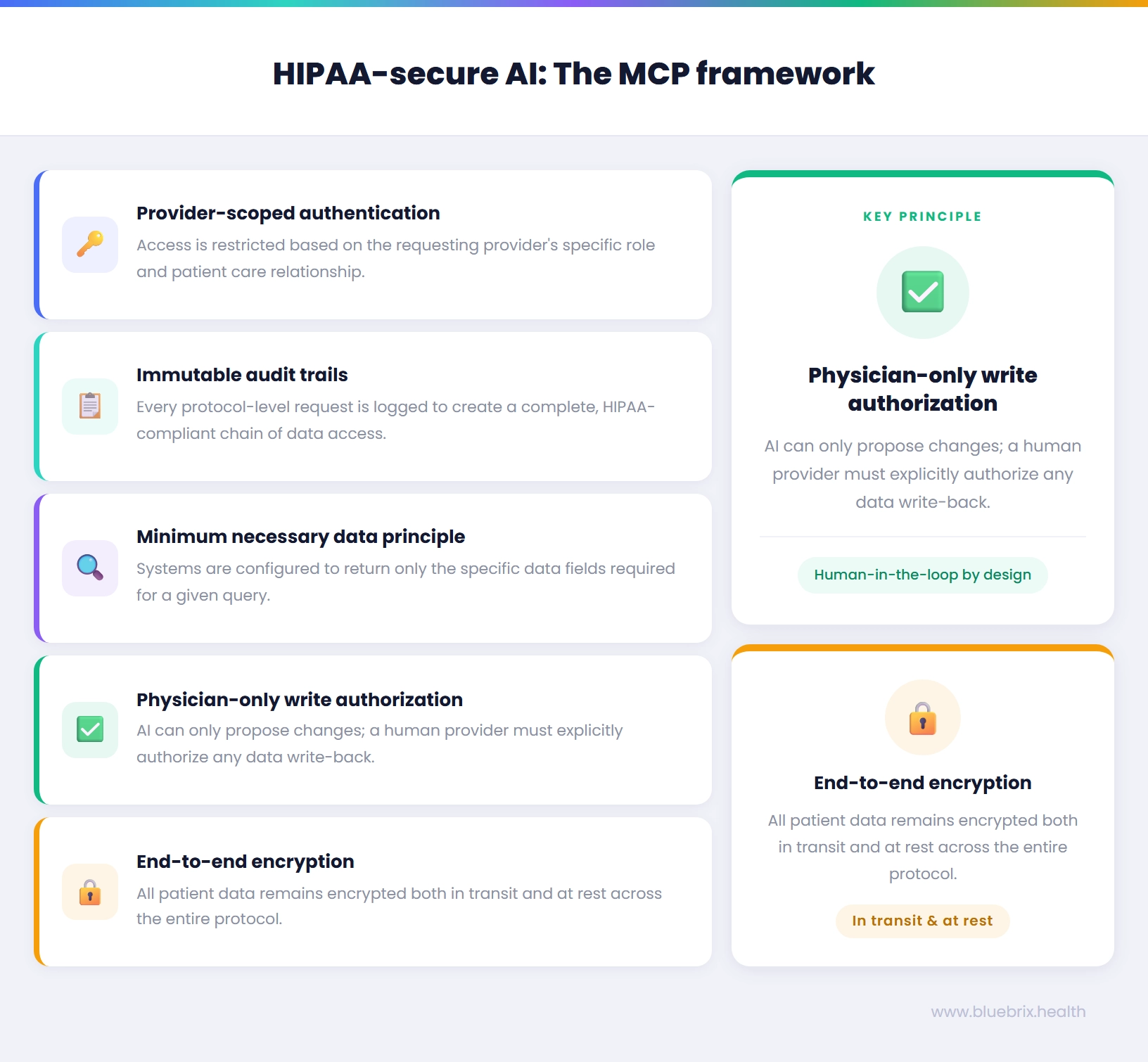
MCP-based EHR access is HIPAA compliant when the MCP server layer enforces provider-scoped authentication, minimum-necessary-data access controls, full query audit logging, and physician-only write authorization — which is exactly how blueBriX implements it.
The most immediate concern raised by architects evaluating MCP for healthcare is obvious: if AI agents have dynamic, protocol-level access to patient data, how do you maintain HIPAA compliance?[6]
The answer lies in the architecture of the MCP server layer itself. In the blueBriX implementation, MCP servers are not open data portals. They are purpose-built, scope-limited, authenticated microservices. Every MCP server enforces the following controls:
- Provider-scoped authentication: Every MCP query is authenticated against the requesting provider’s role and patient panel. An AI agent assisting a behavioral health clinician cannot query cardiology records outside their care relationship.
- Query logging and audit trail: Every MCP request and response is logged in immutable audit records, creating a complete, HIPAA-compliant chain of data access that can be produced for any payer or regulatory audit.
- Minimum necessary data principle: MCP servers are configured to return the minimum data set required to answer a given query class. The protocol supports field-level access control, so an AI handling documentation tasks cannot incidentally access financial records.
- Encryption in transit and at rest: All MCP traffic is encrypted end-to-end. Patient data never traverses an unencrypted channel between the data store and the AI model.
- Write-back approval gate: No MCP write request executes without traversing the trust engine and receiving explicit provider authorization. The AI can propose; only the physician can commit.
The net effect is a compliance posture that is, in many respects, more auditable than traditional EHR usage—because every AI-driven data access event is logged at the protocol layer, not just the application layer.
What are the clinical use cases for a faceless EHR?
How does ambient documentation go beyond transcription to intelligent coding?
The first generation of ambient documentation tools solved a real but narrow problem: they transcribed the spoken clinical encounter into a draft note, eliminating the need for the physician to type. This is valuable. It is also insufficient.
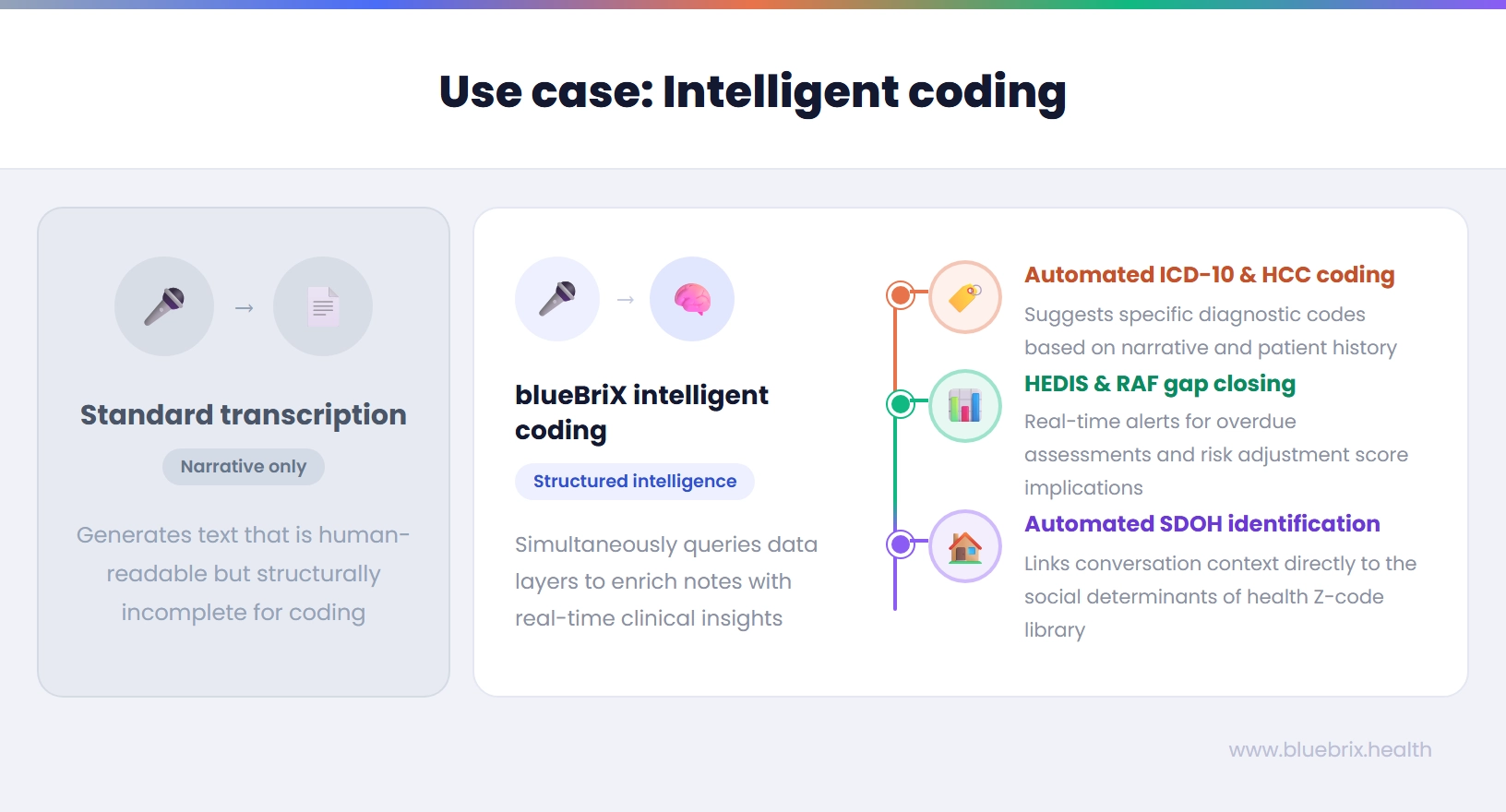
The problem with simple transcription is that it produces a narrative note—useful for human readers, but structurally incomplete for a value-based care world that runs on diagnostic codes, quality measures, and risk adjustment data. A transcription tool that produces a note reading “Patient reports fatigue and difficulty sleeping” has not solved the documentation problem. It has transferred it.
The blueBriX approach to ambient documentation uses MCP to go further. As the AI transcribes the encounter, it simultaneously queries the MCP data layer to enrich the draft note with structured clinical intelligence:
- Suggested ICD-10 codes based on the narrative content and the patient’s existing diagnosis history, with full specificity for HCC coding accuracy.
- HEDIS measure gaps flagged inline: “Patient is overdue for a PHQ-9 assessment. Consider administering before end of visit.”
- Risk score implications surfaced in real time: “Adding MDD with comorbid anxiety to this note affects the RAF score. Confirm for submission.”
- Social determinants of health identified from conversation context and linked to the SDOH Z-code library.
This is not transcription, but intelligent coding. Intelligent coding means documentation that is simultaneously narrative and structured: human-readable for the clinician, machine-processable for the billing system, and financially complete for the payer — generated in real time at the point of care rather than assembled after the fact.
How does proactive decision support work without a clinician prompt?
The second major use case operates entirely without a clinical conversation. It demonstrates perhaps the most powerful implication of the faceless EHR architecture: AI that monitors the headless data stream proactively, without waiting for a user prompt.
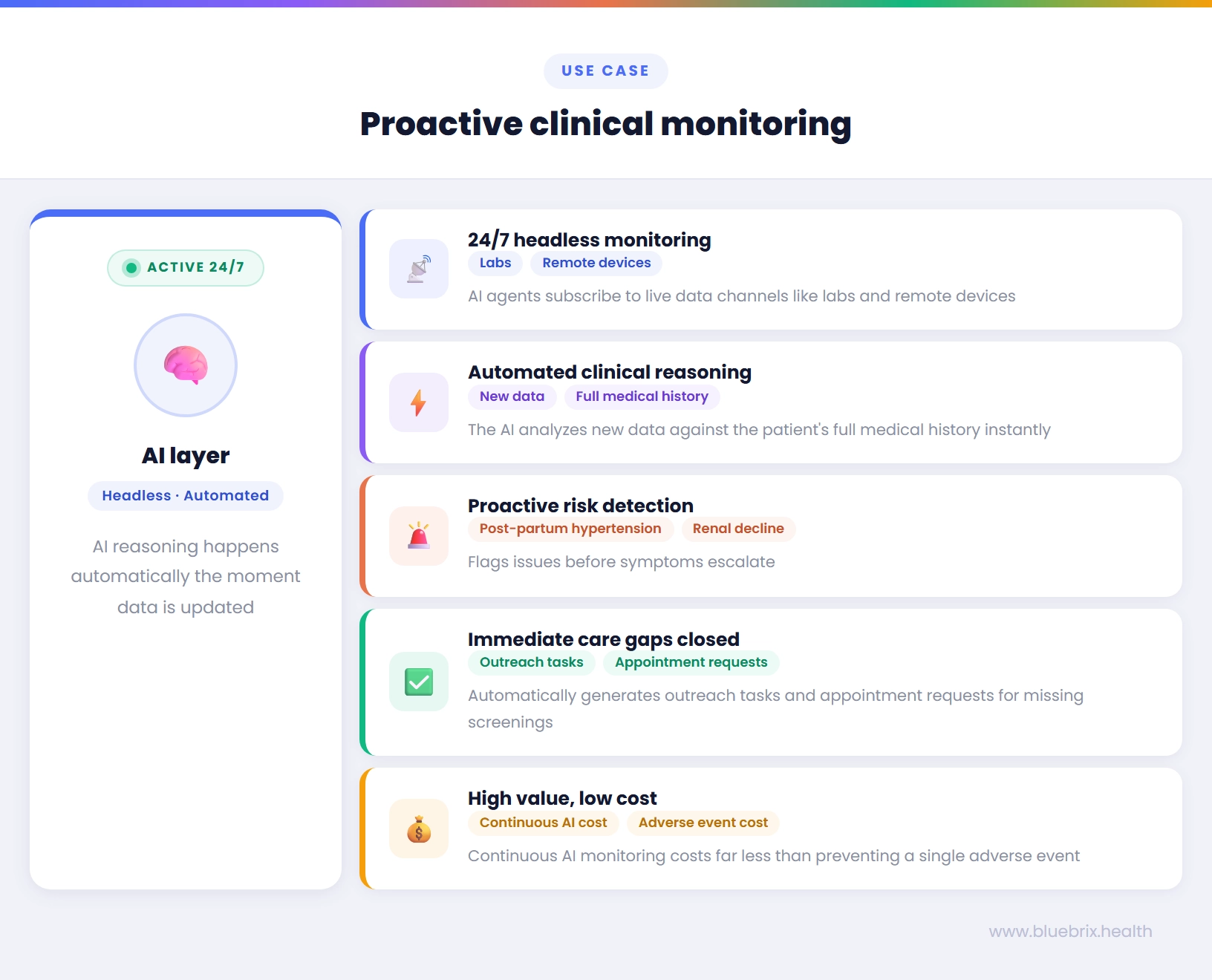
In the blueBriX architecture, AI agents can be configured to maintain persistent MCP subscriptions to specific data channels. A risk stratification agent, for example, maintains a subscription to the labs data server for all patients in a high-risk cohort. When a new lab result is written to the EHR—whether during an inpatient stay, an outpatient visit, or a remote patient monitoring event—the MCP subscription triggers an AI reasoning cycle automatically.
The agent does not wait for a physician to open a chart. It does not wait for a care coordinator to run a weekly report. It reasons over the new data in the context of the patient’s full longitudinal record, identifies any anomalies or care gaps that the new result creates or closes, and surfaces a prioritized alert to the appropriate care team member.
Consider the operational implications for a value-based care program:
- A maternal patient discharged two days ago has an elevated blood pressure reading from a remote monitoring device. The AI flags this to the care coordinator as a potential post-partum hypertension risk before any clinical symptoms escalate.
- A diabetic patient’s HbA1c result comes back elevated. The AI identifies that the patient has an open HEDIS care gap for diabetic eye exam and generates an outreach task and an appointment request simultaneously.
- A patient on a complex medication regimen has a new lab result showing a renal function decline. The AI cross-references this against their active prescriptions via an MCP query, identifies two nephrotoxic medications, and surfaces a pharmacist review recommendation before the next scheduled encounter.
None of these interventions required a clinician to open a screen. The Inference Costs vs. Clinical Value calculation here is decisive: the computational cost of running these AI reasoning cycles continuously is a small fraction of the clinical cost—and the financial cost to the health system—of the adverse events they prevent.