

Starting January 1, 2027, Medicaid eligibility management is about to become a much bigger operational issue for behavioral health organizations. An organization with a 60%–70% Medicaid payer mix could be checking community-engagement compliance for most of its expansion-population patients twice a year. For a 50-provider outpatient organization, that could mean hundreds of reverification events every month. In SUD residential care, a renewal could come in the middle of treatment. In CCBHC and PHP/IOP programs, even a brief lapse in eligibility could put already-delivered services at risk of payment.
The impact may not show up as a denial until it is too late. The workflow has to start much earlier—with eligibility, compliance, and documentation.
What do OBBBA work requirements mean for behavioral health providers?
Providers should prepare for three operational consequences: more frequent Medicaid eligibility changes, greater need for clinical documentation supporting medical-frailty exclusions, and new revenue-cycle risk when eligibility changes during active treatment.[1] [2]
The coverage-loss projections matter, but they are not the whole story. The more immediate question for behavioral health leaders is how many eligibility, documentation, and reverification events their teams will need to manage before those losses ever appear in a denial report.
Here’s how it could affect your organization:
| Organization Type | Primary OBBBA pressure point |
|---|---|
| SUD Residential (multi-site) | Five-year stable-recovery cliff; documentation burden across care transitions |
| BH Outpatient Enterprise (51+ providers) | Multiplicative reverification volume; payer-mix concentration risk |
| CCBHC | Disenrolled patients still require service; PPS denominator erosion |
| FQHC with BH integration | Medicaid-to-sliding-fee conversion; duty to serve regardless of coverage |
| PHP/IOP multi-program | Single-day coverage lapse affects per-diem claim for already-delivered services |
The June 2026 rule turned OBBBA policy into an operating requirement
The One Big Beautiful Bill Act, P.L. 119-21, was signed July 4, 2025 and established the new Medicaid community-engagement mandate. CMS translated that mandate into operating rules through CMS-2454-IFC, issued June 1, 2026 and published in the Federal Register on June 3. The interim final rule became effective July 31, 2026, the same day its comment period closed. [3]
States generally must implement the requirement by January 1, 2027. CMS identified 43 states plus the District of Columbia as covering populations potentially affected by the new framework. A qualifying state may receive additional implementation time based on a good-faith effort, but any federal delay must expire by December 31, 2028. [4]
The requirement generally applies to adults ages 19 through 64 in the Medicaid expansion population and certain Section 1115 populations, subject to federal exclusions and exceptions.
Affected individuals can satisfy the requirement through several routes, including:
- 80 hours per month of employment
- Community service
- Participation in qualifying work programs
- A combination of qualifying activities totaling 80 hours
- At least half-time enrollment in an educational program
- Earnings equivalent to 80 hours at the federal minimum wage
CMS estimated that roughly 20 million expansion enrollees could fall within the population affected before exclusions, exceptions, and compliance are considered.[5]
CMS estimates that 26% of applicable individuals would have an exclusion or short-term hardship exception. It projects enrollment reductions of 2.3 million in FY2027 and between 3.1 million and 3.3 million in subsequent years.[6] CMS also estimates that the requirement could reduce enrollment by about 15% among the adults covered by it. For a behavioral health organization where 60% of patients are covered by Medicaid, mostly through the expansion population, that 15% gives you a useful sense of the potential exposure. [7]
For providers, however, the key mechanics are more important than the national estimate.
Community-engagement compliance must be evaluated at application and renewal, and states may check it more frequently. When compliance cannot be verified through available data, individuals generally receive a 30-day opportunity to submit evidence of compliance or an applicable exclusion. [8]
A separate OBBBA provision changes the Medicaid renewal cadence itself. Most adults in the expansion group will move from annual eligibility redetermination to every six months beginning with renewals scheduled on or after January 1, 2027. [9]
Those are related requirements, but they are not the same thing.
The six-month cycle is an eligibility-redetermination requirement. Community-engagement compliance is checked as part of application and renewal, with states allowed to verify more frequently.
For a behavioral health provider, both eventually reach the same place: the front-end team responsible for knowing whether a patient is covered.
The medically frail exclusion is narrower than a diagnosis-only reading suggests
Behavioral health providers cannot assume that a patient with SUD or a serious mental health diagnosis will automatically qualify for exclusion from the community-engagement requirement.
CMS applies a functional standard.
Under the interim final rule, a medically frail individual must have a physical, mental, or behavioral condition that significantly impairs the person’s ability to comply with the community-engagement requirement and fit within one of five federal categories. [10]
Those categories include individuals who:
- Are blind or disabled under applicable federal standards
- Have a qualifying substance use disorder
- Have a disabling mental disorder
- Have a qualifying physical, intellectual, or developmental disability
- Have a serious or complex medical condition
CMS explicitly prevents states from treating diagnosis alone as sufficient. States must develop auditable lists of conditions that may support a medical-frailty determination, but appearing on that list does not guarantee the exclusion. The required functional impairment still has to be established. States cannot add their own medical-frailty exemptions beyond the five categories set by the federal government. In other words, states have to work within the federal framework—it sets both the minimum and maximum. [11]
That changes what behavioral health organizations may need to document.
A chart may thoroughly establish bipolar disorder, schizophrenia, PTSD, major depression, or opioid use disorder while saying little about whether the patient’s current condition prevents them from reliably satisfying 80 hours per month of employment, education, community service, or another qualifying activity.
When a patient seeks the medical-frailty exclusion, documentation may need to connect:
- Diagnosis or qualifying condition
- Current symptoms
- Functional impairment
- Expected duration
- Specific limitations relevant to community engagement
- Treatment intensity
- Supporting assessments or clinical observations
This does not mean every psychotherapy progress note should become a work-capacity assessment. It means organizations need a defined process for producing the right documentation when the exclusion is being established or renewed.
The documentation route gets tighter beginning in 2028
The interim final rule initially gives states some flexibility when reliable documentation is not reasonably available. Before January 1, 2028, a state may accept a statement or other information under penalty of perjury as part of establishing medical frailty. [12]
Beginning in 2028, that route becomes more limited. The statement-based pathway may generally be used only once during an individual’s continuous enrollment period. Subsequent determinations require other reliable evidence or documentation. [13]
For behavioral health organizations, that is a reason to build structured functional-impairment documentation now rather than assume patient self-attestation will remain an adequate long-term solution.
The five-year SUD rule needs to be separated from active treatment
CMS also created a specific issue for SUD providers.
For purposes of the SUD medical-frailty category, CMS defines “stable recovery” as recovery lasting five years or longer. Individuals meeting that definition do not qualify for medical frailty solely through the SUD category. [14]
That does not mean every patient more than five years into recovery becomes subject to the work requirement.
Individuals currently participating in a qualifying drug or alcohol treatment or rehabilitation program have a separate federal exclusion. Active-treatment status and SUD-based medical frailty are different pathways. [15]
For residential and multi-level SUD organizations, the distinction matters as patients move between residential care, outpatient treatment, MOUD, recovery support, and other services over long treatment trajectories.
The medical-frailty definition has also faced legal and clinical opposition. A federal district court rejected a request to temporarily block parts of the interim final rule on July 30, 2026. For now, the rule remains in effect while the court considers the broader legal challenge. [16] The AMA has separately urged CMS to revise the medical-frailty standard, arguing that the rule creates an unnecessarily restrictive and burdensome process. [17]
Providers should monitor those developments, but they should not base 2027 preparation on an assumption that the current rule will disappear.
Six-month eligibility cycles will create continuing coverage churn
The operational challenge is repetition.
Starting January 1, 2027, most Medicaid expansion adults will face eligibility redetermination every six months rather than annually.
CBO expects more frequent redeterminations and the community-engagement requirement to produce significant coverage loss, including procedural disenrollment among people who may remain substantively eligible. [18]
For behavioral health providers, that means clinical need and coverage status can move independently.
A patient in a 90-day residential SUD episode could reach a Medicaid renewal while still in treatment. A patient halfway through an IOP or PHP episode could encounter an eligibility issue after prior authorization has already been secured. An ongoing MOUD patient may move through repeated Medicaid eligibility decisions without any corresponding change in treatment need.
An active authorization cannot compensate for inactive coverage. That is why eligibility and prior authorization must be tracked separately.
Early state implementation shows how different the workflows can become
Nebraska became the first state to implement the federal community-engagement requirement, beginning May 1, 2026. New expansion applicants became subject immediately, while existing members entered the process through their scheduled Medicaid renewals. The first existing-member cohort reached the new requirement at the end of July. [19]
Nebraska’s outreach included more than 75,000 letters, 38,000 text messages, and 10,000 emails before implementation.
Provider-side estimates also illustrate the potential workload. The Nebraska Hospital Association estimated that 30%–40% of roughly 70,000 expansion enrollees could require manual verification. Bluestem Health’s CEO projected that 10%–15% of the clinic’s Medicaid patients could be disenrolled, representing an estimated $400,000–$600,000 in annual revenue exposure for that clinic. [20]
Those are organization-level estimates, not national projections, but they show why the rule matters operationally.
State approaches are already diverging.
- Montana began implementation July 1, 2026.[21]
- Iowa has set December 1, 2026 for implementation affecting new Iowa Health and Wellness Plan applicants, with existing members entering through renewals.[22]
- Arkansas began a soft launch July 1, 2026, with beneficiary notices and verification activity occurring before penalties begin in January 2027.[23]
For multi-state behavioral health organizations, this means there will be no single national OBBBA workflow. Federal requirements establish the boundaries. State systems determine many of the operational details.
The revenue-cycle disruption starts before the denial
The most important shift for revenue and finance leaders is that OBBBA risk enters the revenue cycle before claim submission.
Eligibility verification becomes more time-sensitive because an active Medicaid response today does not guarantee active coverage throughout a longer treatment episode.
There’s another catch: eligibility systems don’t yet have a standard way to show whether someone is meeting the community-engagement requirement. A 270/271 check may tell a provider that a patient has active Medicaid coverage, but it may not show whether their compliance is up to date.
That could mean providers have to check coverage and compliance separately, rather than getting both answers through a single eligibility transaction. Exactly how states will make this compliance information available through their systems is still taking shape.
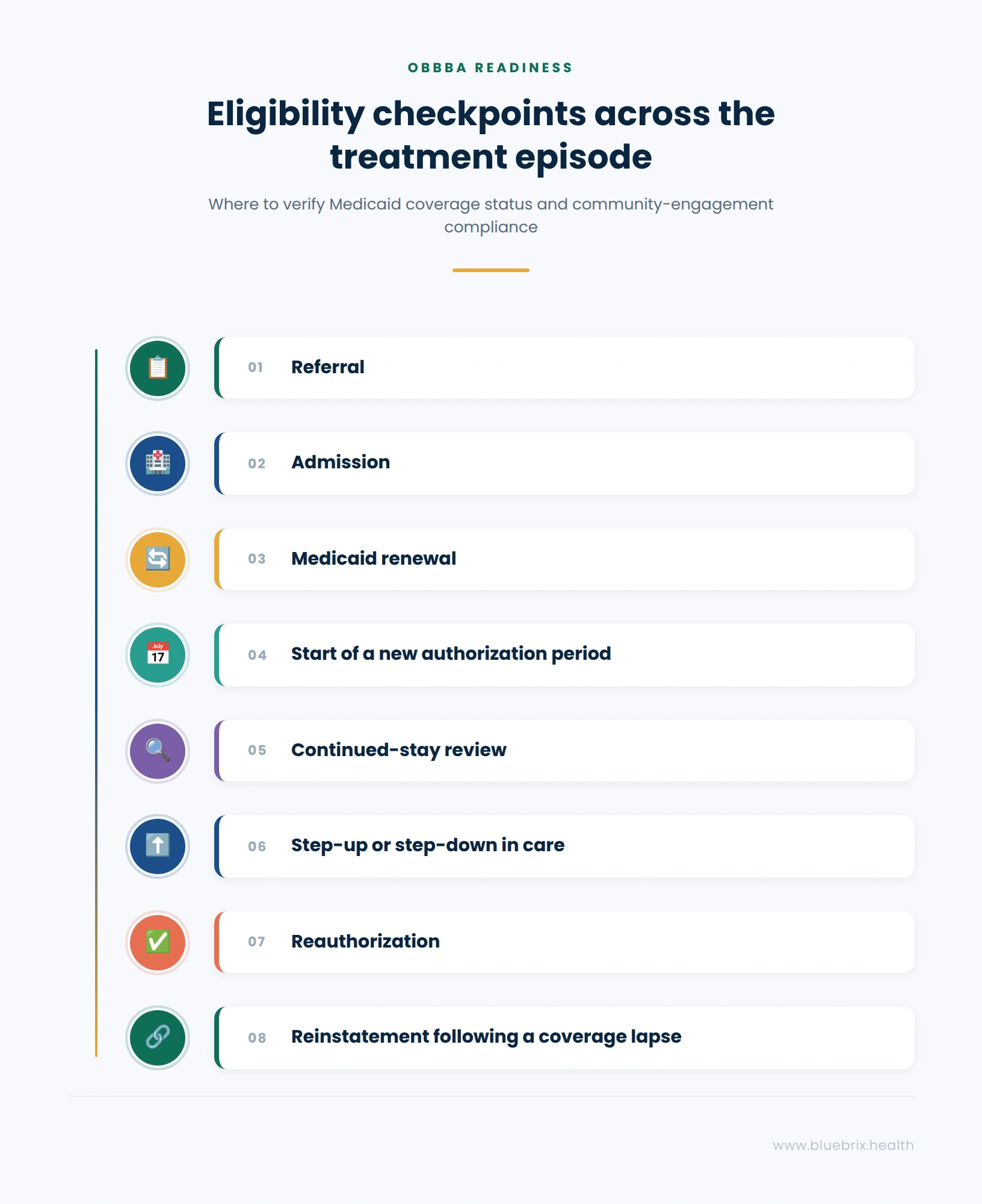
Organizations should consider eligibility checkpoints around events such as:
- Referral
- Admission
- Medicaid renewal
- Start of a new authorization period
- Continued-stay review
- Step-up or step-down in care
- Reauthorization
- Reinstatement following a coverage lapse
The exact cadence should reflect the state, payer, service line, and financial exposure.
Eligibility and authorization will run on different clocks
Consider a PHP patient with an authorization valid through October 15.
If Medicaid eligibility terminates September 30, the authorization does not preserve payment for services delivered after coverage ends. That creates a specific control requirement: utilization review, eligibility, scheduling, and billing teams need to see both authorization status and coverage status.
The problem becomes more pronounced in per-diem or daily service models, where even a short coverage interruption can affect reimbursement for treatment already delivered.
CCBHCs and FQHCs face additional uncompensated-care pressure
CCBHCs must provide access to services regardless of a person’s ability to pay or place of residence.[24] Medicaid demonstration CCBHCs may also operate under daily or monthly prospective payment methodologies. [25]
A patient losing Medicaid does not necessarily stop needing care. Instead, a Medicaid-paid encounter may shift toward uncompensated care, another payer source, or an enrollment problem the organization must help resolve.
FQHCs face a similar issue. Health centers are required to maintain sliding-fee policies and cannot deny services based solely on inability to pay. [26] A Medicaid patient who loses coverage may therefore remain in care while the revenue source changes.
For finance teams, the useful measures are broader than disenrollment:
- Medicaid encounters shifting to self-pay
- Sliding-fee volume
- Uncompensated behavioral health care
- Re-enrollment lag
- Revenue exposed during temporary coverage gaps
- Staff hours spent resolving eligibility
At enterprise scale, the issue becomes exception management rather than simple eligibility checking.
For a deeper look at front-end billing controls, see Behavioral Health Revenue Cycle Management: Commercial Billing Readiness Guide.
Talk to blueBriX about preparing your behavioral health revenue cycle for OBBBA reverification.
CBO, ASPE, Health Affairs, and RAND describe different parts of the risk
The national projections are useful for context, but they should not be mistaken for an operational forecast for an individual provider.
CBO projects that the community-engagement provision alone will increase the number of uninsured people by approximately 5.3 million in 2034. It estimates that the Medicaid provisions overall will increase the uninsured population by roughly 7.5 million in 2034. [27]
CBO also expects administrative friction to contribute to those losses because reliable electronic data will not always establish work activity, exceptions, or exclusions.
ASPE offers a very different view. Its June 2026 analysis estimates that community-engagement requirements could reduce poverty by 1.6 million to 2.9 million people under two modeled scenarios. [28] The paper describes those scenarios as illustrative rather than predictive and depends heavily on assumptions that affected individuals increase employment.
Health Affairs Forefront challenged that methodology, arguing that the ASPE model assumes much of the employment response that produces its poverty-reduction result rather than demonstrating that the policy itself will cause those employment gains. [29]
Arkansas’s 2018 waiver-era program provides the closest real-world precedent. More than 18,000 adults lost Medicaid coverage, while subsequent peer-reviewed research found no meaningful increase in employment. The program was later struck down in federal court. [30]
RAND’s revised June 2026 analysis provides another planning lens. It estimates that the Medicaid provisions it examined could reduce state Medicaid funding by approximately $665 billion from 2025 through 2034 and result in 7.6 million fewer Medicaid enrollees in 2034. [31]
Those projections differ because they ask different questions and use different assumptions. For providers, the operational conclusion is the same: plan around the mechanisms you can actually control.
- How many Medicaid expansion patients do you serve?
- When will they renew?
- How will you know a renewal is approaching?
- Who gathers medical-frailty documentation? What happens when eligibility lapses during treatment?
Those answers matter more to next quarter’s revenue cycle than choosing which national forecast will ultimately prove closest.
Behavioral health organizations should prepare now, not in January
The remaining months of 2026 should be used to build the operating model.
1. Measure expansion-population exposure
Identify:
- Medicaid patients in the adult expansion group
- Revenue tied to that population
- Exposure by state, payer, program, and location
- Patients in long or recurring treatment episodes
This gives leadership a realistic ceiling for direct community-engagement exposure.
2. Map renewals against active treatment
Residential, PHP, IOP, and ongoing outpatient programs should identify when a six-month renewal could occur during treatment.
The goal is not to predict disenrollment. It is to know when coverage status is about to become a financial risk.
3. Create a functional-impairment documentation workflow
Clinicians should have a defined process for documenting functional impairment when a medical-frailty determination requires it.
The workflow should capture clinically supportable evidence without forcing providers to recreate the entire patient history in a free-text letter.
4. Track state rules separately
Multi-state organizations should maintain a controlled implementation matrix.
| State requirement | What the organization needs to track |
|---|---|
| Implementation date | When new workflows begin |
| Verification cadence | Application, renewal, and additional checks |
| Medical-frailty process | State criteria and required evidence |
| Documentation route | Forms, portals, uploads, or attestations |
| Notice process | How unresolved compliance is communicated |
| Appeal process | How eligibility decisions can be challenged |
| Eligibility status | How active, pending, and terminated coverage appears |
The matrix needs an owner and an update process.
5. Stress-test the revenue impact
Model multiple disruption scenarios against your actual Medicaid expansion population.
A finance team might test 5%, 10%, 15%, and 20% changes and evaluate:
- Medicaid revenue at risk
- Self-pay conversion
- Uncompensated-care exposure
- CCBHC or FQHC impact
- Residential or PHP/IOP days at risk
- Eligibility workload
- Cash-flow effects of temporary gaps
These are scenarios, not predictions. Their purpose is capacity planning.
6. Make the EHR and revenue cycle configurable
OBBBA implementation will not look identical in every state. The underlying system therefore needs to be configurable around:
- Eligibility checkpoints
- Renewal dates
- State-specific processes
- Payer rules
- Functional-impairment documentation
- Eligibility work queues
- Multi-site reporting
- Payer-mix monitoring
blueBriX’s configurable architecture is built to adapt to evolving payer and regulatory requirements across behavioral health settings. Real-time eligibility verification, configurable clinical documentation, payer-specific billing logic, and cross-program workflows provide the underlying controls organizations can configure as state requirements mature.
The useful question is not whether an EHR vendor claims to have a finished “OBBBA feature.”
It is whether the system can adapt when a state changes its verification process, condition list, payer workflow, or documentation requirements.
| Timeframe | Priority Actions |
|---|---|
| Now–October 2026 | Audit Medicaid expansion-population exposure; model 5%, 10%, 15% disenrollment scenarios against current payer mix |
| October–November 2026 | Map six-month renewal dates against active treatment episodes; identify collision points for residential, PHP/IOP, and MAT |
| November–December 2026 | Build functional-impairment documentation workflow; configure eligibility checkpoints around treatment milestones |
| December 2026 | Validate state-specific implementation rules; confirm eligibility system can surface compliance status separately from coverage status |
| January 1, 2027 | Hard deadline: federal requirement takes effect in 43 states + DC |
| Ongoing 2027 | Monitor state-specific rule changes; track self-pay conversion and uncompensated-care trends; maintain state implementation matrix |
For additional revenue-cycle evaluation criteria, see Behavioral health RCM evaluation: 10 questions to ask in 2026.
The eligibility, documentation, and revenue-cycle changes OBBBA introduces are not a single configuration update. They require coordinated preparation across clinical, billing, and front-desk teams — and the specifics will vary by state.
Less than 90 days to prepare. Start now.
blueBriX can help you assess your Medicaid expansion exposure, configure eligibility checkpoints around treatment milestones, and build the documentation and billing workflows your organization will need as state implementation rules take shape.
Book a demo