

Introduction: is there an objective way to compare RCM platforms?
A behavioral health RCM evaluation framework is a set of pre-established criteria applied before vendor conversations begin, so procurement decisions are governed by your performance benchmarks rather than a vendor demo environment. Right now, your RCM vendor shortlist looks like a tie. Every platform claims clean claim rates above 95%. Every sales team can walk you through a denial management workflow that handles 10 denial scenarios in 20 minutes. Every demo environment is pre-loaded with favorable data from a reference client to the vendor selected.
You are evaluating under conditions the vendor landscape has spent years optimizing in its own favor, not platform performance under your payer mix. Most evaluation frameworks test vendor persuasiveness under controlled conditions, not platform performance under your payer mix.
In 2024, initial claim denial rates across healthcare reached 11.8%. For behavioral health and other complex specialties, MGMA benchmarking data indicates denial rates exceed 10% for more than half of healthcare organizations, with behavioral health providers facing disproportionately higher rates driven by prior authorization complexity, carve-out routing errors, and time-based CPT coding requirements[2]. At these margins, a miscalibrated platform selection is a compounding financial risk, not a recoverable inconvenience.
This framework gives you 10 main evaluation questions and 6 supplementary questions, each with a production benchmark and explicit red flags, designed to be used before vendor conversations begin – so evaluation criteria are set by you, not your vendor.
Three reasons behavioral health RCM vendor evaluations go wrong
The case for a structured approach rests on three factors that make behavioral health and primary care RCM uniquely difficult to evaluate: rising denial rates have moved platform selection to the board level, behavioral health billing complexity trips up generic evaluation frameworks, and unstructured evaluations default to vendor-controlled criteria rather than your own.
1. C-suite pressure: how denial rates made RCM a board-level issue
Revenue cycle management moved from a billing department function to board-level priority over a short period. Initial denial rates reached 11.8% in 2024, Medicare Advantage now covers more than 54% of all Medicare-eligible beneficiaries[3], and payers have deployed AI-driven claims review that produces denials faster than most organizations can process appeals.
The 2025 AMA Prior Authorization Survey documents the operational cost directly: physicians and their staff now spend an average of 13 hours per week on prior authorization management, with 40% of practices employing staff dedicated exclusively to prior authorization tasks[4]. That is a solvable workflow problem at the platform level, or it becomes a permanent staffing cost.
2. Five structural differences that make behavioral health and primary care RCM evaluation uniquely difficult
Generic RCM evaluation frameworks built for medical-surgical settings systematically underweight the criteria that matter most in behavioral health and primary care. Five structural differences must be explicitly accounted for:
Per-session medical necessity: every behavioral health session must independently establish medical necessity. Payer AI systems flag progress notes missing measurable symptom severity or functional impairment data, producing denials that cannot be appealed without clinical record amendments.
Time-based CPT coding: psychotherapy codes are determined entirely by session duration. A scrubbing engine that does not validate the CPT code against documented session time produces clean-looking claims that are denied after submission.
Carve-out billing architecture: behavioral health benefits are frequently administered by a separate managed behavioral health organization (MBHO). A claim submitted to the medical benefits payer rather than the MBHO payer produces a hard denial that cannot be corrected once the timely filing window closes.
Multi-tier prior authorization: IOP, PHP, residential, and SUD programs each require separate authorization pathways with payer-specific documentation thresholds. A platform that tracks authorization only in the billing module produces lapse failures invisible until a claim is denied for an unbillable date of service.
Value-based care billing models: CCM, PCM, and CCBHC require per-member-per-month payment tracking and care team time aggregation that is structurally incompatible with fee-for-service claims processing. A platform that handles PMPM billing through a parallel spreadsheet workflow produces both missed revenue and compliance exposure.
3. RFP paralysis: the operational and financial cost of evaluating without benchmarks
RFP paralysis is a benchmarking failure. Without pre-established performance criteria, procurement decisions default to demo quality, rapport, and pricing – the inputs most easily controlled by vendors, with the weakest correlation with production performance.
Every month of deferred decision is a month of revenue leakage at the current denial rate. MGMA estimates reworking a single denied claim costs between $25 and $118 in staff time[5]. At 500-plus encounters per week, that figure – multiplied by months of deferred evaluation – is the cost of paralysis.
What questions should you ask about front-end revenue integrity?
1. How does your platform handle real-time eligibility verification and carve-out routing for behavioral health patients?
This question integrates two of the most critical and most frequently misrepresented front-end capabilities: benefit-level eligibility verification and carve-out claim routing. Evaluate them together – carve-out identification must happen at the eligibility step to prevent routing errors that become permanent once timely filing windows close.
Coverage breadth: does the platform verify against state Medicaid plans and smaller regional carriers, or only major commercial payers?
Benefit-level detail: does verification return visit limits, deductibles, carve-out payer identification, and SUD versus mental health benefit separation, or only binary active/inactive status?
Carve-out identification at eligibility: does the platform separate carve-out benefits from medical benefits during eligibility verification, before any claim is generated?
Misdirected claim recovery: does the platform identify misdirected claims already submitted before the timely filing window closes?
What a strong answer looks like: real-time verification with behavioral health-specific benefit detail, carve-out identification, automated MBHO routing before submission, and Medicaid re-verification capability before appointments. Demonstrated live with a patient record carrying a behavioral health carve-out.
Walk away if:
- Hard denials from MBHO routing errors begin accumulating immediately after go-live and are unrecoverable once timely filing limits expire, converting billing errors into permanent write-offs.
- Manual carve-out identification loses claims every billing cycle – carved-out behavioral health benefits run 30-50% in many commercial payer populations.
- Without Medicaid re-verification before appointments, mid-episode coverage changes produce denied claims that were clean at the initial eligibility check but invalid at the date of service.
2. How does your platform manage prior authorization across behavioral health levels of care, including IOP, PHP, residential, and SUD programs?
Authorization gaps produce permanent, unappealable revenue loss – an unbillable date of service cannot be recovered regardless of documentation quality. The 2025 AMA Prior Authorization Survey confirms prior authorization management consumes an average of 13 hours per week across physician practices, underscoring the cost of inadequate automation.
Authorization visibility inside the clinical workflow: can the clinician writing the session note see authorization status without leaving the documentation screen?
Expiry warning timing: does the platform alert days before lapse, and to the right people? An alert reaching only billing after expiry is not prevention.
Payer-specific authorization logic: are rules configurable by payer, level of care, and program type?
What a strong answer looks like: authorization status visible in the clinical workflow, payer-specific alerts no fewer than 5 days before lapse with supervisor escalation, configurable by level of care. Demonstrated live.
Walk away if:
- Authorization lapse failures are invisible in standard billing reports because a denied date of service produces no claim, only a missing charge. You won’t know the scope of the problem until month-end reconciliation.
- Any practice running IOP, PHP, or residential programs without level-of-care-specific authorization tracking loses entire episode segments when a single expiry goes undetected.
- Without supervisor escalation logic, authorization alerts function as notifications rather than prevention – when billing staff are absent, the alert is missed.
3. What is your first-pass clean claim rate, and how does your scrubbing engine handle behavioral health-specific coding complexity?
Clean claim rate is the most frequently manipulated metric in RCM marketing – vendors calculate it against claims that reach external submission, excluding those their own scrubbing engine rejected. The benchmark below requires the denominator to include all claims entering the submission queue.
Denominator definition: calculated against all claims entering the submission queue, including those caught by internal scrubbing, or only claims that reached the clearinghouse?
Payer mix stratification: does the rate include Medicaid? Excluding Medicaid inflates the aggregate figure in almost every behavioral health operating environment.
behavioral health-specific scrubbing: does the engine flag a CPT code mismatched to documented session duration before submission, not after denial?
Payer-specific edit library currency: how frequently are rules updated? Payer adjudication logic changes continuously. An annually updated library is already outdated.
What a strong answer looks like: independently verifiable first-pass rate above 95%, calculated against all claims including those caught internally, with behavioral health-specific CPT time-based validation and payer-specific edit libraries updated no less than quarterly. Demonstrated live in a claim submission scenario.
Walk away if:
- A vendor who cannot disclose a behavioral health-specific clean claim rate separately from the all-specialty aggregate is almost certainly reporting a figure that overstates performance in your operating environment.
- Annually updated payer editing rules produce a growing compliance gap as payers increase the pace of AI-driven adjudication changes without formal policy notice.
- CPT time-based mismatches not caught at scrubbing produce denials requiring resubmission, compounding into A/R aging problems across the billing cycle.
4. Does your platform support value-based care billing for primary care, including CCM, PCM, and CCBHC models?
CCM, PCM, and CCBHC billing logic is structurally incompatible with fee-for-service claims processing. Platforms that cannot handle these natively force billing staff into spreadsheet-based parallel workflows that produce missed revenue and compliance exposure.
CCM time aggregation: does the platform automatically aggregate CCM time across all care team members and alert when the billing threshold is reached?
CCBHC cost reporting: is CCBHC prospective payment billing built into the module, or does it require a separate workflow?
PMPM payment handling: can the platform distribute capitated payments across patient populations and reconcile against the fee-for-service equivalent?
What a strong answer looks like: native CCM and PCM billing with automated time aggregation, CCBHC billing module with cost reporting support, and PMPM reconciliation. Demonstrated live.
Walk away if:
- Billing CCM without automated time aggregation leads to underbilling – not all care team time is captured before the threshold is crossed, producing systematic revenue leakage.
- CCBHC prospective payment without a built-in cost reporting module creates compliance risk under HRSA oversight requirements, not only a revenue risk.
- PMPM reconciliation managed in spreadsheets produces errors that persist until a payer audit, compounding revenue loss with repayment risk.
What questions reveal whether a platform's claims quality will survive contact with payers?
5. How does your platform handle telehealth billing, including place of service codes, modifier requirements, and state-specific rules?
Telehealth billing errors remain disproportionately costly because payer policies are highly variable and continue evolving at the state level. Errors in POS codes and modifier application produce clean-looking claims that are denied or downcoded after submission.
Place of service code accuracy: CMS POS 10 applies when the patient is at home; POS 02 applies when the patient is at a non-home location; POS 11 is the standard in-person office code and is not a telehealth code. Misapplying it is itself a denial trigger.
Modifier application: are GT and 95 modifiers applied with payer-specific logic, not uniformly across all payers?
State rule configurability: can telehealth billing rules be configured by state for multi-state organizations?
What a strong answer looks like: payer-specific and state-configurable telehealth billing with automated POS code and modifier application. Demonstrated live across at least two different payers.
Walk away if:
- Uniform modifier application produces systematic denials from payers whose rules differ or have changed since the platform was last updated.
- POS code errors often produce downcoded payments rather than hard denials, making revenue loss invisible without a regular contracted-rate audit.
- Multi-state telehealth organizations without state-configurable billing rules operate under a single state’s rules applied across all states, producing both denial exposure and compliance risk in states where rules differ.
What questions test denial management and payment integrity?
The back end is where every front-end and mid-cycle failure lands financially. Nearly half of revenue cycle leaders now identify payer denials as the single greatest threat to their organization’s financial performance[6]. These three questions determine whether a platform manages denials proactively or reactively.
6. What is your denial management architecture, and what verified evidence of performance can you provide?
“Denial management” in a vendor demo usually means a worklist with a status field, not a root-cause engine that traces denial patterns back to their origin. Evaluate both the architecture and the vendor’s ability to prove performance with real client data.
Root-cause analysis depth: can the platform identify denial patterns by payer, reason code, provider, and CPT code, or only by surface-level reason code?
Trend reporting: does the platform surface denial trends over time so corrections can be made before the trend becomes a collection problem?
Appeals management: does the platform generate and submit appeals with documentation pulled from the clinical record?
Verified performance evidence: what is the denial rate for comparable behavioral health clients, how is it calculated, and is a reference client willing to confirm the number directly? A vendor unable to provide verified evidence beyond marketing materials is a red flag in itself.
What a strong answer looks like: denial root-cause analysis by payer, reason code, provider, and CPT code; integrated appeals management; documented behavioral health denial rate below 8%, verifiable through reference conversations. Demonstrated live.
Walk away if:
- Without root-cause analysis by CPT code, the same denial recurs on every claim from a provider with a coding mismatch until manually identified.
- A denial rate disclosed only in marketing materials and not verifiable through reference conversations is a projection or cherry-picked figure, not a production rate.
- Any organization carrying denial rates above 12% has significant uncollected revenue compounding every billing cycle, with a narrowing timely filing window for recovery on aging denials.
7. How does your platform identify and recover underpayments after ERA posting, and what payer contract performance analytics does it provide?
Underpayment recovery is the most underutilized revenue opportunity in RCM. When a payer remits less than the contracted rate, the balance is typically written off without being identified as a payer error – this happens at scale as payers use algorithmic payment processing.
Contracted-rate validation: does the platform compare every ERA payment against the contracted rate by payer, CPT code, and provider, flagging discrepancies automatically at posting?
Shortfall resolution workflow: when an underpayment is identified, does the platform generate an appeal or flag it for manual follow-up?
Payer contract analytics: can leadership identify payers that systematically underpay specific codes as input for contract renegotiation?
Payer benchmarking: can the analytics layer compare payers across the organization’s mix by payment speed, denial rate, and underpayment frequency?
What a strong answer looks like: automated contracted-rate validation on every ERA posting, integrated shortfall resolution workflow, and payer-level underpayment trend reporting accessible to financial leadership without a vendor report request. Demonstrated live.
Walk away if:
- Without contracted-rate validation at posting, underpayments are written off as adjustments and accumulate silently across every posting cycle.
- Without payer contract analytics, you’re negotiating contract renewals without data on which payers systematically underpay which codes – producing contracts that structurally underperform your volume.
- A platform that identifies underpayments but requires a vendor support request for the trend report is a managed reporting service, not an analytics tool.
8. How does your A/R management workflow handle aging accounts, and what is your average days-in-A/R across behavioral health clients?
Days in A/R reflects the combined effect of clean claim rate, denial rate, recovery speed, and payment posting efficiency. An organization with 50-plus days in A/R is carrying earned but uncollected revenue at risk of timely filing expiration. The industry benchmark for days in A/R is 30 to 40 days, with well-performing practices consistently below 35[7].
A/R aging analysis: does the platform prioritize high-value and high-risk accounts, distinguishing payer processing delay from billing errors requiring intervention?
Automated follow-up: does the platform automate follow-up scheduling with task queues and escalation rules based on aging thresholds?
Documented production metric: what is the vendor’s average days-in-A/R across comparable behavioral health clients, verified through reference conversations, not projected from implementation estimates?
What a strong answer looks like: A/R aging analysis with priority-based work queuing, automated follow-up scheduling, and documented average days-in-A/R below 35 days. Verified through reference conversations.
Walk away if:
- A/R days above 50 compound monthly – revenue uncollected beyond 90 days carries a cost-of-capital dimension and timely filing risk if the underlying claim issue remains unresolved.
- A vendor who cannot provide days-in-A/R from comparable behavioral health reference clients is either not tracking this metric or not willing to disclose it – neither is defensible at decision stage.
- Work queues that do not distinguish payer delay from billing errors direct staff time to accounts where the payer is processing normally, not to accounts requiring intervention.
See these questions answered in a live production environment
Ready to evaluate these 10 core questions against blueBriX in a live production environment? blueBriX offers a free Revenue Cycle Assessment to identify current performance gaps before you compare any platform. A baseline assessment means you walk into every vendor conversation with your own denial rate, days-in-A/R, and underpayment exposure – not the vendor’s projected figures.
Schedule a demoWhat questions about integration and TCO separate a safe investment from a risky one?
The final two main questions address the factors most responsible for the gap between projected and realized ROI: fragile integration, implementation overruns, and hidden pricing costs that surface after signing.
9. What is your EHR integration architecture, and what specifically flows bidirectionally in live production?
“Seamless EHR integration” can mean anything from fully bidirectional FHIR-based exchange to a one-directional CSV file upload triggered by a manual export. The distinction directly impacts charge capture accuracy, denial root-cause analysis, and authorization gap prevention.
Integration standard: FHIR, HL7 v2, RESTful API, or proprietary flat file? This determines current interoperability and future compatibility with state HIEs and Medicaid agencies.
Bidirectional data elements: minimum acceptable bidirectional flow includes demographics, insurance, clinical documentation (for charge generation), charge data, claim status, and ERA/EOB posted back to the patient record.
Live production evidence: the integration must be demonstrated live with your specific EHR, not a pre-loaded demo environment.
What a strong answer looks like: FHIR and HL7 standards-based open API integration with bidirectional flow of demographics, insurance, charges, claim status, and ERA data. Demonstrated live in your specific EHR environment.
Walk away if:
- A one-directional integration that does not post ERA data back to the clinical record forces a second system lookup for every billing inquiry.
- Proprietary flat-file integrations require custom re-implementation with every EHR upgrade cycle, transferring a recurring IT cost to your organization that was not factored into your TCO model.
- A vendor who cannot demonstrate the integration live in your EHR environment during the evaluation cannot guarantee it will perform as represented in production.
10. What is your implementation methodology, and what is the total cost of ownership including implementation, support, and add-on fees?
Implementation risk is the most underweight factor in RCM evaluations – a platform taking 9-12 months to implement delays in every revenue improvement by the same duration. The pricing model appearing most cost-effective at signing frequently reveals its true cost in year two through add-on fees.
Implementation team: in-house team with behavioral health RCM experience, or a third-party integrator?
Parallel operation period: fewer than four weeks running the legacy system alongside the new platform is a red flag for complex behavioral health billing environments.
Open A/R at cutover: what is the vendor’s methodology for claims in submission, denial, and appeal during transition? Open A/R not actively worked is often partially lost.
Pricing model structure: percentage-of-collections, flat fee, per-claim, or hybrid? Percentage-of-collections aligns vendor incentive with client revenue.
Performance guarantees: does the vendor commit to specific clean claim rates, denial rates, or days-in-A/R with financial remedies for failure?
What a strong answer looks like: structured implementation with defined milestones, in-house behavioral health RCM experience, parallel operation of no fewer than four weeks, documented open A/R methodology, transparent pricing with a three-year TCO model provided during evaluation, and performance guarantees with financial remedies.
Walk away if:
- A platform implemented by a third-party integrator without documented behavioral health RCM experience is being configured by generalists in a specialty where configuration decisions directly determine denial rate outcomes.
- A vendor unwilling to provide a three-year TCO model with documented add-on fees before signature is protecting a pricing structure that will surface unfavorably post-signing.
- An implementation with no parallel operation period exposes the organization to revenue disruption at cutover if the new platform’s payer connections are not fully operational on day one.
What other questions carry equal elimination weight?
These six questions are material evaluation criteria for most behavioral health and primary care organizations. Apply the same scoring rules as the main 10 – a red flag in a domain critical to your environment carries the same elimination weight.
1. What types of medical coding services does your platform support, and how current are your payer-specific claim editing rules?
Coding accuracy in behavioral health spans CPT (time-based and E/M), ICD-10, HCPCS, and facility coding for residential programs. Payer adjudication rules are not static – each reworked denied claim already carries $25-$118 in documented staff costs.
What a strong answer looks like: CPT, ICD-10, and HCPCS support with behavioral health-specific validation; documentation integrity audit in the pre-submission workflow; behavioral health-specialized certified coders for managed RCM clients; payer rule updates triggered by both policy changes and denial pattern analysis, deployed within 30 days, with a client-accessible change log.
Walk away if:
- Annually updated payer rule libraries produce a growing compliance gap as payers increase the pace of AI-driven adjudication changes without formal policy notice.
- A coding workflow that does not flag documentation gaps before claim generation produces medical necessity denials that cannot be appealed without clinical record amendment.
2. What clearinghouse relationships does your platform use, and how are claim rejections handled?
Not all clearinghouses have equivalent payer connectivity, and the choice directly affects claim transmission speed, rejection visibility, and state Medicaid direct submission capability.
What a strong answer looks like: multi-clearinghouse support with state Medicaid direct submission; rejection visibility with reason code-level detail and correction workflow.
Walk away if:
- Single-clearinghouse lock-in with inadequate Medicaid connectivity produces systematic submission delays on Medicaid claims, disproportionately affecting organizations with high public-payer volume.
- Rejection visibility without reason code-level detail addresses the surface symptom rather than the underlying cause, generating recurring rejections across billing cycles.
3. What is your charge capture architecture, and how does the platform prevent charge leakage between clinical documentation and the billing queue?
Charge leakage is a silent revenue loss – a service never billed disappears from all reporting. Leakage commonly occurs in group therapy, care coordination, co-therapy, and same-day services.
What a strong answer looks like: automated charge capture from signed documentation with daily reconciliation surfacing unbilled encounters within 24 hours. Demonstrated live.
Walk away if:
- Month-end reconciliation of unbilled encounters finds charge leakage after timely filing windows have narrowed, reducing the recovery window and sometimes eliminating it.
- Manual charge entry in group therapy settings can result in an entire group session going unbilled from a single staff error.
4. How does your platform handle provider credentialing, and what happens to claims when a provider’s credentials lapse?
Credentialing is treated as administrative overhead until a lapsed payer enrollment starts generating denied claims with no warning. In behavioral health organizations with high provider turnover and contractor relationships, this is a continuous monitoring function with direct revenue implications.
What a strong answer looks like: proactive credential expiration alerts no fewer than 60 days before expiry; billing workflow integration that flags lapsed-enrollment claims before submission; payer enrollment management with automated compliance checks.
Walk away if:
- A platform that submits claims under a lapsed NPI generates a denial queue requiring manual identification, resubmission, and retroactive enrollment correction.
- If your provider workforce is contractor-heavy and you lack automated credential monitoring, you’re running credentialing on manual spreadsheets – enrollment gaps surface only when claims are denied.
5. What are your security certifications, and how is HIPAA compliance maintained across integration touchpoints?
Behavioral health records carry a heightened stigma risk. Certifications claimed in a sales conversation must be verified with documentation, not credited on verbal disclosure.
What a strong answer looks like: documented HIPAA compliance with ISO 27001:2013 or equivalent; API-level encryption with immutable audit logs; a comprehensive BAA covering all subprocessors.
Walk away if:
- A HIPAA BAA that does not cover subprocessors creates PHI exposure at every downstream integration point, including clearinghouses, coding services, and analytics vendors.
- Certifications disclosed verbally but not provided as documentation may not exist or may have lapsed – these should be standard pre-contract deliverables.
6. What does your reporting and analytics layer cover, and what is configurable without a vendor support ticket?
Demo dashboards are pre-loaded with favorable data. In production, the same dashboards may require vendor development tickets to modify, update on a 24-48 hour delay, or exclude the metrics that matter most to billing leadership.
What a strong answer looks like: real-time dashboards configurable by billing administrators without vendor support; covering core RCM metrics and cash flow forecasting. Demonstrated live in the actual production dashboard, not a demo environment.
Walk away if:
- A reporting layer that requires vendor support tickets to add metrics is a managed reporting service whose turnaround time limits the speed of denial management decisions.
- Batch-refreshed data means the follow-up queue reflects yesterday’s payer responses – in high-volume environments, this directly defers follow-up on time-sensitive accounts.
How do you turn vendor answers into a defensible platform decision?
Scoring vendor answers is only half the framework. The other half is translating them into an internal recommendation that survives board scrutiny.
A. Which answer patterns should trigger elimination rather than negotiation?
Some response patterns indicate fundamental architectural limitations that will not resolve post-implementation. These warrant elimination, not a reduced score and continued evaluation:
- Refusal to demonstrate any claimed capability live, substituting a slide, a roadmap item, or a post-contract promise.
- No behavioral health-specific clean claim rate disclosed separately from the all-specialty aggregate.
- No documented methodology for managing open A/R through the implementation transition.
- Denial rate statistics available only in marketing materials, with no verified production data from reference clients.
- Pricing model with no documented add-on fee list, making TCO modeling impossible before signing.
- No performance guarantees of any kind. Commitments made only in marketing language, with no contractual accountability.
B. How do you build the internal business case for the selected platform?
The business case that survives board scrutiny has three quantified components, not descriptions of them.
Current cost of the status quo: denial losses as a percentage of net patient revenue multiplied by annual collections; underpayment write-offs from ERA reconciliation data; billing staff rework hours at fully-loaded labor cost; and a charge leakage estimate from the gap between documented encounters and generated charges.
Projected improvement from the selected platform: translate vendor evaluation commitments into a specific annual dollar figure. If the current denial rate is 14% and the vendor benchmarks 8%, that 6-point improvement applied to billed charges is the projection. Ground every number in evaluation benchmarks, not vendor marketing. For primary care organizations evaluating medical billing solutions alongside behavioral health platforms, the same business case applies – the only variation is the behavioral health-specific coding benchmarks for your patient population.
Payback period: the break-even point at which cumulative revenue improvement exceeds cumulative platform and implementation cost. Present this as a specific month on a timeline. CFOs and boards respond to break-even dates, not percentage improvement claims.
What does an ideal revenue cycle management solution look like for behavioral health?
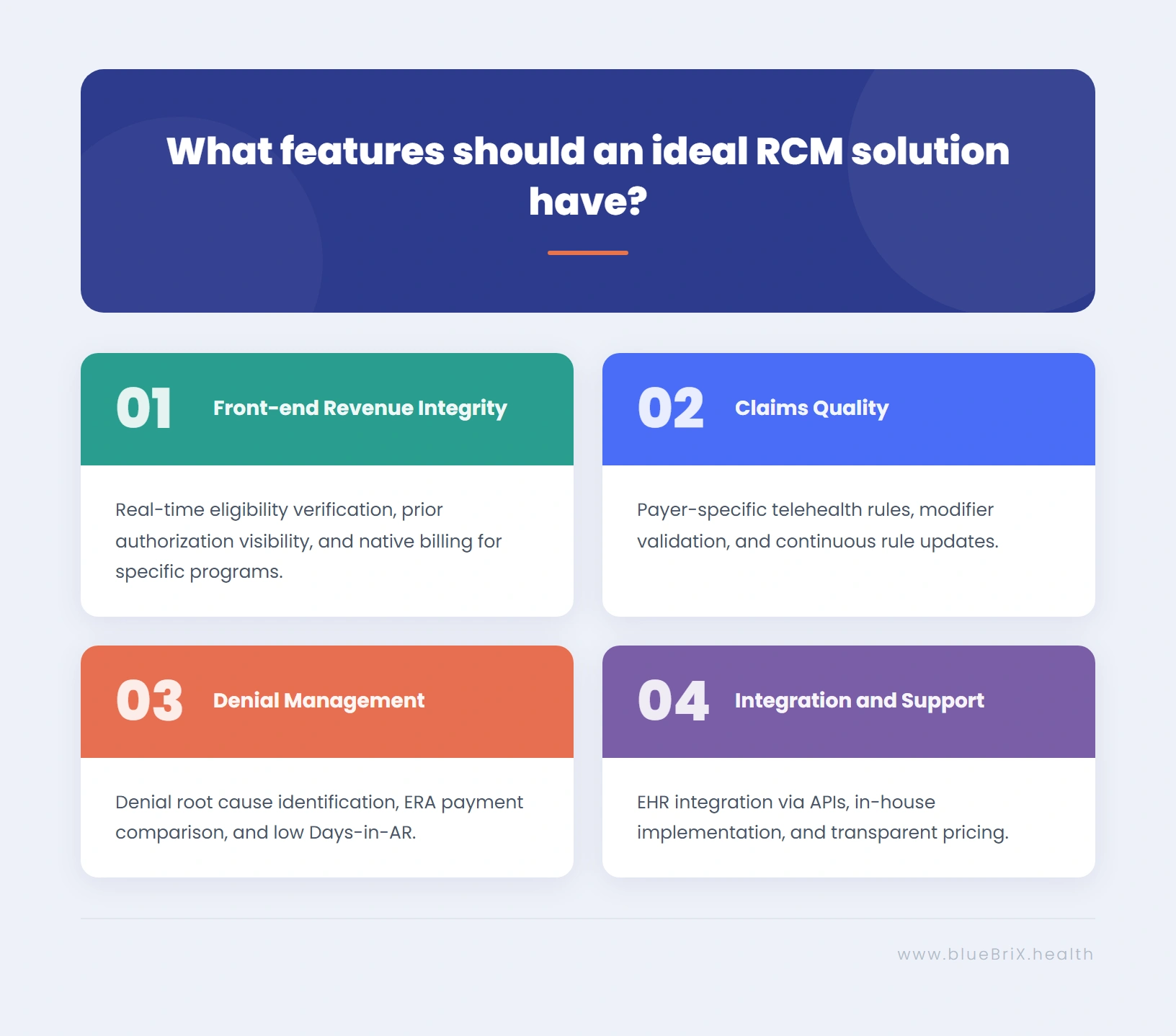
This framework is platform-agnostic. This section describes the criteria an ideal RCM platform would meet across the four evaluation phases and what that platform would deliver in production.
Across phase 1 (front-end revenue integrity): an ideal platform delivers real-time eligibility verification with behavioral health-specific benefit detail and carve-out identification at the pre-appointment step. Prior authorization status is visible in the clinical documentation screen, with alerts no fewer than 5 days before lapse escalating beyond individual staff. CCM, PCM, and CCBHC billing is native, with automated time aggregation and PMPM reconciliation built in.
Across phase 2 (claims quality): an ideal platform applies payer-specific telehealth rules by state at the claim generation step. CPT time-based validation runs before external submission. Payer-specific editing rules update continuously, tied to policy changes and denial pattern monitoring, with a client-accessible change log.
Across phase 3 (denial management and payment integrity): an ideal platform identifies denial root causes by payer, reason code, provider, and CPT code, surfacing trends before they become collection problems. Every ERA payment is compared against the contracted rate at posting. Days-in-A/R is verifiable through reference conversations and falls below 35 days.
Across phase 4 (integration and TCO): an ideal platform connects to any EHR through FHIR and HL7 APIs with bidirectional data flow posting ERA data back to the patient record. Implementation is in-house with behavioral health RCM experience, defined milestones, parallel operation of no fewer than four weeks, and a documented open A/R protocol for cutover. Pricing is fully transparent, with a three-year TCO model provided during evaluation.
How blueBriX addresses these criteria for behavioral health and primary care organizations
With more than 17 years of specialized behavioral health and primary care RCM experience, blueBriX delivers real-time eligibility verification with carve-out identification, prior authorization management with expiration alerts in the clinical workflow, automated charge capture from signed documentation, multi-clearinghouse claim routing with payer-specific scrubbing, and proactive denial management with root-cause analytics by payer, reason code, provider, and CPT code. Automated ERA posting flags underpayments at time of posting. When Fair Oaks Psychiatric Associates partnered with blueBriX, the practice achieved 33% revenue growth in 90 days, recovering $120,000 in aged A/R and reducing denials by 4 percentage points. The platform connects to any EHR through FHIR, HL7, and custom API endpoints, with verified HIPAA compliance, ISO 9001:2015, and ISO 27001:2013 certifications. During the evaluation, confirm CCM time-aggregation and PMPM handling in a live demonstration, ask about payer-specific rule update frequency, and require a full three-year TCO breakdown before signing. Production benchmarks – denial rates, days-in-A/R, underpayment recovery rates – are not published publicly; request and verify them through reference conversations.