

The CMS ACCESS Model substance use disorder (SUD) track starts April 1, 2027, and brings outcome-aligned payment to opioid, alcohol, and other SUD care for people with Original Medicare.[1] CMS announced it on September 15, 2026, alongside new heart failure, COPD, and tobacco cessation tracks, less than three months after the model launched on July 5, 2026.[2] For outpatient and intensive outpatient (IOP) programs weighing outpatient SUD value-based care, the track is a Medicare test of outcome-aligned payment: a recurring fixed amount for managing a patient over 12 months, with full payment depending on whether enough patients meet outcome targets. Participation is voluntary and limited to Original Medicare. An organization that joins bills one monthly G-code per enrolled patient, reports outcome data to CMS through APIs, sends care updates to each patient’s primary care clinician, and gives up Medicare fee-for-service billing for that patient during the care period. CMS has confirmed the SUD track’s scope, but its published payment amounts, outcome measures, and targets still cover only the four initial tracks.[3]
That gap shapes what leadership teams can do today. The architecture of ACCESS (who can enroll, how billing works, what data CMS expects, and what happens to fee-for-service claims) is already public through the model’s Request for Applications (RFA), and the behavioral health track is the closest working precedent for SUD. This guide works from those documents, flags what is still pending, and translates each requirement into what it means for IOP, partial hospitalization (PHP), outpatient, residential, and Certified Community Behavioral Health Clinic (CCBHC) programs.
What is the CMS ACCESS Model SUD track?
How does ACCESS pay for technology-supported care?
ACCESS is a 10-year voluntary CMS Innovation Center model running from July 5, 2026 through June 30, 2036.[4] In place of per-visit payment, it uses an Outcome-Aligned Payment (OAP): a recurring fixed amount for managing all of a patient’s qualifying conditions within a track across a 12-month care period, with full payment contingent on outcome targets measured against that patient’s own baseline. Patients with Original Medicare enroll directly with a participating organization, on their own or after a referral. The four launch tracks are early cardio-kidney-metabolic, cardio-kidney-metabolic, musculoskeletal, and behavioral health (BH), with BH limited to depression and anxiety.
What has CMS confirmed about the SUD track?
The SUD track covers opioid, alcohol, and other substance use disorders, including integrated support for co-occurring depression and anxiety. It starts April 1, 2027. Current ACCESS participants and applicants will not need to reapply, and other organizations can complete CMS’s ACCESS Model Interest Form to receive updates.
One design rule from the existing tracks matters more for SUD than for most conditions. A participant is responsible for every qualifying condition a patient has within the track, and while participants may propose additional clinical exclusions for CMS approval, they may not exclude an entire condition. If that rule carries into the SUD track as written, a program could not manage a patient’s alcohol use disorder while leaving a co-occurring opioid use disorder to another provider.
What has CMS not published yet?
SUD-specific outcome measures and targets, payment amounts, participation criteria for the track, qualifying-condition and ICD-10 definitions, and required clinical exclusions had not been published in the CMS materials reviewed for this article as of October 22, 2026. What programs can rely on now is the published ACCESS rulebook for participation, billing, data, and care coordination, plus the BH track as the nearest precedent. Anything in this guide that depends on unpublished SUD details is marked as such, and the guide will be updated as CMS releases specifics.
Does the CMS ACCESS Model SUD track apply to your program?
Which patients are eligible?
Eligibility starts with payer mix. A patient must be enrolled in Original Medicare Parts A and B with Medicare as the primary payer; people dually eligible for Medicare and Medicaid qualify, while Medicare Advantage, PACE, and Medicare hospice enrollees do not. Medicaid-only and commercially insured patients sit outside the model itself. The underlying Medicare need is large: according to SAMHSA’s National Survey on Drug Use and Health, as reported in Health Affairs, 6.4 million Medicare beneficiaries had a substance use disorder in 2023, including 1.9 million with opioid use disorder.[5] That figure covers Medicare beneficiaries generally, so it sizes overall need and leaves the Original Medicare share unknown. The first number to pull is the share of your SUD census that is Original Medicare primary, because it decides whether everything below is a near-term priority or a watch item.
Can your organization enroll?
Start with provider type, because it determines whether you bill Medicare for intensive SUD care at all. Since January 1, 2024, Medicare has paid for IOP services furnished in hospitals, community mental health centers (CMHCs), federally qualified health centers (FQHCs), and rural health clinics (RHCs), and in opioid treatment programs (OTPs) for opioid use disorder.[6] Freestanding SUD clinics that are none of these provider types have no Medicare IOP benefit to bill under today.
ACCESS defines participants differently. Each participant is a single Medicare Part B-enrolled taxpayer identification number (TIN) eligible to bill under the Physician Fee Schedule, excluding DMEPOS and laboratory suppliers. Medicare IOP, by contrast, is billed per diem on institutional claims. A hospital outpatient department or CMHC that bills IOP on the UB-04 should confirm with CMS how its enrollment maps to the ACCESS definition, and whether an affiliated professional TIN would be the participant, before assuming it qualifies.
The clinician requirements follow from that TIN-level design. Every physician and non-physician practitioner furnishing or supervising ACCESS care must be individually Medicare-enrolled with billing rights reassigned to the participating TIN, and the organization keeps a current roster with NPIs. A Medicare-enrolled MD or DO must serve as Medical Director, accountable for care quality, a written patient safety plan with escalation pathways, and outcome monitoring. CMS program integrity screening applies, and an application is not fully approved until Medicare enrollment is complete, so programs whose counselors and prescribers are not yet individually enrolled have an enrollment project ahead of them.
Is a brick-and-mortar IOP a fit for a technology-supported model?
The model’s name suggests virtual-first companies, yet the application lists brick-and-mortar-only care as a selectable care setting and asks applicants to describe how they use technology, with “N/A” allowed. Care may be delivered in person, virtually, or asynchronously. Two obligations hold regardless of setting: the participant must be a HIPAA covered entity, and any software or devices it deploys that qualify as medical devices must meet FDA requirements.
What changes for your fee-for-service billing?
This requirement carries the most operational weight for IOP and outpatient programs. During an active care period, ACCESS participants and their affiliated entities may not submit Medicare fee-for-service claims for other services furnished to an aligned patient, directly or through an organization they contract with; only ACCESS G-codes may be billed. CMS’s technical FAQs describe ACCESS as an outcome-aligned payment option that replaces traditional fee-for-service billing for the beneficiaries a participant bills ACCESS codes for, and the RFA says Medicare claims processing systems will automatically suppress fee-for-service billing from participants for aligned beneficiaries during their care periods.[7] Affiliation is broad: a 5% or greater direct or indirect ownership interest, operational or managerial control over another organization, or a reassignment relationship between organizations. CMS’s technical FAQs clarify that an individual clinician who reassigns billing rights to a participant does not become an affiliate on that basis alone. For multi-entity operators, that definition can pull a sister IOP or outpatient clinic into the exclusion.
For an IOP that becomes a participant itself, aligning a Medicare patient therefore means the program cannot also bill that patient’s IOP days per diem during the care period. Two points are still open: whether a hospital or CMHC IOP that bills on institutional claims is treated the same way as a Part B professional TIN, and whether the SUD track carries the rule over unchanged. Ask CMS before modeling participation. A team that cannot see a patient’s alignment status also risks submitting claims the system will suppress. The table below shows how far apart the two billing engines sit.
| Billing element | Medicare IOP today | ACCESS participant |
|---|---|---|
| Unit of payment | Per diem, for a day meeting service requirements | Fixed amount per patient per 12-month care period |
| Claim cadence | Per program day, on institutional claims | One G-code claim per patient per month, within 90 days of service |
| What triggers payment | Documented attendance and services | Monthly attestation of active care, then outcome reconciliation |
| Outcome accountability | None tied directly to payment | Half of the annual amount withheld and reconciled on outcomes |
| Same-patient FFS billing | Standard | Excluded for participant and affiliates during the care period |
Operationally, aligned and non-aligned Medicare patients can sit in the same group room, one billed through per-diem claims and the other through a monthly G-code. ACCESS payments also exclude the cost of medications, laboratory tests, imaging, and DMEPOS, which are billed separately by financially unaffiliated entities. How that interacts with OTP bundled payments for medications for opioid use disorder is another question SUD-specific guidance will need to answer.
What does participation ask of clinical and care coordination workflows?
How do patients enroll and align?
Alignment follows a fixed sequence. Before querying CMS, staff tell the patient the service is part of a CMS payment model test and that they may be randomly assigned to a comparison group (CMS starts at a 90:10 intervention-to-control ratio in the first year). The program then verifies coverage through the ACCESS Eligibility API, validates and documents the qualifying condition through its own assessment, a referral, or a documented diagnosis, obtains and documents informed consent, and provisionally aligns the patient through the Alignment API. CMS’s payment and performance targets document requires valid baseline measures within 60 days of alignment, or the patient is unaligned. Patients may switch participants or disenroll any time after 90 days.
What care standards and escalation duties apply?
Care must be consistent with nationally recognized clinical guidelines, and participants must recognize when a patient’s needs exceed the scope of ACCESS services and make a good-faith referral to an appropriate clinician and setting. The RFA ties the 10-day care update to transitions that happen because a patient’s needs exceed the scope of ACCESS services. CMS has not said which SUD level-of-care changes, such as a step-up to withdrawal management or residential care, will meet that definition. CMS also monitors claims and clinical submissions for patterns suggesting excessive treatment intensity and may take corrective action against persistent overtreatment.
Which care updates are required, and where does 42 CFR Part 2 come in?
The RFA requires participants, with the patient’s consent, to send standardized updates to the patient’s primary care practitioner and referring clinician within 10 days of care initiation, within 30 days after the care period ends (or sooner on disenrollment), and within 10 days of an escalation. Updates go through secure methods such as Direct Secure Messaging or a health information exchange (HIE) push, and query-only exchange does not satisfy the requirement. PCPs and referring clinicians who review those updates can bill an ACCESS co-management payment of $30 per service, before geographic and other Medicare adjustments, without joining the model themselves.
For SUD records, the consent layer is heavier. 42 CFR Part 2 programs have had to comply with the 2024 final rule since February 16, 2026; it permits a single patient consent for all future uses and disclosures for treatment, payment, and health care operations.[8] Whether a specific ACCESS care update falls inside a patient’s consent, and who the recipient is, needs to be tracked at the record level. A consent form scanned into the chart cannot tell a care coordinator whether a 10-day escalation update is cleared to send.
How will your outcomes become public?
CMS maintains a public ACCESS directory listing each participant’s tracks and conditions treated, and beginning in winter 2028 it will add each organization’s risk-adjusted outcomes, with minimum case counts applied to protect patient privacy.[9] Once SUD outcomes are published, referral sources and patients will be able to compare programs on results.
Check your workflows against ACCESS before CMS publishes the SUD rules
Three workflows decide how ready a program is for outcome-aligned payment: whether outcome scores are captured in structured fields, whether Part 2 consent can be checked per record before a care update goes out, and whether billing can flag aligned Medicare patients. The blueBriX team can walk through how those workflows are configured today.
Schedule a demoWhat technology infrastructure and data reporting does ACCESS require?
Which CMS APIs will you connect to?
ACCESS runs on four CMS APIs: an Eligibility API, an Alignment API, a Fast Healthcare Interoperability Resources (FHIR)-based Reporting API for outcome measures, and an optional Beneficiary Claims Data API (BCDA) that returns Medicare Parts A, B, and D claims for aligned patients. CMS posts an ACCESS API implementation guide and operations manual on the model page and held a health IT and interoperability webinar on July 23, 2026.[10] A FHIR-capable EHR gives you the foundation; ACCESS connectivity adds CMS-defined, model-specific workflows on top of it, and those specifications continue to be revised.
What health IT minimums apply?
Participants are not required to use Certified EHR Technology, according to the RFA. They are required to implement APIs that meet the ONC standardized API criterion for patient and population services at 45 CFR 170.315(g)(10), using at least the most recent adopted version of the United States Core Data for Interoperability (USCDI); to establish or maintain bidirectional HIE connectivity within 12 months of the model start date, which CMS’s interoperability webinar slides set at July 6, 2027; and to transmit clinical and patient-reported outcomes to CMS’s FHIR reporting server. The application form separately has organizations that are not yet connected certify they will establish connectivity before delivering ACCESS services. Which timing applies to an organization entering through the SUD track on April 1, 2027 is a question for CMS. The same secure channels carry the required care updates. For a closer look at what multi-payer interoperability asks of a behavioral health EHR, see how to choose an interoperable behavioral health EHR.
What outcome data will you capture, and when?
The BH track is the closest template to study, and SUD terms may differ. Every BH patient reports both PHQ-9 and GAD-7 at baseline, quarterly, and end of period, whichever condition qualified them. Per CMS’s payment and performance targets document, for a patient who starts at 10 or higher, the depression target is a 5-point PHQ-9 reduction and the anxiety target is a 4-point GAD-7 reduction; for a patient who starts below 10, the target is a final score that stays under 10. A patient who scores below 10 on both instruments at baseline cannot enter the higher-paying initial period and can align only in the follow-on period, which requires a referral and a documented history of depression in the past 18 months. A one-item patient global impression of change is required at end of period, and WHODAS 2.0 is optional. Each patient-reported measure must be collected within 15 days of submission, and quarterly submissions fall 70 to 110 days after the previous one.
Because the SUD track includes integrated depression and anxiety support, overlap with PHQ-9 and GAD-7 is plausible, but CMS has not confirmed SUD measures. Capturing SUD outcomes reliably has its own demands: programs may see patients disengage between visits, and under the published rules patients who are lost to follow-up or who choose to unalign stay in the denominator of the participant’s outcome rate. That single rule converts retention into revenue risk. ACCESS requires care consistent with nationally recognized guidelines and monitors for excessive treatment intensity, so placement and step-up decisions should rest on clinical assessment alone. One published rule partly offsets that risk. In the BH track, participants may submit end-of-period measures up to 180 days before day 365, and later worsening does not cancel that earlier success, although the participant must keep delivering active care and reporting quarterly to keep billing. Whether the SUD track keeps the same window is a question for CMS. CMS also requires all clinical data to arrive through a FHIR-based API with standardized data elements, so an outcome recorded only in a narrative progress note will not count.
How do billing, withholds, and audits work?
The mechanics below come from CMS’s published rules for the four launch tracks, and SUD terms may differ. Under CMS’s OAP billing guidelines, participants submit one G-code claim per aligned patient per month, within 90 days of the date of service, and each claim covers a month in which the participant furnishes active care. Medicare Administrative Contractors process the claims as zero-paid, and CMS issues the payments.[11] The payment document caps monthly payments at 50% of the Medicare portion of the annual amount; the other half is withheld and reconciled semi-annually through two possible downward adjustments. The Clinical Outcome Adjustment compares the share of completed care periods meeting all targets (the Outcome Attainment Rate) to a 50% threshold, with the reduction capped at 50%. The Substitute Spend Adjustment compares the share of patients who did not receive listed duplicative services from other Medicare providers to a 90% threshold, capped at 25%. Only the larger of the two applies in each reconciliation, and both thresholds are published for the period through December 31, 2027. ACCESS will not qualify as an Advanced Alternative Payment Model, and CMS anticipates that ACCESS services will not count toward MIPS eligibility or reporting or receive MIPS payment adjustments. Revenue models that assume an Advanced APM bonus or MIPS credit for ACCESS volume should drop that assumption. CMS may audit participants, requires record retention, and can recover overpayments through standard Medicare recoupment.
Here is an illustration using published BH figures. The BH track’s initial-period allowed amount is $180 per patient per year, of which Medicare’s 80% portion is $144. Up to $72 arrives in monthly installments during the care period and $72 is withheld. If 40% of a participant’s completed care periods meet all targets, the Clinical Outcome Adjustment is 1 minus (40 ÷ 50), or 20%, so the participant earns $115.20 of the $144 and about $43 of the withheld $72 is released. All figures are before the 2% sequestration reduction that CMS applies to Medicare payments. This is an indicative calculation for illustration only: SUD track amounts and thresholds are unpublished and may differ.
What does the SUD track mean for your program type?
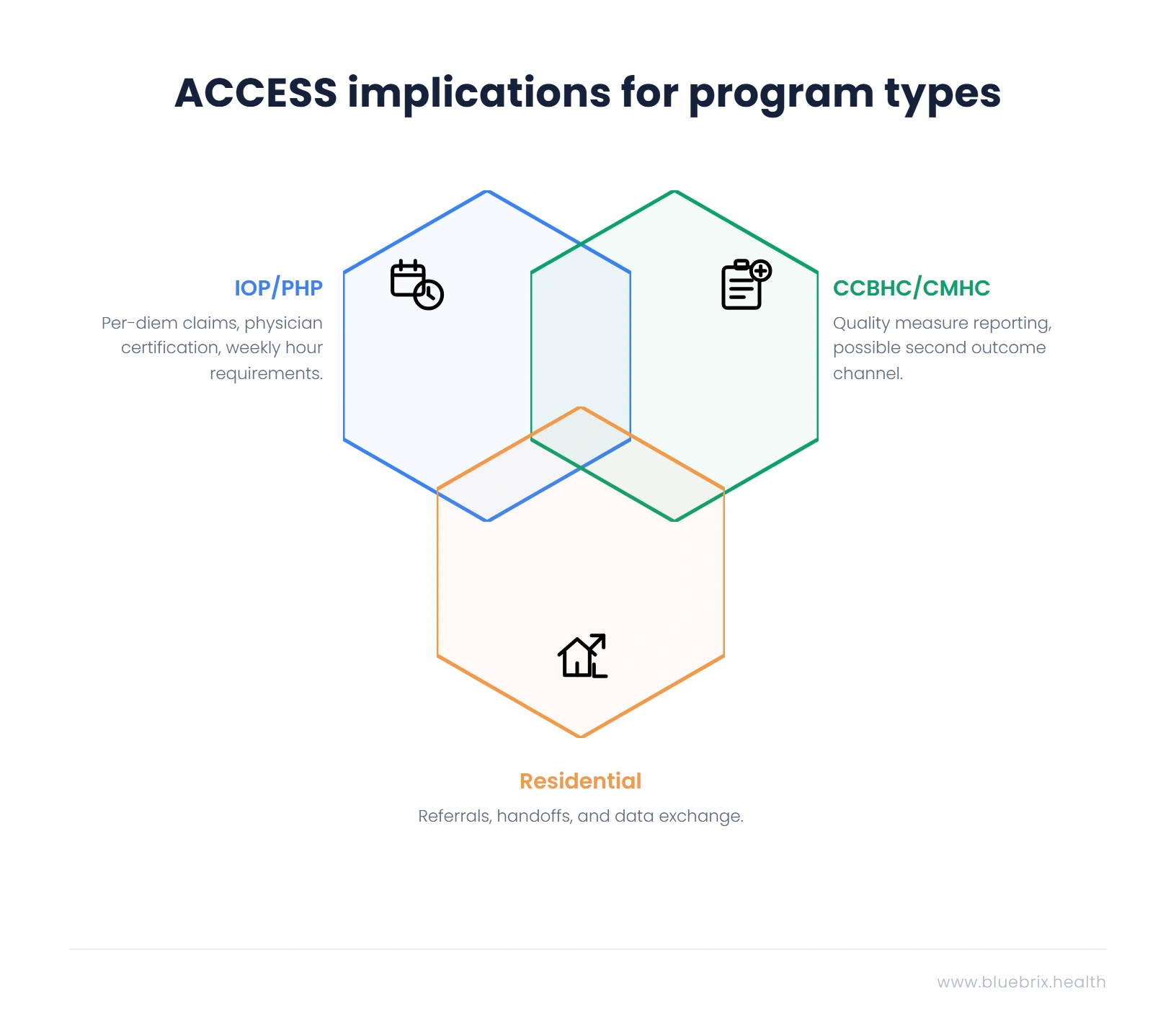
What changes for IOP, PHP, and outpatient programs?
Today’s Medicare IOP and PHP revenue engine runs on per-diem claims, physician certification, weekly hour requirements (at least 9 hours for IOP and 20 for PHP), and payer utilization review.[12] The ACCESS engine runs on 12-month outcomes, one monthly G-code, and a panel-level outcome rate. The collision points are predictable: a level-of-care transition inside a single care period, a census mixing aligned and non-aligned patients, and documentation that has to satisfy a per-diem auditor and an outcome reconciliation at the same time.
Programs that never participate still feel the effect. The BH track’s substitute spend list includes new psychiatric diagnostic evaluations (CPT 90791 and 90792), initial psychiatric collaborative care management (99492), digital mental health treatment devices, and remote therapeutic monitoring setup, when another Medicare provider furnishes them for the same diagnosis during the care period. An outside program that opens a new intake evaluation for a participant’s aligned patient counts against that participant, which gives participants a reason to manage where they refer. The outside program is still paid under standard Medicare rules; the adjustment reduces only the participant’s payment. The first question for any IOP is still the simplest one: which of our patients would be eligible at all?
Does the SUD track apply to CCBHC and CMHC programs?
The BH track excludes beneficiaries enrolled in a Certified Community Behavioral Health Clinic program. Whether the SUD track carries the same exclusion is among the unpublished details, and the answer will largely decide whether ACCESS is relevant to a CCBHC’s Medicare SUD patients. CMHCs that are not CCBHCs face no such exclusion under the BH precedent. CCBHCs already carry quality-measure reporting, so ACCESS would add a second outcome channel with its own data format and submission windows.
How does the SUD track reach residential SUD programs?
Non-hospital residential addiction treatment is the only level of care Medicare does not cover, according to the American Society of Addiction Medicine (ASAM).[13] The Residential Recovery for Seniors Act (H.R. 9538), introduced June 30, 2026 and referred to the House Ways and Means Committee, would create Medicare coverage for it.[14] Until a benefit like that exists, ACCESS is most likely to touch freestanding residential programs through referrals, handoffs, and data exchange. CMS has not published how the SUD track treats residential stays.
Three handoffs deserve attention. A residential or withdrawal management program may be where an ACCESS participant sends a patient whose needs exceed the model’s scope, triggering the participant’s 10-day escalation update and a real question about who pays for that stay. A patient stepping down from residential care may already be aligned to an ACCESS participant, so the record, medication list, and consent need to travel with them. And for operators running outpatient and residential programs under one umbrella, the affiliated-entity rule makes it essential to know which affiliate bills Medicare at all.
Will Medicaid, Medicare Advantage, and commercial payers follow?
ACCESS uses track-specific G-codes that any payer can adopt, and CMS is publishing alignment resources such as a sample provider agreement structure and payment adjustment code. Payers representing 165 million Americans across Medicare Advantage, Medicaid, and commercial plans have pledged to offer ACCESS-aligned payment arrangements by January 1, 2028.[15] Whether those pledges will extend to SUD is not yet known, but programs with limited Medicare volume may meet outcome-aligned contracting through their health plans before they meet it through CMS. If your team is still working through what that shift means, our overview of the move from fee-for-service to value-based care covers the basics.
What should your program do before CMS publishes the SUD details?
How should you size the exposure without guessing at numbers?
Five questions frame the exposure without inventing SUD figures: what share of the SUD census is Original Medicare primary; which provider type and enrollment status each program holds; whether every clinician is individually Medicare-enrolled; whether a physician can serve as Medical Director; and what structured outcome data already exists. The only payment precedent is the BH track, at $180 per patient per year in the initial period and $90 in the follow-on period. Those amounts signal that ACCESS is designed as an outcome-aligned management payment, and given the fee-for-service exclusion, it cannot be layered on top of per-diem IOP revenue for the same patient. Until CMS publishes SUD amounts, the defensible model is a flat per-patient payment set against your cost to serve, with half of it at risk on outcomes.
Which four steps should you take now?
- Start by auditing your outcome measurement baseline: which validated instruments you administer, how consistently they are captured at intake and follow-up, and whether scores live in structured fields or in narrative notes. Under the BH precedent, a missing quarterly score is a missing payment condition.
- Next, check interoperability, consent, and secure messaging. Confirm HIE connectivity, a Direct Secure Messaging address, and a Part 2 consent workflow that tracks scope and status per record, so a 10-day care update can go out without a manual consent hunt.
- Then map revenue workflows against the fee-for-service exclusion. Trace where aligned and non-aligned Medicare billing would diverge in your census, your claim forms, and your affiliated entities, and decide how front-desk and billing staff would know a patient is aligned.
- Finally, decide your pathway: participate, partner with a participant while minding the affiliation rules, or prepare and watch through CMS’s interest form. Factor in the exit terms before choosing: a participant must give CMS at least 180 days’ written notice to withdraw and must keep serving aligned patients until the termination date.
How does blueBriX help programs prepare for outcome-aligned payment?
The readiness work above depends less on any single feature than on whether measurement, consent, and billing live in one connected record. Here is what the blueBriX platform supports today, by program type. CMS’s ACCESS API connection is a model-specific build that CMS is still finalizing for SUD; the capabilities below are designed to support that kind of reporting, and programs should confirm ACCESS-specific readiness with us as CMS publishes the SUD specifications.
One blueBriX customer’s experience points at the same exposure. The Blackbird Health case study, about a mental health provider serving children and young adults, notes that narrative treatment documentation complicates standardization and data extraction in behavioral health clinics, and it reports that configurable, condition-specific clinical forms in blueBriX were the biggest advantage in mitigating data capture issues and reducing administrative overhead. That is an outpatient mental health setting outside SUD care. The lesson carries over: a score that lives only in a note cannot be reported through a FHIR-based API.
What does blueBriX support for IOP, PHP, and outpatient programs?
The blueBriX outpatient, IOP, and PHP EHR includes 200+ pre-built assessments, including validated tools such as PHQ-9, GAD-7, C-SSRS, and CAGE, with longitudinal score tracking, assessments tied to treatment plan goals, and a no-code form builder for new instruments. Condition-specific pathways cover depression, anxiety, SUD, trauma, and co-occurring disorders, and outcomes reporting trends PHQ-9 and GAD-7 for quality and payer reporting. Scheduling, documentation, billing, authorization, and payer rules can be configured independently by program, with attendance-driven HCPCS per-diem billing and CMS-1500 and UB-04 claims generated from one system. That program-level configuration is designed to support a census that mixes billing models, although ACCESS G-code billing itself is a CMS-specific build to confirm. One record follows patients across PHP, IOP, and outpatient care.
What does blueBriX support for residential SUD programs?
The blueBriX residential SUD EHR carries one continuous record across detox, residential, PHP, IOP, and outpatient programs, including treatment history, level-of-care placement data, medications, and billing. SUD outcome reporting covers completion and readmission rates, level-of-care movement, toxicology trends, and MAT adherence. Clinical workflows include configurable ASAM-structured documentation, CIWA-Ar and COWS scales, toxicology tracking, and MAT protocol support. Part 2 consent follows the single-consent model, tracked at the record level, with every disclosure logged and re-disclosure notices generated automatically, and eligibility is verified at admission, during the stay, and before claim submission.
What does blueBriX support for CCBHC and CMHC programs?
The blueBriX CCBHC and CMHC EHR captures FUH, FUA, FUM, IET, OUD pharmacotherapy, and PCR-AD quality measure data during care delivery, with dashboards. Measurement-based care scores and trends validated instruments across visits, including PHQ-9, GAD-7, C-SSRS, CAGE, AUDIT, CIWA, and COWS. PPS encounter billing and fee-for-service claims run from one system under separate configurations, and SUD safeguards include granular 42 CFR Part 2 consent with segmented access and audit trails, plus MAT and OUD pharmacotherapy tracking with EPCS and PDMP integration.
On the revenue side, behavioral health organizations using blueBriX have published results: Laurel Life reported a 20% increase in reimbursements and revenue, and Blackbird Health reported an 83% year-over-year improvement in claim processing. Both organizations are outpatient mental health providers, and neither case study involves SUD treatment or outcome-aligned payment, so they speak to workflow and billing discipline and say nothing about ACCESS performance.