
If you run compliance or IT integration for a behavioral health organization, you already know that 42 CFR Part 2 is a structural constraint on how your systems move data. As of the February 16, 2026 general compliance deadline for the 2024 Final Rule[1], covered entities are expected to have these controls in place, and OCR’s enforcement authority under the updated regulation is now fully active.[2] The grace period is over.
For most HIPAA-covered functions, your EHR treats data uniformly. Part 2 does not allow that. Your EHR needs to flag SUD-related data at the field level, keep consent status live and queryable rather than a static form on file, and enforce it at every point the data could leave the organization — the same standard OCR now enforces under HIPAA-aligned penalties. The moment a record originates from, or touches, a federally assisted SUD program, it carries a different consent standard, a different redisclosure obligation, and a different breach exposure profile than the rest of the chart. If your EHR cannot reliably tell the difference between the two at the point of exchange, every referral, every HIE query, and every claims submission becomes a judgment call your staff has to make manually, under time pressure, without a system backstop.
That is the real problem behind the question “what does our EHR need to do for Part 2.” The regulation itself is well documented at this point. The harder question is whether your technology stack can operationalize consent, so your staff are not the last line of defense against an unauthorized disclosure. In this blog, we unpack what the 2024 Final Rule actually requires from your systems, where disclosure risk actually originates across care coordination, HIE exchange, and billing, and what your EHR needs to do to close that gap.
How the 2024 final rule changed Part 2 compliance
The Substance Abuse and Mental Health Services Administration (SAMHSA) and HHS’s Office for Civil Rights jointly finalized updates to Part 2 in February 2024, implementing the CARES Act mandate to align Part 2 more closely with HIPAA while preserving heightened protections for SUD records.[3] Compliance became mandatory this year, and organizations covered by Part 2 no longer have the two-year runway that followed the rule’s April 2024 effective date.
A few changes matter directly to your EHR configuration and your integration architecture:
Single consent for TPO (treatment, payment, and health care operations)
Patients can now execute one consent authorizing use and disclosure of Part 2 records for treatment, payment, and health care operations, rather than a separate consent for every recipient or purpose. That sounds like a simplification, but it shifts the operational burden onto your system. You now need to track a single, durable, revocable consent across every downstream workflow that touches that patient’s record, not a stack of point-in-time authorizations.
HIPAA-aligned breach notification and enforcement
Part 2 violations are no longer prosecuted under an obscure criminal statute with token penalties. The Final Rule directs HHS to align Part 2’s confidentiality provisions more closely with HIPAA, and civil enforcement now runs through OCR using HIPAA-style penalty tiers. A disclosure error that used to be a compliance footnote can now trigger the same investigative and financial exposure as a HIPAA breach.
Redisclosure and accounting obligations remain distinct from HIPAA
Even with HIPAA alignment, Part 2 still requires that a redisclosure notice accompany Part 2 data leaving your organization, consistent with the notice language specified at 42 CFR § 2.32[4], and it still restricts use of SUD records in criminal or civil proceedings without consent or a court order. This is where the “single consent” simplification can create a false sense of security. One consent covering TPO does not make the data unrestricted once it lands in a downstream system.
Here is the detail that trips up a surprising number of compliance and IT teams evaluating their EHR against this rule: the Final Rule does not require Part 2 records to be segregated or segmented as a matter of federal law. A covered entity receiving records under a single TPO consent is not obligated to keep them in a physically separate system. If your vendor’s sales team has told you segmentation is now a hard federal requirement, that is not accurate, and it is worth correcting internally before it drives the wrong procurement conversation.
What the rule does require, unavoidably, is that your organization can identify which records are Part 2 data, track the consent status attached to them, control who and what can access them, and produce an accurate accounting of disclosures on request. Segmentation for its own sake isn’t really the goal here. Being able to prove, at any moment in the data’s lifecycle, that a disclosure matched an active consent, is the actual bar. In practice, for almost every EHR architecture in production today, field-level tagging and segmentation remain the only reliable way to clear that bar, even though the rule stops short of naming them as the required mechanism.
Understanding what the rule requires on paper is one thing. Seeing where that requirement actually breaks down inside a live EHR, in the moment a referral goes out or a claim gets submitted, is another, and it’s where most real exposure lives.
Why manual consent tracking creates Part 2 disclosure risk
Ask any compliance officer where Part 2 disclosure risk actually materializes, and the answer is rarely “someone read the policy wrong.” It is almost always a workflow moment where the system didn’t stop the data before a human had to make a judgment call. Three moments account for most of the real exposure: care coordination handoffs, HIE queries, and billing submissions. Each has its own mechanics, so it is worth taking them one at a time rather than treating them as interchangeable examples of the same problem.
A fourth failure sits underneath all three: a consent expires or is revoked, but nothing in the system flags the change, so downstream feeds keep transmitting data under an authorization that no longer exists. That gap is what turns each of the following scenarios from a theoretical risk into a recurring one.
Manual consent tracking, whether that means a spreadsheet, a scanned consent form in a document repository, or a free-text note in the chart, cannot keep pace with the volume and speed of automated data exchange. Your EHR and interface layer are moving data faster than any human review process can verify consent status in real time. That mismatch is the actual source of disclosure risk, and it is a systems design problem before it is a training problem.
Care coordination risk under 42 CFR Part 2
The specific risk point here is the multi-provider handoff: a patient in SUD treatment also sees a primary care physician, maybe a psychiatrist, maybe an emergency department, and every one of those providers benefits from visibility into a shared care plan. The instinct to give all of them full-record access is understandable and, under Part 2, wrong by default.
- Discharge summary leakage: A care coordinator generating a discharge summary or referral packet is usually pulled from the same underlying record that contains the SUD encounter. If the EHR cannot isolate that data at the field level, the summary includes it without authorization by default.
- Manual redaction dependency: When the system can’t separate protected data on its own, the fallback is a staff member manually stripping it out before the document goes anywhere. That step is slow, easy to forget under time pressure, and impossible to audit consistently.
- Emergency access gray zone: Part 2 permits disclosure without patient consent to medical personnel treating a bona fide medical emergency. But most EHRs have no defined workflow for this exception. It happens ad hoc, if it’s documented at all.
- Unmonitored emergency overrides: Even where emergency access exists as a feature, it often isn’t time-boxed, logged with a stated justification, or flagged for follow-up review. That leaves the door open for “emergency access” to quietly become a routine workaround whenever the standard consent check is inconvenient.
Handoffs are the coordination side of this risk, one provider handing a record to another. The other major exposure point shows up further out, when a query pulls that same record across a much wider network.
HIE queries and 42 CFR Part 2 exchange risk
Standard HIE queries are built to be comprehensive. A treating provider requests a patient’s longitudinal record, and the responding system’s job, by design, is to pull everything it has. That design goal is exactly what creates Part 2 risk: a query-response architecture built for completeness has no inherent reason to withhold the SUD encounter unless something specifically tells it to.
- Comprehensive-by-default queries: Most HIE and interoperability infrastructure was built to maximize data completeness for continuity of care, not to selectively withhold a protected subset of a patient’s record.
- No consent check before response: Many responding systems assemble and send the full record first, with no verification that the requesting party is authorized to receive the SUD-specific portion of it.
- All-or-nothing suppression: Where organizations try to manage this risk, the common workaround is excluding all behavioral health data from HIE participation entirely, which solves the disclosure risk but recreates the original care coordination problem the exchange was meant to fix.
- Limited adoption of tagging standards: Frameworks exist for attaching consent-aware labels to data at the field level, including HL7’s Data Segmentation for Privacy (DS4P) guide and HL7’s Consent resource, but many EHR and HIE implementations have not adopted them, leaving no technical mechanism for granular suppression.[5]
- Network participation confusion: Organizations participating in the Trusted Exchange Framework and Common Agreement (TEFCA) through a Qualified Health Information Network (QHIN) sometimes assume that framework’s trust and governance requirements substitute for Part 2 consent obligations. They do not.
HIE risk is about data leaving your organization through clinical exchange. The same underlying risk shows up on the financial side too, in a place compliance reviews tend to underweight.
Billing and RCM risk under Part 2
Billing tends to get less attention in Part 2 compliance reviews than clinical documentation and HIE exchange, which is exactly why it is one of the more common places unauthorized disclosure actually happens.
- Claims as disclosure events: A claim carrying an SUD-related diagnosis or procedure code discloses Part 2 data to whoever receives it, and most billing workflows have no step that checks whether that recipient is authorized under the patient’s current consent before the claim goes out.
- Clearinghouse pass-through risk: Claims frequently route through a clearinghouse before reaching the payer. That intermediary is a second party the data passes through, and most RCM systems don’t distinguish “authorized payer” from “authorized payer and authorized clearinghouse.”
- Parallel-process pitfalls: Organizations that try to manage this risk by building a separate, manual billing pathway for SUD-related claims tend to see higher denial rates and heavier reconciliation workload, since the workaround disconnects those claims from the standard revenue cycle process.
- Uncontrolled payer conversations: Prior authorization calls, appeals, and case management conversations with a payer happen outside the EHR entirely, over phone or a payer portal, with no system check on what gets said. Staff on these calls are often the last line of defense against disclosing a protected diagnosis, with no structured guidance on what they’re allowed to share.
Care coordination, HIE exchange, and billing are three different doors the same underlying risk walks through. What they have in common is the fix, a short, specific list of technical capabilities your EHR either has or doesn’t.
What your EHR actually needs to do
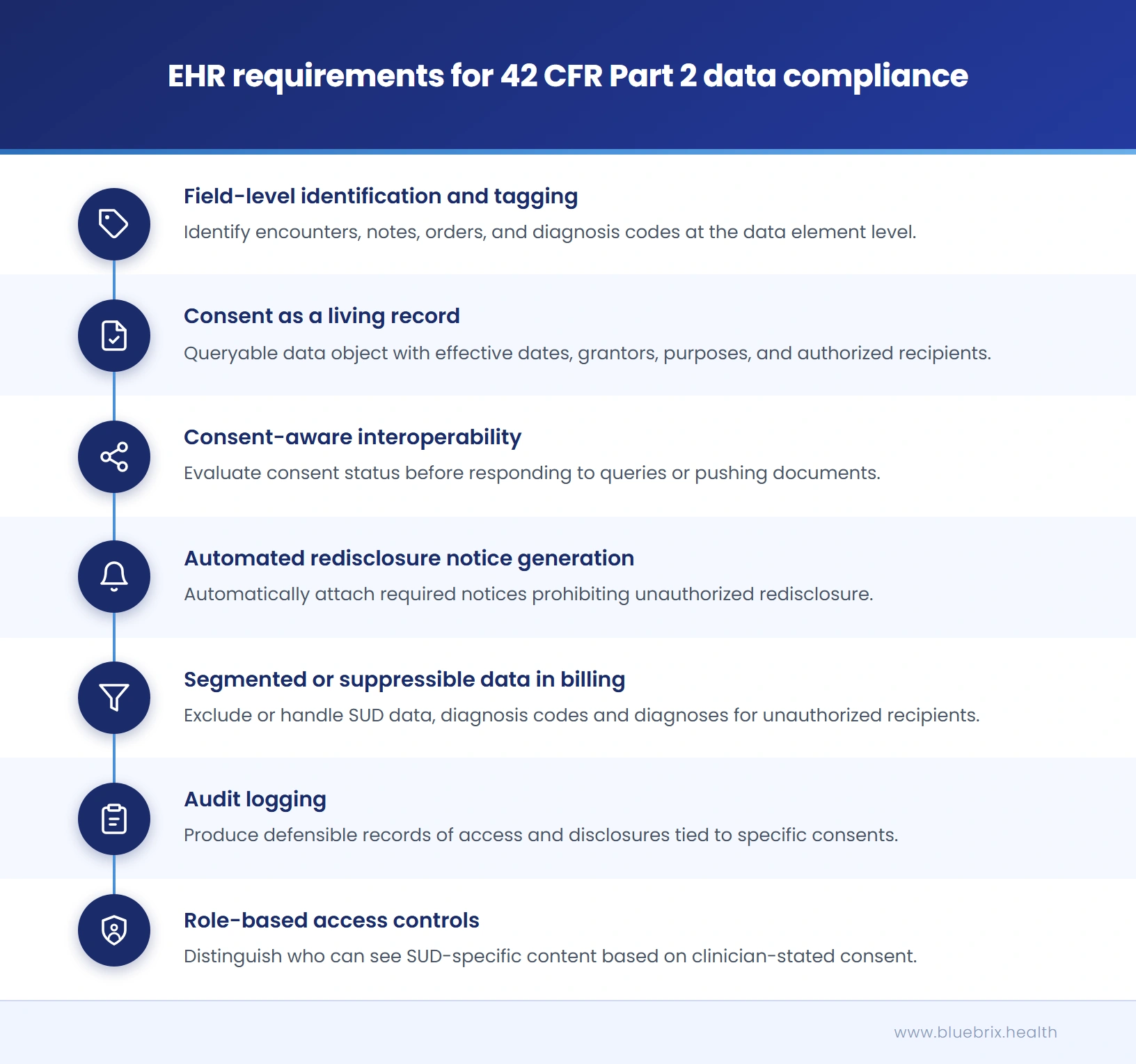
The technical requirements for Part 2 compliance reduce to a short list of capabilities. If your current system cannot check most of these boxes, that gap should be driving your platform evaluation, not a general dissatisfaction with the interface.
Field-level identification and tagging of Part 2 data
The system needs to know, at the data element level, which encounters, notes, orders, and diagnosis codes originated from or relate to SUD treatment under a Part 2 program. Tagging at the encounter level alone is not sufficient once that encounter’s data gets pulled into problem lists, medication histories, or summary documents that travel to other systems.
Consent as a living record
Consent status needs to be a queryable data object with an effective date, an expiration or revocation trigger, a defined set of authorized purposes, and a defined set of authorized recipients. Every workflow that could disclose Part 2 data, referral generation, HIE query response, patient portal release, billing submission, should check that object before the data moves, not rely on staff remembering to check a paper form.
Consent-aware interoperability
Your HIE participation, direct messaging, and FHIR-based exchange endpoints need to evaluate consent status before responding to a query or pushing a document that contains Part 2 data. This is where a lot of behavioral health organizations discover their EHR was never built with SUD-specific exchange logic, because the vendor’s primary market was general medical or acute care.
Automated redisclosure notice generation
When Part 2 data is disclosed with consent, the required notice prohibiting unauthorized redisclosure needs to travel with it automatically. If this depends on staff attaching a document manually, it will eventually be missed.
Segmented or suppressible data in billing and claims workflows
Revenue cycle systems need the ability to exclude or specially handle SUD-related charge codes and diagnoses when the payer or clearinghouse is not an authorized recipient, without creating a parallel, disconnected billing process that increases denial and reconciliation work.
Audit logging built for Part 2 accounting requests
You need to produce a clear, defensible record of every access to and disclosure of Part 2 data, tied to the consent that authorized it, on demand. Generic HIPAA access logs that do not distinguish Part 2 data from the rest of the chart will not get you there.
Role-based access controls calibrated to Part 2
General EHR role-based access typically governs who can see a chart. Part 2 compliance requires a finer distinction: who can see the SUD-specific components of that chart, under what circumstances, and with what consent basis.
Even organizations that understand this list on paper tend to stumble in a few predictable ways once they try to put it into practice.
Five Part 2 compliance mistakes behavioral health organizations keep making
A few patterns show up repeatedly in Part 2 compliance reviews, and they are worth naming directly because they are usually the result of reasonable assumptions rather than negligence. The five most common Part 2 mistakes are: assuming “segmentation isn’t required” means no field-level control is needed, treating a signed consent as a one-time static event, building manual workarounds around an EHR not designed for Part 2, underestimating billing as a disclosure risk, and having no process to catch expired or revoked consent.
Segmentation “not required” myth
As noted above, the rule does not require segmentation as a specific mechanism. Some organizations have read that as license to skip the investment entirely, when the actual requirement, being able to track and control consent-based disclosure, still demands something functionally very close to segmentation in most system architectures.
Treating consent as static
One consent form does not mean one static state. Patients can revoke, and revocation has to propagate to every downstream system and workflow immediately, not on the next batch sync.
Manual Part 2 workarounds
This is common in organizations running a mainstream EHR that was not designed with behavioral health or Part 2 in mind. The workaround usually involves a parallel tracking spreadsheet, a designated staff member who manually reviews certain exports, or a policy that certain reports simply are not run through automated interfaces. These workarounds function until staff turnover, volume growth, or a new HIE participation agreement exposes the gap.
Underestimating billing exposure
Compliance teams often focus heavily on clinical documentation and HIE exchange, and less on revenue cycle, even though claims data carrying SUD-related codes is one of the more common unintentional disclosure vectors, particularly with clearinghouses and payers that are not confirmed as authorized recipients under the current consent.
No process for consent expiration monitoring
Static consent forms with no system-level expiration tracking mean data can continue flowing under an authorization that has technically lapsed, with no one aware until an audit or a patient complaint surfaces it.
Recognizing these patterns in your own organization is useful on its own. Turning that recognition into a system-level fix means forcing a direct answer to a few pointed questions, whether you’re auditing your current EHR or evaluating a new one.
Questions to ask when evaluating your EHR for Part 2
If you are assessing whether your existing EHR or a prospective platform genuinely supports Part 2 compliance, a few direct questions cut through vendor language quickly:
- Can the system tag SUD-related data at the field or element level, not just at the encounter or document level?
- Does consent status function as a real-time, queryable object that interface engines and interoperability endpoints check before transmitting data?
- What happens automatically when a patient revokes consent? Does that revocation propagate to active HIE connections and scheduled exports, or does it require manual intervention?
- Can billing and claims workflows identify and appropriately handle Part 2-related charge data before submission to a payer or clearinghouse?
- Does the audit trail distinguish Part 2 disclosures from general PHI access, with the associated consent basis, in a format that supports an accounting of disclosures request?
- How does the system handle Part 2 data in patient portal releases and continuity of care documents generated for referrals?
- Is redisclosure notice generation automated, or dependent on staff remembering to attach it?
Organizations that get honest answers to these questions usually find the gap sits in platform capability, not policy. No amount of staff training closes a gap that only a system-level control can address.
This is the point in the evaluation where many behavioral health organizations start looking specifically at platforms built around SUD workflows, as opposed to general medical EHRs retrofitted with a Part 2 module.
How a compliant EHR handles Part 2 data
Pulling the requirements above into a single picture, an EHR built for Part 2 compliance, rather than retrofitted for it, generally does a few things well:
Access control at the program, encounter, or form level
It separates SUD-related programs, encounters, or documentation from the rest of the chart clearly enough that access can be restricted at that level, rather than relying on staff to manually identify and redact protected information before it moves anywhere. Program-, encounter-, or form-level access control covers most real-world cases, since SUD-specific information is usually captured in its own dedicated form or encounter type, not scattered across a general note. blueBriX supports this today at the program, encounter, and form level, though not yet at the individual data-element level within a single note: organizations can categorize SUD-related programs and encounters and restrict access accordingly, so a form containing protected information stays hidden from users without specific access, even when it sits alongside general medical documentation in the same chart.
Emergency access as a logged exception
It treats emergency access as a deliberate, logged exception rather than a silent workaround. A break-the-glass control that walls off protected information behind a separate credential check, limited to admins or designated privileged users, creates the kind of audit trail Part 2’s emergency exception actually requires. blueBriX includes this as a built-in feature.
Field-level tagging and consent-aware automation
Program-, encounter-, and form-level access control handles most real-world SUD documentation, but it isn’t the ceiling. A more advanced system would tag SUD-related data at the individual element level, so a single medication order or diagnosis code could carry its own consent status even inside a note that’s otherwise general medical documentation, rather than requiring an entire form or encounter to be walled off. That granularity would let downstream workflows make automated decisions instead of defaulting to “exclude everything behavioral health” or “include everything and hope someone reviews it.”
The same logic extends to data leaving the organization. Ideally, consent status would be checked at the point of exchange itself, HIE queries, referral generation, Direct messaging, so a lapsed or revoked consent stops a disclosure automatically rather than depending on a staff member catching it first. Billing would work the same way: claims carrying SUD-related codes would be checked against active consent and authorized recipient status before submission, closing one of the more commonly overlooked disclosure paths in behavioral health revenue cycle operations. And redisclosure notices and audit trails would generate automatically and tie back to the specific consent record, which matters directly when an organization has to respond to an accounting of disclosures request or an OCR inquiry.
Interoperability is where Part 2 compliance gets tested most
Care coordination and HIE participation are where the operational tension between “share more to coordinate care” and “disclose nothing without consent” becomes concrete. The 2024 Final Rule was written partly to reduce information-sharing friction that had historically made SUD patients harder to coordinate care for, particularly during emergencies or transitions between providers. That is a legitimate and worthwhile goal. But the underlying obligation hasn’t gone away. What has changed is the consent mechanics beneath it.
If your organization participates in a regional or state HIE, or exchanges data through Direct messaging, TEFCA-aligned frameworks, or FHIR-based APIs, your integration layer needs consent logic sitting in front of every outbound and inbound Part 2-relevant transaction. A query-based HIE that pulls a patient’s full longitudinal record for a treating provider needs a mechanism to suppress or specially authorize the SUD component of that record based on current consent status, not a blanket policy of excluding all behavioral health data from HIE participation, which defeats the purpose of the exchange and can itself work against good care coordination.
This is also where the distinction between “segmentation is not mandatory” and “you still need field-level control” becomes most concrete. An HIE responding to a query cannot make a nuanced, consent-based decision about which parts of a combined record to release unless the underlying data is tagged in a way that supports that decision. The rule gives you flexibility in how you architect that capability. It does not give you flexibility in whether you need it.
Technology and standards address the mechanics of consent-aware exchange. None of it holds up without governance discipline sitting on top of it.
What good Part 2 governance looks like operationally
Beyond the technology itself, sustainable compliance depends on a few operational disciplines that hold regardless of which EHR platform you run:
- A documented data flow map showing every point where Part 2 data enters, is stored, and could potentially leave the organization, including billing, HIE, referrals, and patient portal releases.
- A defined process for consent capture, revocation, and expiration that is tied directly to system-level enforcement rather than relying on staff memory or manual review.
- Regular audits comparing actual disclosures against active consents, ideally quarterly, to catch drift before it becomes a pattern OCR would characterize as systemic.
- Updated Notices of Privacy Practices reflecting the new Part 2 language requirements, since the February 16, 2026 deadline covered NPP updates as well as system-level compliance.
- A clear internal owner for Part 2 governance, since it frequently falls into a gap between compliance, IT, and clinical operations when no single role is accountable for it.