

Why do behavioral health no-show rates need a different approach?
Behavioral health has the highest no-show rates of any medical specialty in the United States. [2] [3]
| Medical Specialty / Setting | Typical No-Show Rate |
|---|---|
| Substance Use Disorder (SUD) Treatment | 30%+; up to 50% in some settings |
| Outpatient Therapy | 20–30% |
| Psychiatry | ~23% |
| Cardiology | 8–15% |
| Primary Care | 5–8% |
That’s a significant gap!
A 2024 analysis of nearly two million encounters published in npj Digital Medicine found that behavioral health appointments carry roughly three times the no-show odds of other specialties. In safety-net settings, the numbers climb further: a peer-reviewed study of 11 FQHCs across New York City documented a baseline behavioral health no-show rate of 41.6% [4] — and found that adding appointment reminders reduced that figure by just two percentage points.
That last data point particularly signals that the interventions most practices rely on — automated reminders, no-show fees, overbooking — are treating a symptom they do not understand. Instead of asking “how do we get patients to show up?” behavioral health organizations should be asking “why do the standard approaches fail in this specialty, and what does that failure tell us about what the behavioral health EHR needs to do differently?”
In this blog, we’ll explore these questions.
How missed appointments impact value-based contracts
A 2026 systematic review and meta-analysis published in Psychiatric Services — the American Psychiatric Association’s services research journal — analyzed 35 studies and 40 datasets covering mental health outpatient nonattendance from inception through July 2024. The findings were unambiguous: nonattendance at mental health clinics was consistently associated with greater illness severity, low functioning, substance use disorders, negative attitudes toward treatment, and poor therapeutic alliance. [5] The pooled nonattendance rate was 34% at first appointments, 42% at second appointments, and 64% at subsequent appointments — a pattern of escalating disengagement that tracks with worsening symptoms, not with worsening scheduling logistics.
That pattern does not appear in general medical settings. A 2025 systematic review [6] of over 13 million primary care appointments across eight countries found that no-show predictors in general practice clustered around transportation barriers, scheduling friction, and socioeconomic disadvantage — structural and logistical factors, not clinical ones. A separate 2021 systematic review of 26 primary care studies [7] confirmed the same: the most commonly reported reasons patients gave for missing general practice appointments were work or family commitments, forgetting the appointment, and transportation difficulties.
The contrast is the point. In primary care, the dominant no-show drivers are external to the patient’s clinical condition. [8] In behavioral health, the dominant drivers are the clinical condition itself.
The evidence for this runs across diagnoses. A 2023 systematic review and meta-analysis of behavioral economic interventions for appointment nonattendance, published in BMC Health Services Research [9], identified that behavioral factors including cognitive overload and avoidance impede timely care-seeking and influence motivation to attend appointments — and noted that these factors are distinct from the logistical barriers that dominate general medical nonattendance literature. In a 2021 study of psychiatric outpatient nonattendance published in BJPsych Open, 34% of patients who missed psychiatric appointments had documented histories of self-harm risk, and 75% were unemployed — both markers of functional impairment driven by the psychiatric condition, not by scheduling inconvenience.[10] A 2025 study of telepsychiatry implementation in Qatar, published in PMC, documented that in mental health settings specifically, nonattendance results in clinical deterioration, inappropriate emergency department use, and delayed treatment onset — and that for patients recently discharged from inpatient units, missing initial outpatient appointments is predictive of higher re-hospitalization rates. [11]
For substance use disorders, the evidence is equally direct. A 2025 study published in PLOS ONE reported that meta-analyses of SUD treatment dropout place rates between 19.7% and 47%, with relapse and disengagement identified as clinically distinct, measurable phenomena that predict treatment failure. A 2022 peer-reviewed study in Substance Abuse Treatment, Prevention, and Policy confirmed that treatment completion is strongly correlated with lower risk of relapse — meaning the missed appointment and the clinical deterioration reinforce each other in a cycle that generic scheduling interventions cannot interrupt [12].
The 2024 npj Digital Medicine analysis of nearly two million encounters quantified the result: mental health appointments carried no-show odds of 2.99 (95% CI 2.84–3.14) relative to other specialties — and this remained true even after controlling for demographic and insurance factors. [13] The condition, not the circumstance, explains the gap.
A behavioral health EHR should handle this differently from a general practice system.
| General practice EHR | Behavioral health EHR |
|---|---|
| No-show is primarily treated as an administrative event. | No-show should be treated as a potential clinical signal. |
| Triggers a rescheduling prompt. | Triggers a clinical workflow in addition to rescheduling. |
| May generate a no-show billing/fee flag. | Should initiate risk-stratified outreach based on the patient’s clinical context. |
| Assumes nonattendance is largely a scheduling or convenience issue. | Recognizes that illness severity, low functioning, and active symptoms can drive nonattendance. |
| Rescheduling is generally the primary response. | Assigned care team is alerted to assess potential deterioration or disengagement. |
| Same workflow can be applied across specialties. | Workflow should account for behavioral-health-specific risk and history. |
| A missed appointment remains largely separate from clinical decision-making. | Patients with a documented history of disengagement can be escalated to the treating clinician. |
| Architecture: optimized for appointment management. | Architecture: connects appointment behavior to clinical risk, engagement, and care-team workflows. |
Core distinction: A behavioral health EHR should not treat a no-show like a missed dermatology appointment—it should recognize that nonattendance itself can be clinically meaningful.
Stigma compounds the problem. The Ferreira (2026) meta-analysis [14] confirmed that negative attitudes toward treatment remain a consistent predictor of nonattendance across the 35 studies reviewed, more than a decade after the Corrigan framework was published.
The pattern across all of these populations is the same: the no-show is a clinical engagement problem that manifests as a scheduling event, and the EHR is the system that either recognizes the difference or doesn’t.
How missed appointments impact value-based contracts
A $200 lost billable hour is what a behavioral health no-show cost under fee-for-service. Under value-based care, it costs something harder to recover: a quality measure, a contract performance tier, and the clinical signal you needed to intervene before the patient deteriorated.
Multiplied across a practice, the fee-for-service arithmetic alone is significant: industry analyses estimate annual revenue losses of approximately $150,000 per provider, and the U.S. healthcare system absorbs an estimated $150 billion in total annual no-show costs.[15] But the value-based care math changes shape entirely, because a missed appointment is no longer just an empty slot. It is a degraded quality measure, a treatment retention failure, and — under the right contract structure — a direct reduction in reimbursement.
Three regulatory shifts since 2024 have made this concrete for behavioral health organizations.
- The Consolidated Appropriations Act of 2024 made CCBHCs a permanent Medicaid state plan benefit.
SAMHSA’s 2023 updated certification criteria mandated quality measure reporting for all CCBHCs beginning calendar year 2025, with the first data submission to SAMHSA due September 2026. The required measure set includes follow-up after hospitalization for mental illness (FUH), follow-up after emergency department visits for mental illness (FUM) and alcohol/drug dependence (FUA), and initiation and engagement of treatment (IET) — every one of which is degraded by missed appointments and lost-to-follow-up patterns.[16][17] - The 2024 MHPAEA Final Rule (published September 9, 2024; effective November 22, 2024) requires health plans to conduct and document comparative analyses of non-quantitative treatment limitations for mental health and substance use disorder benefits.
Although federal enforcement of the new NQTL comparative analysis requirements was paused in May 2025, several states continue independent parity enforcement — meaning access and wait-time data already carries compliance weight in those jurisdictions. [18] - Behavioral health organizations with value-based contracts tied to engagement, retention, and outcome metrics — whether through CCBHC demonstration participation, Medicaid managed care contracts, or ACO arrangements — are now measured on the downstream consequences of no-shows, not just the no-shows themselves.
This is where the EHR becomes the decisive system. Quality measure reporting pulls from the clinical record. If the EHR does not connect scheduling data (missed appointments) to quality measure denominators (follow-up rates, treatment engagement rates) automatically, the organization is either manually reconciling two data sources or — more commonly — discovering the gap at reporting time when it is too late to intervene. A behavioral health EHR built for value-based care should surface no-show trends in the context of the quality measures they affect, not in a standalone scheduling report that no one connects to contract performance.
How missed appointments impact value-based contracts
No-show rates in behavioral health are not a single problem. The clinical dynamics, the patient populations, the visit frequency, and the regulatory exposure differ materially by setting. Each one makes a distinct demand on the EHR.
CCBHCs
CCBHCs serve diverse populations — often including individuals with co-occurring disorders, justice involvement, and housing instability — which concentrates every structural barrier to attendance in one patient panel. The mandatory CCBHC quality measure set now ties reimbursement to metrics like follow-up after hospitalization (FUH) and initiation and engagement of treatment (IET), both of which are directly suppressed by no-shows. The EHR requirement here is specific: the system needs to connect missed appointment data to follow-up measure denominators in real time, so the care team can intervene within the measure’s compliance window rather than discover the gap during annual reporting.
PHP/IOP multi-program organizations
Partial hospitalization and intensive outpatient programs operate on a structured attendance model — typically three to five days per week. A single no-show in a PHP or IOP does not just empty a time slot. A missed appointment can affect the entire group and disrupt the patient’s treatment continuity. The payer may even question whether the patient still meets medical-necessity criteria for that level of care. That’s why the EHR needs to track attendance at the program level and not just through individual provider schedules. It disrupts a group therapy cohort, breaks therapeutic continuity for the absent patient and the group, and may trigger an authorization question from the payer about whether the patient still meets medical necessity for that level of care. The EHR needs program-level attendance visibility, not just provider-level scheduling. A scheduling dashboard that tracks individual provider calendars without surfacing program-wide attendance patterns will miss the problem PHP/IOP administrators actually need to manage.
SUD residential (multi-site enterprise)
Residential SUD treatment has the highest dropout rates in behavioral health — SAMHSA’s Treatment Episode Data Set (2023) documented attrition rates across SUD treatment settings that, combined with early dropout literature, place residential treatment interruption rates in the range of 22% to over 40% depending on the population and program structure. The highest-risk no-show moment is not during residential stay (where the patient is on-site) but at the first post-discharge outpatient follow-up appointment. Missing that appointment is a strong predictor of relapse and re-admission. The EHR needs to manage post-discharge outreach workflows that comply with 42 CFR Part 2 consent requirements for substance use disorder records — a regulatory layer that general-purpose EHRs typically do not handle natively, and one that complicates every automated outreach message sent to a patient with an SUD diagnosis.
BH outpatient enterprise
At enterprise scale, the revenue impact of no-shows compounds in ways that single-site clinics never experience. A 25% no-show rate across 51 providers represents hundreds of unrecoverable clinical hours per week — and the pattern is often invisible at the leadership level because no-show data is siloed by location or provider rather than aggregated and analyzed across the organization. The EHR must offer multi-site scheduling analytics to highlight no-show trends by provider, location, payer, visit type, and patient demographic. This should not come as a custom report request, but a standard operational dashboard available to operations leadership without requiring IT intervention.
Psychiatric residential treatment facilities (PRTF/QRTP)
PRTFs present a different no-show pattern from outpatient or community settings. The residents are on-site; individual therapy and group sessions are part of the daily schedule, not appointments patients travel to attend. The no-show problem in PRTFs centers on family therapy sessions, court-mandated family visits, school coordination meetings, and discharge planning appointments — all of which depend on caregiver or guardian attendance, not patient attendance. The EHR needs to track caregiver engagement as a distinct workflow element, separate from the patient’s own treatment record, with its own scheduling, reminder, and follow-up logic. Most behavioral health EHRs do not make this distinction.
Turn no-shows into an early warning signal
If your no-show data lives in a scheduling module disconnected from your quality reporting, you’re finding out about the problem after it has already cost you.
blueBriX connects scheduling, clinical workflows, and quality data—so missed appointments can become actionable signals, not just missed visits. Give your care teams the context they need to identify disengagement, prioritize outreach, and intervene earlier.
Book a demoWhat the evidence says works — and what a behavioral health EHR needs to enable it
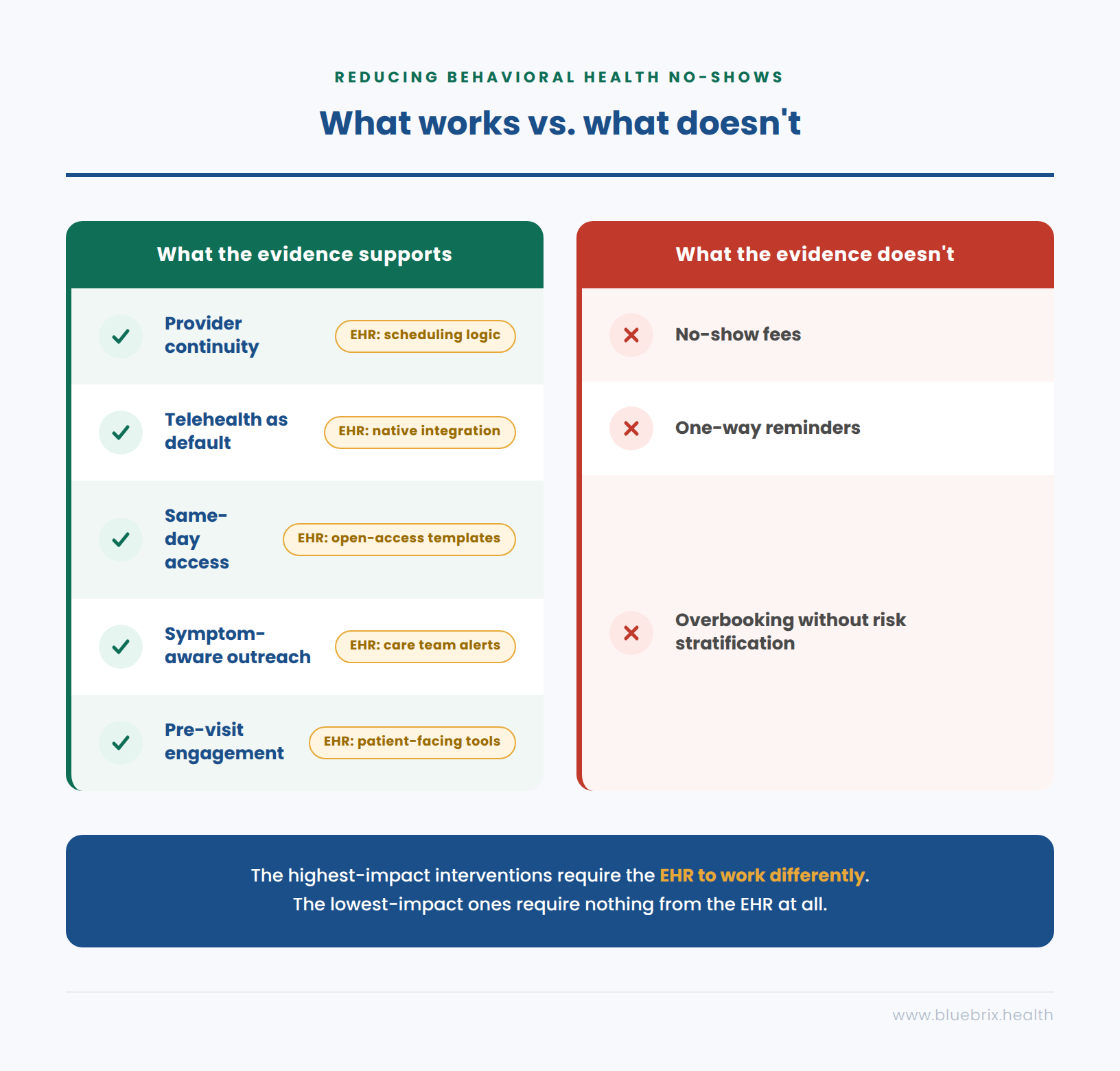
The following interventions dominate the peer-reviewed evidence on reducing behavioral health no-shows.
Therapeutic alliance and provider continuity consistently predict whether a behavioral health patient stays in treatment or drops out — and this holds true across residential, outpatient, and transitional settings.
In a residential DBT program, a 2023 study in BMC Psychiatry found that therapeutic alliance was the only factor that significantly predicted dropout — not diagnosis, not demographics, not trauma history.[19] A 2025 study of nearly 796 adults in outpatient psychiatric care confirmed the same pattern: patients who reported stronger early alliance with their provider were significantly less likely to drop out. And for organizations managing level-of-care transitions — PHP to IOP, residential to outpatient — a 2024 study in the British Journal of Psychiatry[20] found that keeping the same treatment team across settings improved outcomes specifically because it preserved the therapeutic relationship through the transition.
The takeaway for operations leaders: if your scheduling system makes it easy to break provider continuity — reassigning patients to whoever has the next open slot, resetting the provider relationship at every level-of-care change — it is actively working against the single factor most likely to keep patients in treatment. The EHR should route patients to their assigned provider by default, flag when continuity is about to break, and carry the provider-patient relationship forward through step-downs and transitions rather than treating each level of care as a separate scheduling silo.
Telehealth as a default modality for appropriate visit types significantly reduces no-show rates, with stronger effects in behavioral health than in other specialties.[21] Medication management, brief follow-ups, and crisis check-ins are natural telehealth candidates. The EHR needs telehealth integrated natively — not as a bolt-on that requires a separate login, a separate scheduling workflow, or a separate billing path — so that converting an in-person appointment to a virtual visit is a one-step action for the front desk or the patient, not a workflow change that requires coordination across systems.
Same-day and next-day scheduling access reduces no-shows by shortening the gap between the decision to seek care and the appointment itself. Research consistently shows that longer lead times between scheduling and appointment increase no-show probability, with appointments scheduled more than 60 days out showing the highest no-show rates.[22] The EHR needs open-access scheduling templates that make same-day availability visible and bookable — including through patient-facing self-service tools — without requiring front-desk staff to manually identify and release slots.
Symptom-aware outreach triggers are the intervention most directly connected to the clinical-signal argument at the core of this article. When a behavioral health patient misses an appointment, the EHR should initiate a clinical workflow — not just a rescheduling prompt. blueBriX’s treatment plan notification system is designed for this: configurable alerts route missed-appointment signals to the assigned care team, trigger outreach tasks, and connect to referral management and scheduling actions directly from the notification dashboard. This turns the no-show from a scheduling gap into a care coordination event, which is what the clinical evidence says it should be.
Pre-visit digital engagement creates psychological investment in the appointment before the patient arrives. Patient portal check-ins, pre-visit self-assessments, and digital intake forms reduce no-show rates by an additional margin on top of reminders alone.[23] The EHR needs patient-facing tools that are woven into the care workflow — not a separate portal that patients have to remember to log into — so that the pre-visit engagement feels like part of the care relationship, not an administrative task.
What doesn’t work — or works less than assumed: No-show fees in behavioral health populations show modest deterrent effects at best and disproportionately penalize patients with the highest clinical acuity and the lowest financial resources. A 2025 MGMA member survey suggest found that only 25% of practices charging no-show fees reported any improvement in attendance rates. One-way automated reminders in isolation — without two-way communication, without the ability to reschedule via the reminder itself — produced just a 2% improvement in the FQHC study. Overbooking without clinical risk stratification creates wait-time problems that themselves drive future no-shows.
What to look for in a behavioral health EHR built for this problem
If your EHR cannot do the following five things, it was not designed for the specialty-specific dynamics of behavioral health no-shows — and no amount of reminder automation or scheduling policy will close the gap.
Treat a missed appointment as a clinical workflow trigger, not a scheduling void
The EHR should route no-show events to the care team as configurable alerts, with direct actions available from the notification — outreach tasks, referral initiation, appointment rescheduling — without requiring the care coordinator to navigate to a separate module. blueBriX’s treatment plan notifications dashboard is configured to do this: alerts are routed to selected care team members, with schedule appointment, task creation, referral management, and direct patient communication actions available in a single workflow step.
Connect scheduling data to quality measure reporting automatically
No-show trends could directly impact CCBHC measures such as FUH, FUM, FUA, and IET, apart from HEDIS behavioral health metrics and value-based care quality targets. When scheduling data lives in one system and quality reporting is in another system, such gaps get noticed only after they’ve already become a problem. blueBriX brings scheduling, clinical documentation, and quality tracking together, within one system, with reporting designed for CCBHC, Medicaid, and value-based care requirements.
Support program-level attendance visibility, not just provider-level scheduling
PHP, IOP, and residential programs need to see attendance at the program and cohort level — which patients attended group today, which are trending toward disengagement, which are approaching authorization review thresholds. blueBriX’s program management module provides scheduling dashboards at the program level with configurable enrollment, level-of-care tracking, and ASAM-score-based workflows.
Integrate telehealth at zero incremental cost with a single scheduling and billing path
If converting an in-person appointment to a virtual visit requires a separate system, a separate workflow, or a separate charge structure, it will not happen at the front-desk level where it needs to happen. blueBriX includes HIPAA-compliant telehealth natively — with in-session documentation, ePrescribing, and billing support across Medicaid, commercial, and self-pay — at no additional cost.
Provide multi-site scheduling analytics for enterprise operations
Organizations with multiple locations need no-show data aggregated across sites, segmented by provider, payer, program, and visit type, and available as a standard operational view — not a custom report. blueBriX’s centralized multi-site management consolidates scheduling, documentation, and billing across all locations in a single system.
The missed appointment is the signal. The EHR is where you decide what to do with it.
Behavioral health’s higher no-show rates make missed appointments a clinical signal, not just a scheduling gap. Under value-based care, CCBHC reporting, and MHPAEA requirements, failing to act on that signal can affect quality scores, contract performance, and patient outcomes.
See how blueBriX turns no-show data into clinical workflow triggers across your programs — from scheduling through quality reporting, in a single system.
Book a demo