

Autism centers and (Applied Behavior Analysis) ABA practices that outgrow a general behavioral health billing system usually run into the same wall: the software wasn’t built for how ABA services are actually authorized and delivered. ABA billing software is built around a different unit of measurement than most revenue cycle tools: unit-based authorization consumption, tracked in 15-minute increments, paired with session-level clinical documentation that must independently justify each billed unit. That’s a different design problem than the encounter-based logic driving most medical billing platforms, where a visit either happened or it didn’t and the note exists mainly to support coding level.
That mismatch surfaces as two failure modes that tend to compound each other. Authorized units run out before a treatment plan concludes, forcing a scramble for reauthorization mid-course of care. Session notes, written to satisfy an internal checklist, don’t hold up when a payer reviews them for medical necessity or requests documentation to support continued treatment. Neither problem shows up as urgent on its own. Together, they define the operational bind at the center of ABA revenue cycle management: clinicians lose continuity of care, billing teams lose revenue to denials and recoupment, and most practices don’t connect the two until they land on the same claim.
A Registered Behavior Technician (RBT) delivers most of the direct service in this model, working under the supervision of a Board Certified Behavior Analyst (BCBA), which is the layered structure behind most of what follows in this piece. That supervision relationship carries direct billing weight: auditors review supervision documentation alongside session notes, which means a gap on the clinical side can undercut a claim that’s otherwise clean.
What follows covers why units run out mid-plan, what payers actually check in session notes, where supervision fits into claim defensibility, and how to evaluate software built for this model.
What makes ABA and autism center billing different from other behavioral health billing?
Most behavioral health billing runs on a per-encounter model: a session happens, a code gets billed, and authorization (where required) covers a number of visits over a defined period. ABA billing runs on unit math instead. Codes like 97153 (technician-delivered treatment by protocol), 97155 (treatment with protocol modification, typically billed by the BCBA), and 97156 (family adaptive behavior treatment guidance) are billed in 15-minute increments, part of the Category I adaptive behavior treatment code set (97151 through 97158) that payers require.[1]
That unit structure changes what an authorization actually represents. It is a finite pool of 15-minute units tied to a specific date range, and a treatment plan can run out of units well before it runs out of calendar days if session frequency or duration drifts even slightly from what was authorized.
The layered service delivery model adds a second dependency most general medical billing platforms were never built to track. An RBT delivers direct service under BCBA supervision, and a single qualified health professional cannot bill 97153 and 97155 concurrently for the same session, which means billing accuracy depends on knowing exactly who did what, when, under whose direction.[2] A generic behavioral health EHR built for solo-practitioner psychotherapy or psychiatry simply doesn’t have a data model for that chain. It has no concept of a technician acting under a supervising clinician’s authorization, because most BH billing doesn’t require one.
ABA authorization also runs on a different model than the visit-based concurrent review used for other behavioral health levels of care, such as IOP, PHP, or residential treatment. Organizations offering both ABA and one of these levels of care need separate tracking logic for each, rather than a single authorization framework stretched across service lines.
That layered dependency is a structural fact of ABA billing. What it doesn’t explain on its own is why units specifically tend to run out mid-plan, which is where the actual breakdown patterns come in.
Why do ABA authorization units run out before the treatment plan is complete?
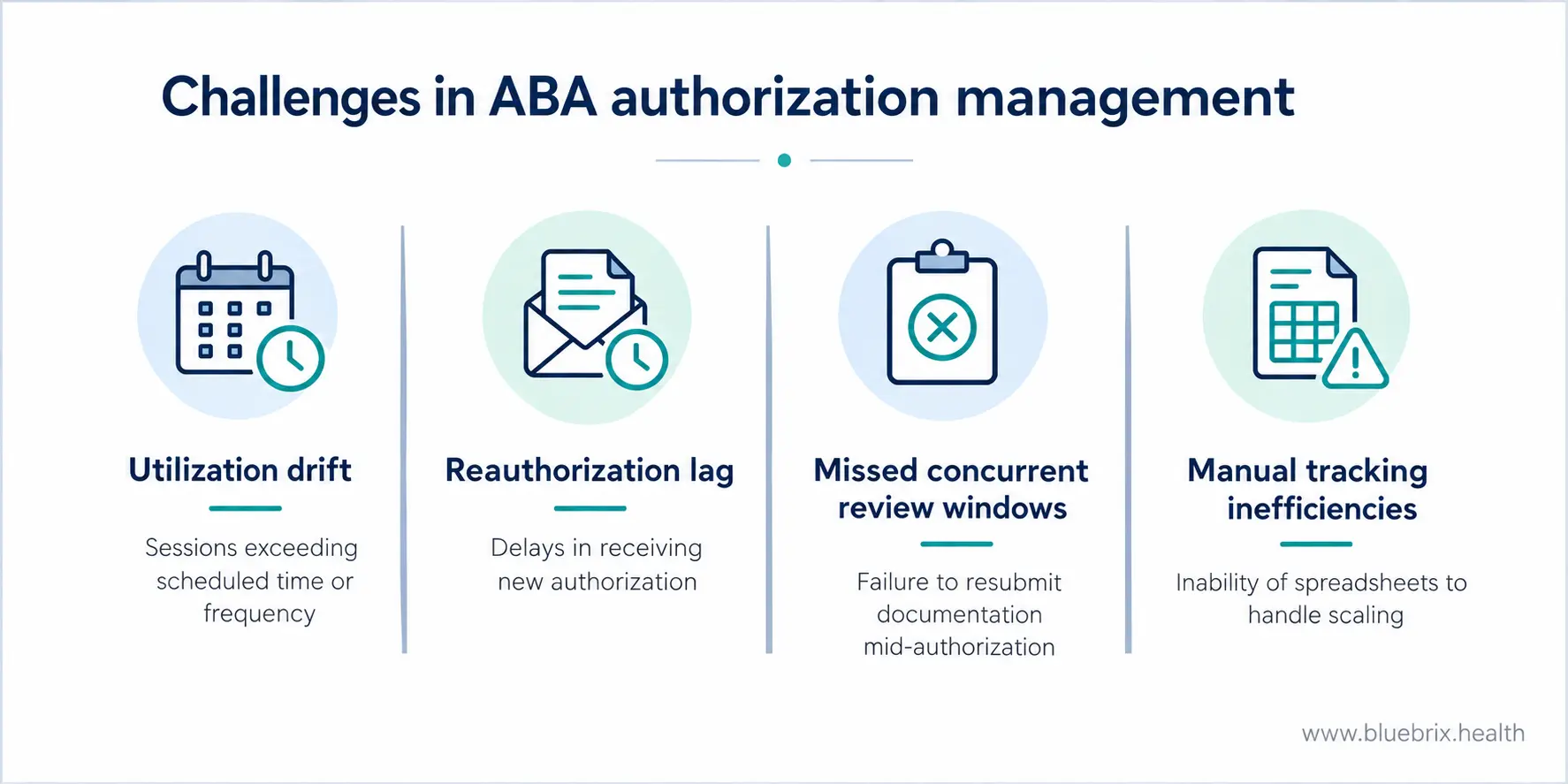
Unit exhaustion rarely comes from one dramatic failure. It comes from small, compounding gaps that a manual tracking process can’t catch until the balance is already gone. The scale of that risk shows up in federal audit data: HHS-OIG has completed four state Medicaid ABA audits to date, Indiana[3], Wisconsin[4], Maine[5], and Colorado[6], and everyone found that all 100 sampled enrollee-months included at least one improper or potentially improper claim line. Authorization and unit management are where a large share of that exposure starts. Here are the reasons, or common hurdles, clinics stumble on most often.
Utilization drift
A treatment plan is authorized assuming a certain weekly cadence, but sessions run slightly longer than scheduled, get added for makeup days, or increase in frequency as a BCBA adjusts the protocol. Each adjustment is clinically reasonable on its own. None of them individually trigger a red flag. But units burn faster than the authorization period assumed, and by the time someone notices, there are three weeks of treatment plan left and two weeks of units.
Reauthorization lag
Submitting a reauthorization request the week units run out doesn’t account for payer processing time, and the gap between “units exhausted” and “new units approved” becomes a period where a practice either interrupts care or delivers sessions on the expectation that authorization will be backdated. That second option carries its own audit exposure, since backdated authorization doesn’t retroactively make undocumented medical necessity defensible if the payer later reviews the claim.
CMS’s Interoperability and Prior Authorization Final Rule (CMS-0057-F) requires impacted payers, Medicare Advantage plans, state Medicaid and CHIP fee-for-service programs, Medicaid and CHIP managed care plans, and qualified health plan issuers on the federal exchanges, to issue prior authorization decisions within 72 hours for expedited requests and seven calendar days for standard requests, and to build electronic prior authorization APIs that let providers submit and track requests without manual portal work.[7] Most of these requirements took effect in 2026. For ABA practices, the practical effect is a shorter, more predictable turnaround window on reauthorization, which helps, but only for practices that submit requests early enough to actually benefit from a faster decision rather than treating reauthorization as a last-minute task.
Missed concurrent review windows
Some payers and managed care organizations also require concurrent review windows specific to ABA, meaning documentation has to be resubmitted at a defined point mid-authorization to justify continued service, separate from the initial authorization request. Missing that window can trigger a denial even with units technically still remaining.
Manual tracking that doesn’t scale
Spreadsheet-based tracking works for a handful of BCBAs managing a handful of caseloads. It stops working once a practice scales past that, because unit balances, authorization end dates, and treatment plan timelines are living independently in someone’s memory, a shared spreadsheet, and a payer portal, with nothing forcing those three sources to reconcile before a session gets scheduled. For a rev/finance leader, this shows up as unbilled units, write-offs on sessions delivered without valid authorization, and cash flow gaps that trace directly back to treatment interruptions nobody flagged in time.
Every one of those four failure points gets sharper once you factor in where a practice actually operates. The reauthorization lag and concurrent review problems above don’t play out the same way in every state, since Medicaid programs each set their own rules for how authorization is administered and renewed.
How ABA authorization requirements vary by state Medicaid program?
CMS-0057-F sets a floor for how fast a payer has to respond to a prior authorization request. It doesn’t touch how long an authorization actually lasts, who’s administering it, or what criteria get used to decide medical necessity, and that’s exactly where state Medicaid programs go their own way. If your organization operates across state lines, this is often the bigger headache, more than any single payer’s specific rules. Let’s look at the difference through three states, each running authorization through a different kind of administrator, which is where the real complexity actually lives for a multi-state operator.
- South Dakota keeps it simple: the state Medicaid program handles authorization directly. Six-month authorizations, reauthorize at the end of each period, done.[8]
- South Carolina hands the job off to Acentra Health, its Medicaid Quality Improvement Organization, instead of running it in-house. Authorizations still run six months, but reauthorization requests are due 10 to 30 days before expiration, which catches practices off guard if they’re only watching the expiration date itself. SCDHHS also layers in caseload limits as part of its medical necessity rules: a BCBA can carry up to 12 cases without a BCaBA on the team, or 16 with one. Most states don’t build caseload math into the authorization process at all.[9]
- Maryland goes a third direction, routing everything through a Behavioral Health Administrative Services Organization. Authorizations max out at 180 days, and getting more isn’t just a renewal form, the BCBA or BCBA-D has to complete a full reassessment before the clock runs out to justify continuing services.[10]
Same rough authorization length across all three states, three completely different administrators, three different renewal mechanics hiding underneath. A workflow built around “just renew every six months” would miss South Carolina’s earlier deadline and Maryland’s reassessment requirement without even realizing it. The lesson travels well past these three states: if you’re operating in more than one, assume the administrator and the renewal process are different until you’ve actually checked, rather than assuming your home state’s process is universal.
That covers the exhaustion half of the compounding risk named at the top of this piece, and how it varies depending on where you operate. The other half only shows up once a payer actually opens the file.
What does a payer audit actually check in ABA session notes
A clean claim isn’t the same as a defensible one. Payers reviewing ABA claims, particularly during post-payment audits, look past whether the code and modifier matched the authorization and into whether the session note itself supports medical necessity for that specific unit of service.
What the note actually has to show
The note has to connect the intervention delivered to a specific goal in the treatment plan, not simply log that a session occurred for a given duration.
- Time-logging only: “Worked on communication skills for 60 minutes.” Describes time spent, nothing else.
- Medical necessity documented: the specific protocol implemented, the client’s response, and progress toward a stated treatment plan objective.
Common triggers for denial or clawback
These are documentation patterns that look complete on a quick internal review but don’t meet a payer’s specific medical necessity criteria:
- Templated language that repeats across sessions with minimal individualization
- Missing linkage between the note and the authorized code or unit count it’s billing against
- Notes that don’t reflect the client’s individual treatment plan closely enough to withstand scrutiny
Internal QA checklists often catch formatting and completeness. They don’t always catch whether the clinical content would survive an external reviewer applying payer-specific standards.
Why this hits revenue?
A documentation failure discovered after payment doesn’t just risk a future denial. It triggers recoupment, meaning money already collected gets clawed back, sometimes across a sample of claims extrapolated to a broader improper payment estimate. This is the same pattern behind all four completed OIG audits in this series: at least $56 million in improper payments in Indiana, $18.5 million in Wisconsin, $45.6 million in Maine, and $77.8 million in Colorado, with documentation gaps and credentialing or supervision issues as recurring drivers across every state.
Both halves of the problem covered so far point to the same underlying fix: systems that treat authorization status and documentation as connected data instead of things reconciled by hand after something’s already gone wrong. Authorization tracking is where that fix starts.
How ABA authorization tracking reduces the risk of unit exhaustion?
The reasons units run out described above share a common root: nobody is watching the balance and the treatment plan timeline together, in real time, until something has already gone wrong. This isn’t a separate system to bolt on. It’s the authorization-side function that any ABA billing platform needs to get right, the same platform that also needs to handle documentation and supervision, covered next. This capability addresses that root cause directly, instead of surfacing it only after a session has already been booked or delivered. It functions differently from a general practice management dashboard, which typically shows scheduling and billing status but has no concept of a unit pool that depletes against a clinical timeline.
Real-time unit visibility
The core function is showing units consumed against units authorized, mapped directly to the treatment plan timeline. A BCBA or billing coordinator sees remaining balance and days remaining in one view, without reconciling two separate systems.
Threshold-based alerts
A number on a dashboard isn’t enough on its own; it has to trigger action before the balance runs out. Platforms built for this typically support automated alerts at defined thresholds:
- A set percentage of authorized units remaining
- A set number of days before an authorization period expires
Both remove the dependency on someone remembering to check manually.
Scheduling enforcement
This is the most operationally significant piece. Software that checks authorization status at the point of scheduling can block a session from being booked, or flag it before delivery, against an authorization that’s already exhausted or expired. That single control point closes most of the gap spreadsheet tracking leaves open: the check moves from “someone remembers to look” to “the system won’t let it happen.”
Why this matters more at scale
A solo BCBA can hold unit balances and authorization cycles in working memory. A practice running multiple BCBAs, multiple payers with different authorization cycles, and dozens of active treatment plans can’t rely on memory the same way. At that scale, exhaustion risk grows with headcount unless the tracking is built into the system itself.
That covers the authorization side. What closes the documentation half needs to be built on the same principle: structured around the same data.
What audit-ready ABA session documentation looks like
Authorization tracking addresses the unit-exhaustion half of the problem. Structured documentation addresses the audit-defensibility half. Both need to live in the same platform, since a note that’s audit-ready but disconnected from the authorization it bills against still fails the review.
Templates built around medical necessity language
Open free-text fields leave individualization entirely up to whoever is writing the note. Structured templates fix that by prompting for:
- The specific intervention delivered
- The treatment plan goal it addresses
- The client’s response
Built this way, a note reads as clinically specific by design, not by whoever happened to write it well that day.
Time-stamped, signature-verified records
This matters directly in an audit context. A timestamp and verified signature establish who delivered the service and when, without a separate log to confirm it.
Direct linkage to the authorized code and unit
Every note connects to the specific authorized service code and unit count it bills against. This closes the exact gap payer audits flag most often: a note that stands alone, disconnected from the authorization it’s supposed to support.
Does this add documentation burden or reduce it
For BCBAs and clinical directors evaluating this kind of tool, that’s the real question. Done well, structured templates reduce rework: a note built against the right prompts the first time doesn’t get sent back for revision before submission. They also reduce variability between RBTs writing notes for the same client, without removing clinical judgment from what gets written.
There’s a third piece of documentation sitting underneath both of the above, and it’s the one most billing conversations skip past entirely.
What role does RBT supervision documentation play in claim defensibility?
Supervision documentation sits at an intersection most billing conversations skip past: it’s simultaneously a professional standard, a payer condition of reimbursement in some cases, and a variable that can undermine an otherwise defensible session note.
The Behavior Analyst Certification Board’s RBT Handbook (current as of its most recent 2026 revision) requires RBTs to receive ongoing supervision for a minimum of 5% of the hours spent providing behavior-analytic services each calendar month, structured around at least two face-to-face, real-time contacts per month, with direct observation required in at least one of them.[11] That’s a certification requirement independent of billing. But some payers treat supervision documentation as a condition of reimbursement itself, which means a gap in the supervision log isn’t only a BACB compliance issue. It’s a billing exposure.
This creates a specific audit risk that’s easy to miss: a session note can meet every medical necessity standard on its own and still contribute to a claim that doesn’t hold up, if the supervision log for the RBT who delivered that session is incomplete or missing for the relevant period. The note and the supervision record are reviewed together, not independently.
In practice, ownership of supervision documentation often falls into a gap between clinical and administrative teams. BCBAs are responsible for delivering supervision and know whether it happened, but tracking whether every RBT’s monthly log is complete, current, and stored in a format that can be produced quickly during an audit request is closer to an administrative function. Practices that leave this ambiguous tend to discover the gap during an audit, not before one.
What should rev/finance and clinical leaders evaluate in ABA billing software
A feature list tells you what a platform claims to do. It doesn’t tell you whether the claim holds up once your BCBAs, RBTs, and billing staff are actually using it under a live caseload. The evaluation questions below are built to surface that gap during the sales process, before it becomes an implementation problem.
Ask to see it, not hear about it
Any vendor can say “real-time tracking” or “supervision documentation” on a slide. The differentiator is whether they’ll show it live: book a session against a near-exhausted authorization in a demo environment and watch what actually happens. If the platform lets the booking go through with just a visual flag, that’s a materially different product than one that blocks it outright, even though both might get described the same way in a sales conversation.
Ask who has to do the reconciling
The question isn’t whether clinical and billing data technically live in the same platform. It’s whether a BCBA and a billing coordinator can look at the same authorization status without one of them exporting a report or sending an email to the other. Ask to see both user views in the same demo, side by side.
Ask about the transition, not just the destination
Migrating supervision logs, active authorizations, and treatment plan data from an existing system carries real risk of dropped or corrupted records mid-transition. Ask specifically how the vendor handles migration of active, in-progress authorizations, not just how the finished system behaves on day one.
Ask what happens when a payer’s rules don’t match the template
Payer-specific documentation requirements change, and Medicaid programs update policy manuals more often than commercial payers. Ask how quickly the platform’s templates can be reconfigured for a payer policy change, and whether that requires the vendor’s engineering team or something your own staff can do.
Four questions worth putting to any vendor directly:
- Can unit-remaining alert thresholds be configured per payer or per client?
- Is the link between a session note and its authorized billing code visible to both clinical and billing staff, or only stored in the background?
- How quickly could you pull a complete supervision record for a specific RBT and date range if a payer requested one mid-audit?
- Does the platform block scheduling against an exhausted or expired authorization, or only flag it after the session is already booked?
Every question above traces back to one structural choice: whether these systems are actually connected or just sold as if they are.
How connecting ABA clinical documentation and revenue cycle data reduces risk
Siloed systems compound both halves of the pain point described earlier. When authorization status lives in a billing system, session notes live in a separate clinical documentation tool, and scheduling lives in a third, no single system has enough information to catch a problem before it becomes a denial or a recoupment event. Each system is technically doing its job. None of them can see the whole picture.
A unified workflow changes that by putting BCBAs, RBTs, and billing staff on the same authorization and documentation data, rather than three teams working from three partial views that only get reconciled manually, usually after something has already gone wrong. The operational benefit shows up as fewer reconciliation conversations between clinical and billing teams, faster identification of authorizations approaching exhaustion, and documentation that’s structurally linked to the billing code it supports rather than connected only by the coincidence of matching dates.
This is where a platform like blueBriX fits as a healthcare technology partner: supporting that kind of connected workflow across authorization tracking, scheduling, and clinical documentation, so the information a BCBA needs and the information a billing coordinator needs come from the same source rather than requiring a cross-check between systems that don’t talk to each other.