
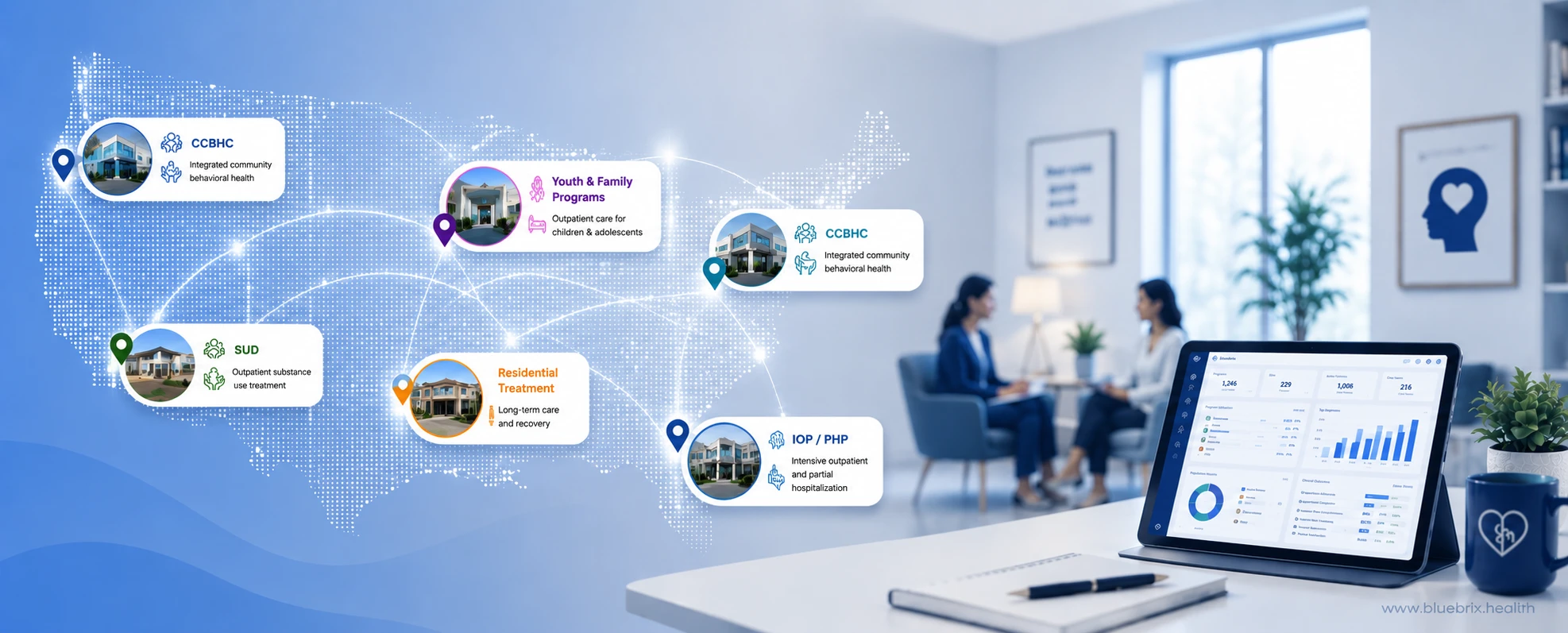
What is the need for a multi-site behavioral health EHR?
A multi-site behavioral health EHR is a clinical and operational platform that unifies patient records, scheduling, billing, compliance documentation, and reporting across two or more service locations within a single organizational instance. Unlike a general-purpose EHR deployed at multiple sites, a behavioral health-specific multi-site EHR is configured to handle the complexity inherent to this specialty: multiple levels of care within the same organization, substance use disorder confidentiality requirements under 42 CFR Part 2, program-level reporting for CCBHC certification or state contracts, and payer mix variation across locations.[1]
For operations leaders and IT decision-makers at enterprise behavioral health organizations, the core challenge is not whether to adopt an EHR. According to a 2026 ONC data brief [2] analyzing SAMHSA’s 2024 National Substance Use and Mental Health Services Survey (N-SUMHSS), more than two-thirds of substance use and mental health treatment facilities now use EHRs exclusively. The challenge is that the operational model required to run a multi-site behavioral health organization changes fundamentally at scale, and most EHR implementations were not designed for the version of the organization they now serve.
This article identifies the five operational functions that break in a predictable sequence as behavioral health organizations add sites. More importantly, it identifies the root cause that most technology evaluations miss entirely.
Why scaling a behavioral health EHR is not the same as growing your team
There is a persistent assumption in multi-site expansion planning: if the EHR worked at one location, deploying the same system at the next site should produce the same results. That assumption holds for basic functions like charting and scheduling. It collapses the moment you need data from two sites to tell you something meaningful about the organization as a whole.
Behavioral health is structurally more complex to scale than most other healthcare specialties. A general medical practice adding a second location primarily replicates the same service mix at a new address. A behavioral health organization adding a second site often introduces entirely new service lines, levels of care, payer contracts, and regulatory requirements. A community mental health center expanding into a partial hospitalization program operates under different documentation standards, different billing rules, and frequently different accreditation requirements than its existing outpatient operation.
Three characteristics of behavioral health make this complexity compound faster than in other specialties.
Multiple levels of care within a single organization. A mid-size behavioral health organization may simultaneously operate outpatient individual and group therapy, intensive outpatient programs (IOP), partial hospitalization (PHP), residential treatment, medication-assisted treatment (MAT), and crisis stabilization — each with its own documentation requirements, staffing models, and billing rules. When these programs span multiple physical locations, the permutations multiply.
Federal confidentiality rules with operational teeth. 42 CFR Part 2, which governs the confidentiality of substance use disorder patient records, imposes consent and data-segmentation requirements that do not apply in general medical settings. The final rule that took effect February 16, 2026, aligned Part 2 more closely with HIPAA but retained distinct consent requirements for initial disclosure. For multi-site organizations, this means the rules governing what patient data can flow between your own locations differ depending on the diagnosis, the consent status, and the specific services involved. An EHR that treats all clinical data as equally shareable across your network is a compliance liability.
Payer and program mix variation by site. Each location in a multi-site behavioral health organization may carry a different payer mix: one site may be predominantly Medicaid-funded and operating under a managed care contract, while another relies on commercial insurance with a significant self-pay component. If the organization operates CCBHCs, those locations use cost-based prospective payment rates that are structurally different from fee-for-service billing at non-CCBHC sites. The organization needs a single EHR instance that can accommodate these differences without forcing either site into a billing workflow designed for the other.
When organizations underestimate this complexity, the consequences follow a pattern. The EHR does not fail catastrophically. Instead, it degrades gradually — in a specific, repeatable sequence.
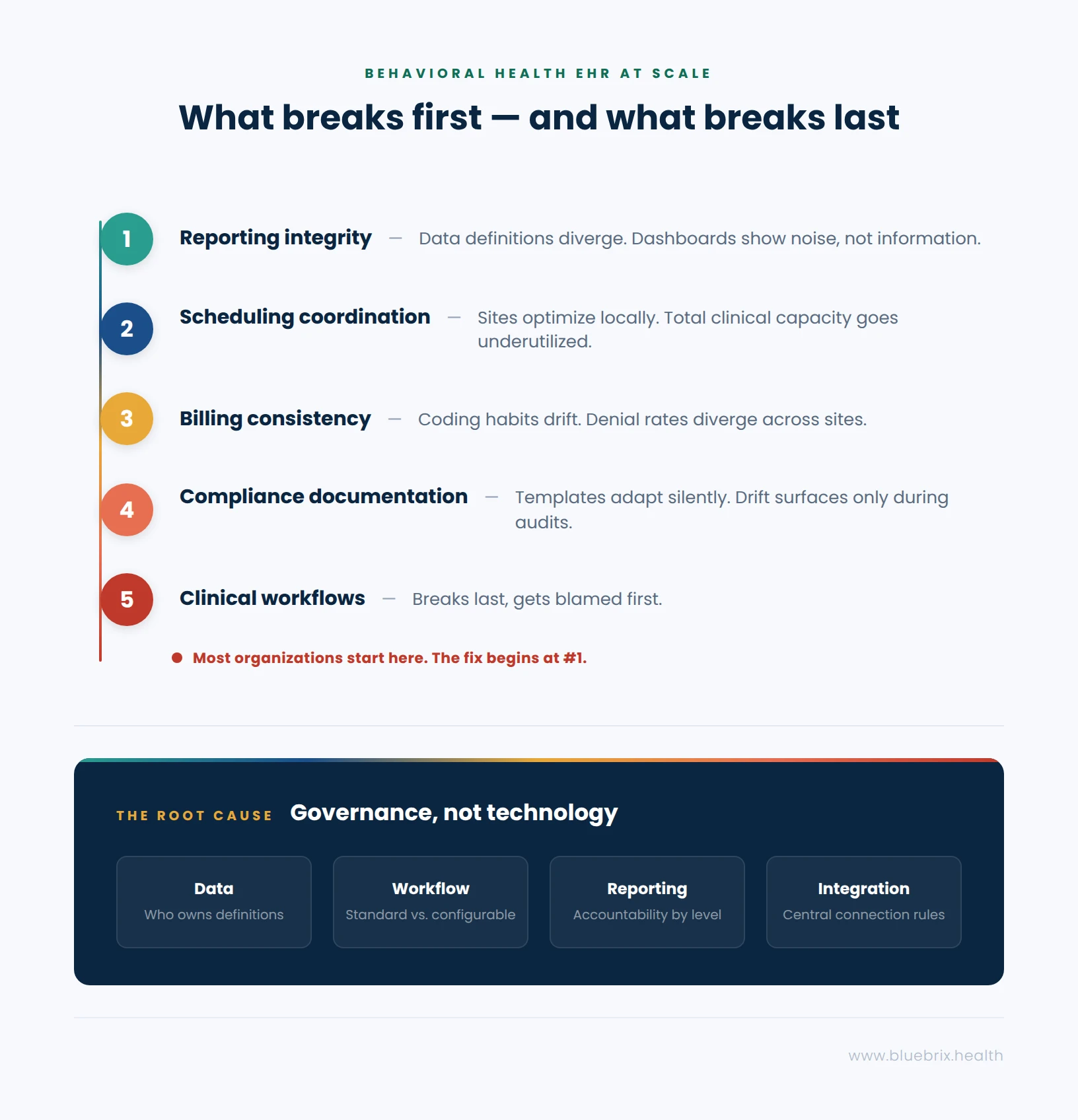
The first thing that breaks: reporting integrity
Reporting is the first operational function to fail in a multi-site expansion because it depends on data consistency across locations, and data consistency is the first thing that diverges when a second site starts operating.
The problem is rarely that the EHR lacks reporting capabilities. The problem is that the data feeding those reports means different things at different sites. Consider a metric as basic as “active patient count.” At one site, an active patient might be anyone with a scheduled appointment in the next 30 days. At another, it might include anyone seen in the past 90 days regardless of future scheduling. Neither definition is wrong. Both are defensible. But when an enterprise dashboard aggregates them, the number it produces is not information — it is noise.
This divergence accelerates in behavioral health because of program-level reporting requirements. A CCBHC must track and report on quality measures defined in SAMHSA’s certification criteria across nine required service categories, including crisis services, outpatient mental health treatment, substance use disorder services, and care coordination [3]. These measures require structured data captured at the point of care; narrative notes cannot be retroactively mined to produce them. If two sites in the same organization capture screening data differently — one using structured fields mapped to the required measures, the other embedding screening results in free-text progress notes — the organization’s aggregate CCBHC quality reporting [4] is compromised before anyone at the enterprise level realizes it.
The ONC’s 2026 data brief [5] on behavioral health facilities found that fewer than half of substance use and mental health treatment facilities use their EHR for health information exchange or care coordination workflows. For multi-site organizations, this gap means that even when a single EHR is deployed across locations, the data infrastructure supporting cross-site reporting is often incomplete. The EHR stores data at each site, but the definitions, structures, and workflows that would make that data comparable across sites were never standardized.
Operations leaders often discover this problem when they request a cross-site report and the numbers do not reconcile with what individual site managers are reporting. The instinct is to question the reporting tool. The actual issue is upstream: no one decided, at the organizational level, what each data element should mean across every location.
2. Scheduling coordination fragments before anyone notices
Scheduling is the second function to break because it is the first operational process that requires cross-site visibility to work well, and cross-site visibility is exactly what most single-site EHR configurations lack.
At a single behavioral health location, scheduling is a local optimization problem: match available clinician time with patient demand, manage room and telehealth slot availability, and minimize gaps. The site manager or scheduling coordinator has direct line of sight into the entire picture. At two or more sites, scheduling becomes a network coordination problem. A patient referred from one location to a specialist at another needs visibility into both schedules. A clinician who splits time between sites needs a unified view. Telehealth capacity — which has no physical location constraint — should be visible and bookable across the entire network, but in many multi-site configurations, it exists only in the schedule of the site where the provider is administratively assigned.
The result is a pattern familiar to every multi-site behavioral health operations leader: individual sites report that their schedules are full, but the organization is underutilizing its total clinical capacity. One site has a two-week wait for psychiatric evaluations while another has open slots. IOP groups at one location are under-enrolled while the site 20 miles away is turning patients away. The data to identify and resolve these mismatches exists in the EHR, but it is siloed by site because the scheduling configuration was replicated rather than unified.
For the IT gatekeeper, the structural question is whether the EHR treats the organization as a single scheduling entity with location-level views, or as a collection of separate scheduling instances that happen to share a database. The difference is architectural, not cosmetic, and it determines whether cross-site scheduling requires manual intervention or is natively supported.
3. Billing consistency erodes across payer contracts and sites
Billing is the third function to break, and it is the one where the financial cost of multi-site fragmentation becomes directly measurable.
In behavioral health, billing complexity is already elevated relative to other specialties. Time-based psychotherapy CPT codes [6] (90832, 90834, 90837) require precise session-duration documentation. Substance use disorder services use a different code set (H-codes for many Medicaid programs, distinct revenue codes for facility-based billing). Levels of care carry different billing forms: outpatient services typically bill on CMS-1500 [7], while residential and partial hospitalization programs bill on UB-04 institutional forms. Add telehealth modifiers, place-of-service variations, and the growing complexity of prior authorization requirements, and the billing rules a multi-site behavioral health organization must manage can vary meaningfully from one location to the next.
When billing teams operate independently at each site, coding habits diverge. One site’s billers might default to the 45–53-minute psychotherapy code (90834) while another site’s clinicians consistently document for the 53+ minute code (90837) — not because the clinical work differs, but because the documentation templates and time-capture workflows differ. Modifier usage for telehealth varies [8]. Prior authorization tracking is managed differently. Over time, these site-level variations produce measurably different denial rates, revenue per encounter, and days in accounts receivable across the organization.
Behavioral health claims are already denied at significantly higher rates than general medical claims. Research from the American Psychological Association found that 82% of psychologists report experiencing insufficient reimbursement rates, and 62% encounter administrative challenges including preauthorization and audit issues.[9] In a multi-site environment, inconsistent billing practices amplify these baseline challenges because the revenue cycle team cannot benchmark performance, identify patterns, or implement corrections consistently when the underlying data is not comparable across sites.
The operations leader sees this as diverging financial performance between sites. The IT decision-maker sees it as a configuration problem: can the EHR enforce standardized billing rules — code validation, modifier application, authorization tracking — at the organizational level while accommodating the payer-specific variations each site requires?
Find out where your multi-site operations stand in this sequence
If your organization is evaluating a behavioral health EHR for multi-site operations, request a guided walkthrough of how blueBriX handles cross-site configuration, reporting, and governance.
Schedule a walkthrough4. Compliance documentation drifts silently
Compliance drift is the fourth break, and it is the most dangerous because it is invisible until an external event exposes it: an accreditation survey, a Medicaid audit, or a payer retrospective review.
In behavioral health, compliance documentation requirements vary by program type, funding source, accreditation body, and state. A CCBHC must document compliance with SAMHSA’s certification criteria across staffing, service accessibility, care coordination, quality measures, and data reporting. A CARF-accredited program [10] must demonstrate adherence to standards that were updated for the July 2026 cycle, including expanded requirements for measurement-informed care (MIC) [11] and measurement-based care (MBC) that require structured outcome data captured at defined intervals. A Medicaid-funded program must maintain documentation that meets the specific requirements of its state’s Medicaid agency, which can differ substantially from the state where a sister site operates.
When a single-site EHR configuration is replicated at additional sites, the compliance documentation infrastructure initially matches the original location’s requirements. Over time, site-level staff adapt templates, modify assessment frequencies, adjust consent workflows, or create workarounds to accommodate local realities. A site manager might shorten an intake assessment to reduce patient wait times. A clinician might skip a screening instrument that feels redundant for their population. A billing coordinator might modify a documentation template to capture a field required by a local payer contract. Each individual adaptation is a reasonable response to a real operational pressure. Collectively, they produce a compliance landscape where no two sites are documenting in the same way — and the organization’s leadership does not know this until a surveyor or auditor identifies the variance.
The CCBHC model makes this risk especially acute. The May 2026 expansion of the CCBHC Medicaid Demonstration to 10 additional states (Alaska, Colorado, Hawaii, Louisiana, Maryland, Mississippi, Montana, North Dakota, Washington, and West Virginia) [12] means more organizations are operating under cost-based prospective payment rates that are tied directly to documented, allowable cost. The compliance documentation is not a regulatory formality — it is the foundation of the reimbursement rate itself. Drift in how that documentation is captured at one site directly affects the financial integrity of the entire organization’s rate-setting process.
For the IT gatekeeper, the question is whether the EHR architecture supports template governance: can the organization lock certain documentation elements at the enterprise level while allowing configurable elements at the site level? Without this capability, compliance drift is not a failure of discipline. It is a structural inevitability.
5. Clinical workflow standardization breaks last and gets blamed first
Clinical workflow variation is the most visible operational inconsistency in a multi-site organization, which is why leadership tends to address it first. That instinct is understandable but counterproductive. Clinical workflows are the last function to break because clinicians are the most adaptive operators in the system: they develop workarounds, create personal templates, and adjust processes to match their individual practice patterns regardless of what the EHR prescribes.
The variation itself is not always problematic. A clinician with 20 years of experience conducting psychiatric evaluations may need a different assessment workflow than a newly licensed therapist — and forcing both into an identical template can reduce clinical quality rather than improve it. The problem arises when clinical workflow variation produces downstream consequences: inconsistent data for quality measurement, incompatible documentation for care transitions between sites, or clinical records that do not support the billing codes submitted.
Multi-site organizations that attempt to standardize clinical workflows before addressing the upstream breaks — reporting, scheduling, billing, and compliance infrastructure — spend significant change management effort on a problem that is partly self-correcting. When reporting definitions are consistent, clinicians can see how their documentation feeds organizational metrics and adjust accordingly. When scheduling is coordinated across sites, workflow friction decreases. When billing rules are standardized, the documentation requirements that support those rules become clearer. When compliance templates are governed at the enterprise level, the boundaries of acceptable clinical variation are explicit.
None of this means clinical workflow standardization is unimportant. It means the sequence matters. Addressing it last, after the infrastructure that supports it is in place, produces faster adoption with less resistance.
6. The common root: governance, not technology
The five breaks described above share a single structural cause. In each case, the failure is not that the EHR lacks a feature. It is that the organization has not made explicit governance decisions about how that feature should function across sites.
Data governance:
- Who owns the definitions of key operational and clinical data elements?
- What does “active patient,” “completed session,” or “program enrollment” mean across the organization?
Without explicit data definitions owned at the enterprise level, every site creates its own — and cross-site reporting becomes unreliable.
Workflow governance:
What is standardized across all sites, and what is configurable at the site level?
This is not an all-or-nothing decision. Intake workflows, assessment instruments, and consent processes may need to be standardized. Clinician note templates, session scheduling patterns, and patient communication preferences may appropriately vary. The governance decision is defining the boundary.
Reporting governance:
Who is accountable for which metrics, at which level?
Site managers need site-level performance data. Regional directors need comparative data across their sites. Executive leadership needs organization-wide metrics that roll up accurately. The reporting governance structure determines what the EHR’s reporting configuration must support.
Integration governance:
How do external systems connect, and who approves changes?
In multi-site behavioral health organizations, each location may interface with different health information exchanges (HIEs), different lab systems, different state reporting registries, and different payer portals. Without centralized integration governance, each site develops its own connection points, and the IT team inherits an unmaintainable patchwork.
When these governance decisions are made explicitly and documented, the EHR becomes the mechanism through which they are operationalized. Configuration choices flow from governance decisions rather than from ad hoc site-level preferences. The result is a system where standardization and local flexibility coexist by design, not by accident.
When these decisions are not made, even the most capable behavioral health EHR becomes a mirror of organizational ambiguity. It stores data that cannot be compared. It runs workflows that cannot be benchmarked. It produces reports that cannot be trusted. The technology is not the problem. The absence of governance is.
What to evaluate in a behavioral health EHR before scaling to multiple sites
The five-break framework translates into a set of evaluation criteria that operations leaders and IT decision-makers should apply when selecting or reconfiguring a behavioral health EHR for multi-site operations. These are not feature requirements. They are architectural and governance questions.
For reporting integrity
- Can the platform enforce standardized data definitions across all sites while allowing site-level views?
- Does it support program-level reporting that maps to CCBHC quality measures, state Medicaid reporting requirements, and accreditation metrics without requiring manual data reconciliation?
- Is the reporting layer real-time, or does it rely on batch exports that introduce latency?
For scheduling coordination
- Does the EHR treat the organization as a single scheduling entity with location-level views, or as separate scheduling instances?
- Can clinicians who serve multiple sites see and manage a unified schedule?
- Is telehealth capacity visible and bookable across the network regardless of the provider’s administrative home site?
For billing consistency
- Can the platform enforce organizational billing rules — code validation, modifier application, authorization tracking — while accommodating site-specific payer contract variations?
- Does it support both CMS-1500 and UB-04 billing within a single organizational instance for locations operating different levels of care?
- Can it produce cross-site revenue cycle benchmarking with comparable data?
For compliance documentation
- Does the EHR support template governance — the ability to lock certain documentation elements at the enterprise level while allowing configurable elements at the site level?
- Can it enforce assessment frequencies, consent tracking under 42 CFR Part 2, and state-specific documentation requirements without requiring each site to self-police compliance?
For clinical workflow standardization
- Does the platform allow controlled variation — standardized elements where consistency matters (intake, screening instruments, outcome measures) with flexibility where clinical judgment should prevail (note structure, session documentation style)?
- Can workflow changes be deployed across sites from a central configuration, or must each site be updated individually?
For governance infrastructure
- Does the platform’s architecture support the governance model your organization needs?
This includes role-based access that aligns with reporting accountability, audit trails that track configuration changes across sites, and an integration framework (FHIR-native is the current standard) that centralizes how external systems connect to the platform.
blueBriX’s behavioral health EHR is designed to support multi-site organizations through a configuration-first architecture that separates enterprise-level governance from site-level flexibility. Cross-site reporting, unified scheduling, standardized billing rules with payer-specific variation, and template governance are configured to support the organizational structure rather than the other way around. The platform’s FHIR-native build supports centralized integration governance without requiring middleware or custom development for each site’s external connections.
Conclusion: scale the governance, and the technology follows
The behavioral health organizations that scale successfully across multiple sites are not the ones with the most advanced EHR. They are the ones that recognized, early enough, that the EHR is an operating system for organizational decisions — and that the decisions need to exist before the system can operationalize them.
The five-break sequence described above is the pattern that repeats when organizations add locations without first establishing how data, workflows, reporting, compliance, and integrations will be governed across the enterprise. Reporting integrity degrades. Scheduling fragments. Billing becomes inconsistent. Compliance documentation drifts. Clinical workflows diverge. Each break compounds the one before it, and by the time leadership notices, the cost of correction is significantly higher than the cost of prevention would have been.
The corrective path is the same regardless of where your organization is in the scaling journey. Start with the governance layer: define what is standardized, what is locally configurable, who owns each decision, and how accountability flows from site to enterprise. Then evaluate whether your current EHR can enforce those governance decisions in its configuration — or whether the platform itself needs to change.
For operations leaders, this means the EHR conversation is not a technology procurement exercise. It is an organizational design conversation that happens to require a technology decision at its center. For IT decision-makers, it means the most important evaluation criteria are not feature lists but architectural questions: can this platform separate enterprise governance from site-level flexibility in a way that scales without breaking?
The organizations that get this right build a foundation that supports not just their next site, but their fifth and their tenth — without revisiting the same operational failures at each stage of growth.