
Chronic disease burden is rising. Hospital readmission rates remain stubbornly high. And payers are increasingly tying reimbursements to outcomes rather than volume. For healthcare organizations navigating this landscape, a disconnected patchwork of tools is no longer sufficient.
Care management software brings together the clinical workflows, data intelligence, and patient engagement capabilities that care teams need to proactively manage health across populations and not just episodically treat illness. The best platforms don’t just digitize workflows; they fundamentally change how care is coordinated, documented, and measured.
The challenge is that the market is crowded. Between enterprise EHR giants, analytics-focused vendors, and purpose-built care management platforms, it can be difficult to know which solution is the right fit for your organization’s size, model, and goals.
This guide cuts through the noise. We’ve evaluated six leading platforms across the criteria that matter most, so you can compare objectively and choose with confidence.
The platforms, reviewed
As healthcare organizations accelerate their shift toward value-based care, the platform you choose to manage care coordination, population health, and patient engagement will define your outcomes — financially and clinically. We reviewed the top care management software available today to help you make a confident, informed decision.
blueBriX: Best overall care management platform
blueBriX was built from the ground up with one goal: to give healthcare organizations a complete, configurable platform that makes value-based care operationally achievable and not just theoretically possible. While many platforms focus on a single dimension of care management (analytics, EHR integration, or patient communication), blueBriX integrates all of them into a unified, cohesive system.
Best for: Accountable Care Organizations, integrated health systems, community health centers, and any care delivery organization transitioning to or scaling under value-based care contracts.
What makes blueBriX stand out
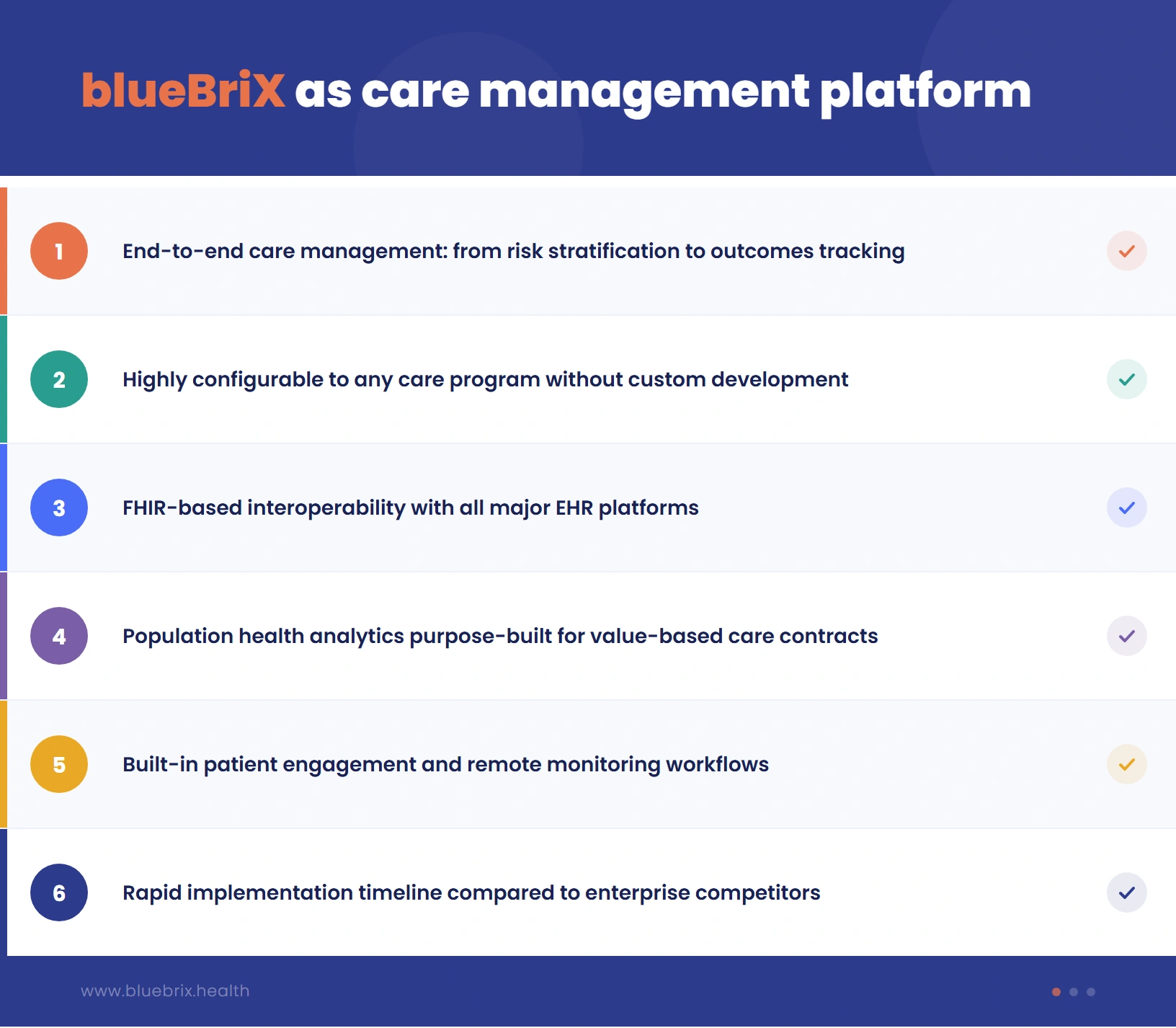
At its core, blueBriX is a care management command center. Care teams can risk-stratify their patient populations, build and assign personalized care plans, coordinate care across disciplines, and track outcomes and that too all from a single platform. The interface is designed for clinical users, not IT departments, which dramatically reduces the time-to-value after implementation.
One of the platform’s strongest differentiators is its configurability. Whether your organization runs a complex chronic care management program, a behavioral health integration initiative, or a SDOH-informed care model, blueBriX can be configured to match your workflows, without months of custom development. This flexibility makes it equally effective for a regional ACO and a federally qualified health center.
On the data side, blueBriX is built for the multi-system reality of modern healthcare. It integrates with major EHRs through FHIR-based APIs, ingests claims data, lab results, and remote monitoring feeds, and surfaces actionable insights through a population health dashboard designed to drive clinical decisions, not just generate reports.
Patient engagement is equally robust. blueBriX supports proactive outreach, care gap closure campaigns, remote patient monitoring integrations, and patient self-management tools that can create a continuous connection between care teams and the patients they serve and between appointments.
| Feature | blueBriX | Others |
|---|---|---|
| Platform Design | Purpose-built care management platform designed for value-based care operations | Often EHR-centric or analytics-focused solutions extended into care management |
| Care Coordination Workflows | End-to-end workflows from risk stratification to outcomes tracking in one system | Core workflows available but may require multiple modules or additional tools |
| Multi-EHR Interoperability | Built to integrate with multiple EHRs using standards-based APIs | Integration possible but frequently optimized for a single primary EHR environment |
| Implementation Timeline | EHR implementation can be completed in weeks to a few months | Enterprise deployments can take longer depending on system complexity |
| Population Health Management | Unified dashboards combining clinical, claims, and engagement data | Reporting and analytics available but may be separated from daily workflows |
| Patient Engagement & Outreach | Built-in outreach, care gap closure, and remote monitoring capabilities | Engagement tools available but sometimes delivered as add-ons or integrations |
| Scalability for Value-Based Care | Designed to support organizations managing complex populations and risk-based contracts | Suitable for defined patient panels or incremental value-based programs |
See blueBriX in action
Your care teams need a platform that brings together population health intelligence, proactive patient engagement, care coordination, interoperability, and outcomes tracking in one unified system. blueBriX helps healthcare organizations operationalize value-based care with configurable workflows, multi-EHR interoperability, built-in outreach capabilities, and real-time visibility into patient populations.
Request a demoInnovaccer
Innovaccer has built a strong reputation in the health data space with its unified patient record and data activation platform. For organizations whose primary pain point is data fragmentation that is pulling together siloed records across disparate systems, Innovaccer offers one of the most technically sophisticated aggregation layers in the market.
The platform’s strength lies in its analytics engine and its ability to create longitudinal patient records from fragmented sources. Organizations with robust data science or analytics teams will find genuine value in Innovaccer’s capabilities for surfacing population insights.
However, organizations looking for a fully operational care management suite with out-of-the-box care planning tools, care coordinator workflows, and patient engagement built in may find Innovaccer’s focus on data activation means they still need additional tooling to support day-to-day care management execution. It is best understood as a powerful analytics and data layer rather than an end-to-end operational platform.
Athenahealth
Athenahealth is a well-established name in ambulatory care, offering an integrated suite of EHR, revenue cycle management, and practice management tools. For small to mid-size physician practices already operating on the athena EHR, the addition of care management functionality within a familiar ecosystem is a meaningful advantage.
The care coordination features are well-designed for primary care and single-specialty environments. Athenahealth’s network-based insights are drawn from its large customer base and also provide useful benchmarking context for quality and performance.
The primary limitation becomes apparent at scale. Organizations managing complex populations across multiple sites of care, or those operating under risk-bearing contracts that require sophisticated population health analytics and cross-system interoperability, may find athenahealth’s care management capabilities better suited to simpler, practice-level workflows than enterprise-grade population health programs.
Epic care
Epic is the dominant force in health system EHR deployment, and Epic Care extends that footprint into care management and population health through modules like Healthy Planet and Care Everywhere. For large academic medical centers and integrated delivery networks already deeply embedded in the Epic ecosystem, the tight integration between the EHR and care management workflows is genuinely powerful.
Epic’s breadth of data is spanning inpatient, outpatient, and increasingly ambulatory settings that provides a rich foundation for population health programs when it is the primary (and ideally exclusive) data source across the organization.
The well-known constraints are cost and complexity. Epic implementations require substantial capital investment, dedicated IT resources, and multi-year timelines. For mid-market organizations, community health networks, or any entity operating in a multi-EHR environment, Epic Care’s value proposition diminishes considerably. Its care management modules are most powerful when Epic is everywhere, a reality only a subset of health systems can claim.
Oracle cerner
Oracle Cerner has long been a fixture in hospital information systems, with particular strength in inpatient clinical documentation, pharmacy, and acute care workflows. Since Oracle’s acquisition, the platform has been positioned as part of a broader enterprise health management vision that includes population health and care management functionality.
For health systems where Cerner is the primary EHR, the care management tools offer solid inpatient-to-outpatient transition capabilities and care plan documentation. The integration of Oracle’s data and cloud infrastructure adds long-term scalability on the enterprise IT side.
That said, the population health and ambulatory care management experience has historically lagged behind purpose-built platforms. Organizations prioritizing proactive, community-based care management programs like those involving complex chronic disease management or SDOH-informed care may find that Cerner’s care management capabilities are still maturing relative to solutions designed specifically for these use cases from the ground up.
NextGen healthcare
NextGen Healthcare serves a loyal customer base of independent and multi-specialty physician practices, delivering an integrated EHR and practice management platform that meets the needs of groups operating outside of large health systems. For this segment, NextGen offers solid clinical documentation, billing integration, and patient communication tools within a familiar environment.
The care management functionality is meaningful for groups managing a defined panel of patients with relatively straightforward chronic disease programs. NextGen’s recent investments in population health reporting and quality measure tracking also demonstrate genuine progress in value-based care readiness.
Where NextGen naturally reaches its limits is in population scale and cross-organizational care coordination. Organizations managing large, complex populations under full-risk contracts, or those that require sophisticated interoperability with external health systems, community organizations, and payers, are likely to find NextGen’s population health capabilities narrower in scope than platforms purpose-built for enterprise-grade care management.
Ready to make value-based care work in practice?
blueBriX gives your care teams the tools to risk-stratify populations, close care gaps, and track outcomes all in one platform. See it for yourself.
Request a Free Demo