
Marcus steps down from your residential SUD program on a Tuesday. Within 48 hours, three things go wrong. No one requests his IOP authorization, because the residential discharge never reached the IOP system. His IOP counselor opens a chart with no assessment history and no record of the dose change made three days before discharge. And his Part 2 consent sits in the residential system, so one staff member over-shares his record while another withholds the medication history his prescriber needs. No clinician was careless. Revenue leaked, a clinician worked blind, and a consent gap went unnoticed, all because two systems didn’t share one record.
These handoffs are getting harder to manage. Medicare began covering IOP on January 1, 2024,[1] and The ASAM Criteria Fourth Edition reorganized the adult SUD continuum.[2] This article covers why transitions are the riskiest point in care, a six-step framework for managing them, and what your EHR needs to handle.
Why transitions are the highest-risk moment in care
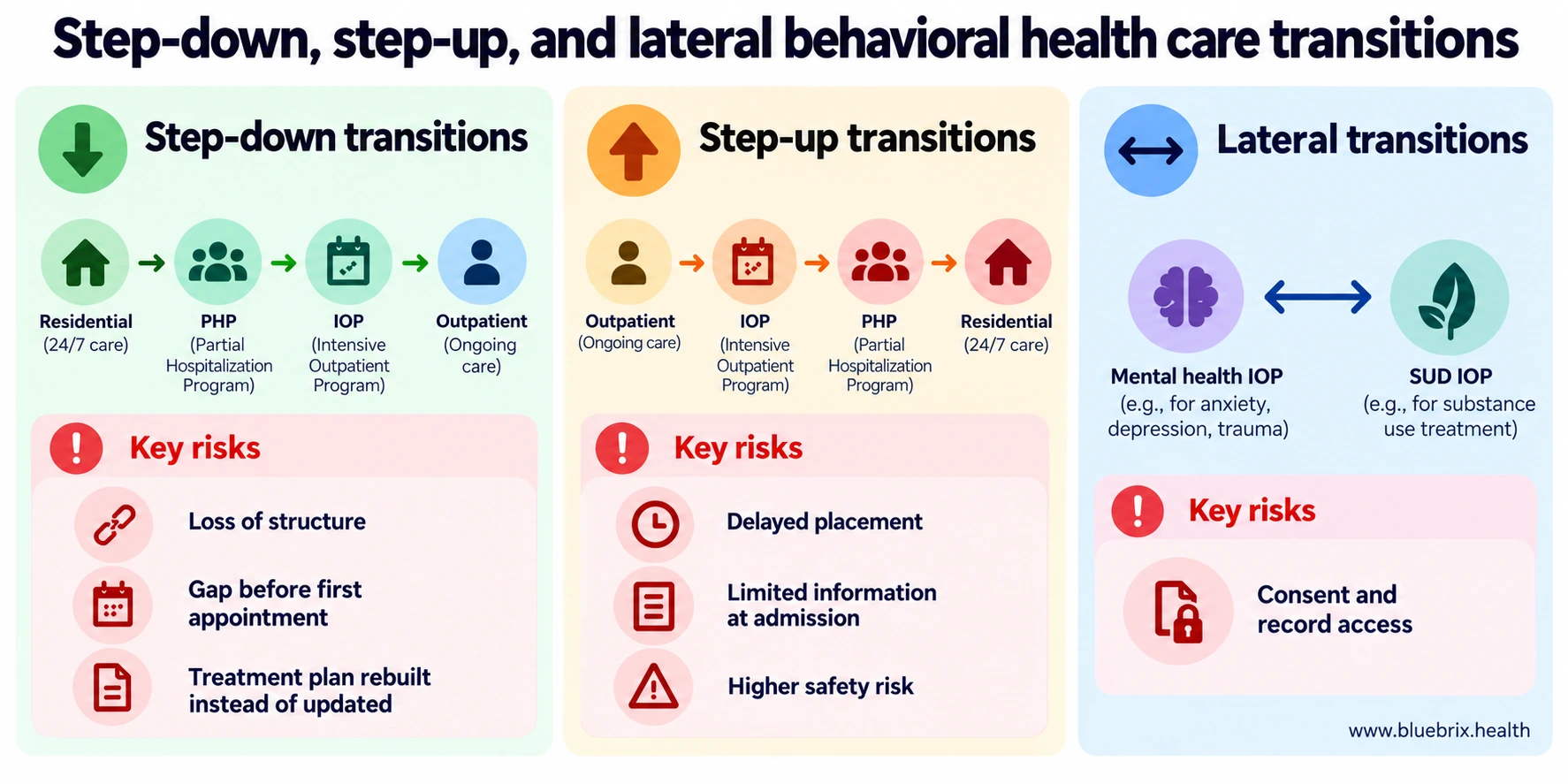
Clinical risk peaks right after discharge
A 2025 meta-analysis found that suicide rates after psychiatric hospital discharge are extremely high in the first week and then decline steeply.[3] A national registry study published in January 2026 found that, compared with control periods, the suicide incidence rate ratio was 6.32 in the first week after discharge.[4]
Both studies looked at discharge from inpatient mental health care. The underlying pattern is relevant to any step-down, though. Your patient moves to a setting with less supervision and a new team at the same time.
Patients disengage between levels
Every transition asks the patient to start over in some way: a new schedule, a new group, new clinicians, sometimes a new location. Each of these is a chance to stop showing up. Disengagement is most likely when the patient leaves one program before the first appointment at the next one is confirmed.
Revenue leaks at the handoff
Transitions create predictable financial gaps:
- The receiving program’s authorization is not in place on day one.
- Service dates overlap or leave gaps between programs.
- Claims go out under the wrong billing model.
- A concurrent review deadline lapses during the move.
These are rarely clinical failures. They are coordination failures, and they show up later as denials and rework.
How to manage care transitions: a six-step framework
1. Base the level-of-care decision on standardized criteria
Use a validated, multidimensional assessment so the transition decision is defensible to clinicians, auditors, and payers.
For SUD, The ASAM Criteria include transition and continued-service criteria as a core component alongside admission criteria.[5] For adult mental health, many organizations use tools such as LOCUS. Check which edition each payer applies. At least one payer uses the Fourth Edition for adult admissions while continuing to use the Third Edition for children and adolescents.[6]
For a deeper look at the levels themselves, see our guide to ASAM criteria and levels of care.
2. Confirm eligibility and authorization before the move
Verify that the patient meets the receiving program’s enrolment criteria and that authorization is approved before the transfer date. This means checking diagnosis, age, payer, and assessed level of care against the receiving program’s requirements. It also means aligning the discharge date at one level with the start date at the next. A patient who is clinically ready but administratively unready will either wait or be billed incorrectly.
3. Carry the treatment plan forward instead of restarting it
The receiving team should update the existing treatment plan to reflect the new level of care, not write a new one. Goals, objectives, and progress notes should stay visible. So should measurement trends, such as PHQ-9 or GAD-7 scores collected across programs. When the IOP clinician can see that a patient’s PHQ-9 dropped from 19 to 11 during residential care, the next treatment decision starts from evidence.
4. Reconcile medications at every level-of-care change
Run a documented medication reconciliation at each transition, not only at final discharge. Medication responsibility shifts sharply between levels. In residential care, staff administer and log medications. In PHP, IOP, and outpatient care, the patient usually manages them. That shift is when omissions, duplications, and adherence problems surface. For patients on medications for opioid use disorder, confirm the prescriber and pharmacy plan before the transfer.
5. Manage consent and information sharing across programs
Make sure the consent that allows records to move between your programs is captured, current, and visible to the receiving team. The updated 42 CFR Part 2 rule lets patients sign a single consent for all future uses and disclosures of Part 2 records for treatment, payment, and health care operations.[7] It also states that segregating or segmenting Part 2 records is not required.[8] Compliance with the final rule has been required since February 16, 2026. This simplifies transitions between your SUD and mental health programs. It does not remove the need to track what each patient consented to and when.
6. Close the loop with timely follow-up
Schedule the first appointment at the next level before the patient leaves the current one, and track whether it happens. Payers measure this directly after inpatient psychiatric stays. The Follow-Up After Hospitalization for Mental Illness (FUH) measure tracks follow-up visits within 7 days and within 30 days of discharge.[9] FUH is part of the Medicaid and CHIP Behavioral Health Core Set.[10]States also collect it for certified community behavioral health clinics (CCBHCs).[11]
FUH applies to hospital discharges specifically. Using the same 7-day and 30-day windows as internal targets for residential step-downs is a sensible standard. If you operate a CCBHC, see how CCBHC workflows connect to quality reporting.
See a patient move from residential to IOP in one record.
Watch how blueBriX carries the treatment plan, medications, consent, and authorizations through every level of care.
Schedule a demoSpecial considerations for youth residential transitions (PRTF and QRTP)
Transitions out of youth residential care look different from adult step-downs. A young person leaving a psychiatric residential treatment facility (PRTF) or a qualified residential treatment program (QRTP) often returns to a family home, a foster placement, or a community-based program rather than to a PHP. You need to plan for family and guardian involvement, school re-entry, and coordination with child welfare agencies.
For QRTPs, federal law sets a specific obligation. A QRTP must provide discharge planning and family-based aftercare support for at least six months after discharge.[12] States have written this requirement into their own licensing rules, including a 2024 Nevada regulation.[13] That means the transition is not complete at discharge. Your team needs a record that stays active through the aftercare period.
Learn more about EHR support for PRTF and QRTP programs.
Where transitions break when each level runs on a different system
Many organizations grew one program at a time and added a system for each. That works until a patient moves between programs. Then the gaps show:
- Duplicate data entry. Intake staff re-enter demographics, diagnoses, and history that already exist in another system.
- Treatment plans that do not travel. The receiving team starts a new plan because it cannot see or edit the old one.
- Assessment history that disappears. Score trends collected in residential care are invisible in IOP.
- Medication lists that drift. Two systems hold two versions of the truth.
- Consent that does not follow the record. Staff cannot confirm what the patient authorized, so information gets withheld or shared incorrectly.
- Billing models that do not connect. Per diem residential billing, attendance-based IOP billing, and fee-for-service outpatient billing run in separate systems, which makes date gaps and overlaps hard to catch.
For operations and finance leaders, each of these breakpoints has a cost: staff hours spent on re-entry and reconciliation, denials from authorization and date mismatches, and readmissions when a patient falls through the gap.
What your EHR needs to handle in level-of-care transitions
If you are evaluating EHRs for a multi-program organization, test each of these capabilities with a real transition scenario during the demo.
- One continuous patient record across all programs. Ask in the demo: “Show me a patient moving from residential to IOP. What does the IOP clinician see on day one?”
- Criteria-based placement and referral between programs. Ask: “How does an assessment score trigger a referral to a different level of care?”
- Enrolment validation against the receiving program’s criteria. Ask: “What happens if the patient does not meet the receiving program’s payer or diagnosis requirements?”
- Treatment plan and assessment history that carry over. Ask: “Can the receiving team update the existing plan, and can they see score trends from the previous level?”
- Medication reconciliation triggered at level-of-care change. Ask: “Is reconciliation prompted at every transition, or only at discharge?”
- Per-program billing models and authorization tracking. Ask: “Can residential bill per diem and IOP bill by attendance for the same patient, and how are authorization windows tracked across the move?”
- Part 2 consent and access controls that persist across programs. Ask: “Where does staff in the receiving program see the patient’s current consent?”
How blueBriX supports level-of-care transitions
blueBriX is built around a program management engine. Each program and sub-program can run its own clinical workflows, documentation standards, billing strategy, enrolment criteria, and compliance requirements, while the patient keeps one record.
Here is how that maps to the breakpoints above:
- One continuous record across residential, PHP, IOP, and outpatient care, so intake staff don’t re-enter demographics, diagnoses, and history. The receiving team opens the same treatment plan it will update.
- Assessment history and multidimensional scoring that stay visible across programs, so the IOP clinician sees the PHQ-9 trend from residential care. The step-down decision rests on documented criteria a payer or auditor can follow.
- Enrolment criteria validated before the transfer date, so a patient who is clinically ready doesn’t arrive administratively unready, waiting on eligibility or billed under the wrong program.
- Medication reconciliation at every level-of-care change, not only at final discharge, so you catch list drift before the patient manages medications unsupervised for the first time.
- Authorization and concurrent review deadlines tracked by payer across the move, so the receiving program’s authorization is in place on day one and a review deadline doesn’t lapse mid-transition.
- Part 2 consent that travels with the record, so staff in the receiving program can see what the patient authorized instead of withholding information or sharing it incorrectly.
See how blueBriX keeps every level of care connected in one behavioral health EHR. For outpatient and intensive programs specifically, explore blueBriX for IOP, PHP, and outpatient care. For SUD residential and IDD programs, see blueBriX for addiction treatment and IDD.