

The real behavioral health EHR implementation timeline vs the vendor's quote
Ask three EHR vendors how long implementation takes and you will get three confident answers, none of which may apply to your organization. This is because the number in their deck was built for a single-program outpatient practice with one clinician type and one payer mix. A behavioral health organization running substance use disorder treatment, outpatient mental health, and maybe a residential or partial hospitalization program under one roof is a different project, and the timeline that actually applies to that project rarely shows up in the sales conversation.
The gap between those two numbers is where budgets go to die. Configuring an EHR, even a fairly complex one, is a bounded, controllable piece of work, and a disciplined, structured build can move fast. A 12-week system configuration and go-live is realistic for the software itself. What actually extends a behavioral health rollout past its promised date almost always sits outside that software track: credentialing, payer enrollment, and the fact that your staff need two different kinds of training instead of one.
Three timeline gaps that delay most behavioral health EHR rollouts
1. Multi-program credentialing runs on its own separate clock
Credentialing is not one process. It runs on at least three separate layers: the individual clinician, the facility, and in many cases the specific program. Being credentialed with a payer for general medical services does not carry over to behavioral health, since most major commercial payers route behavioral health enrollment through a separate managed behavioral health organization with its own application and its own clock. Add a medication-assisted treatment track, an intensive outpatient program, or a residential level of care, and each one can trigger its own enrollment step layered on top of facility-level credentialing.
None of this is paperwork you can skip to hit a go-live date. Providers must be enrolled in Medicare to get paid for covered services, and that enrollment runs through the Provider Enrollment, Chain, and Ownership System, known as PECOS.[1] CMS has continued to build out PECOS specifically to give providers and credentialing staff a way to track applications and manage enrollment status in real time, which tells you something about how much of this process is still administrative rather than clinical.[2] The same logic holds across commercial and Medicaid behavioral health networks. Your system can go live exactly on schedule and still not be able to bill a program until its credentialing catches up.
Standards for how that credentialing gets verified are also getting stricter, not looser. The National Committee for Quality Assurance updated its credentialing standards in 2025, shortening primary source verification windows and requiring a fixed 36-month recredentialing cycle with monthly monitoring in between.[3] That is a tighter, faster-moving target than the loose “every three years or so” assumption a lot of operations teams still plan around.
If a program is new and needs third-party accreditation, that adds a separate track entirely. CARF International accredits behavioral health programs at the individual program level rather than the facility level, which means a newly launched IOP or residential service can need its own accreditation timeline even if the rest of the organization is already accredited.[4] That timeline runs on CARF’s schedule.
2. Payer enrollment multiplies with every program, state, and payer you add
Even once credentialing clears, payer enrollment is its own separate timeline, and it multiplies by every program and every state you operate in. A behavioral health organization with programs in three states and contracts with Medicare, Medicaid, and four commercial payers is not managing one enrollment process. It is managing dozens of them, each with its own portal, its own document requirements, and its own review cycle.
If any of your programs touch substance use disorder treatment, there is another layer on top of that. The confidentiality protections in 42 CFR Part 2 govern how SUD patient records can be used and disclosed, and a final rule from the Substance Abuse and Mental Health Services Administration and the HHS Office for Civil Rights updated those protections to align more closely with HIPAA.[5] That rule took effect April 16, 2024, with a compliance deadline of February 16, 2026. That deadline has now passed. HHS’s Office for Civil Rights launched a civil enforcement program the same week, and began accepting complaints and breach notifications tied to Part 2 violations on February 16, 2026.[6] That work has to happen alongside your EHR build.
3. Training two workforces: clinical staff and revenue cycle staff, on two different curricula
This is the piece that rarely makes it into a vendor’s implementation plan at all. Clinical staff need to learn documentation, treatment planning, and level-of-care workflows in the new system. Revenue cycle staff need a separate curriculum entirely: authorization tracking, program-specific coding, and the billing handoffs between clinical and RCM teams that a generic outpatient practice never has to think about. A timeline built for a single-specialty practice typically budgets training hours for one of these groups. A behavioral health rollout needs to budget for both, run on overlapping schedules, without pulling either team away from patient care or claims for too long.
This lands harder in behavioral health because the workforce doing the training is already stretched. An estimated 137 million people, about 40% of the US population, live in an area with a documented mental health workforce shortage, spread across 6,807 designated shortage areas nationwide.[7] Training time is not a line item you can quietly expand when the people sitting in that training are already covering more caseload than the org chart assumes.
See how a program-by-program rollout actually gets sequenced.
Talk to blueBriX about running credentialing, payer enrollment, and dual clinical and RCM training as one coordinated plan instead of three separate ones.
Schedule a demoWhat a realistic timeline actually looks like
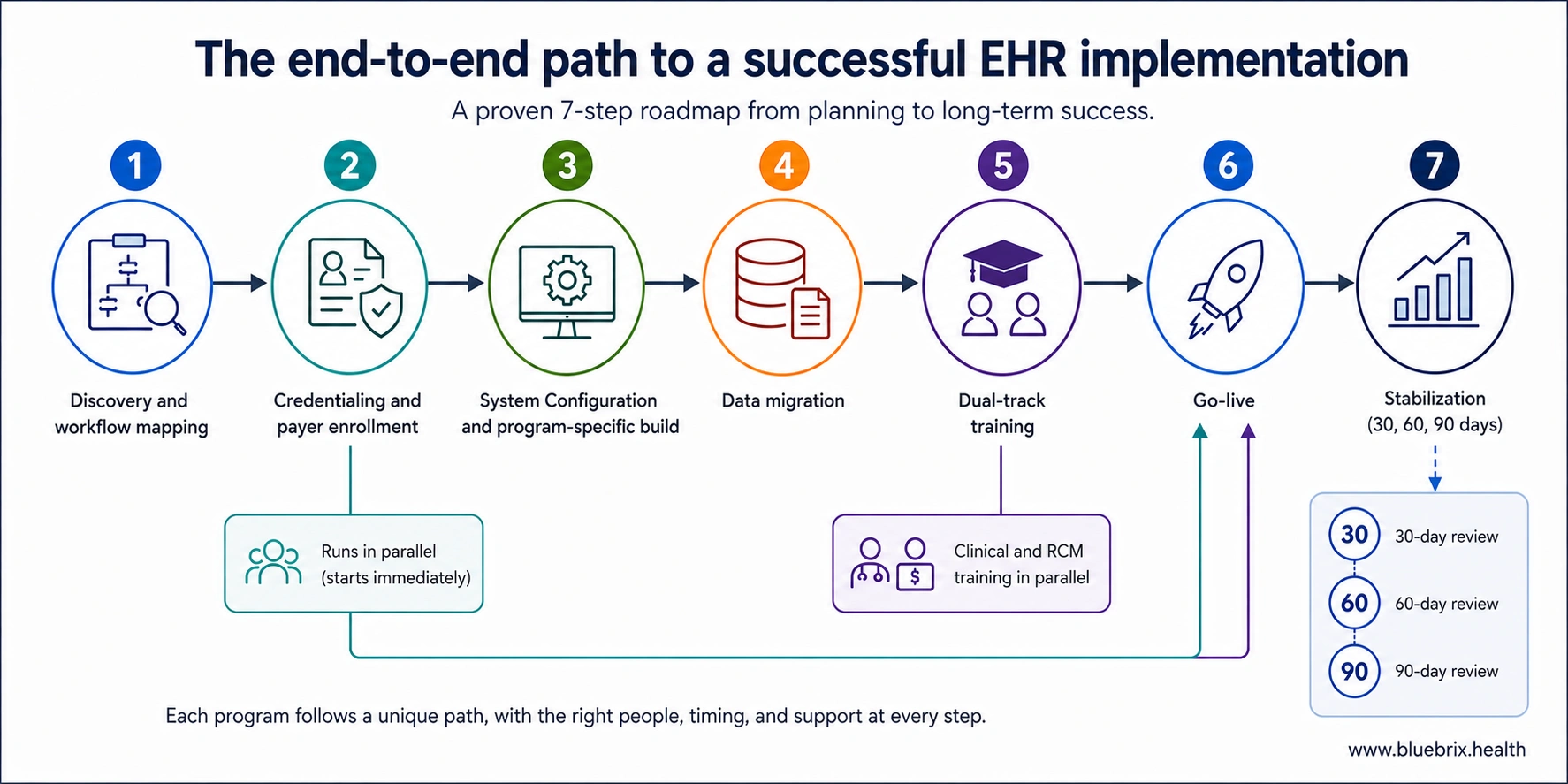
Rather than a single flat number, think of a multi-program rollout as several tracks running at different speeds, some of which should start on day one regardless of where system configuration stands. On a well-run build, the system configuration and go-live track can complete in about 12 weeks. The tracks below determine how long it takes the rest of the organization to actually catch up to that date.
- Discovery and workflow mapping. Every program gets its own workflow map, not a shared template, since a residential level of care and an outpatient clinic document and bill differently.
- Credentialing and payer enrollment. This track should start immediately, in parallel with configuration, not after the system is built. Submitting applications sequentially rather than concurrently is one of the most common and most avoidable causes of a slipped go-live date. Depending on program count and payer mix, this track often runs well past the 12-week system build.
- System configuration and program-specific build. Templates, code sets, and permissions get configured per program, per level of care.
- Data migration. Legacy records, treatment histories, and billing data move over and get validated, ideally in test batches before the full cutover.
- Dual-track training. Clinical and RCM curricula run on parallel schedules, not sequentially, so neither team is left unprepared at go-live.
- Go-live. Often phased by program rather than all at once, so a program whose payer enrollment is still catching up does not hold back the rest of the organization.
- Stabilization. A structured 30, 60, and 90-day review after go-live to catch workflow gaps, billing issues, and training gaps before they become entrenched habits.
What a delayed behavioral health EHR go-live actually costs
When a rollout runs past its original date, the costs are not abstract. Running two systems side by side means paying for two licenses, supporting two sets of workflows, and asking staff to double-document, all at the same time. Any disruption to claim submission, eligibility verification, or payer connectivity has an immediate effect on cash flow, and the longer that disruption runs, the more it complicates denial follow-up and reconciliation later on.[8] That is why organizations like MGMA recommend building a documented transition and downtime plan before go-live, rather than improvising one after a delay has already started.[9]
Behavioral health adds its own specific version of this problem. If system go-live outpaces payer enrollment for even one program, that program cannot bill through the new system for services it is already delivering. Claims stack up, accounts receivable ages, and the finance team ends up doing the exact manual reconciliation work the new system was supposed to eliminate.
There is a staffing cost too. Extending a dual-training period, or running clinical and RCM teams through it back to back instead of in parallel, adds weeks of reduced capacity in a workforce that was already short-staffed before the project started.
5 questions to ask before you sign a behavioral health EHR contract
A vendor’s proposed timeline will tell you a lot about whether they understand behavioral health specifically, or whether they are quoting from a generic template. Before you sign, ask:
- How is credentialing and payer enrollment sequenced against system go-live? Can they run in parallel, or does one wait for the other?
- How many training hours are budgeted for clinical roles versus revenue cycle roles, and are they treated as two separate curricula?
- Can you show a reference implementation with a similar program mix, not just a similar organization size?
- What is the plan if one specific program’s payer enrollment lags behind the rest of the go-live date?
- What does the stabilization period after go-live actually look like, and who owns it on the vendor’s side?
A vendor who can answer all five specifically, with real numbers instead of ranges, is quoting you a timeline built for your organization. A vendor who cannot is quoting you the same number they give everyone else.