
A patient portal built for a primary care practice is built around discrete events: a visit, a lab result, a bill. Behavioral health care doesn’t work in discrete events. It works in an ongoing relationship that plays out over weeks or months, with most of the actual clinical work, the follow-through on a coping strategy, the medication side effect that shows up on day four, the crisis that lands on a Tuesday between two Thursday sessions, happening in the gaps between visits.
That mismatch is why a lot of behavioral health practices end up running a portal that technically works and still doesn’t fit. Whether you call it a behavioral health patient portal or a mental health patient engagement app, patients are describing the same functional gaps. This piece looks at the problem in two parts: first, where patients actually feel the gap in day-to-day use, and second, what’s happening underneath, the regulatory and architectural reasons a portal built for general medical care can’t just be relabeled for therapy. If you’re on the care team side, thinking about patient experience and engagement, the first half is for you. If you’re the one who has to build or buy the thing, stay for the second half too.
Where patient portals fail to meet therapy-specific requirements
Patients logging in isn’t the issue. The portal itself, its defaults, its access model, its assumptions about what a message is for, was built for a lab-results-and-refills kind of care. Therapy runs on a different set of requirements, and here’s where the mismatch actually shows up.
One-size confidentiality doesn’t hold up in behavioral health
Most portals inherited their access model from primary care, where one setting works for everyone. That breaks down fast in behavioral health, especially for teenagers navigating how much their family should see. Researchers analyzing portal messages at three children’s hospitals found guardians writing from inside their teen’s own account, not their separate parent login, in more than half of cases, a general pediatric portal finding, not a behavioral-health-specific one, but exactly the kind of access gap that matters most when sensitive information is involved.[1] The American Academy of Pediatrics called this out directly in a policy statement earlier this year: portals still aren’t reliably keeping mental health and substance use information confidential for the adolescents who are legally entitled to that privacy.[2]
Mental health notes aren’t experienced the same way by patients
Once federal rules put most behavioral health notes on the same release timeline as any other medical record, the strain showed up fast. In a survey of 29 providers whose organizations gave patients portal access to their mental health notes, 72% said patients asked for the note to be changed, 55% said patients showed real distress after reading it, and 21% described the patient’s reaction afterward as negative or self-destructive.[3] Small sample, and it’s providers describing what they observed rather than patients speaking for themselves, but it’s a clear signal that a note written for a therapist’s own use doesn’t always land the same way once it’s sitting on a screen.
Crisis content needs to be triaged in real time
Mayo Clinic researchers went back through portal messages from patients who’d had a hospitalization or ER visit tied to depression or self-harm, and found real, identifiable language patterns already sitting in those ordinary, asynchronous messages, the same inbox handling reschedule requests and refill questions.[4] Most portals still have no way to flag that message the moment it arrives.
Progress tracking has to live inside the relationship
Measurement-based care, regularly tracking symptoms with tools like the PHQ-9 or GAD-7 throughout treatment rather than just at intake, is about as close to a gold standard as behavioral health gets. And still, fewer than one in five practitioners actually do it on schedule. NCQA said the quiet part out loud earlier this year: most EHR systems simply weren’t built to capture, manage, or share this kind of ongoing data, so tracking progress between sessions turns into a manual chore instead of something the system just does.[5]
Patients expect control over sensitive information
Substance use treatment records have always required a stricter consent process than general behavioral health information, and the 2024 final rule updating 42 CFR Part 2, now enforceable as of February 16, 2026, keeps that separate consent trail intact even while aligning the rest of Part 2 more closely with HIPAA.[6] Most portal architecture was never built to run two different consent regimes under a single patient login.
Why a generic patient portal can't meet behavioral health requirements
Everything above reads like a list of feature requests, but most of it is downstream of two regulatory facts that a general medical portal was never built to handle.
First, psychotherapy notes aren’t just excluded from a patient’s own right of access. They’re also excluded from the definition of electronic health information under the information blocking rule at 45 CFR 171.102, and ONC has confirmed this applies regardless of which type of mental health professional authored the note.[7] That means a portal has to actively know which notes fall into that category and keep them out of both the patient-facing view and standard electronic health information exchange, rather than treating “the record” as one undifferentiated pool of data.
Second, the 42 CFR Part 2 final rule adds SUD counseling notes as a related but separate category, with its own consent requirement that can’t be folded into a single blanket authorization [8]. The final rule also states explicitly that segregating or segmenting Part 2 records into a separate system is not required, which runs against a common assumption. The requirement isn’t a separate database. It’s correct handling of consent and access within the same system.
What the IT and integration side needs to see under the hood
The two regulatory facts above translate into a concrete list of technical requirements. Here’s what that means for the platform itself.
Consent architecture with more than one tier
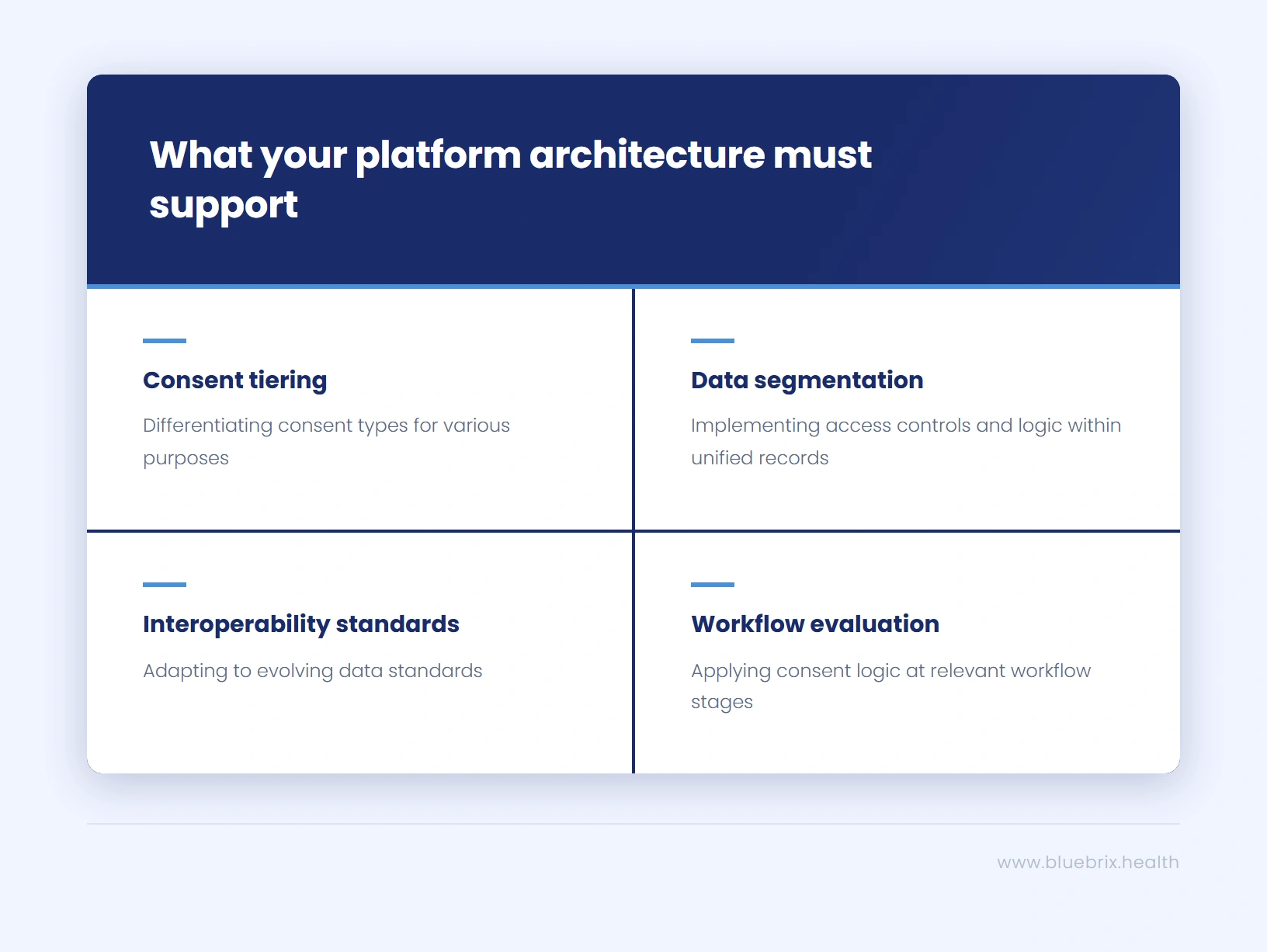
A therapy-specific portal needs to model at least three tiers of consent: standard treatment, payment, and operations disclosures; a standalone authorization for psychotherapy notes, which HIPAA requires to be separate from any other release; and, for SUD-serving practices, a separate consent for SUD counseling notes under the revised Part 2 rule. That’s three distinct consent states to track, not one.
Segmentation is a workflow problem
The Part 2 final rule doesn’t require segregating SUD records into a separate system. The practical requirement is access controls, consent status, and disclosure logic evaluating correctly within a unified record, not SUD data living somewhere else entirely. Worth clarifying up front, since it changes the shape of the integration work considerably.
Changing interoperability standards
ONC published Draft USCDI v7 on January 29, 2026, and there’s an active HL7 FHIR implementation guide, USCDI+ Behavioral health, built specifically to represent behavioral health data classes, still in draft status as of this writing.[9] Any interoperability claim measured against a fixed behavioral health data standard is being measured against something that’s still being defined.
Consent logic needs to evaluate at the workflow stage where it matters
Consent and disclosure requirements aren’t static across a patient’s record. They apply differently depending on where in the workflow a request originates, a scheduling action touching a program flagged for SUD-specific consent rules versus a claim generation step triggering a payer redisclosure requirement. Consent evaluated once, at intake, misses both of those downstream moments.
How blueBriX approaches this: The platform’s rules engine evaluates disclosure and consent logic at the workflow stage where it’s relevant, for example scheduling versus claim generation, rather than applying a single global consent check, which reflects how psychotherapy notes protections and 42 CFR Part 2 consent requirements actually function stage by stage rather than as one flat rule.