

Patient engagement software for mental health: the case against generic portals
A therapist finishes a session on Friday. The patient leaves with a plan, a next appointment, and maybe a medication adjustment, coping exercise, safety reminder, or follow-up task. On paper, the session is complete. In reality, the most fragile part of care has just begun.
For the next several days, the provider may have no reliable view of what is happening. Did the patient take the medication. Did they complete the exercise. Did their PHQ-9 score worsen. Did anxiety spike after a family conflict. Did they miss a digital check-in. Did substance use risk increase over the weekend. If something begins to go wrong on Tuesday, the first signal may not arrive until the next session, assuming the patient shows up at all.
Behavioral health outcomes are not created only during scheduled visits. They are shaped in the days between visits, when symptoms fluctuate, motivation changes, and patients either stay connected to the care plan or drift away from it. That is where generic patient portals fall short. Most were built around transactions: reminders, forms, intake packets, bill pay, portal messages, and digital signatures. Those functions are useful, but they are not continuous care presence. A reminder does not tell the care team whether the patient is improving. A completed form does not automatically become a clinical signal. A portal login does not equal engagement.
Current tools fail in three predictable ways.
- First, they automate touchpoints but do not maintain presence between sessions.
- Second, outcome measures such as PHQ-9 and GAD-7 are often collected as forms, then stored without being surfaced in time to shape care. The behavioral healthcare on Measurement-Based Care position routine outcome measurement as part of clinical decision-making, making behavioral health EHRs with integrated outcome tracking a workflow standard rather than a bonus feature[2].
- Third, many platforms were built with primary-care privacy assumptions. Behavioral health, especially substance use disorder treatment, needs consent logic, record segmentation, and disclosure controls that generic portals were never designed to handle.
The issue is a design philosophy problem. Behavioral health requires presence. Most portals were built for transactions. That would be problem enough on its own. In 2026, new federal requirements make it significantly more expensive to ignore.
How 2026 compliance rules are changing the standard for patient engagement software
The first forcing function is 42 CFR Part 2, which governs confidentiality of substance use disorder treatment records. HHS states that compliance with the 2024 Part 2 final rule was required by February 16, 2026. The updated rule permits a single consent for future uses and disclosures for treatment, payment, and health care operations, but that flexibility only helps if consent forms, system workflows, and disclosure controls have been updated. The rule also aligns breach notification more closely with HIPAA and brings civil enforcement under the HHS Office for Civil Rights.
For SUD-touching programs, this changes the software standard. A generic patient portal without record segmentation, treatment-payment-operations consent workflows, and controlled disclosure logic is not merely inconvenient. It creates measurable compliance exposure. Per HHS’s January 2026 inflation-adjusted civil penalty schedule, Part 2 violations in the lowest tier (‘Did Not Know’) begin at $103 per violation and cap at $51,299, with an annual ceiling of $1,538,970. Willful neglect that goes uncorrected starts at $51,299 per violation[3].
The second forcing function is CMS-0057-F, the Interoperability and Prior Authorization Final Rule. CMS finalized the rule to improve electronic health data exchange and streamline prior authorization. Beginning January 1, 2026, impacted payers must report Patient Access API usage metrics. By January 1, 2027, impacted payers must implement and maintain required APIs, including Patient Access, Provider Access, Payer-to-Payer, and Prior Authorization APIs.
For community mental health centers, Certified Community Behavioral Health Clinics, and virtual behavioral health practices dependent on Medicaid and managed care payers, the operational impact is direct. Prior authorization, outcome reporting, and payer data exchange are becoming more structured and more API-driven. Static portals, manual uploads, and disconnected documentation cannot keep up with that direction.
Engagement software for behavioral health can no longer be evaluated only by patient convenience. It has to support privacy, consent, outcomes, and exchange readiness as part of ordinary care.
What effective patient engagement solutions for behavioral health actually deliver
Closing the care gap does not mean sending more messages. It means creating a living view of the patient between appointments. Most digital health patient engagement solutions are built around a primary care model that does not translate to the between-session demands of behavioral health.
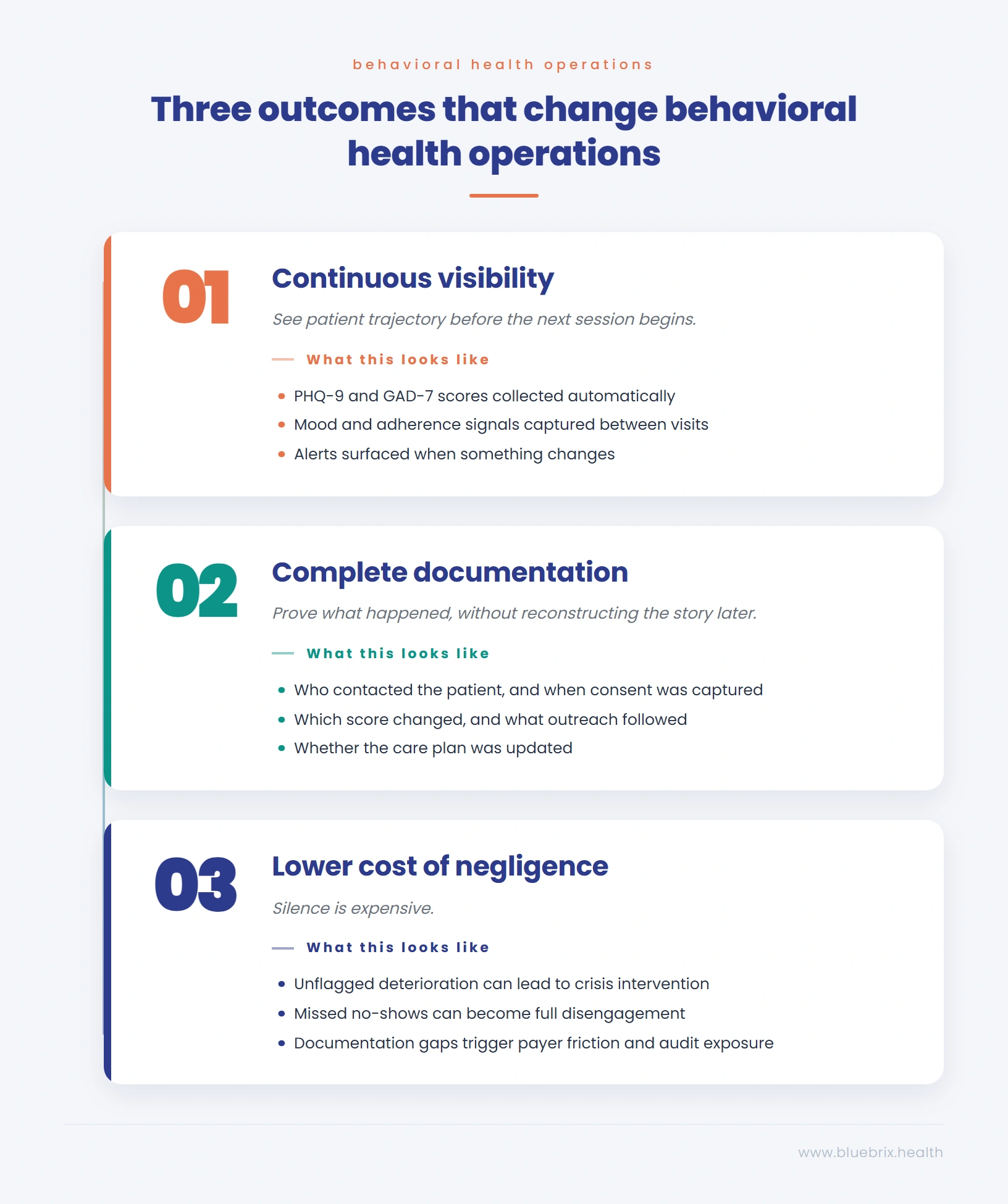
The first outcome is continuous visibility. Providers should be able to see patient trajectory before the next session begins. That includes PHQ-9 and GAD-7 scores collected automatically, mood or adherence signals captured between visits, and alerts when something changes. If a depression score worsens, the provider should not discover it halfway through the appointment. If a patient misses a check-in after a high-risk session, the care team should know. If anxiety scores rise over several days, that trend should be visible before the next scheduled clinical conversation. Consider what this looks like in practice. A provider opening their dashboard before a Tuesday session sees a PHQ-9 score that has dropped significantly since the previous week, alongside a flagged missed check-in from Monday. The care team has that context before the session begins, not halfway through it.
A December 2025 retrospective cohort study published in JMIR Formative Research examined 3,572 patients at a technology-enabled psychotherapy practice and found high rates of PHQ-9 and GAD-7 completion throughout care, along with 89.1% retention in treatment[4]. The lesson for buyers is not that every platform will reproduce the same result. The lesson is that outcome tracking becomes more useful when it is woven into care instead of treated as a separate reporting task.
The second outcome is complete documentation. Behavioral health practices are often asked to prove what happened after the moment has passed. Who contacted the patient. When was consent captured. Which score changed. What outreach occurred after a missed appointment. Was the care plan updated. Did the patient receive a telehealth follow-up. If those details live in disconnected systems, staff end up reconstructing the story later.
A stronger platform captures the journey as it happens. Outcome measures, consent records, outreach attempts, care interactions, telehealth activity, and follow-up tasks become part of the same record. For CCBHC and Medicaid reporting, that matters. Reporting should be a byproduct of normal workflow, not a monthly scavenger hunt across spreadsheets, notes, and portal logs.
The third outcome is a lower cost of negligence. Silence is expensive. A worsening patient who is not flagged may later require crisis intervention. A missed no-show pattern can become full disengagement. A missing consent update can become a compliance problem. A documentation gap can trigger payer friction or audit exposure. The right platform reduces these risks by making deterioration, missed steps, and documentation gaps visible early enough to act. For practice operators, these risks translate directly into staff time. Reconstructing a documentation trail after a payer audit, reworking denied claims from incomplete outcome data, and manually compiling Medicaid or CCBHC reporting from disconnected systems are overhead costs that repeat every billing cycle. A platform that captures the care journey as it happens reduces that administrative burden at the source.
Telehealth reinforces the same point. A 2024 NIMH-funded RAND study, published in JAMA Health Forum, found that 80 percent of mental health treatment facilities accepting new patients were offering telehealth services[5]. Virtual access is now part of behavioral health delivery. The harder question is whether virtual visits, digital check-ins, outcome measures, and documentation all connect into one clinical picture.
The standard for buyers is simple: what does the provider know about the patient when the patient is not in the room.
Ready to close the care gap
By the time a patient walks into their next session, it is too late to act on what you missed between appointments. blueBriX closes that window, giving care teams real-time visibility into outcome scores, adherence signals, and care gaps so problems are caught early, not discovered late.
Book a demoHow bluebrix goes beyond generic digital health patient engagement solutions
Every section of this guide points to the same problem. The gap between appointments is where behavioral health outcomes are shaped, where documentation breaks down, and where compliance exposure grows. Most generic patient portals were never built to address that gap. blueBriX was.
EngageAI creates a continuous presence between sessions through conversational check-ins, outcome measure requests, adherence signals, care journey tracking, and proactive alerts. PHQ-9 and GAD-7 movement, mood signals, missed steps, and care gaps surface before the next session starts. The provider’s understanding of the patient does not freeze at the last appointment.
Clinician authority stays intact throughout. AI surfaces signals. The care team acts. That distinction matters in behavioral health, where context, trust, and clinical judgment cannot be outsourced to automation.
Documentation follows the workflow rather than running parallel to it. Consent records, outcome scores, engagement history, telehealth activity, care interactions, and follow-up tasks remain tied to the patient journey. For CCBHC and Medicaid reporting, that means cleaner data without duplicate entry. The sequential record of consent events, outcome scores, outreach attempts, care interactions, and workflow activity is maintained in a form that supports full audit reconstruction without manual consolidation. For compliance teams, it means audit readiness is built into ordinary care rather than reconstructed after the fact.
For programs that touch substance use disorder care, blueBriX supports 42 CFR Part 2 and HIPAA-sensitive workflows, including SUD record segmentation, consent management, and privacy-aware disclosure controls. Telehealth, portal, outcome capture, scheduling, and EngageAI are included in one platform and one pricing model, so practices are not assembling care visibility from disconnected modules and separate contracts.
The question this guide started with was simple: what does the provider know about the patient when the patient is not in the room. blueBriX is built to answer that question every day, between every session. For practices planning a portal replacement, blueBriX implements in 60 to 90 days with workflows configured to the practice’s existing structure.