

What is a behavioral health EHR vendor evaluation?
A behavioral health EHR vendor evaluation is the structured process an organization uses to assess whether an electronic health record platform can support its clinical workflows, regulatory obligations, billing requirements, and growth trajectory. In behavioral health, this evaluation carries higher stakes than in most other healthcare specialties because the documentation demands are more complex, the regulatory environment is more layered (HIPAA, 42 CFR Part 2, state-specific Medicaid rules, CCBHC certification standards), and the consequences of a poor fit compound across every clinician, every claim, and every compliance report.
A rigorous evaluation goes beyond feature checklists. It tests whether the vendor can demonstrate — in your workflows, with your payer mix, against your reporting requirements — that the platform works the way your organization actually delivers care.
Why most EHR evaluations fail
Here is what most behavioral health EHR evaluations look like:
- A vendor runs a polished demo.
- The scheduling screen is clean.
- The treatment plan template is pre-loaded.
- The billing module submits a sample claim in two clicks.
- Everyone on the selection committee nods.
Six months after go-live, clinicians are building workarounds in spreadsheets. The billing team is manually checking eligibility on payer portals because the system cannot handle your Medicaid MCO’s specific modifier requirements. The compliance officer is pulling CCBHC quality data by hand because the pre-built reports do not match your state’s measure specifications. And the support contact who understood your setup during implementation has been replaced by a general ticket queue.
This pattern is not hypothetical. Organizations using behavioral health EHRs report some of the lowest satisfaction scores of any KLAS-measured market segment.[1] A peer-reviewed study published in Mayo Clinic Proceedings found that physicians rated EHR usability at 45.9 out of 100 on the System Usability Scale — placing EHRs in the bottom 9% of all software products ever evaluated and categorizing them in the “not acceptable” range.[2] The same study found that every one-point drop in usability was independently associated with a 3% increase in the odds of physician burnout. And according to Black Book Research (2025), 40% of behavioral health practices switch EHRs within the first three years — most commonly due to poor workflow fit, inadequate billing functionality, or insufficient customer support. The costs of discovering a poor fit after signing are not just financial. They are clinical, operational, and cumulative.
Why 2026 changes the behavioral health EHR evaluation criteria
Three regulatory developments have reshaped what a behavioral health EHR must do, and what your evaluation must test:
42 CFR Part 2 alignment with HIPAA [3]
The final rule aligning substance use disorder patient record protections with HIPAA took effect on February 16, 2026, and is now in active enforcement by the HHS Office for Civil Rights. The rule replaces the fragmented, program-by-program consent model with a single consent for treatment, payment, and healthcare operations. It brings SUD records under HIPAA breach notification requirements. For any organization providing SUD services, your EHR must support these consent workflows, data segmentation, and breach notification processes today — not as a roadmap item.
CMS Interoperability and Prior Authorization Final Rule (CMS-0057-F)- [4]
Impacted payers were required to implement operational provisions — including specific prior authorization response timelines — by January 1, 2026. FHIR-based API requirements follow by January 1, 2027. For behavioral health organizations, this means the payers funding the majority of your services are transitioning to electronic prior authorization. An EHR that is not FHIR-ready will require manual workarounds at every payer transition.
CCBHC permanent Medicaid benefit
The Consolidated Appropriations Act of 2024 made the CCBHC program a permanent Medicaid state plan benefit. SAMHSA’s certification criteria require quality measure reporting — including FUH, FUA, IET, and PCR-AD measures — beginning calendar year 2025. If you are a CCBHC or pursuing certification, your EHR must generate these reports natively.
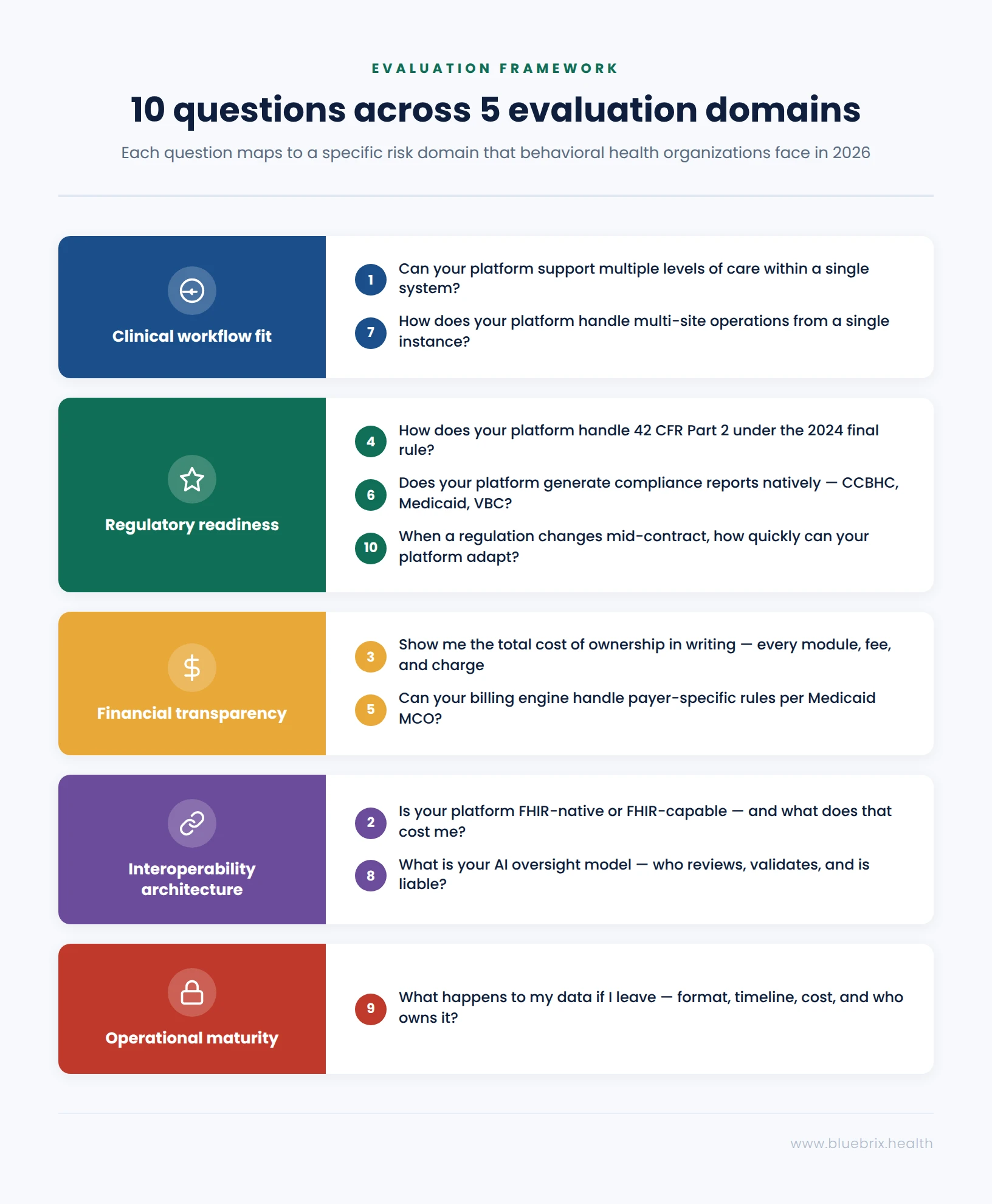
Here are the 10 questions to consider, why they matter and some red flags to spot early on:
1. Can your platform support multiple levels of care within a single system — or do I need separate configurations per program?
Why this matters: Behavioral health organizations rarely deliver a single type of care. A CMHC may run outpatient therapy, intensive outpatient, crisis services, and medication management. A residential provider may operate detox, PHP, IOP, and aftercare programs under one roof. The question is whether the EHR treats these as native program types within a unified system — or whether each level of care requires its own configuration, templates, billing rules, and reporting setup. When programs are configured as separate silos, every operational task — transferring a patient between levels of care, running cross-program reports, managing staff who work across programs — becomes a manual reconciliation exercise.
What to look for in the answer:
- Can the vendor demonstrate a patient moving between levels of care (e.g., residential to IOP to outpatient) within the same system, with documentation, billing, and treatment plan continuity preserved?
- Does the platform support program-specific documentation templates, billing rules, and authorization requirements without requiring separate system instances?
- Can clinicians who work across multiple programs access a unified view of the patient’s history, or do they need to switch between program-specific configurations?
Red flag: The vendor describes level-of-care transitions as “configurable” but cannot demonstrate one in real time, or the transition requires manual re-enrollment in a separate program module.
2. Is your platform FHIR-native or FHIR-capable — and what does that distinction cost me over the next five years?
Why this matters: The CMS Interoperability and Prior Authorization Final Rule [5] is shifting the entire payer-provider data exchange model toward FHIR-based APIs. This is not a theoretical future state — payer operational provisions took effect January 1, 2026, and FHIR API requirements follow by January 1, 2027. The critical distinction for buyers is whether a platform was built on FHIR from the ground up (FHIR-native) or whether it was built on an older architecture — typically HL7 v2 or a proprietary data model — with a FHIR translation layer added on top (FHIR-capable). The practical difference shows up in integration speed, cost, and reliability: FHIR-native platforms connect to new systems faster and at lower cost because they do not need to translate between internal and external data formats. FHIR-capable platforms require middleware for every new connection, and that middleware needs maintenance every time a standard is updated.
| FHIR-native | FHIR-capable | |
|---|---|---|
| Core architecture | Built on FHIR from the ground up. Data model is FHIR — no translation between internal and external formats. | Built on legacy HL7 v2 or proprietary data model with a FHIR translation layer added on top. |
| New integrations | Connect directly to HIEs, PDMPs, and payers without middleware or per-interface development. | Every new integration requires middleware to translate between internal format and FHIR — adding cost and maintenance. |
| Standards updates (R4 to R5) | Absorbed by the architecture. Not bolted on as patches. | Require translation layer rework. Each version change is a development project. |
| Integration cost trajectory | Stays flat as the number of connected systems grows. | Compounds with every new connection, creating cumulative technical debt. |
| Per-interface fees | Typically none — standard connections included. | Common — each HIE, PDMP, or payer connection priced separately. |
| CMS-0057-F readiness | Architecturally aligned. FHIR API requirements (Jan 1, 2027) require no structural rework. | Requires middleware upgrades and translation layer maintenance to meet FHIR API mandates. |
What to look for in the answer:
- Can the vendor specify whether the platform’s core data architecture is FHIR-native, and which FHIR version it supports? (R4 is the current CMS baseline; R5 is the emerging standard.)
- What does the vendor charge for API connections, HIE integrations, and PDMP interfaces? Are these included in the base price or priced per interface?
- Can the vendor demonstrate a live data exchange with at least one HIE or payer in your state?
Red flag: The vendor cannot specify which FHIR version the platform supports, or charges per-interface fees for standard connections like HIEs or PDMPs.
3. Show me the total cost of ownership in writing — including every module, integration fee, and per-transaction charge
Why this matters: Behavioral health EHR pricing is notoriously opaque. The per-user-per-month rate that anchors most proposals often excludes implementation fees, data migration costs, training beyond initial onboarding, API access charges, custom report development, and add-on modules for capabilities like telehealth or e-prescribing. Industry analysis shows that telehealth add-ons, billing module fees, per-claim clearinghouse charges, and onboarding costs can add $50 to $200 or more per month on top of base pricing. And that does not account for the productivity impact: industry sources report that output often drops 10% to 40% in the early weeks after go-live — a cost that never appears on a vendor proposal but hits your revenue immediately.
What to look for in the answer:
- Can the vendor provide a written total cost of ownership estimate that includes implementation, data migration, training (initial and ongoing), integration fees, and any per-transaction charges?
- Are telehealth, patient portal, e-prescribing (including EPCS), and claims processing included in the base price, or priced as add-ons?
- What are the contract terms? Is there an early termination clause, and what does it cost?
- Does the vendor charge for custom report development or template modifications after go-live?
Red flag: The vendor cannot produce a written TCO breakdown, or the proposal lists features as “included” without specifying whether that applies to the base tier or a higher pricing level.
4. How does your platform handle 42 CFR Part 2 compliance under the 2024 final rule — specifically single consent, data segmentation, and breach notification?
Why this matters: The revised 42 CFR Part 2 rule is now in active enforcement as of February 16, 2026. Any organization that provides SUD diagnosis, treatment, or referral and receives federal assistance is a Part 2 program. The operational changes are significant: a single consent for treatment, payment, and operations replaces the legacy per-program model; SUD records now fall under HIPAA breach notification requirements; and a specific redisclosure notice must accompany every consent-based disclosure. These are not abstract compliance requirements — they affect consent capture workflows, data architecture, and breach response processes. An EHR that treats Part 2 as “HIPAA compliance plus a checkbox” will create operational risk in every encounter involving SUD services.
What to look for in the answer:
- Does the EHR support the new single-consent workflow for TPO disclosures, or does it still require separate consents per program?
- Can the system segment SUD records at the data level — not just at the access-permission level — so that disclosures can be controlled granularly?
- Is breach notification tracking for Part 2 records integrated into the platform, or does it require a separate process?
- Is breach notification tracking for Part 2 records integrated into the platform, or does it require a separate process?
Red flag: The vendor references “HIPAA compliance” without specifically addressing Part 2, or describes Part 2 features as “in development.”
5. Can your billing engine handle payer-specific rules per Medicaid MCO without custom development — and can you show me how that works with my top three payers?
Why this matters: Behavioral health billing is structurally different from medical billing. Medicaid — which funds a majority of behavioral health services in community settings — varies by state, by managed care organization, and often by program type. Every MCO has unique modifier requirements, bundling rules, authorization thresholds, and timely filing deadlines. A platform that handles medical billing well may still fail at behavioral health billing because it was not designed for the volume and diversity of payer rules that behavioral health organizations manage every day. The difference between a configurable payer rules engine and a system that requires custom development for each payer variation is the difference between a billing team that processes claims and a billing team that fights denials.
What to look for in the answer:
- Does the system support payer-specific billing rules — including modifier logic, authorization requirements, and bundling rules — that can be configured per payer without custom development?
- Can the platform handle real-time eligibility verification across Medicaid MCOs, commercial payers, and self-pay simultaneously?
- Can the platform handle real-time eligibility verification across Medicaid MCOs, commercial payers, and self-pay simultaneously?
- Does the system flag missing prior authorizations before claim submission, not after denial?
- Ask the vendor to demonstrate billing workflows using your actual top three payers — not a generic commercial insurance example.
Red flag: The vendor demonstrates billing using a commercial insurance example and cannot show Medicaid-specific workflows on demand, or describes payer rule updates as requiring a support ticket rather than a configuration change.
6. Does your platform generate the compliance reports my accreditation and payer contracts require natively — or do I need to extract data and build reports manually?
Why this matters: Compliance reporting in behavioral health is not a single report — it is a matrix of requirements that vary by accreditation body, payer contract, state Medicaid program, and federal certification. A CCBHC must report on FUH, FUA, IET, and PCR-AD quality measures. A Medicaid-funded program must meet state-specific reporting formats. A value-based care contract may require outcome measures, utilization data, and cost benchmarks. The question is whether the EHR can generate these reports from the data it captures natively, or whether the compliance team must export raw data to spreadsheets and build reports manually — a process that introduces errors, delays reporting cycles, and consumes staff time that should be spent on clinical and operational priorities.
What to look for in the answer:
- Can the vendor demonstrate pre-built reports aligned with CCBHC quality measures, Medicaid state reporting requirements, and value-based care contract metrics?
- Does the reporting engine aggregate data across programs and sites without requiring manual data stitching or export?
- When a new reporting requirement is introduced — a new quality measure, a new state format — how is it added? Is it a platform update, or does it require custom report development at additional cost?
Red flag: The vendor says “we have a reporting module” but cannot demonstrate a specific compliance report your organization is required to submit, or describes cross-site reporting as requiring a data export.
7. How does your platform handle multi-site operations — centralized scheduling, documentation, billing, and reporting from a single instance?
Why this matters: Behavioral health organizations that operate across multiple sites — even two or three locations — face a compounding set of problems that single-site platforms cannot address. Scheduling must work across locations. Documentation standards must be consistent but configurable by program. Billing must support site-specific payer contracts. Reporting must aggregate across the organization without requiring manual data reconciliation. And access controls must be granular enough to protect patient data across sites without creating workflow bottlenecks for clinicians who work at multiple locations. The architectural question is whether the platform runs as a true single instance serving all sites — or whether each site is effectively a separate installation that shares a brand name but not a unified data model.
What to look for in the answer:
- Can the platform support centralized scheduling, documentation, and billing across all sites from a single instance — or does each site require its own configuration?
- Does the reporting engine aggregate data across all sites by default, or does cross-site reporting require custom development?
- Are role-based access controls granular enough to manage clinicians who work across multiple locations and programs?
- Can the system handle different payer contracts and billing rules per site without duplicating configuration?
Red flag: The vendor describes multi-site support as “available” but cannot demonstrate cross-site scheduling or organization-wide reporting in a live demo.
8. What is your AI oversight model — who reviews, who validates, and who is liable if an AI-generated note fails an audit?
Why this matters: AI-assisted documentation is now a standard marketing feature across most behavioral health EHR platforms. The evaluation question for 2026 is not whether the platform has AI capabilities, but whether its AI architecture maintains clinician oversight at every step. For organizations with CCBHC quality measure reporting obligations or payer audit exposure, AI-generated notes that are not reviewed and validated by a clinician before submission create compliance risk and potential liability. The vendor’s answer to this question reveals whether AI is positioned as a clinician support tool or as a clinician replacement — and the distinction matters in an audit.
- Does the platform follow a defined human-in-the-loop model where AI suggests and the clinician validates before any note is finalized?
- Can the organization configure which AI features are enabled and which are disabled, by role and by program?
- Does the vendor provide transparency into how the AI model was trained, and whether patient data is used for model training?
- Are AI-generated suggestions clearly labeled as such within the clinical record, so auditors can distinguish AI-assisted content from clinician-authored content?
Red flag: The vendor positions AI as reducing the need for clinician review rather than supporting clinician decision-making, or cannot explain the oversight model in concrete terms.
9. What happens to my data if I leave — format, timeline, cost, and who owns it?
Why this matters: No one signs an EHR contract expecting to leave. But 40% of behavioral health practices switch EHRs within the first three years, according to Black Book Research (2025). The time to understand your exit options is before you sign, not when you are already locked in. Data portability is not a theoretical concern — it determines whether a future migration is a manageable project or an organizational crisis. Switching costs for mid-size behavioral health organizations range from $25,000 to $350,000 or more, and a significant portion of that cost comes from extracting data from a proprietary format that the vendor controls.
What to look for in the answer:
- Does the contract include a clear data export clause that specifies the format, timeline, and cost of extracting your data?
- Can the vendor export clinical data in a standard format (FHIR, C-CDA, or at minimum structured CSV) — not a proprietary database dump that requires vendor assistance to interpret?
- Are there early termination fees, and if so, how are they structured?
- Does the vendor retain any rights to your clinical data after contract termination?
Red flag: The contract does not address data export, or the vendor’s standard export is a proprietary format that requires paid professional services to convert.
10. When a regulatory requirement changes mid-contract, how quickly can your platform adapt — and what does that cost me?
Why this matters: Healthcare regulation does not wait for vendor release cycles. The 42 CFR Part 2 final rule gave organizations a two-year implementation window that is now closed. CCBHC quality measures are being updated as states expand the program. Medicaid MCOs change billing rules quarterly. CMS-0057-F is introducing new FHIR-based API requirements that payers must meet by January 2027, which will cascade to provider-facing workflows. The question is whether your EHR vendor can respond to these changes through platform configuration — or whether each regulatory update requires a custom development project, a new module purchase, or months on a product roadmap before it reaches your system. Organizations on legacy platforms consistently report that regulatory updates take months to appear in the system and sometimes require paid custom development to implement.
What to look for in the answer:
- Can the vendor provide specific examples of how they responded to a recent regulatory change — the 42 CFR Part 2 enforcement deadline, a CCBHC measure update, or a Medicaid MCO rule change — and how long it took for the update to reach production?
- Are regulatory updates delivered as part of the standard platform subscription, or do they require additional cost?
- Does the platform’s architecture allow your team to configure new compliance workflows without depending on the vendor’s development timeline?
Red flag: The vendor describes regulatory adaptation as “on our roadmap” or cannot cite a specific example of a regulatory change they delivered to production within the past 12 months.
Why blueBriX behavioral health EHR is worth considering
The questions above are designed to be asked of every vendor, including blueBriX. Transparency requires that we show how our platform responds to the same evaluation criteria. The table below summarizes blueBriX’s position on each question. Where we have verified capabilities, we state them directly.
| Evaluation area | blueBriX capability |
|---|---|
| Multi-program, multi-level-of-care support | Configurable for outpatient, IOP, PHP, residential, SUD, crisis, and group therapy within a single platform instance. Patient transitions between levels of care preserve documentation, billing, and treatment plan continuity. |
| Interoperability and FHIR | FHIR R5-native architecture — not a translation layer on top of legacy HL7 v2. HL7/FHIR interoperability with HIEs, PDMPs, and payers. Open API at no additional per-interface fee. |
| Total cost of ownership | One pricing model: telehealth, patient portal, e-prescribing (including EPCS), claims processing, and compliance reporting included in the base price. |
| 42 CFR Part 2 compliance | Single-consent TPO workflow, data segmentation at the record level, redisclosure notice automation, and HIPAA breach notification tracking for SUD records. Compliance-ready as of the February 2026 enforcement date. |
| Payer-specific billing rules | Configurable billing rules engine supporting modifier logic, authorization requirements, and bundling rules per payer. Real-time eligibility verification across Medicaid MCOs, commercial, and self-pay. Prior authorization flags before claim submission. |
| Native compliance reporting | Pre-built compliance reports aligned with CCBHC certification requirements, Medicaid quality measures, and value-based care models. Cross-program and cross-site reporting aggregation without manual data extraction. |
| Multi-site operations | Centralized scheduling, documentation, and billing across all sites from a single instance. Cross-site reporting without custom development. Granular role-based access controls for multi-location clinicians. |
| AI and clinical decision support | Human-in-the-loop model: AI suggests, the platform validates against contract rules, the clinician decides. AI features configurable by role and program. AI-generated content labeled within the clinical record. |
| Data portability and exit terms | Standard data export in structured formats. No proprietary lock-in on clinical data. Contract terms include clear data export provisions. |
| Regulatory adaptation speed | Platform architecture supports configuration-level regulatory updates. 17+ years in digital health. Regulatory updates delivered as part of the standard subscription. |
blueBriX has been in digital health for 17+ years. Our platform is built for behavioral health — not adapted from a general-practice EHR. We invite evaluation committees to test these claims against their own workflows, with their own data, using their own clinical scenarios.
Take the next step
Use this guide to structure your next vendor conversation — whether that conversation is with us or with another vendor. If you want to see how blueBriX responds to these ten questions in a live demo built around your workflows, schedule a demo.
Request a demo