

What multi-program Medicaid billing leakage actually looks like
For illustration, nobody loses $200,000 in one bad claim. You lose it $300 at a time — a missed eligibility re-check on a program transfer, an authorization that expired two weeks before anyone noticed, a filing window that closed on claims the billing team didn’t know were at risk. Spread that across five programs and three MCOs and it adds up to a number that would stop a CFO cold, if anyone were actually tracking it by program.
Revenue leakage in multi-program behavioral health Medicaid billing is the cumulative loss of reimbursable revenue that occurs when an organization operating multiple service lines — outpatient, residential, SUD, IOP/PHP, child and adolescent — manages each program’s distinct billing rules, authorization requirements, claim form types, and MCO contracts through a billing infrastructure that wasn’t configured for that level of variation. The leak doesn’t show up as a single denial category. It compounds across programs, across payers, and across the revenue lifecycle from intake to claim payment.
A March 2026 MACPAC analysis of federal T-MSIS data[3] found that total Medicaid spending on enrollees with behavioral health conditions — including their medical, pharmacy, and behavioral health services combined — reached nearly $370 billion in 2023, accounting for more than half of all Medicaid service-related spending. Multi-program behavioral health agencies depend on a share of that spending, and the billing infrastructure behind it determines how much they collect.
If your organization operates five or six programs, each with its own billing logic, its own MCO contracts, and its own documentation requirements, how many distinct failure points are you actually managing?
It is a hard question to answer without program-level tracking. And that’s where the revenue goes.
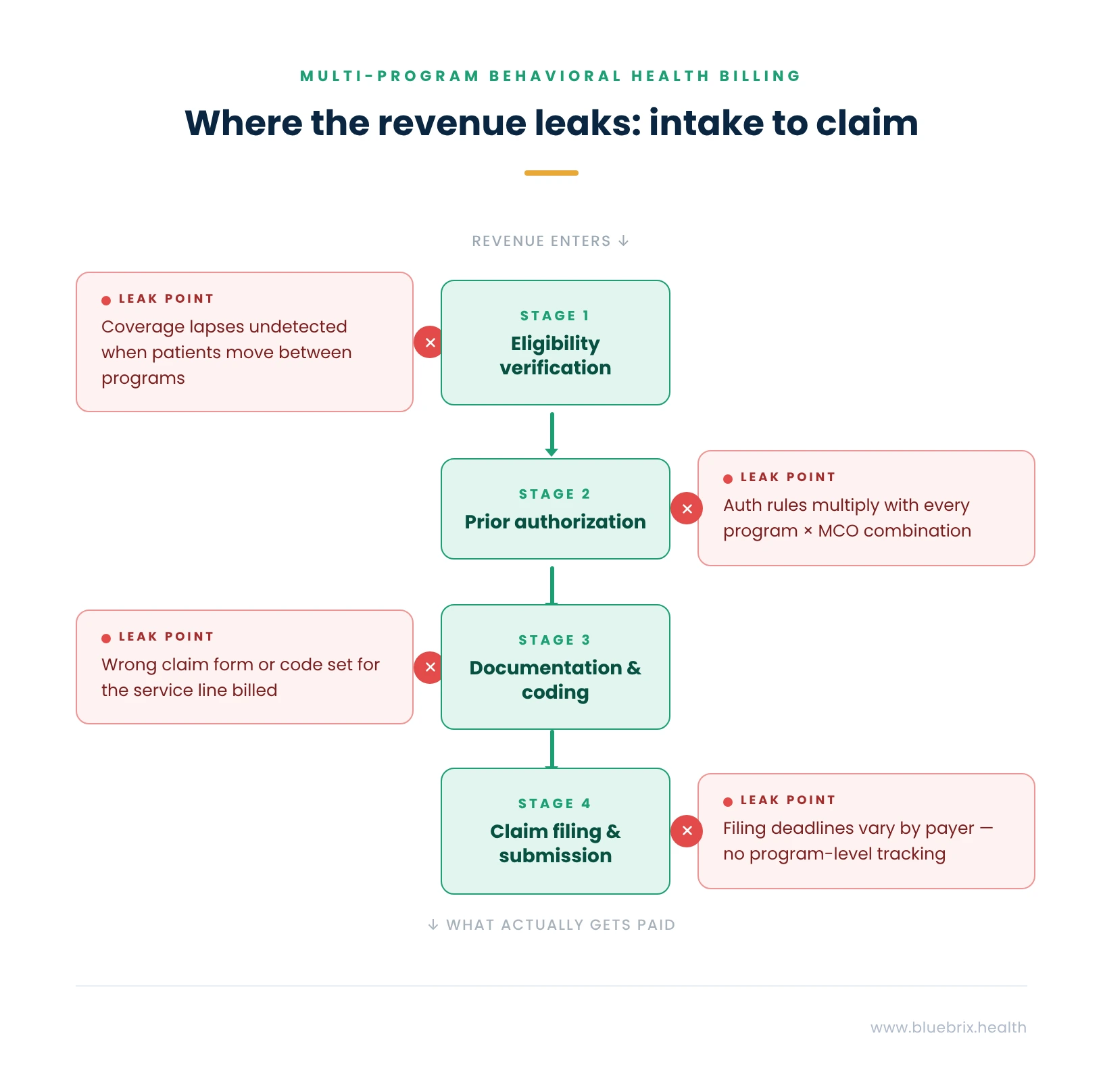
Where the chain breaks: intake to claim
Here’s where it typically falls apart.
Eligibility gaps at program transitions.
When a patient moves from outpatient into IOP, or from SUD treatment into residential, that transition is a good point to re-verify coverage. Eligibility can lapse in any month, and the MCO or benefit plan that covers the new service may differ from the one covering the old one. If that isn’t caught before the claim is built, the episode can bill against coverage that is no longer active.
Authorization rules that multiply by program.
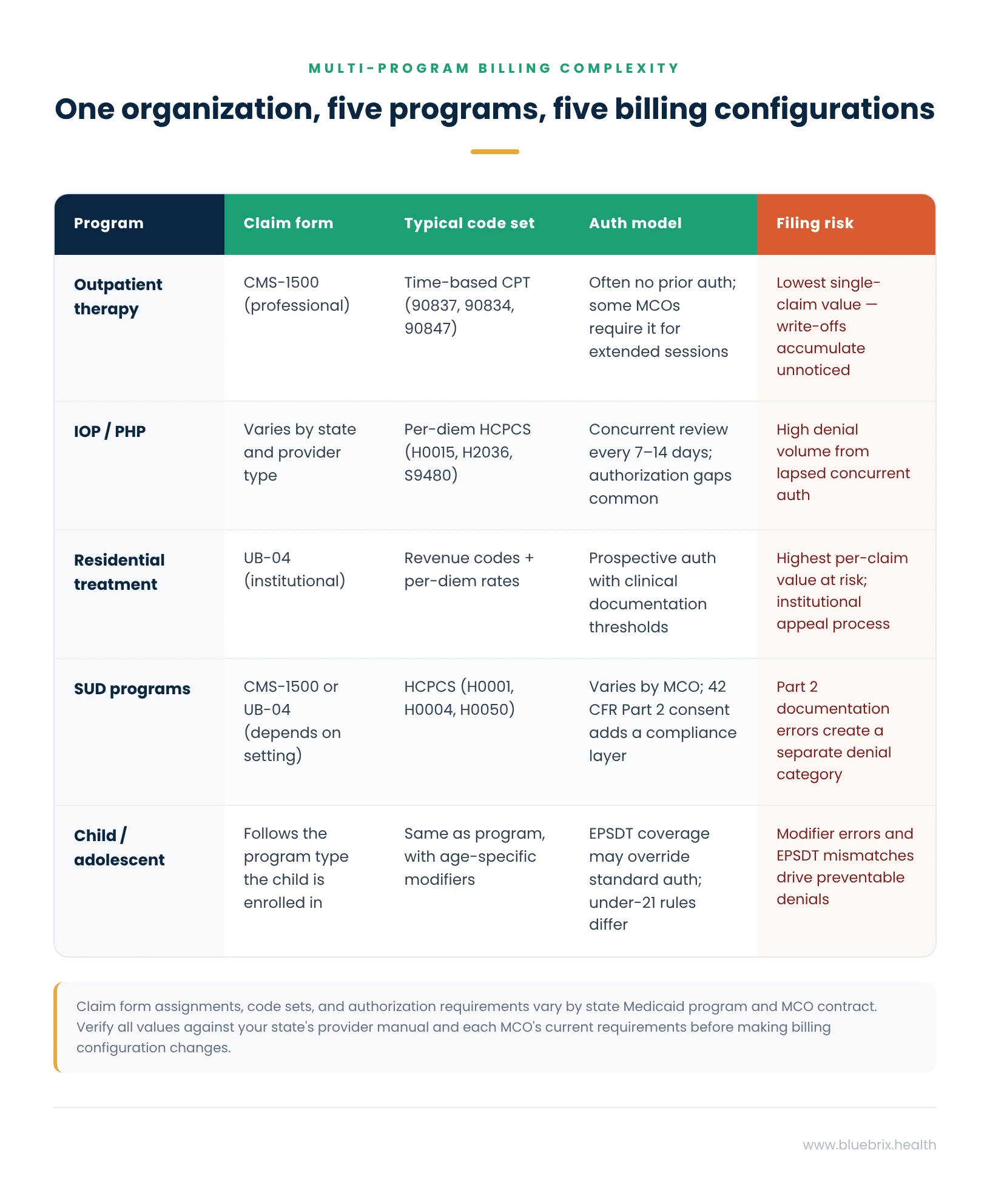
Outpatient therapy may require no prior auth from a given MCO. IOP through the same MCO may need concurrent review every 7 to 14 days. Residential may need prospective authorization with clinical documentation thresholds the outpatient team has never had to meet. An agency running four programs through three MCOs is managing up to twelve distinct authorization rule sets — and the billing team can end up learning what each one requires through denials, not from a central reference.
The federal audit record now confirms this isn’t just an operational headache. In June 2026, HHS OIG audited Community Behavioral Health (CBH), the Pennsylvania behavioral health Medicaid MCO with the highest number of denied service requests of any BH-MCO in the state. OIG sampled 100 of the 1,102 prior authorization denials CBH issued in 2023. Zero of the 100 met all applicable federal and state requirements (OIG Report A-03-24-00204). Thirty-four denials involving enrollees younger than 21 lacked required consultation documentation. Adverse determination notices failed to comply with federal standards.
OIG attributed the most common deficiency — all 100 notices failed to inform enrollees of their right to records free of charge — to a gap in the State’s own denial notice template. CBH denied 1,102 of 96,130 behavioral health service requests requiring prior authorization in 2023. OIG described the findings as administrative and procedural, while warning they may have delayed or denied medically necessary services.[1]
OIG’s March 2026 audit of Louisiana Healthcare Connections[4] reached a different result: 64 of 76 sampled behavioral health prior authorization denials met federal and state requirements. The 12 that didn’t — an estimated 15.8% of the full population — failed primarily because the MCO did not send written adverse determination notices (OIG A-06-24-02000). OIG made no recommendations.
OIG did not measure direct provider cost. Notice defects and process failures can create rework and appeal delays for providers, and in a multi-program agency that can happen across programs in parallel.
Documentation that doesn’t match the billing form.
Outpatient therapy bills on a CMS-1500 with time-based CPT codes. Which claim form and code set applies to IOP, PHP, residential and SUD programs depends on the state Medicaid manual and the provider type. Some programs bill institutional claims on a UB-04 with revenue codes. Others bill per-diem HCPCS codes on a professional claim. A documentation gap in an outpatient note produces a medical necessity denial you can appeal with additional narrative. With some payers, the same gap in a residential per-diem claim can trigger an institutional-level medical record review — a fundamentally different rework process. Billing teams that treat all denials the same, regardless of program and claim form, are writing off revenue they could recover.
Timely filing deadlines that nobody tracks by program.
Federal rules cap state Medicaid fee-for-service filing limits at 12 months from the date of service. Wyoming uses the full 12 months, and other states set shorter windows. MCO contracts can impose tighter windows on top of that — some behavioral health carve-outs require 60 to 90 days. Even within Pennsylvania’s HealthChoices program, filing windows vary by BH-MCO contract, and some are as short as 60 days.[5]
In practice, this means the billing team is juggling a 60-day window on one MCO’s IOP claims, 90 days on the same MCO’s outpatient services, 180 days on fee-for-service claims for a different program, and a separate calendar for resubmissions. If AR aging is tracked in aggregate, claims can hit the filing wall without anyone seeing it coming.
The denial patterns that cost the most in multi-program BH
Not all denials are equal. In multi-program behavioral health billing, the patterns that do the most financial damage are structural — built into the billing process, not caused by one-off coding mistakes.
Parity red flags: denial rates that diverge by service category
In August 2026, OIG published an audit of New York State’s oversight of Medicaid managed care parity compliance (OIG Report A-02-24-01011)[6]. The findings raised serious concerns. Selected MCOs had denial rates for mental health and substance use disorder services above New York’s 20% threshold.
One MCO’s outpatient out-of-network mental health denial rate reached 70% in Q2 2023, compared with 25% for comparable medical services — a disparity OIG flagged as an indicator of potential noncompliance. The MCOs’ own comparative analyses were either unsupported or indicated possible parity issues.
For providers, this raises an important question: are you tracking your own denial rates by MCO and service type, flagging disparities, and checking whether your state publishes MCO-level parity reports?
OIG found that the audited MCOs couldn’t reproduce the data behind their own comparisons. Your own denial data is the record you control.
Federal oversight of Medicare Advantage behavioral health authorizations is changing
In May 2025, GAO published its review of Medicare Advantage prior authorization for behavioral health services (GAO-25-107342)[7]. It examined nine MA organizations covering roughly 45% of MA enrollment. GAO found that CMS had not targeted behavioral health services in its program audit reviews of MA prior authorization denials, despite identifying behavioral health access as a priority.
GAO recommended CMS begin doing so and now lists that recommendation as implemented — CMS targeted two behavioral health services in its coverage criteria reviews in April 2025 and instructed auditors to consider selecting clinically relevant behavioral health denials for review in its 2026 program audits.
Why should Medicaid providers pay attention?
If you also bill Medicare Advantage plans, the same discipline applies: track denial rates by payer and service type. The oversight infrastructure is now in motion, but it’s new. Providers should not assume it will catch payer-level patterns quickly enough to protect their current revenue cycle.
Billing mismatches between service lines
When a patient moves between programs within the same organization, the billing requirements can change too. A transition from outpatient care to IOP, PHP to residential, or SUD to co-occurring mental health treatment may involve a different claim form, code set, modifier, or even payer.
If the billing system doesn’t adjust claim settings automatically based on the patient’s program, staff have to make those changes manually. Across a large caseload, this leaves plenty of room for errors. Often, these problems only become visible when the organization looks at denial patterns program by program.
See how your programs are billing today.
If you manage Medicaid billing across multiple behavioral health programs and the numbers aren’t adding up, a walkthrough of your program-level billing configuration can show you exactly where the exposure sits.
Schedule a demoWhy multi-program agencies are more exposed to billing failures
These billing challenges aren’t exclusive to behavioral health. Multi-specialty organizations also deal with different claim forms and payer requirements. But multi-program behavioral health agencies face a few additional complexities that make them more vulnerable to revenue loss.
Different billing forms within the same organization
Most medical practices use the CMS-1500 for billing, while hospitals generally use the UB-04. Multi-program behavioral health agencies may need to use both, depending on whether a service is classified as professional or institutional.
That means billing teams must keep track of more than just the right codes. They also need to know which claim form, revenue codes, modifiers, and submission process apply to each program. These requirements can also vary from one payer to another.
Multiple MCOs and fragmented billing processes
In many states, Medicaid behavioral health services are handled by specialty MCOs, separate from the organizations managing a patient’s medical benefits.
Pennsylvania, for example, uses county-level BH-MCOs to manage behavioral health services through its HealthChoices program. In New York, behavioral health managed care follows a different regulatory framework from mainstream Medicaid managed care.
For a multi-program agency, this can mean submitting claims for a patient’s IOP services to one MCO and outpatient therapy claims to another. Each may have its own portal, filing deadlines, authorization process, and appeal requirements. Managing all of this adds another layer of work for billing teams.
Additional compliance requirements for SUD billing
Agencies that provide substance use disorder (SUD) treatment also have to account for 42 CFR Part 2. The 2024 final rule[8] (compliance date: February 16, 2026) aligned Part 2 more closely with HIPAA — a single patient consent can now cover treatment, payment, and healthcare operations disclosures, and HHS expressly stated that segregation of Part 2 records is not required. But Part 2 still imposes additional protections beyond HIPAA, including restrictions on how SUD records can be used in legal proceedings and requirements for how consent is documented.
Any RCM process that handles SUD claims — internal or outsourced — must account for these Part 2-specific requirements. A billing workflow built for outpatient mental health may need configuration changes before it can be used for SUD programs, particularly around consent documentation.
Different billing models under one roof
A CCBHC may bill using a prospective payment system (PPS) rate, while an outpatient program uses fee-for-service and an IOP program bills per diem. All three operate within the same organization, but each follows a different reimbursement model.
The billing team has to manage all these models at the same time. And every new program, whether PHP, residential care, or child and adolescent services, brings another set of billing requirements into the mix.
The financial stakes are significant. Medicaid covers nearly one-third of adults with mental health disorders in the United States (Saunders et al. 2025, cited in MACPAC March 2026).[3] For organizations serving these individuals across multiple programs, even small billing errors can affect revenue.
A SAMHSA Uniform Reporting System analysis[9] found that state mental health agency expenditures reached $61.4 billion in FY 2024, with 73% of funding supporting community-based services (NRI/SAMHSA, January 2026). The agencies delivering these services depend on their billing infrastructure to capture the revenue they’re entitled to. When that infrastructure falls short, revenue is lost along the way.
What your billing infrastructure needs to handle
A multi-program behavioral health agency needs a billing setup that accounts for the rules and requirements of each service line and payer. Here are five capabilities that should be in place.
Program-level billing configuration
Each service line, whether outpatient, residential, SUD, IOP/PHP, or child and adolescent services, needs its own billing rules, code sets, claim form logic, and modifier requirements. Relying on one billing template and asking staff to make manual changes for each program leaves too much room for errors. These rules should be built into the system at the program level, rather than corrected when a claim is ready for submission.
MCO-specific rules across programs
If your agency works with three MCOs across five programs, you could be managing up to 15 different combinations of billing requirements. Each may have its own authorization rules, filing deadlines, and appeal processes.
Your billing system should account for these differences automatically. When staff have to remember which rules apply to each MCO and program, the risk of errors grows with every new contract and every new team member.
Eligibility checks whenever patients change programs
When a patient moves from one program to another within the same organization, eligibility should be checked again at the time of enrollment. Waiting until a claim has been prepared and submitted to discover an eligibility issue can lead to avoidable denials. Every program transition should trigger its own eligibility check.
Timely filing alerts by program and payer
Looking at average accounts receivable (AR) aging across the organization can hide problems within individual programs. For example, a 45-day average may look manageable, but the residential program could be working with an MCO that allows only 60 days to file, while the IOP program has a 90-day limit. Claims in both programs may be approaching their deadlines.
Revenue cycle reports should track how close claims are to their filing deadlines for each program and payer, rather than relying only on overall AR aging.
Claim validation based on the billing form
Different claim forms need different validation checks. CMS-1500 scrubbing rules won’t catch UB-04 errors, just as UB-04 validation won’t identify CPT-level modifier issues that can lead to outpatient therapy denials.
Multi-program agencies need claim validation that recognizes the form being used and applies the relevant checks before submission. A single set of rules applied to every claim simply won’t catch all the errors.
blueBriX is built for exactly this
blueBriX’s Program Management Engine allows each service line to have its own billing rules, enrollment criteria, code sets, claim form logic, and payer-specific requirements. These are configured at the program level, rather than handled through manual changes to individual claims.
When a patient enrolls in a program, the corresponding billing configuration applies automatically. Outpatient CMS-1500 rules, residential UB-04 institutional billing, and IOP per-diem H-codes can all operate within the same system, each with its own set of rules. Eligibility checks are triggered when patients move between programs, while timely filing deadlines can be tracked by program and payer instead of getting lost in overall AR aging reports.
For organizations that need additional revenue cycle support, blueBriX’s RCM services team works within this same setup to manage authorization tracking, denial rework, and payer-specific appeals across programs.
In a documented client engagement, blueBriX’s platform and RCM support helped Fair Oaks Psychiatric Associates recover $120,000 in previously lost revenue, achieve 33% revenue growth, and reduce denials by 4 percentage points.