

A Psychiatric Residential Treatment Facility, or PRTF, provides intensive residential psychiatric care to children and adolescents whose clinical needs cannot be met safely in a less intensive setting.[2] For a PRTF, eligibility verification and prior authorization failures show up directly as reimbursement delays: a referral that cannot be confirmed, a bed committed before authorization is settled, or a child who enters care before the payer relationship is resolved.
PRTF eligibility verification confirms that a child is enrolled in the correct Medicaid or managed care plan, that the residential behavioral health benefit is active, and that the facility is recognized by whichever entity is responsible for that benefit. Prior authorization confirms that the payer has approved the requested level of care, the service dates, the unit count, and the clinical basis for admission or continued stay.
When either process fails, the financial problem starts before the claim exists.
What makes this uniquely demanding for a PRTF is the timeline itself. In Minnesota’s Medicaid program, for example, a PRTF must submit its plan of care within 14 days of admission, and the initial authorization typically covers only 90 days,[3]so continued-stay documentation work starts almost as soon as a child is admitted, not near the end of a long stay. A bed held on an unconfirmed benefit, an authorization that lapses mid-treatment, or a continued-stay request filed late all produce the same result: a Revenue or Finance Owner sees it in denial rates and unpredictable occupancy, while admissions and utilization review staff spend hours confirming approvals that should already be settled.
Why do PRTF eligibility and prior authorization failures cause reimbursement delays?
PRTF eligibility and prior authorization failures cause reimbursement delays because Medicaid often routes the behavioral health benefit through a different entity than the medical benefit, because delays and denials carry different deadlines that get tracked inconsistently, and because federal payers are only now moving prior authorization onto standardized electronic systems. Each gap compounds the next.
The portal-hopping and payer carve-out problem
Some states fold the behavioral health benefit into a beneficiary’s primary Medicaid managed care plan; others route it, including residential placements, to a separate behavioral health organization or limited-benefit plan operating alongside the medical plan.[4] A staff member who confirms only the medical benefit can get an accurate answer that still fails to confirm the benefit that actually pays for the placement: a second login, network, and authorization process the medical eligibility check will never reveal.
Delay and denial create different financial risks
Claims also move through different post-submission statuses that are not interchangeable. A rejected claim never enters adjudication at all and can usually be corrected and resubmitted without an appeal.[5] A pended claim is on hold for review or missing information against a payer-specific resolution window before it converts to a denial.[6] A PRTF needs to track each clock separately, since a claim can be filed correctly and still get pended, denied, or written off long after the days of care were delivered.
Electronic prior authorization is becoming a federal payer requirement
CMS-0057-F now requires Medicare Advantage, Medicaid and CHIP fee-for-service and managed care plans, and exchange issuers to build FHIR-based prior authorization APIs, with decision timeframes of 72 hours for expedited requests and seven calendar days for standard ones, generally required by January 1, 2027. For a PRTF, whose patients are overwhelmingly Medicaid-funded, that only helps if the facility’s own systems can submit and track requests electronically: faster payer infrastructure does not by itself create a faster provider workflow.
How does the same failure affect finance and care teams?
Eligibility and authorization failures create different symptoms for the revenue or finance owner and for the care team, but the underlying problem is usually the same: neither group has a shared, current view of a referral’s financial and authorization status.
Finance sees the denial, but the delay creates the first cost
Denial rate is easy to report because it produces a defined claim status. The financial loss frequently begins weeks earlier. If the facility holds a bed while waiting on authorization, it can lose occupancy revenue without a single denial ever being recorded. If a child is admitted before approval is complete, the facility may deliver days of care with no confirmation the payer will pay for them. If the initial authorization expires before continued-stay approval is secured, later days can become disputed even though the original admission was fully authorized.
A denial-only report measures the end of the process. It says nothing about the value of beds held for unresolved referrals, the staff time spent on follow-up, or the revenue tied to treatment days still awaiting a continued-stay decision. A stronger finance view follows the referral from the first eligibility check through final payment, not from the first denial forward.
Care teams lose time meant for admission and clinical preparation
Admissions coordinators and utilization review staff often become the manual bridge between systems. They log into one portal to confirm medical eligibility, another to check behavioral health benefits, and a third to submit an authorization request. When a portal will not confirm status, they call the payer directly. When a request is pended, they track down the clinical team for more records. When authorization comes through, they manually relay the dates and units to scheduling and billing.
- Referral assessment and family communication: the hours spent chasing payer status are hours not spent talking with the family or reviewing the referral itself.
- Clinical preparation and transition planning: treatment-team preparation and documentation for the incoming resident compete directly with administrative follow-up for the same staff time.
Administrative work cannot be removed from a PRTF admission. It can be moved earlier in the process, connected across the teams that need it, and presented without forcing staff to reconstruct the same answer in three different systems.
The shared root cause is disconnected visibility
The recurring failure point is separation. Eligibility and authorization status live outside the referral workflow. Continued-stay dates live outside the clinical calendar. Pended claims sit inside a payer portal while filing deadlines live in a billing spreadsheet. Admissions decides whether to commit a bed without seeing the full reimbursement risk, and billing discovers the problem only after care has already been delivered.
That produces a predictable sequence: a referral gets accepted before the correct behavioral health payer is confirmed, a bed gets held before authorization status is reliable, a child gets admitted before every approval condition is visible, an authorization expires before reauthorization is complete, and the claim that follows gets pended or denied after the days of care are already delivered. Breaking that sequence requires shared visibility at each decision point, not another report generated after the fact.
Find where your own reimbursement delay chain starts
Most PRTF denials and pended claims trace back to one of four points: a missed behavioral health carve-out, an authorization that expired unnoticed, a referral held too long, or a claim that crossed a deadline before anyone noticed it was pending. blueBriX’s behavioral health revenue cycle team reviews eligibility, authorization, and claim data against a facility’s live Medicaid and commercial payer mix to identify which one is actually driving the delay. Book a free revenue cycle assessment to see your own pattern mapped out.
Schedule a demoHow can PRTFs prevent eligibility and prior authorization reimbursement delays?
PRTFs can prevent eligibility and prior authorization reimbursement delays by checking eligibility at the point of referral, keeping authorization status visible to whoever is deciding on a placement, surfacing reauthorization alerts before deadlines, and tracking pended claims against their specific resolution windows, rather than forcing residential care into a workflow built for scheduled outpatient visits.
Eligibility has to be checked when the referral arrives
Verifying eligibility on the day of admission is too late to inform the decision that matters most: whether the facility can accept the referral and commit a bed at all. The check needs to happen when the referral enters the workflow, and the result needs to stay attached to that referral so admissions, utilization review, and billing are all working from the same information. A new check may still be needed before admission or after a long delay, but the goal is to surface uncertainty before the placement decision, not after it.
Authorization status has to be visible to whoever is deciding on the placement
Authorization information should not live only on a billing screen. Whoever is deciding whether to accept a referral needs to see where the request stands: not started, submitted, pending payer review, approved, partially approved, denied, or approaching expiration. Approval status alone is not enough; staff need the approved level of care, the start and end dates, the unit count, and any scheduled review date, so the facility never commits a bed to an assumed approval or admits a child under authorization that does not match the planned service.
Continued-stay alerts need to arrive before the deadline, not after
PRTF treatment routinely runs past the first approved period, so the continued-stay process has to start while the current authorization is still active. An effective system calculates the reauthorization lead time and notifies the responsible team early enough to gather documentation, assign a reviewer, and submit before the deadline, rather than flagging the gap only after a claim comes back denied for an expired authorization.
Pended claims need a deadline attached, not just a status
A pended claim sitting in a work queue is only useful if it shows the reason, the age, the owner, and the specific deadline that applies, whether that is a filing deadline, a record-submission deadline, or a reconsideration window. That turns an invisible receivable into an assigned task the finance team can act on before the payer’s response window closes.
What should PRTFs ask vendors beyond the demo?
PRTFs should ask vendors to run a live eligibility check instead of describing one, to break denial and delay causes into specific categories rather than a single aggregate rate, and to show a dedicated continued-stay and pended-claims workflow rather than a general denial queue. A polished demonstration can hide manual work behind a convenient screen.
Ask the vendor to show what “automated” actually means
A live eligibility transaction looks very different from a portal displayed inside another interface. Ask the vendor to run an actual eligibility check against an available test or production-safe payer connection, and watch what comes back: the payer and plan identified, the behavioral health administrator when one applies, the authorization requirement, and what happens when the transaction fails. Then ask for the same demonstration of an authorization request from creation through approval, including the expiration alert. A vendor who describes automation without running the transaction may be showing a manual process behind a more convenient screen.
Ask for denial and delay reasons, not just a rate
An aggregate denial rate does not say what needs to change. Ask the vendor to break denials and delays into categories: incorrect payer or plan, a missed behavioral health carve-out, an authorization that was never obtained or that expired, documentation gaps, or a claim sent to the wrong entity. Without cause-level reporting, a facility cannot tell whether a system is actually fixing the problem or simply counting it.
Watch for a retrofitted outpatient system
A PRTF workflow starts with a referral and a placement decision, not a routine scheduled visit. Warning signs include authorization status that only becomes visible after registration, no dedicated continued-stay workflow, pended claims mixed into a general denial queue, and no distinction between an initial authorization and a reauthorization. When a vendor answers every PRTF-specific question by offering to build a custom report, the underlying product may not reflect how residential care actually operates.
How does blueBriX manage PRTF eligibility and prior authorization?
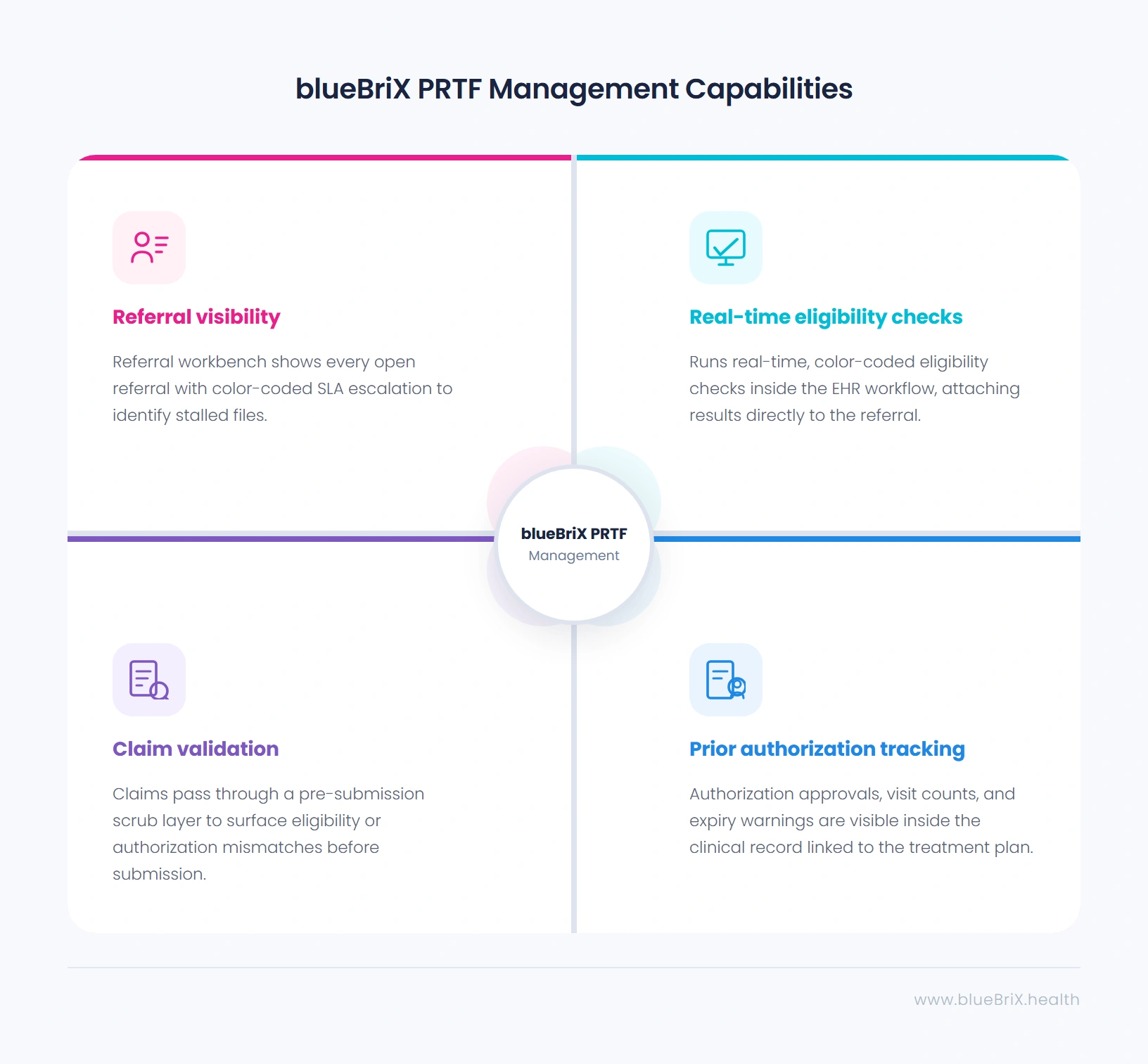
blueBriX connects eligibility verification, prior authorization tracking, claim validation, and referral visibility inside a behavioral health EHR built around PRTF, QRTP, and other residential program models, rather than a general clinic EHR adapted after the fact for residential complexity.
Real-time eligibility checks tied to the referral
blueBriX runs real-time, color-coded eligibility checks, along with batch eligibility, inside the EHR workflow, so the result attaches directly to the referral admissions is already evaluating instead of living in a separate portal. For a PRTF, that timing is the point: coverage status is available before a bed is committed, not after admission. State-specific carve-out routing, meaning which behavioral health organization or limited-benefit plan is responsible in a given state, still needs to be configured during implementation, since those arrangements vary from state to state.
Prior authorization tracked against the treatment plan
Authorization approvals, visit counts, and expiry warnings surface inside the clinical record and stay linked to the treatment plan, so an authorization approaching its end date is visible before a claim fires rather than after a denial comes back. blueBriX’s utilization review workflow lets the UR team manage concurrent review, payer correspondence, and authorization status from one screen, with payer-specific authorization rules configured per program and denial or appeal documentation tracked with timestamps.
Claim validation before submission
Claims generated from the bed log pass through a pre-submission scrub layer before they leave the organization, surfacing eligibility or authorization mismatches, including days where the bed log and the claim disagree, while they can still be corrected. This does not replace eligibility verification or prior authorization; it functions as a final check before the claim leaves the building.
At Blackbird Health, a behavioral health provider that implemented blueBriX’s insurance verification, authorization tracking, and automated claims workflow, claim payments improved 83 percent year over year following go-live. That figure reflects a general behavioral health billing deployment rather than a PRTF-specific one, and the scale of improvement at any facility will depend on its starting point and payer mix.
Referral visibility from intake forward
blueBriX’s referral workbench shows every open referral with color-coded SLA escalation, so a supervisor can see which files are stalled without calling around the building, replacing the spreadsheet-and-phone-call tracking most PRTFs rely on today. Because Medicaid managed care and behavioral health carve-out structures differ by state, routing rules still need to be configured to each facility’s actual payer environment rather than assumed from a generic national workflow.
Platform automation and managed RCM services solve different problems
The eligibility, authorization, and claim-validation capabilities above are built into the platform itself. blueBriX also offers revenue cycle management as a separate managed service, where a dedicated team handles payer follow-up, denial tracking, appeal preparation, and accounts receivable escalation. Denial prevention runs largely through the platform; denial resolution after the fact runs through people. A PRTF can use the platform with its existing billing staff, add managed services for specific functions, or combine both as part of a broader revenue cycle strategy.
A self-check before your next referral
- Before you commit a bed: confirm which entity is financially responsible for the residential benefit, that the PRTF participates in that entity’s network, and whether authorization is already required for the requested level of care.
- Before the current authorization expires: confirm the reauthorization lead time the payer expects, and assign the continued-stay documentation to a specific reviewer with a submission date.
- When a claim is pended or denied: confirm which of the two it actually is, the specific deadline attached to that status, and who owns the next action, before assuming it will resolve on its own.
Once the actual failure point is clear, the fix from there is either a process change a team can run consistently, or a systems change that removes the manual step altogether.
What changes after a PRTF adopts blueBriX?
After adopting blueBriX, eligibility discrepancies surface while a referral is still under review, authorization expiration becomes visible before treatment days fall outside the approved period, and pended claims arrive with reasons and deadlines already attached. Admissions and billing work from the same information instead of each reconstructing it separately.
For the Revenue or Finance Owner
Eligibility discrepancies surface while a referral is still under review. Authorization expiration becomes visible before treatment days fall outside the approved period. Pended claims appear with reasons and deadlines attached, rather than surfacing only in a month-end aging report. None of this means every denial disappears; some payer decisions remain disputed, and some referrals will not meet coverage criteria. The value is in removing the denials caused by preventable administrative gaps and creating enough visibility to respond quickly when a genuine payer issue occurs.
For the care team
Eligibility and authorization status are available at the moment a referral is being evaluated, not after a chain of portal logins and phone calls. Reauthorization alerts create a defined task with an owner, instead of a date someone has to remember. That time returns to referral assessment, family communication, and admission preparation, though blueBriX still cannot decide whether a child is clinically appropriate for the program or prepare a payer appeal without a person doing the work.
How should a PRTF decide whether a system fits?
A PRTF should decide based on whether a system surfaces eligibility, authorization, and claim-status information to the right person at the moment a referral, placement, or reauthorization decision is actually being made, not on how many features appear in a sales demo. The criteria below turn that judgment into specific, answerable questions.
- Referral-stage eligibility: can the system check eligibility, and identify the correct behavioral health payer, at the moment a referral arrives rather than at admission?
- Placement-stage visibility: can admissions see authorization status, approved dates, and units before committing a bed?
- Continued-stay lead time: do reauthorization alerts arrive with enough lead time to complete a clinical and payer process before a deadline?
- Claim-status detail: are pended, rejected, and denied claims tracked separately, each against its own deadline, rather than pooled into one denial queue?
- State-specific configuration: does the product support the facility’s actual state Medicaid carve-out and managed care arrangement, not a generic national workflow?
- Denial resolution ownership: is denial follow-up handled inside the platform, offered as a managed service, or left entirely to the facility’s own staff?
Every day of referral delay affects a child waiting for placement and a facility waiting to use an available bed. Every unresolved authorization puts future treatment days at financial risk. The decision should rest on whether a system makes the right information visible to the right person before the financial or access consequence occurs, not on which vendor gave the more polished demo.