

Medicaid credentialing is one of those operational areas where experienced teams still hit the same walls, repeatedly. Not because they don’t know the process, but because the process has enough moving parts: MCO timelines, document cycles, committee schedules, revalidation deadlines, that something almost always slips through.
This is for credentialing coordinators, practice managers, and operational directors who are already running this process. Not a primer. A practical look at where things break down, even in teams that are doing most things right.
If your Medicaid credentialing runs without delays, without stalled MCO applications, and without providers waiting to become billable, this probably isn’t for you. If it doesn’t, keep reading. And if parts of it feel familiar, blueBriX was built specifically to close these gaps.
The mistakes below follow the natural sequence of the credentialing process, from the moment a hire is confirmed to the point a provider should be fully active and billable. Each one represents a place where the process breaks down most consistently, and where the revenue consequence tends to be the most direct.
Mistake #1: starting the Medicaid provider credentialing process too late
Most practices kick off Medicaid credentialing after a provider is hired, onboarded, and already on the schedule. By that point, you’re already behind.
Medicaid credentialing, just the clinical verification side, runs 90 to 180 days depending on the state and the MCO. That window doesn’t pause because a provider has already started seeing patients. Every visit during that period is a claim that either can’t be submitted yet, or gets submitted incorrectly because the credentialing isn’t in place. Either way, revenue is at risk from day one.
The right trigger is the offer letter, not the start date. The moment a hire is confirmed, credentialing should be initiated: license verification, primary source verification, malpractice history, board certifications. Every week gained at the front end directly reduces the revenue gap at the back end.
Mistake #2: missing or expired documents
Medicaid provider credentialing, whether through the state agency or an MCO, requires a complete, current document package before review even begins. One expired document and the entire application goes on hold. Not paused. On hold, until the gap is resolved and the review restarts.
The documents that expire and get missed most often:
- DEA certificate: 3-year cycle, often renewed by a team that isn’t connected to the credentialing process
- Malpractice insurance COI: Annual renewal, and coverage amounts must meet each payer’s minimums
- Board certifications: Renewal cycles vary by specialty
- State medical license: Renewal timelines differ state to state
The revenue consequence is direct. Every day an application is stalled is a day that provider’s Medicaid visits are sitting unbillable. And if the same document is expired across multiple MCO credentialing applications running in parallel, every one of them stops simultaneously. One administrative gap, multiple payers affected, revenue on hold across all of them.
In fact, CMS is also moving toward a national provider directory, with Medicare Advantage provider directory data expected to appear on Medicare Plan Finder beginning with plan year 2027. That makes provider data accuracy more than an internal credentialing task; it becomes a public-facing compliance issue that affects access, trust, and network readiness.
Mistake #3: skipping NPP credentialing is a compliance and revenue risk
Nurse Practitioners, Physician Assistants, therapists, social workers — anyone delivering clinical care who isn’t a physician falls into this category. And every single one of them needs to go through their own individual Medicaid credentialing process.
The assumption that gets practices into trouble is this: the NPP can see patients and we’ll bill under the supervising physician. It feels like a practical workaround while credentialing is pending. It isn’t. Medicaid wants to know exactly who delivered the care. If an NPP saw the patient but the claim says the physician did, that’s a rendering provider mismatch and it’s a compliance risk, not a billing technicality.
There’s also a reimbursement angle payers actively watch for. Medicaid reimburses NPPs at 85% of the physician rate for the same service. Billing under the physician to capture the full rate is a known audit pattern. It gets flagged.
The credentialing timeline for an NPP is identical to a physician, 90 to 180 days with Medicaid and each MCO. That process needs to start at the point of hire. Not after onboarding. Not once they’re already seeing patients.
Mistake #4: no contingency plan for the credentialing gap
Even when everything goes right, there is a window between when a provider starts seeing patients and when Medicaid credentialing is approved. Most practices have no plans for it.
Retroactive billing is an option in some states, but it is only viable if credentialing is ultimately approved. No approval means no approval date to backdate from, and those visits simply cannot be billed. Each MCO also sets its own policy on whether it allows retroactive billing, and how far back it applies, independent of what the state permits.
Every practice should have a clear answer to this before a new provider sees their first Medicaid patient:
- Delay scheduling until credentialing is confirmed. The only option with no downside risk, though it comes at a cost.
- Apply for retroactive billing. Only viable if your state and each MCO allow it, and only if credentialing is ultimately approved.
- Locum tenens arrangement. A credentialed provider covers patients in the interim.
This decision needs to be made at the start of the credentialing process, not after claims are already sitting unprocessed.
Mistake #5: no proper follow-up process
Medicaid credentialing doesn’t move on its own after submission. MCO credentialing committees meet on fixed schedules, sometimes monthly. If an application misses a review cycle, it waits for the next one. No one calls to flag that.
For a credentialing coordinator managing 30 to 50 active applications across multiple providers and MCOs simultaneously, the challenge is its volume. Each application is at a different stage. Each MCO operates on its own timeline. Keeping track of which ones need a follow-up call this week, which ones are overdue for a status check, and which ones have been sitting in queue longer than they should, that’s where things slip. Not from lack of effort, but because there’s simply too much in motion to track consistently without a system holding it together.
The consequence of a missed follow-up compounds quietly. An application that needed one call to get unstuck in week three instead runs to week ten because nothing flagged it as overdue. By the time it surfaces, the provider has been seeing patients for months with no clear path to billing.
The follow-up log matters here too. If an application needs to be escalated or a retroactive effective date needs to be requested, the first thing an MCO will ask is what happened and when. Without a record of every interaction — date, contact name, outcome — that case is very hard to make.
Mistake #6: assuming credentialing approval means the provider is network-active
Over 70% of Medicaid beneficiaries are enrolled in managed care plans. Which means for most credentialing coordinators, MCO credentialing is the main event. If a provider isn’t active in the MCO network, they can’t reach the majority of their Medicaid patient population, regardless of what the state agency has approved.
That’s what makes this gap particularly costly. These are two separate finish lines. Credentialing is the MCO confirming a provider is qualified: verifying licenses, training, malpractice history, and background. Network activation is an enrollment step, where the MCO confirms where that provider is practicing and under which group. One does not automatically trigger the other.
A provider can clear every clinical requirement and still sit in a pending state because the Type 1 NPI (individual) hasn’t been linked to the practice’s Type 2 NPI (group) in the MCO portal. The provider looks credentialed. The file is complete. But without that confirmed NPI linkage, the MCO’s system doesn’t recognize the provider as active within your practice. Claims go out and come back as out-of-network despite the credentials being fully approved.
This is not a credentialing failure. It is a handoff failure, the point where credentialing ends and enrollment should pick up, but nobody is watching the gap. A final confirmation step verifying the NPI linkage in each MCO portal before the provider is placed on the schedule is what closes it.
Mistake #7: missing revalidation deadlines has credentialing consequences
Miss a revalidation deadline and the state deactivates the provider’s Medicaid ID. That’s where it stops being just an administrative issue.
Every MCO credential sits on top of that state Medicaid ID. When the ID goes down, all of them go down simultaneously. A provider active across multiple plans becomes out of network everywhere, at once.
The notification gap makes this harder to catch than it should be. Revalidation notices go to the address on file with the state. If that address is outdated, the notice never arrives. The deadline still stands.
Revalidation deadlines need to sit on the credentialing calendar alongside MCO re-credentialing cycles, with a named owner. Missing either one lands in the same place.
Seven mistakes. Each one distinct. Each one capable of stalling a provider’s path to billable status on its own. Together, they paint a picture of a process that has too many variables, too many timelines, and too many points of failure to manage reliably without the right infrastructure behind it. Now, let’s see how we can solve them.
How blueBriX eliminates the gaps that delay Medicaid credentialing
If the mistakes above share a common thread, it’s this: Medicaid credentialing is too complex to manage via spreadsheets and memory. When your revenue depends on the perfect alignment of license renewals, state revalidations, and MCO credentialing timelines, manual is just another word for vulnerable.
This is why we built blueBriX.
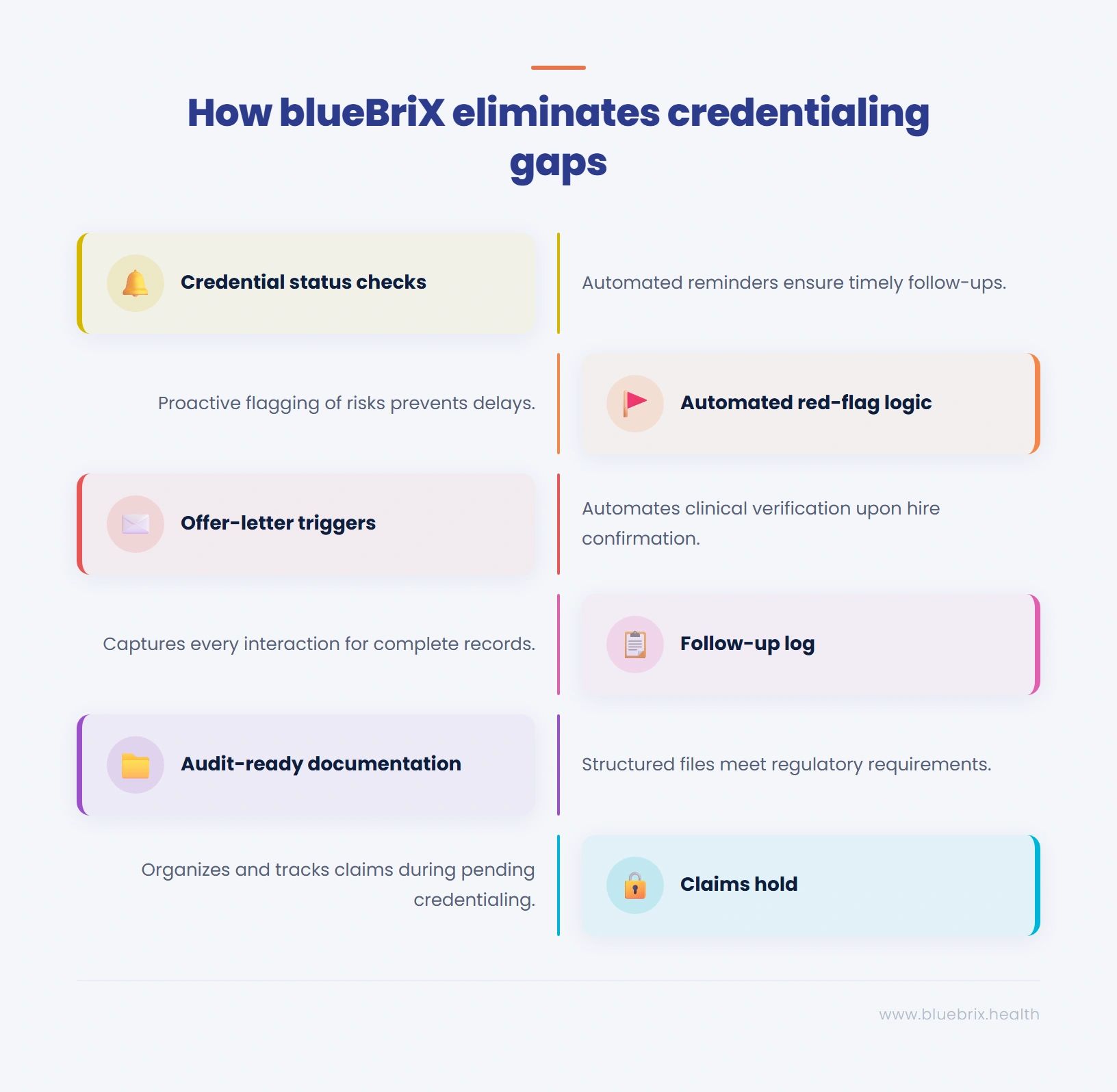
How blueBriX eliminates the gaps that delay Medicaid credentialing
We didn’t design blueBriX to be just another database. We built it to be the command center for your clinical revenue, specifically to close the gaps that turn a 90-day credentialing process into a 180-day delay. blueBriX’s provider network management module, built inside the blueBriX EHR, means your credentialing activity and your clinical operations sit in the same place. The coordinator updating an application status and the practice manager scheduling patients are working from the same picture, not two separate systems with a gap between them.
Credential status checks that run on schedule: Coordinators don’t need to remember when to follow up with an MCO or when an application is due for a status check. blueBriX sends automated reminders at the right intervals, prompting the coordinator to log in, check the portal, and update the application status. Every follow-up happens on schedule, not whenever someone gets around to it. And when the coordinator updates the status, it’s visible to everyone, practice managers included, without a single status meeting.
Automated red-flag logic: Instead of relying on a coordinator to remember a 120-day attestation window, blueBriX uses automated logic to flag risks. If a DEA license is within 30 days of expiring, the system doesn’t just send a notification, it escalates the task. If a board certification renewal is approaching, it surfaces before it becomes a stall. It removes the human error variable from your financial stability.
Offer-letter triggers: blueBriX automates the initiation of the clinical verification track the moment a hire is confirmed. It treats every day before the start date as a day gained toward billable status.
A follow-up log that builds itself: Every interaction on every application is captured with a date, a contact name, and an outcome. When an escalation is needed or a retroactive effective date needs to be requested, the interaction history is already there, timestamped and complete. No reconstruction from memory, no gaps in the record.
Audit-ready documentation at all times: Credentialing files in blueBriX are structured to meet regulatory requirements from day one. Every document, every verification, every status update is stored and organized so that if an audit lands, the response is pulling a file, not rebuilding one.
Claims hold during pending credentialing: When a provider is seeing patients but credentialing hasn’t been approved yet, claims still get generated. blueBriX lets coordinators mark those claims as pending and hold them in the system without submitting. They sit organized and tracked, not scattered across notes or lost in a queue. The moment credentialing is approved, the held claims are right there, ready for immediate submission. No revenue from the gap period gets left behind, and nothing goes out before it should.
Stop losing revenue to credentialing delays
Most practices lose 60–90 days of billable revenue per provider. blueBriX is built to eliminate that. Let’s show you exactly how inside your own workflow.
No lengthy onboarding. No disruption to your existing operations.
Schedule a demo