
Standalone tool or EHR-embedded suite — that's the first decision
Behavioral health assessment software falls into two structurally different categories, and most comparison articles blur the line between them.
Standalone assessment tools such as MindMetrix, Clinicom, and Creyos specialize in screening and diagnostic evaluation. They generate clinical reports. They don’t manage your treatment plan, your progress notes, or your claims. The clinician takes the output and manually carries it into whatever EHR the organization runs.
EHR-embedded assessment suites like blueBriX, ICANotes, Qualifacts, Valant, and SimplePractice build assessment workflows into the clinical record. Scores link to treatment plans. Documentation trails connect what was measured to what was billed. Longitudinal tracking happens inside the same system where the rest of the clinical work lives.
Both categories appear in this comparison because both show up in the buying process. But they solve different problems, and the right choice depends on whether your organization needs better screening or a better connection between screening and everything that happens after it.
Top 8 behavioral health assessment tools
| Feature | blueBriX | ICANotes | Qualifacts | Valant | MindMetrix | Clinicom | Creyos | SimplePractice |
|---|---|---|---|---|---|---|---|---|
| Assessment Library | 200+ pre-built | 100+ embedded | CANS, ASAM, DLA-20, PHQ-9 + configurable | Standard BH instruments + outcomes | 90+ adaptive conditions | 80+ adaptive DSM conditions | Cognitive + BH assessments | PHQ-9, GAD-7 |
| Form Builder | Drag-and-drop | Limited | IT-dependent | Limited | No | No | No | Intake only |
| Outcome Tracking | Trends + early alerts | Basic | Agency-level reporting | Measurement-based care | Follow-up tracking | Change tracking | Cognitive trajectories | Basic visual tracking |
| Care Plan Linkage | Direct | Template-based | Configurable | Integrated | Manual transfer | Manual / integration | Manual / integration | Redox integration |
| Billing | Auto CPT + audit trail | Medical-necessity coding | Medicaid/state aligned | Psychiatric billing | CPT 96130 | Some settings | Reimbursement structured | Standard claims |
| Compliance | Yes | Yes | Yes | Yes | N/A | HIPAA + GDPR | N/A | No |
| Architecture | Embedded | Embedded | Embedded | Embedded | Standalone | Standalone | Standalone + integration | Embedded |
42 CFR Part 2 governs the confidentiality of substance use disorder patient records. Standalone assessment tools that do not store or transmit SUD-specific data outside of a covered provider’s system are marked N/A because the regulation applies to the entity holding the record, not the assessment instrument itself.1.
1.blueBriX
blueBriX approaches behavioral health assessments differently than most EHRs on this list. Instead of offering a curated set of 50 or 70 tools and calling it sufficient, the library ships with over 200 pre-built validated assessments — PHQ-9, GAD-7, C-SSRS, CAGE, MDQ, SDOH instruments, and dozens of condition-specific screening tools that most competitors either don’t include or charge extra to configure.
That library size matters less than what sits next to it: a no-code drag-and-drop form builder that lets clinical teams create entirely new assessments, modify existing ones, adjust scoring logic, and change form layouts — without writing a single line of code and without waiting on IT. In practice, this means a clinical director can build a program-specific intake questionnaire on Monday and have clinicians using it on Tuesday. That’s a fundamentally different speed of clinical operations than submitting a configuration request and waiting weeks.
Longitudinal tracking is where the full picture comes together. Assessment scores feed into trend graphs with real-time scoring. Early intervention alerts flag patients whose trajectories are heading the wrong direction. And the data doesn’t stop at the assessment — scores link directly into treatment plans and auto-populate clinical notes, which means the documentation trail between “what we measured” and “how we adjusted care” is built automatically, not reconstructed after the fact for an auditor.
Worth knowing: blueBriX is a behavioral health EHR, not a standalone assessment tool. The assessment capabilities are part of a broader clinical, billing, and care coordination system. For organizations running residential, PHP/IOP, and outpatient programs — especially those with CCBHC or PRTF requirements — that’s the point. For a solo therapist who just needs a PHQ-9, it’s more system than the situation calls for.
Strongest fit: Multi-program behavioral health organizations (CCBHC, PRTF, PHP/IOP, SUD residential, enterprise outpatient) that need assessment depth, clinical team self-service on form design, and a documentation trail that holds up under audit.[1]
2. ICANotes
Founded by a practicing psychiatrist, and it shows. ICANotes has built one of the deepest documentation engines in behavioral health — menu-driven templates that let clinicians assemble structured notes from phrase libraries instead of writing from scratch every time. The assessment toolkit includes over 100 embedded tools: PHQ-9, GAD-7, SASSI, MoCA, and a long list of clinical measures that are ready at the point of documentation.
The menu-driven approach is genuinely fast for clinicians who learn the system. You select phrases, the note builds itself, and medical-necessity coding happens in the background. For psychiatry practices where documentation speed is everything, this workflow earns its reputation.
Where ICANotes runs into limits is the form builder. You can create new templates, but customization options are restricted to basic text boxes and pre-made elements. You’re not dragging and dropping custom scoring fields or building a new screening instrument from scratch. If the 100+ tools in the library cover what you need, this doesn’t matter. If your organization has program-specific forms that don’t exist in any vendor’s library, you’ll feel the constraint.
Strongest fit: Small to mid-size psychiatry practices and behavioral health clinics where documentation speed matters more than form-building flexibility. Less suited for large multi-program organizations with custom assessment workflows.
3. Qualifacts (CareLogic / InSync)
Qualifacts operates two distinct products under one roof. CareLogic is the enterprise play — built for large community mental health centers, CCBHCs, and multi-program agencies running Medicaid-heavy service lines with state reporting obligations. InSync fits mid-size outpatient practices with diverse payer mixes. Both include assessment capabilities, but CareLogic is the one that matters for this comparison.
The assessment library includes CANS (used across all 50 states in juvenile justice, early intervention, and community mental health) [2], ASAM criteria for SUD level-of-care determination, DLA-20 for daily living functional assessment,[3] and PHQ-9. These aren’t generic templates — Qualifacts has built specific integrations for each of these instruments, including the scoring logic and care-decision workflows that tie them to service planning.
The trade-off is complexity. CareLogic is highly configurable, which means it can do almost anything, but configuring it takes significant effort. User reviews consistently describe a system that rewards investment in implementation but punishes shortcuts. The interface draws criticism for feeling dated, and some functions are buried deep in menu structures. You won’t find a clinical team casually building custom forms here the way they could with a no-code builder — this is a system that runs through your IT or implementation team. Pricing is custom. Implementation timelines are longer than most vendors on this list.
Strongest fit: Large community mental health organizations, CCBHCs, and state-funded behavioral health agencies with dedicated IT resources and complex reporting requirements.
4. Valant
Built by psychiatrists, for behavioral health practices that combine prescribing with therapy. Valant’s core differentiator isn’t the assessment library specifically — it’s how tightly assessments tie into a measurement-based care workflow. Outcome measures are embedded in the clinical cycle: a patient completes an assessment, the score appears in the clinician’s workflow before the session starts, and it informs both the treatment conversation and the documentation that follows.
The tool supports group therapy documentation with a feature that auto-generates individual notes from a single group session — a capability only a handful of platforms on this list can match. IOP/PHP support, native ePrescribing with PDMP access, and a patient portal round out the system. Assessment tools include standard BH instruments (PHQ-9, GAD-7, and condition-specific screeners), with outcome tracking baked in rather than added as a reporting layer.
Valant doesn’t publish its assessment library count the way blueBriX or ICANotes do. The library is solid but narrower in scope — it covers what psychiatric practices need, not the broader range a CCBHC or PRTF might require. Pricing is quote-based, which makes pre-purchase comparison harder.
Strongest fit: Outpatient psychiatry practices and mid-size behavioral health groups running therapy-plus-prescribing workflows where measurement-based care is a clinical priority.
5. MindMetrix
This is not an EHR. MindMetrix is a standalone adaptive assessment tool — and on that specific axis, it’s arguably the most sophisticated product in this comparison.
Here’s what it does: a single adaptive assessment evaluates patterns across 90+ conditions, covering both adolescent and adult populations. The assessment starts with a general symptom check and branches based on the patient’s responses, directing them through validated rating scales and condition-specific follow-ups. It catches comorbidities and risk indicators that single-condition screeners like the PHQ-9 miss by design, because single-condition screeners only ask about one condition.
The output is a detailed clinical report — severity signals, risk flags, comorbidity indicators, patient history — that the clinician reviews and uses to inform diagnosis and treatment planning. Follow-up assessments track change over time. MindMetrix assessments can support a billable CPT 96130[4] service — covering the first hour of psychological testing evaluation services by a physician or qualified healthcare professional, including integration of patient data, interpretation of standardized test results and clinical data, clinical decision-making, treatment planning, and report preparation. Billable time includes both face-to-face time with the patient and time spent integrating and interpreting data.
What MindMetrix doesn’t do: it doesn’t connect to your treatment plan. It doesn’t auto-populate your progress notes. It doesn’t file your claims. The clinician receives a report, and then the clinician has to take that information and manually enter the relevant pieces into whatever EHR they’re using. For a solo outpatient provider, that’s a manageable workflow addition. For a 50-provider multi-site organization, you’ve just added a data-transfer step to every assessment interaction.
Strongest fit: Solo and small-group outpatient providers who want diagnostic screening depth beyond what their EHR offers, and who don’t mind the manual handoff between assessment and clinical record.
6. Clinicom
Clinicom occupies similar territory to MindMetrix — standalone, adaptive, assessment-focused — but with a different clinical emphasis. Where MindMetrix targets busy providers who need faster diagnostic clarity, Clinicom leans harder into intake, triage, and clinical decision support.
A single adaptive assessment screens for 80+ DSM-based conditions. The output is a structured report covering patient history, risk flags, severity signals, and differential diagnosis indicators that the clinician reviews to start the session informed rather than starting from scratch.
Clinicom also targets larger systems. Their positioning includes ED triage, inpatient settings, SUD programs, community mental health, and correctional health — environments where standardizing how assessment data gets collected across providers and locations has operational value beyond any single clinician’s workflow. SOAP note automation using a combination of the assessment data and augmented intelligence is another feature, though it generates the note as a separate output, not inside an EHR’s documentation workflow.
Same fundamental limitation as MindMetrix: the assessment data lives in Clinicom’s ecosystem. Getting it into your EHR is a manual or integration-dependent process. Clinicom does offer EHR integrations, but how seamless that is depends on which EHR you’re running.
Strongest fit: Organizations that need standardized intake and triage across multiple sites or care settings, and that have the integration infrastructure to feed assessment data into their clinical record.
7. Creyos
Creyos is the odd one out in this list, and that’s exactly why it’s here. Every other tool in this comparison assesses behavioral health through questionnaires — self-reported symptoms, rating scales, clinical judgment. Creyos adds a layer none of them touch: objective cognitive testing.
The tool combines digitized behavioral health questionnaires (PHQ-9, GAD-7, and others) with proprietary cognitive tasks that measure memory, attention, reasoning, and processing speed. That combination matters clinically for conditions where cognitive function is part of the picture — ADHD, traumatic brain injury, substance use-related cognitive decline, early-stage dementia, and cases where medication effects on cognition need tracking.
Operationally, Creyos is a standalone tool with EHR integrations (through Redox, which connects to athenahealth, AdvancedMD, eClinicalWorks, and others). Patients self-administer assessments remotely or in-clinic, and results flow into the EHR for clinician review. Reports generate the moment an assessment ends — scored, normed, and structured for documentation and reimbursement.
The limitation is scope. Creyos doesn’t replace a behavioral health assessment library. It supplements one. You wouldn’t use Creyos as your primary depression screener — you’d use it alongside your PHQ-9 when the clinical question involves cognitive function. That makes it a powerful tool for specific populations and a poor fit as a general-purpose assessment solution.
Strongest fit: Practices with ADHD, TBI, neurodegenerative, or substance use populations where objective cognitive measurement adds clinical value beyond symptom self-report.
8. SimplePractice
SimplePractice’s assessment capabilities include built-in scored assessments — PHQ-9, GAD-7 — with automatic scoring and visual progress tracking. You can create custom intake forms and questionnaires using templates. The client portal handles digital form completion and e-signatures smoothly. Everything works within a clean, well-designed interface that solo therapists consistently praise.
That’s roughly where the assessment story ends. No drag-and-drop form builder for clinical assessments (intake forms, yes; scored clinical instruments, no). No C-SSRS, no CAGE, no ASAM, no SDOH tools pre-built. No disease-specific assessment workflows. No longitudinal outcome dashboards beyond the basic visual tracking on PHQ-9 and GAD-7. Limited measurement-based care infrastructure. Custom scored measures aren’t supported.
The product is built for solo and small-group outpatient therapy practices, and it serves that market well. If your organization runs PHP/IOP, residential, SUD, or any multi-program model — or if you need assessment depth beyond depression and anxiety screening — you’ve already outgrown what it offers.
Strongest fit: Solo therapists and small outpatient practices that need clean scheduling, documentation, and billing with basic assessment scoring. If this is the article that made you realize you need more, you’re probably in the right place.
What to evaluate when comparing behavioral health assessment tools
CCBHC reporting already mandates standardized outcome measurement tied to treatment documentation.[5] When payers review treatment documentation, they often find a disconnect between assessment scores and the treatment plan decisions those scores are meant to support. The organizations that pass those reviews cleanly aren’t the ones with the longest assessment library — they’re the ones where assessment data moves into treatment plans and billing records without a manual step in between. That’s the lens for the criteria below:
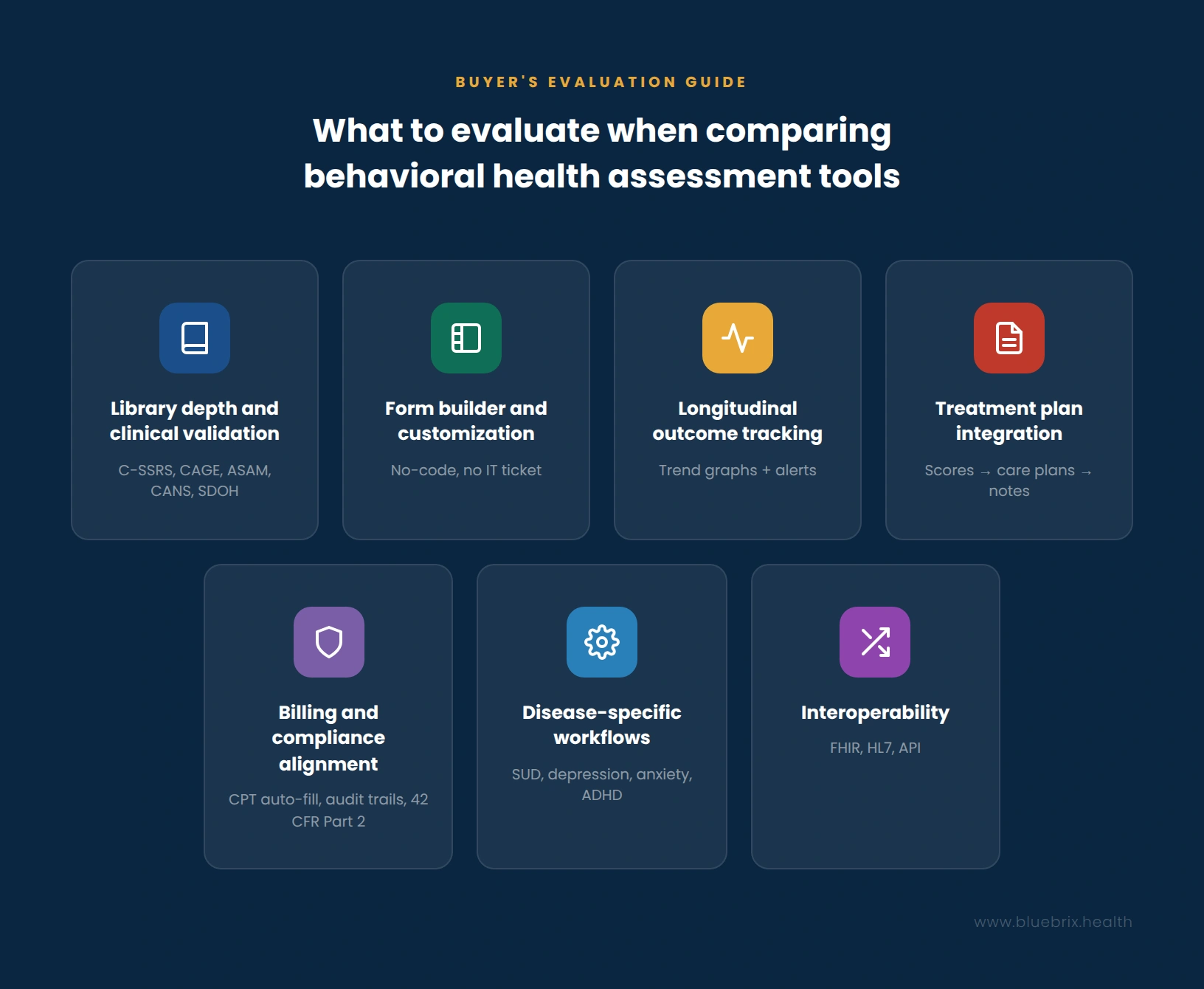
Library depth and clinical validation
How many validated assessments ship ready to use? PHQ-9 and GAD-7 are table stakes. The differentiators are the less common tools — C-SSRS for suicide risk, CAGE and AUDIT for substance use screening, MDQ for bipolar, SDOH tools, DLA-20 for functional assessment, CANS for child and adolescent populations, ASAM for level-of-care determination. If your clinicians need any of these on day one, check whether they’re pre-built or whether you’re building them yourself.
Form builder and customization
Pre-built libraries cover the validated instruments. But every organization also has screening workflows, intake questionnaires, and program-specific forms that don’t come from a textbook. The question: can your clinical team create and modify these forms without submitting an IT ticket? A no-code drag-and-drop builder changes the answer. A text-box-and-dropdown form editor technically qualifies as “customizable” but won’t get you far.
Longitudinal outcome tracking
A single assessment score is a snapshot. Clinical value comes from the trajectory — is a patient’s PHQ-9 trending down over eight weeks, or plateauing? Can you pull that trend graph during a treatment team meeting? Can you flag patients whose scores are moving in the wrong direction before the next scheduled appointment? This is where standalone tools fundamentally can’t compete with EHR-embedded suites, because they don’t hold the longitudinal record.
Treatment plan integration
Assessments that live in a silo create extra work. Assessments that link directly to treatment plan goals, auto-populate progress notes, and inform care plan adjustments create efficiency. Look for whether assessment scores actually flow into the clinical documentation workflow or just exist alongside it.
Billing and compliance alignment
Does the tool auto-populate CPT codes? Does it timestamp assessment completion for audit trail purposes? Does it support 42 CFR Part 2 for SUD populations?[6] These details determine whether your assessment workflow strengthens your compliance posture or creates liability.
Disease-specific and population-specific workflows
Generic assessment templates force clinicians to adapt. Condition-specific workflows — pre-configured for depression, anxiety, SUD, eating disorders, ADHD — reduce setup time and ensure the right instruments are tied to the right clinical pathways.
How to choose the right one for your organization
Start with the category question. If you’re running a multi-program organization — residential and outpatient under one roof, PHP/IOP, CCBHC, PRTF — a standalone assessment tool creates one more system to manage, one more integration to maintain, and one more place where clinical data can fall out of the documentation trail. That math pushes you toward an EHR-embedded solution with a deep enough library to cover your clinical programs and enough customization to handle the rest.
If you’re a solo or small-group outpatient practice on a basic EHR, and the assessment gap you’re trying to fill is diagnostic depth — catching comorbidities, getting beyond the PHQ-9 — a standalone tool like MindMetrix or Clinicom can add clinical value without requiring an EHR migration. Just go in knowing that the data lives in two systems, and plan for how you’ll bridge them.
For the organizations in the middle — growing multi-provider practices that have outgrown SimplePractice or TherapyNotes but aren’t yet running enterprise-scale programs — the deciding factors are usually form builder flexibility and longitudinal tracking. These are the features that determine whether your clinical team can adapt the system to your workflows, or whether your workflows have to bend to fit the system.