
PRTF per diem billing: why occupied beds do not equal paid days
Occupancy is easy to see and easy to report, so it often becomes the headline number in a residential program’s finance review. It only tells you how many beds had a youth in them, though. It does not tell you how many of those days anyone paid for.
Your payer mix adds a second layer. Among residential settings for youth with behavioral health needs, Medicaid payment for room and board is limited to PRTFs, while QRTPs may receive Title IV-E payment [1]. Whichever payer applies to a given youth, both payment streams start from the same bed day on your census.
The seven stages: licensed, staffed, occupied, authorized, billable, billed, paid
Think of every bed day as passing through seven stages. A day that fails at any stage does not become revenue.
| Stage | What it means | Who usually owns it |
|---|---|---|
| Licensed bed days | Licensed beds multiplied by days in the period | Executive team |
| Staffed bed days | Beds you can safely fill with the staff on your schedule | Operations |
| Occupied bed days | Nights a youth is in a bed at your census time | Nursing and unit leads |
| Authorized days | Occupied days covered by an active authorization or placement approval | Utilization review and case management |
| Billable days | Authorized days that also meet payer rules on leave, eligibility and certification | Billing |
| Billed days | Days sent out on a clean claim or invoice | Billing |
| Paid days | Days the payer actually paid | Finance |
The first three stages show up on the bed board, so they are easy to watch every day. The last four show up only in authorization records, billing queues and remittances. When those stages sit with different teams working in different systems, the full path from bed to payment can end up with no single owner.
How small losses at each stage add up
Here is a hypothetical 40-bed program over a 30-day month. Assume all 40 beds are staffed. The yields at each stage are invented to show how the math works.
| Stage | Yield from the stage before | Days |
|---|---|---|
| Licensed bed days | 1,200 | |
| Occupied | 93% | 1,116 |
| Authorized | 97% | 1,083 |
| Billable | 96% | 1,040 |
| Billed on a clean claim | 98% | 1,019 |
| Paid | 95% | 968 |
Each stage after occupancy runs at 95% or better, which looks fine on a stage-by-stage report. Multiply them together and only 86.7% of occupied days reach payment. That leaves 148 occupied days with no payment.
At a hypothetical per diem of $400, those 148 days equal $59,200 for the month, or about $710,000 a year. These numbers are illustrations only. Run your own through the same table with your own rates.
Why a non-billable day still costs full staffing
Staffing ratios, supervision rules and overnight coverage apply to every youth on the unit, whether or not that day is authorized. A youth in the bed on an unauthorized day needs the same care and supervision as any other youth.
That means the staffing cost of the day is already spent, and only the revenue is missing. Recovering the day can send most of its revenue to margin. The actual flow-through depends on your cost structure, including variable costs such as food and supplies.
Stranded days in residential treatment: occupied beds nobody pays for
One loss between the occupied stage and the authorized stage needs its own section, because it happens while the youth is still in the bed and the unit is still staffed. We call these stranded days.
What counts as a stranded day
- A stranded day is a day a youth stays in the bed without a payable reason to be there. The usual causes are:
- The authorization ended and the payer has not yet decided on continued stay.
- The payer denied continued stay, and the youth is still in the bed while you appeal or while the family and agency arrange the next step.
- The youth is clinically ready for discharge, but no step-down placement is available, such as a family home, a foster home or a community program.
- A QRTP placement is waiting on a court date, an agency decision or paperwork before the youth can move.
A continued stay denial does not empty the bed. The youth is still there, the unit is still staffed, and the day is still on your census.
Who pays for it in a PRTF and in a QRTP
In a PRTF, the payer’s authorization decides. Days after a denial or after an authorization ends are not paid unless the payer reverses the decision or grants the days retroactively. Until that happens, and permanently if it does not, the program carries the cost of those days.
In a QRTP, your agency contract decides. Some contracts address delayed discharge or holdover days, and some say nothing. Read yours for this language before you need it, and ask the agency how it treats days when a youth is waiting for a placement.
How the concurrent review calendar affects stranded days
Concurrent review is the process of getting continued stay approved before the current authorization runs out. The clinical team writes the review, and the billing team sees only the end date. That handoff is where stranded days start.
Three habits help:
- Keep the authorized-through date on the same screen as the bed, so anyone looking at the unit can see which youth are close to the end of their window.
- Set an internal submission date ahead of the payer’s deadline, based on how long your payers usually take to decide.
- Track the days between your submission and the payer’s decision. A payer that takes six days to respond needs a different internal deadline than one that takes two.
Therapeutic leave days in Medicaid: one PRTF stay under two state rules
Leave days are where the same stay pays differently from state to state. This section uses one hypothetical stay and scores it under two hypothetical rule sets. Neither rule set describes any real state. They exist to show the mechanism.
The stay on a timeline
For this example, a day counts when the youth is in the bed at midnight. That is a common convention, but states set their own. One state’s PRTF rule, for example, bases occupancy on a midnight census, counts hospital bed-reserve days as absences, and does not count therapeutic pass days as absences [2].
| Day | Event | What happens to the census |
|---|---|---|
| 1 | Admission in the afternoon | Counts as an occupied day, because the youth is in the bed at midnight |
| 14 | Plan of care in place | No census effect, deadline met |
| 30 to 31 | Therapeutic home pass, youth returns on Day 32 | Absent at midnight on Days 30 and 31: 2 leave days |
| 44 | Continued stay review submitted | No census effect |
| 45 | Initial authorization ends | Authorization window closes |
| 46 to 48 | Payer decision still pending | Youth in the bed with no active authorization: 3 days |
| 49 | Continued stay approved | New authorization starts |
| 58 to 62 | Transfer to an acute hospital, youth returns on Day 63 | Absent at midnight on Days 58 to 62: 5 hospital leave days |
| 90 | Discharge in the morning | Not in the bed at midnight, so Day 90 does not count |
Count the nights: the youth was present or on leave at midnight on Days 1 through 89, which is 89 occupied days. Of those, 2 are therapeutic leave and 5 are hospital leave. That leaves 82 nights in the bed, and 3 of them fall in the authorization gap.
Rule set A and rule set B: which days are billable
Now score the same 89 days under two invented rule sets.
| What happened | Days | Rule set A | Rule set B |
|---|---|---|---|
| In the bed with an active authorization | 79 | Paid | Paid |
| Authorization gap | 3 | Paid, because the payer grants retroactive authorization back to the end date when the review was filed on time | Not paid, because the payer does not grant retroactive authorization |
| Therapeutic leave | 2 | Paid, up to 4 days per authorization period | Not paid |
| Hospital leave | 5 | Paid, up to 10 days per hospital stay | Paid for the first 3 days, then not paid |
| Total paid days | 89 | 82 |
The youth, the care and the census are identical in both columns. Under rule set B, 7 days go unpaid: 3 from the authorization gap, 2 from therapeutic leave and 2 from hospital leave beyond the cap. At the $400 per diem, that is $2,800 on one stay.
Your census record has to carry more than “in bed” or “not in bed.” It needs the type of absence, the start and end of each authorization, and the payer on each day. Without those, billing staff rebuild the stay from notes, and rebuilding is where days get lost.
Revenue codes for leave days on the UB-04 per diem claim
When a state bills PRTF days on the institutional claim (the UB-04, or the 837I when filed electronically), in-house days and leave days go on separate lines with different revenue codes. Some states use procedure codes and modifiers for leave days instead, so check your state’s manual for the format it expects.
North Dakota’s PRTF manual shows what the revenue code approach looks like. It lists 0110 for in-house days, 0182 for noncovered leave days, 0183 for therapeutic leave days and 0185 for hospital leave days. It covers up to 15 days of hospital leave per occurrence and limits therapeutic leave per certificate of need period[3]. North Dakota revised this manual several times between January 2025 and April 2026, so confirm the current version before you rely on it.
The code descriptors come from the National Uniform Billing Committee (NUBC) UB-04 manual, and each state decides which codes it accepts, whether the leave is covered, and what limits apply. Other states choose different codes and different limits.
Two practical points follow from this. First, your billing rules need to be set per state and per payer, not once for the whole organization. Second, a leave day entered late can make a claim that has already gone out inaccurate, and fixing it means submitting a corrected claim. Late entries need a path back to the claim.
Find out which stages are costing you paid days
Run your last 90 days through the seven stages with the Revenue Health Assessment. You get a clear view of where occupied days drop out before they reach payment.
Book a demo nowPRTF vs QRTP billing: one bed day, two payment streams
If you operate a PRTF, a QRTP, or a program with both designations, the same night in the same bed can feed two different payment systems.
How PRTF Medicaid per diem billing works
PRTF care is paid through the Medicaid benefit for inpatient psychiatric services for people under 21. Your state sets the per diem rate and the rules for what it covers. Claims go to the state Medicaid agency or to the managed care plan that holds the member.
Three things have to be true for a day to pay. The youth is eligible on that day, the stay is authorized on that day, and your documentation meets the certification and active treatment rules. Check what your state’s per diem includes, too. Billing separately for items the rate already covers is a common source of denials.
How QRTP Title IV-E payments work
For a QRTP placement, the state or tribal child welfare agency that placed the youth pays you under its contract or rate. For youth who are eligible, the agency then claims Title IV-E foster care maintenance payments, which cover costs such as food, shelter and daily supervision. Your contract sets the invoicing terms, including the billing cycle and the form the agency expects.
Federal law stops Title IV-E payment after the first two weeks of a placement in a child care institution, unless the setting is one of a few listed types. Those are a QRTP, a setting for pregnant or parenting youth, supervised independent living for youth 18 and older, and a setting for youth who are, or are at risk of becoming, sex trafficking victims[4]. That is why the QRTP assessment and court review dates matter to you: they decide whether the agency can keep claiming federal payment for the placement.
Where the two billing records disagree
When a program bills Medicaid for one set of costs and invoices an agency for another, the two records tend to drift. The common points of disagreement are:
- Start dates. Your admission date, the agency’s placement date and the Medicaid effective date can differ by days.
- Leave rules. An agency contract may pay a bed hold for a home pass that Medicaid treats as non-covered, or the reverse.
- Units and timing. Medicaid claims run against an authorization. Agency invoices follow contract terms and billing cycles.
- Late edits. Someone corrects a date in the census after the claim and the invoice have gone out, and only one of the two records is updated.
These differences vary by state and by contract. What stays constant is the fix: both records should draw from one census record, so a change in the census reaches both. If each is built by hand from notes, they drift.
A short note on the 16-bed IMD limit
Federal Medicaid funding generally does not pay for services to people living in an institution for mental diseases (IMD), which is a facility with more than 16 beds that is mainly engaged in treating mental illness. The psych under 21 benefit is one of the limited exceptions, and PRTFs fall under it [5].
A QRTP is a child care institution, and a private one can have any number of beds. CMS has said a QRTP with more than 16 beds will most likely meet the IMD definition, and that states decide this facility by facility. Placement in a QRTP that is an IMD does not affect a child’s Medicaid eligibility, but it can limit whether federal Medicaid funds are available for services delivered there. Ask your state Medicaid agency how it classifies each of your facilities, because the answer changes what you can bill.
QRTP requirements and PRTF deadlines that affect payment
Every residential stay carries a set of clocks that start on the admission or placement date. Each one has a payment consequence.
PRTF deadlines: certification of need, 14-day plan of care, 30-day review
Under the federal rules for the psych under 21 benefit, the team responsible for the plan of care must certify the need for the service. For emergency admissions, that certification is due within 14 days after admission. The individual plan of care must be developed and implemented within 14 days of admission, and the team must review it every 30 days [6].
A late plan or a missed review can leave a stay without evidence of active treatment, and the payer may deny the days affected. Treat these dates the way you treat an authorization end date.
QRTP requirements: 30-day assessment and 60-day court review
Federal law sets three main clocks for QRTP placements.
Within 30 days of the start of each placement, a qualified individual must assess the youth’s strengths and needs using a validated functional assessment tool. The assessment decides whether those needs can be met with family members or in a foster family home. If they can’t, it decides which setting would provide the most effective and appropriate care in the least restrictive environment.
Within 60 days, a court, or an administrative body appointed or approved by the court, must review the assessment and approve or disapprove the QRTP placement.
If a youth stays more than 12 consecutive months or 18 nonconsecutive months (more than 6 months if the youth is under 13), the state agency must submit the signed approval of the head of the agency for the continued placement to the federal Secretary of Health and Human Services. At each status review and permanency hearing, the agency must also show that the placement is still appropriate.
Unless the state has an approved waiver, the qualified individual cannot be an employee of the state agency or be connected to or affiliated with any placement setting where the state places children [7]. You do not complete this assessment yourself, but your payment depends on it happening on time.
The federal consequences fall on the agency’s Title IV-E claim. If the 30-day assessment is not completed in time, no federal payment is available for the youth’s foster care maintenance payments during the placement. If the assessment finds the QRTP is not appropriate, or the court disapproves the placement, federal payment continues for no more than 30 days while the youth moves to another setting [42 U.S.C. 672(k)(3)]. How this reaches you depends on your contract. It can show up as disputed invoices, delayed payments or a shorter stay than you planned for.
When Medicaid coverage ends at age 21 or 22
Two age points matter for PRTF billing.
The first is the end of the benefit. Services must be provided before the youth turns 21. If a youth was receiving the services just before turning 21, they can continue until they no longer need them or reach age 22, whichever comes first.[8]
The second is the end of continuous eligibility. States must give children under 19 in Medicaid and CHIP 12 months of continuous eligibility [9]. That protection lowers the risk of a mid-stay coverage lapse for most of your younger residents. Once a youth turns 19, it no longer applies, so check eligibility more often for residents aged 19 and 20, and for any youth whose coverage category or plan changes during a stay.
Who owns each deadline
Most of these dates are owned by one team and needed by another. This is the gap to close.
| Deadline | Who does the work | Who needs to know |
|---|---|---|
| PRTF certification of need | Admissions and clinical team | Utilization review and billing |
| Plan of care in 14 days, review every 30 days | Treatment team | Utilization review and billing |
| QRTP assessment in 30 days | Qualified individual outside your organization | Your case manager and billing |
| QRTP court review in 60 days | Court and agency | Your case manager and billing |
| Extended-stay approval | State agency | Your finance leader |
| Age and eligibility dates | Eligibility staff | Billing |
Put every date on the same record as the bed. A deadline that lives in a clinician’s calendar or a separate spreadsheet is invisible to the person who pays for the delay.
Residential treatment census metrics every finance owner should track
Occupancy alone will not show you the leaks. You need a yield for each stage, plus a few measures of how fast beds turn over. Most of these have no public benchmarks, so set your own baseline from the last 6 to 12 months and watch the trend.
Billing and payment metrics
| Metric | How to calculate it | What moves it |
|---|---|---|
| Authorized-day yield | Authorized days divided by occupied days | Review timing, authorization gaps |
| Billable-day yield | Billable days divided by authorized days | Leave rules, eligibility, certification |
| Billed-day yield | Days on clean first-pass claims divided by billable days | Data entry, edits before billing |
| Paid-day yield | Paid days divided by billed days | Denials, payer rules |
| Denial rate by reason | Denied days by reason code divided by billed days | Root cause of each denial |
| Days to bill | Average days from the end of the service period to claim submission | Month-end process, late entries |
| Leave-day ratio | Leave days divided by occupied days | Treatment plans, hospital transfers |
| Authorization gap days | Nights in the bed with no active authorization | Review submission date |
| Stranded days | Days after clinical readiness or without a payable authorization | Placement options, appeals |
If you run more than one site, roll these up by site and by program. Our article on behavioral health EHR for multi-site organizations covers what changes when you do.
Admission and vacancy metrics
| Metric | How to calculate it | What moves it |
|---|---|---|
| Occupancy rate | Occupied days divided by staffed bed days, and separately by licensed bed days | Admissions, staffing |
| Vacancy turnaround | Days from one youth’s discharge to the next admission in the same bed | Cleaning, intake speed, referral pipeline |
| Referral-to-admission lag | Days from an accepted referral to the admission date | Payer approval, transport, paperwork |
| Actual stay versus authorized stay | Average length of stay compared with authorized days | Utilization review, discharge planning |
| Paid revenue per available bed day | Paid revenue divided by licensed or staffed bed days | Every stage above |
The last row combines everything. If it falls while occupancy holds steady, the loss is happening after the bed stage.
Census projections also support capacity planning. Projected admissions and discharges for the next 30 days tell you how many staff to schedule and whether you can accept a referral for a bed that opens in two weeks. Vacancy turnaround and referral lag show where an empty bed is waiting on something other than demand.
Residential treatment census reconciliation: a daily and monthly checklist
Reconciliation is the habit that connects the census to billing. Run it on three rhythms, so a problem is caught within a day, not at month-end. Each check is a yes or no question someone can answer.
Daily checks
- Does every bed event from the last 24 hours (admission, transfer, leave, return, discharge) have a time and a status? Owner: unit lead.
- Does the midnight count match the bed board? Owner: unit supervisor.
- Is any youth in a bed without an active authorization or placement approval? Owner: utilization review.
- Is any leave event running toward a payer limit? Owner: utilization review and billing.
Weekly checks
- Which authorizations end in the next two weeks, and has each review been submitted? Owner: utilization review.
- Is any youth clinically ready for discharge with no placement lined up? Owner: case management.
- Do the assessment and court review dates for every new QRTP placement appear on the record? Owner: case manager.
- Is any eligibility renewal or age milestone coming due? Owner: eligibility staff.
Month-end checks
- Does every census day match a charge line, a leave line or a documented reason for no charge? Owner: billing.
- For youth with both Medicaid and agency billing, do the days on the claim and the days on the invoice match, or is each gap explained? Owner: billing and finance.
- Were all leave days coded to the state’s rules and kept within the limits? Owner: billing.
- Are denied and unpaid days sorted by reason, and does each reason feed back into the daily checks? Owner: finance or revenue cycle lead.
Questions to ask a vendor about census and UB-04 per diem billing
If you are evaluating a residential EHR, ask to see these things live. The answers show whether census drives billing or whether the two only sit next to each other.
Questions about census and charges
- Admit, transfer and discharge a youth in front of me. Where does the charge line appear, and did anyone type it?
- Edit a census event from last week. What happens to the claim that already went out?
- Show me the bed board for one unit and the charge lines for the same night side by side.
Questions about leave days and authorizations
- Back-date a hospital transfer by two days. What changes in the billing, and what changes in the authorization counter?
- Show me a leave day that goes over a payer’s limit. Does the system warn me before billing or after the denial?
- Show me an authorization that ends in 10 days. Who gets the alert, and what does it say?
- Show me a stay where the payer changes in the middle.
- Questions about Medicaid and agency billing
- Show one census record producing both a Medicaid claim line and an agency invoice line for the same youth.
- Show me where the qualified individual assessment date and the court review date appear, and what starts each clock.
- Who sets up our state-specific leave rules: us, you, or are they fixed in the software?
- Can we see denied days by reason code and by the bed event that caused them?
A vendor that can show these live is connecting census to billing. A vendor that answers with a slide is probably connecting them with a report.
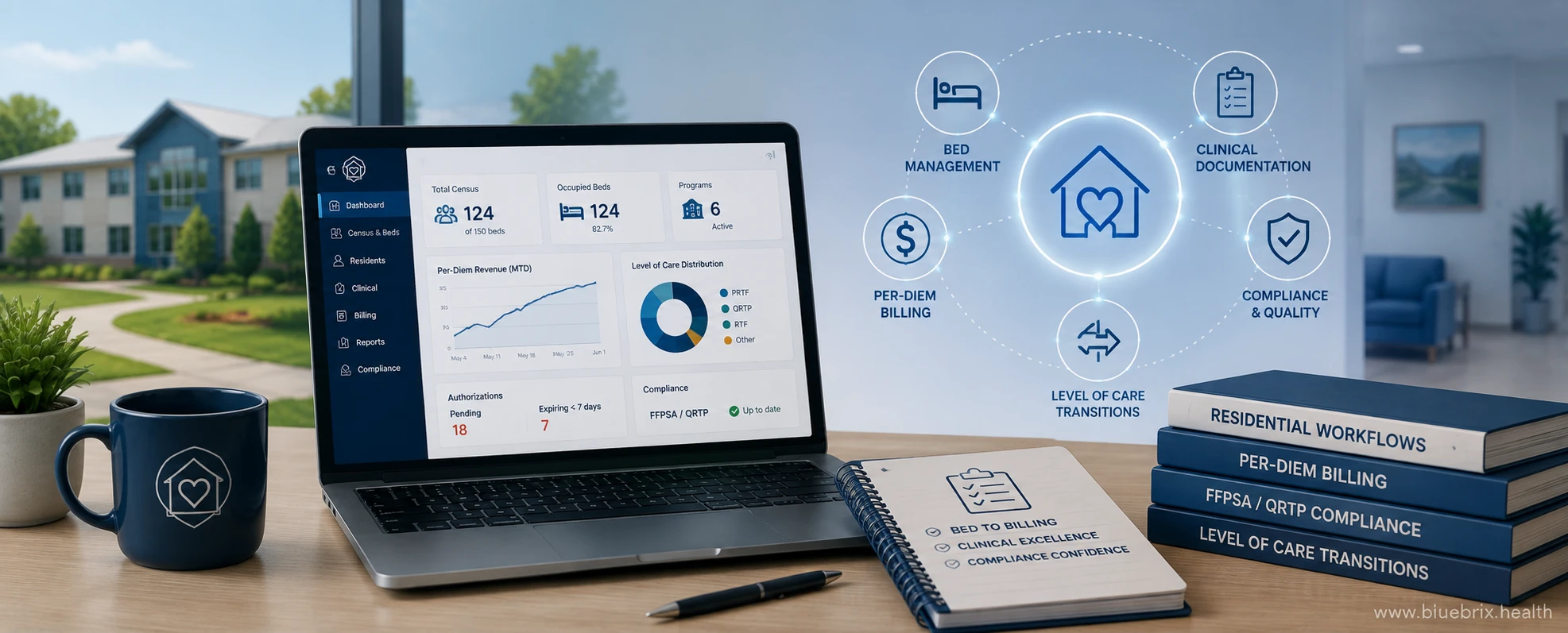
blueBriX builds its PRTF and QRTP workflow around these questions: bed assignment generates per diem charges, leave days follow state-specific billing rules, authorization windows alert before they lapse, and assessment and court review dates surface from the placement date.