
Setting the context
A patient comes in for an annual physical. As part of routine care, the front desk hands over a PHQ-9. The patient screens positive for depression. By the time the visit is coded, the chart shows F32.9, major depressive disorder, single episode, unspecified — entered before any diagnostic evaluation has actually happened.
Multiply that pattern across a CCBHC’s intake volume, a PRTF’s admission workflow, or an outpatient practice’s annual wellness visits, and the line between “we screened for something” and “we diagnosed something” gets blurry fast. It’s an easy mistake to make, because the clinical intent in both cases looks the same: catch a behavioral health condition early. But ICD-10-CM treats them as two entirely different categories of information, and payers are increasingly built to notice when the two get conflated.
It shows up in claim edits, in Medicare Advantage risk-adjustment audits, and in the Medicaid behavioral health reviews the OIG[1] has flagged for continued scrutiny in 2026. For Revenue and Finance leaders, it’s a clean-claims problem. For Clinical Workflow and Compliance leaders, it’s a documentation-integrity problem. Both groups are solving the same root cause from opposite ends of the chart.
What’s actually different: F-codes vs. Z-codes
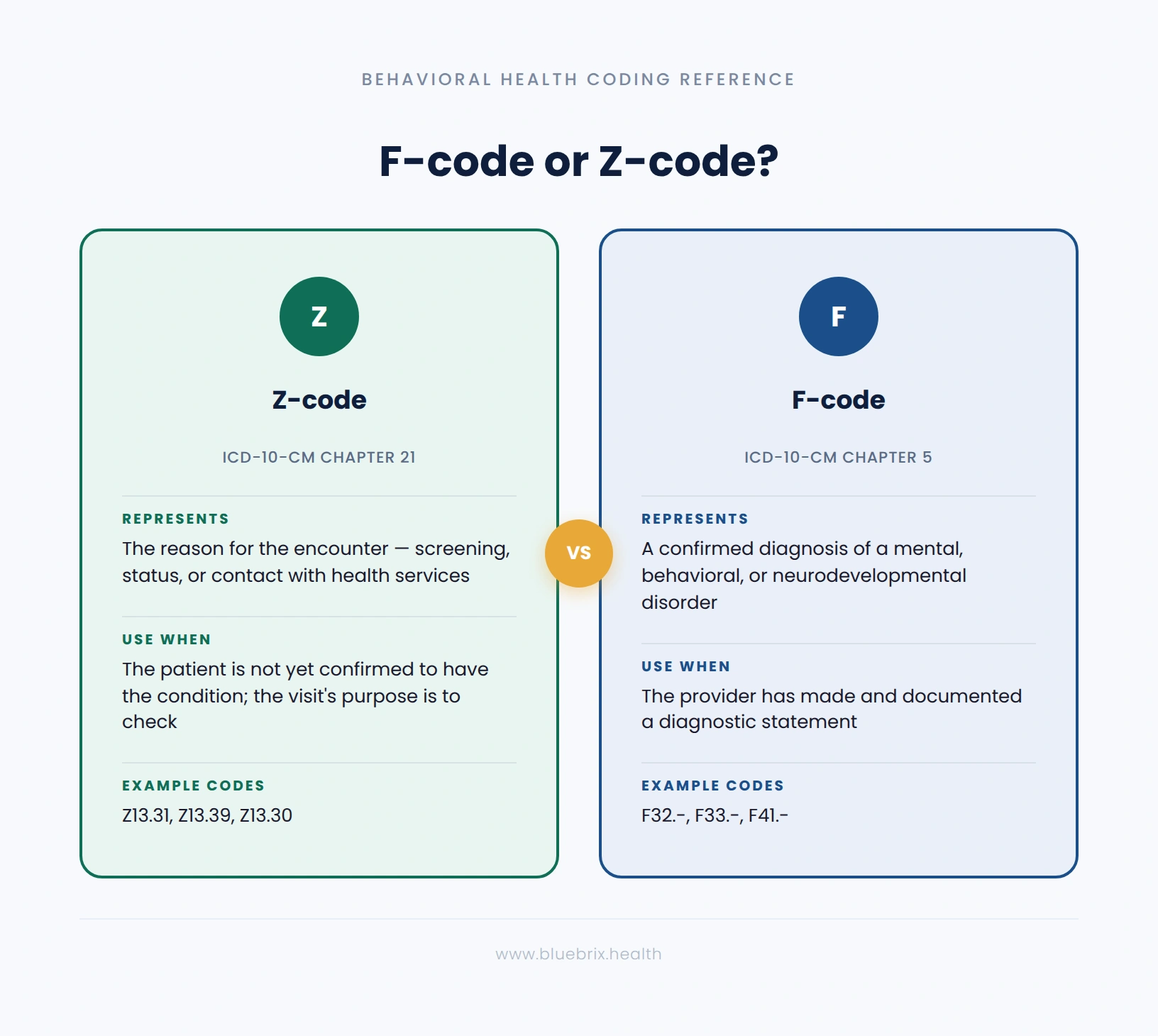
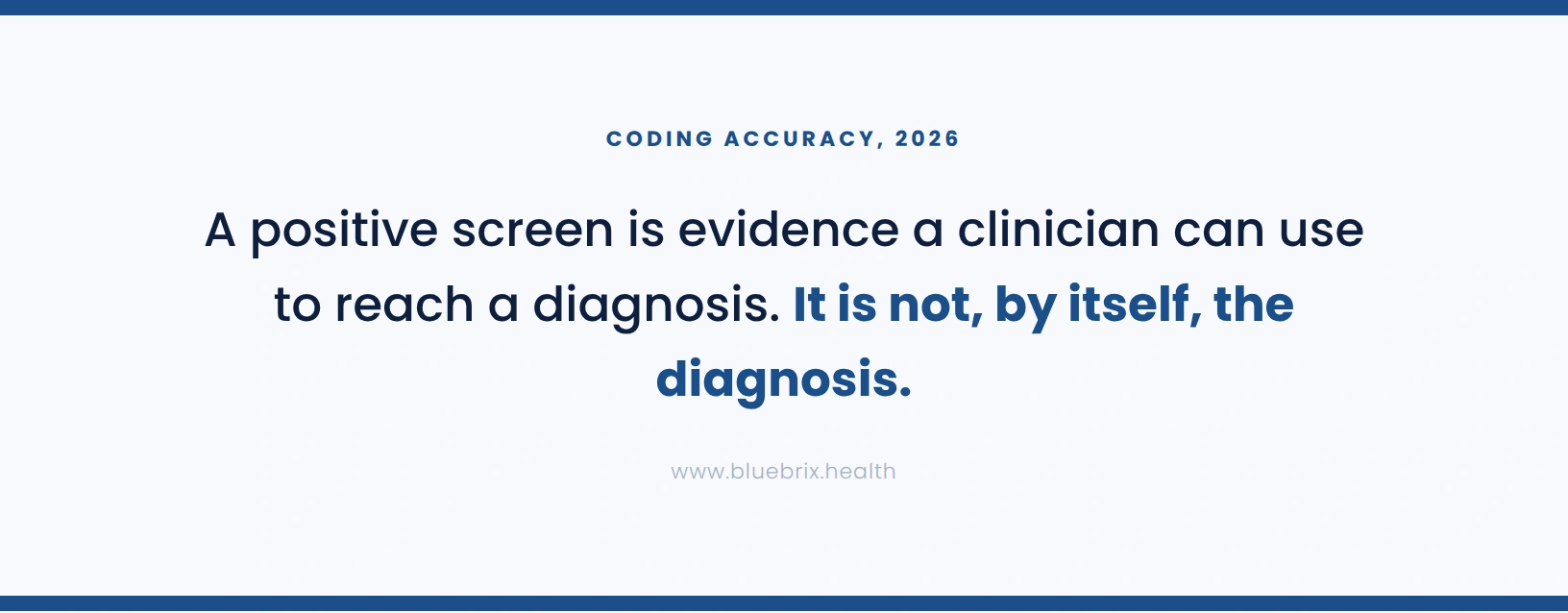
ICD-10-CM Chapter 5 (F01–F99) covers mental, behavioral, and neurodevelopmental disorders. Codes like F32 (major depressive disorder, single episode) and F41 (other anxiety disorders) sit here. These are diagnosis codes. Under CMS and NCHS’s FY2026 ICD-10-CM Official Guidelines for Coding and Reporting, the provider’s documented diagnostic statement that a condition exists is what supports code assignment — not the clinical criteria or test result the provider used to arrive at that statement. In plain terms: a positive screen is evidence a clinician can use to reach a diagnosis. It is not, by itself, the diagnosis.
Z-codes live in Chapter 21,[2]“Factors influencing health status and contact with health services.” Z13.3 and its subcodes — Z13.30 (unspecified), Z13.31 (screening for depression), Z13.32 (screening for maternal depression), Z13.39 (screening for other mental health and behavioral disorders) — describe why an encounter happened: to check for a possible condition in someone not yet confirmed to have it. The FY2026 tabular list is explicit that Z13.3 itself should not be used for reimbursement purposes; the more specific subcodes beneath it carry the billable detail.
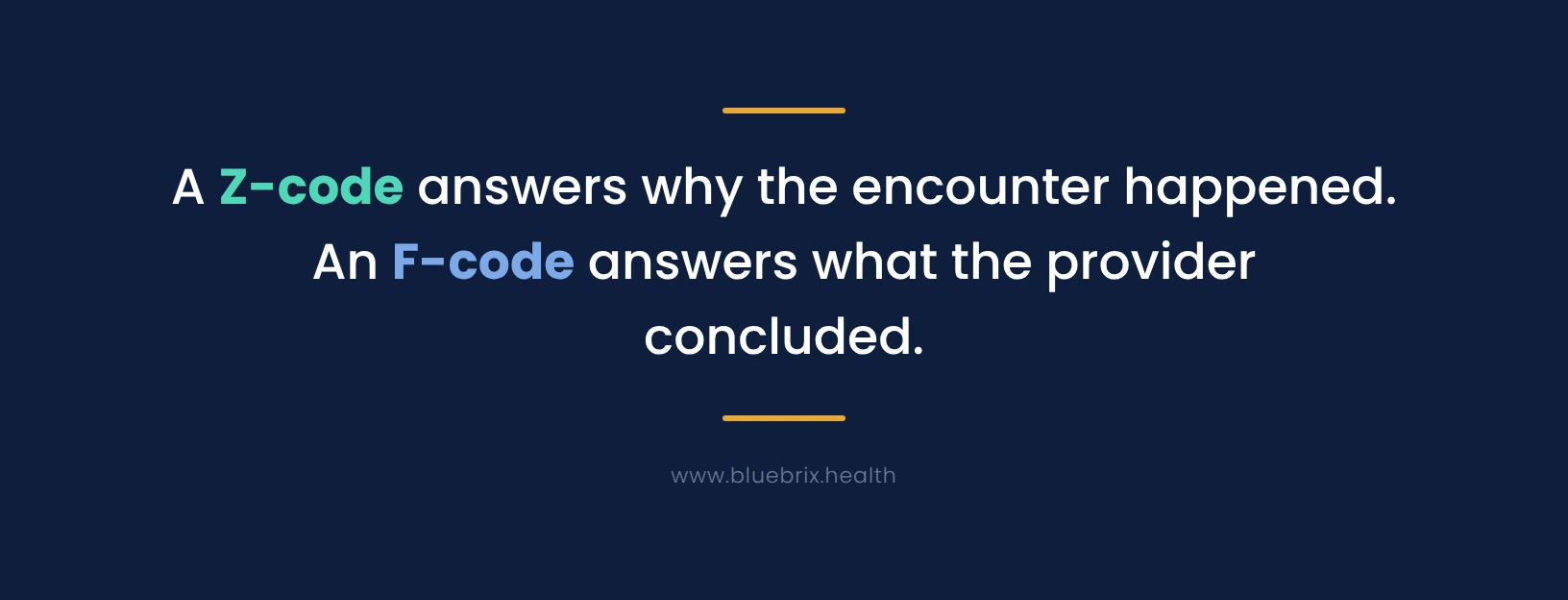
Stated simply: a Z-code answers “why did this encounter happen.” An F-code answers “what did the provider conclude.” One documents intent and process; the other documents outcome. Confusing the two doesn’t just risk a denial — it risks a lasting inaccuracy in the patient’s clinical record, since a diagnosis code, once submitted, becomes part of that patient’s coded history.
Where the confusion actually happens
Three patterns account for most of the F-code/Z-code mix-ups behavioral health organizations run into:
- Screening-only encounters coded as diagnostic. A positive PHQ-9 or GAD-7 gets translated directly into F32.9 or F41.9 without a documented diagnostic evaluation or a clinician’s diagnostic statement. This is the compliance and audit-exposure version of the problem — the code implies a level of clinical certainty the documentation doesn’t support.
- Confirmed diagnoses left under a screening code. The inverse happens too: a patient is seen, diagnosed, and treatment begins, but the claim still carries only the Z13.3x screening code from intake because no one updated it once the diagnosis was confirmed. This is the revenue-leakage version — the encounter is under-coded relative to the care actually delivered.
- Sequencing errors when both codes apply in the same encounter. A patient presents for routine screening, screens positive, and the provider makes a same-visit diagnostic determination. Both a Z13.3x code and an F-code may be appropriate here, but which is sequenced first — and whether the screening code belongs on the claim at all once a diagnosis is confirmed — depends on the documentation, not on template defaults.
These are the direct result of high-volume screening workflows — annual wellness visits, integrated primary care, CCBHC intake — running into EHR templates and coding shortcuts that don’t distinguish clearly enough between “screened” and “diagnosed” at the point of entry.
F-code vs. Z-code at a glance
| Code family | What it represents | When to use it | Example codes | Common misuse |
|---|---|---|---|---|
| Z-code (ICD-10-CM Chapter 21) | The reason for the encounter — screening, status, or contact with health services | Patient is not yet confirmed to have the condition; the visit’s purpose is to check | Z13.31 (screening for depression), Z13.39 (screening for other mental health/behavioral disorders), Z13.30 (unspecified) | Used as if it were a diagnosis; left on the claim after a diagnosis is later confirmed |
| F-code (ICD-10-CM Chapter 5, F01–F99) | A confirmed diagnosis of a mental, behavioral, or neurodevelopmental disorder | The provider has made and documented a diagnostic statement | F32.- (major depressive disorder, single episode), F33.- (recurrent), F41.- (anxiety disorders) | Applied directly from a screening result, without a documented diagnostic evaluation |
The 2026 audit and policy backdrop
Two things make this a worse year than most to get the distinction wrong.
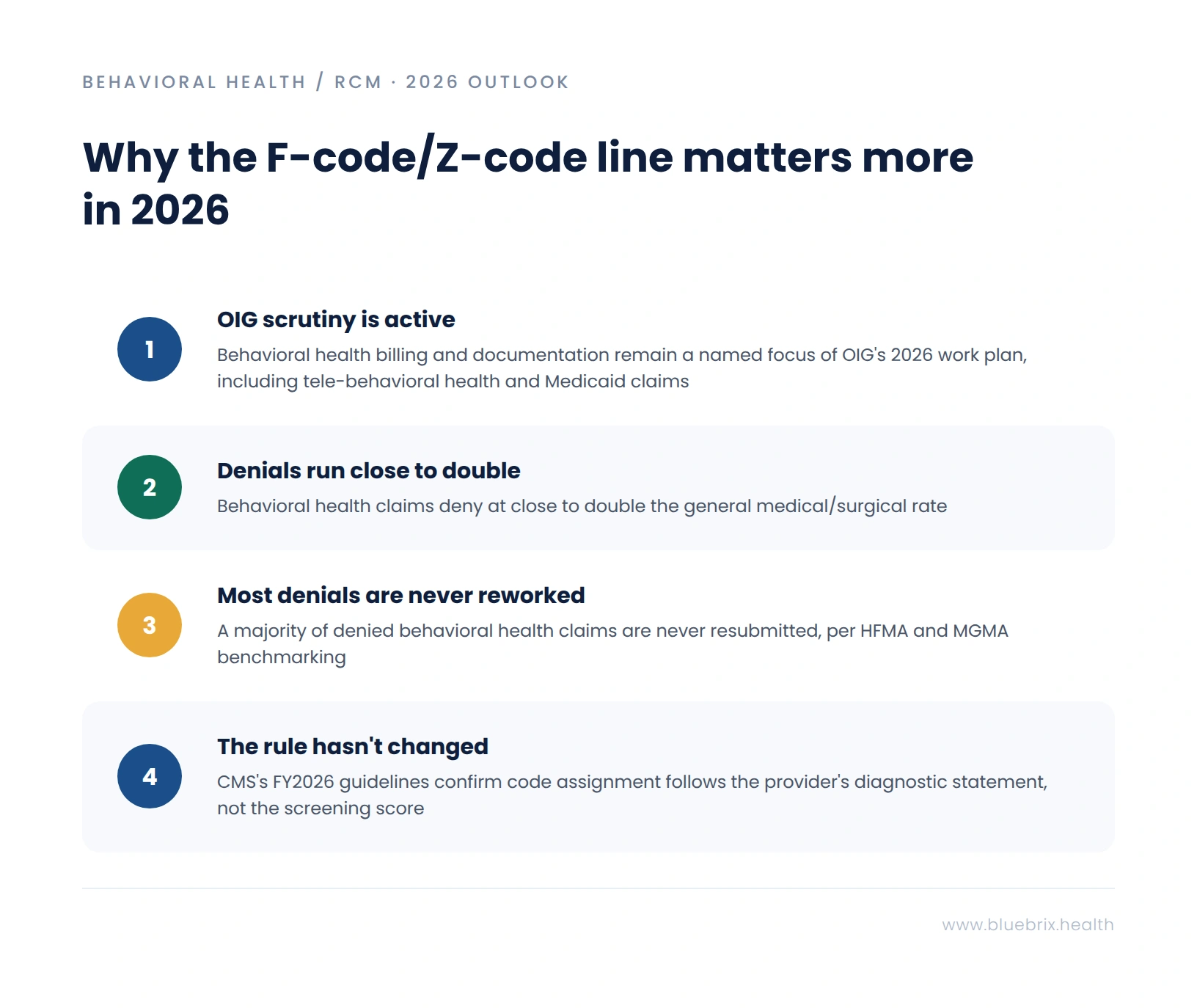
- The OIG’s 2026 work plan keeps behavioral health billing and documentation squarely in scope, with continued attention on Medicaid behavioral health payments and tele-behavioral health services — areas OIG has already identified as a persistent documentation challenge. Separately, OIG’s ongoing Medicare Advantage risk-adjustment audit series continues to review whether diagnosis codes submitted for risk scoring are supported by medical record documentation, and has previously found certain diagnosis categories disproportionately likely to be unsupported.
- The FY2026 ICD-10-CM code set (effective October 1, 2025) carries forward the code-assignment principle above without exception[3]: code assignment tracks the provider’s documented diagnostic statement, not the screening instrument. That guideline hasn’t changed, but the environment enforcing it has — payer claim edits and Medicare Advantage audits are both more automated and more consistently applied to behavioral health claims than they were even two years ago.
Together, this means a screening-coded-as-diagnosis error isn’t just a denial risk anymore. It’s the kind of finding that shows up in a targeted federal review.
What this looks like in a real encounter
Consider a CCBHC intake visit. The patient completes a standard screening battery during registration, which flags a positive result for depression. The intake clinician documents the positive screen and schedules a full diagnostic evaluation for the following week. At that second visit, the clinician documents symptom duration, severity, and functional impact consistent with DSM-5-TR criteria, and records a diagnostic statement of major depressive disorder, recurrent, moderate.
Coded correctly, the intake visit carries Z13.31 (or Z13.39, depending on the instrument used) as the reason for the encounter. The second visit carries the appropriate F32/F33 code once the provider’s diagnostic statement is documented. If a claims workflow instead defaults the diagnosis code into the very first encounter — before the diagnostic visit has happened — the documentation trail no longer supports the code on the claim, and the organization has created exposure that has nothing to do with whether the patient actually has the condition.
This is the operational throughline for both Revenue/Finance and Clinical/Compliance stakeholders: getting the sequence right protects the claim and the clinical record at the same time. The correct sequence is usually also the faster one to defend on appeal or audit.
Why this matters beyond a single claim
A denial tied to unsupported diagnosis coding rarely stays a one-claim problem. Behavioral health claims already deny at close to double the rate of general medical and surgical claims, and industry benchmarking from HFMA and MGMA[4] has consistently found that a majority of denied claims are never reworked at all — meaning the revenue isn’t just delayed, it’s permanently lost. A documentation gap that’s systemic — built into an intake template, for instance — doesn’t produce one denial; it produces the same denial repeated across every patient who goes through that workflow, plus audit exposure that compounds over time.
Getting the F-code/Z-code distinction right at the point of documentation is one of the few coding fixes that pays off on both sides of the ledger: fewer denials on the revenue side, and a defensible, accurate record on the compliance side.
Why consider blueBriX
Coding accuracy problems like this one are rarely a knowledge gap — most coders and clinicians already know the difference between a screening code and a diagnosis code. They’re a workflow gap: the screening result, the diagnostic documentation, and the claim don’t always live in a system that connects them in the right order. blueBriX’s behavioral health platform keeps screening results, clinical documentation, and coding workflows within a single record, so the diagnosis code applied to a claim reflects what has actually been documented — not what a template defaulted to at intake.
See how blueBriX keeps your coding workflow audit-ready
The distinction between a screening code and a diagnosis code is easy to explain and hard to enforce consistently across every intake, every clinician, and every claim. blueBriX gives your team the time and peace of mind that comes from a single behavioral health record, where screening results, clinical documentation, and coding stay connected — so the code that lands on a claim always reflects what was actually documented, not what a template defaulted to at intake.