

Why do generic EHRs fall short for IDD providers?
Generic EHRs fall short because IDD services aren’t organized around a single visit or a single payer. An Individual Service Plan is goal-based and interdisciplinary, HCBS billing runs on unit-based, waiver-specific rate logic, and most systems force both into workarounds, spreadsheets, paper logs, manual cross-checks, rather than handling them natively.
The ISP and person-centered planning gap
An IDD-capable EHR is a system built to run Individual Service Plans, HCBS waiver documentation, and Medicaid day-program billing natively, not a general clinical record with those functions bolted on afterward. Systems built for outpatient or acute clinical charting assume care is organized around a visit: an intake, a note, a billable encounter. IDD services are not organized that way. An Individual Service Plan (ISP) is goal-based and interdisciplinary, written by a team that spans case management, direct support, clinical, and often the family, and it is revisited on a recurring cycle rather than closed out after a single appointment.
Dropped into a generic EHR, that structure has nowhere to live. Goal tracking gets pushed into free-text progress notes, or into a module bolted onto a chart architecture that was never designed to hold it. That gap is usually the first thing a Clinical/Compliance Owner notices, not in the abstract, but in a very specific moment: trying to pull a goal-progress report for an auditor and discovering the data was never structured enough to report on in the first place. It’s also, as the next section shows, the same gap CMS’s own error analysis keeps finding.
HCBS waiver documentation doesn’t map to clinic-style charting
A clinic-style EHR assumes one payer and one note type per encounter. HCBS waiver documentation doesn’t work that way: a service note has to tie to a specific waiver, an authorized service code, and a funding source, and that linkage has to be captured at the point of charting, not reconstructed afterward from memory or a spreadsheet. This is exactly where the familiar “generic EHR plus spreadsheet” workaround starts, and where it becomes hardest to unwind once a practice has grown around it.
Medicaid billing for day programs requires a different rate logic
Day habilitation, community support, and supported employment billing run on unit-based, program-specific rate logic that most general-purpose EHRs simply weren’t built to hold. Unit limits, authorized service codes, and program enrollment all need to sit on the same record the clinician or direct support professional is charting against in real time, not in a separate billing system reconciled after the fact. A day habilitation program billed as a per diem code behaves nothing like the same service billed in 15-minute increments, and a single individual’s day can legitimately touch both plus a personal care code, depending on what actually happened that day.
The workaround tax: spreadsheets, paper logs, and shadow systems
When an EHR can’t hold IDD workflows natively, providers build around it: a parallel spreadsheet for goal tracking, a paper log for incident reporting, a manual cross-check before claims go out the door. Call this what it is, a workaround tax. It rarely appears on a budget line, which is exactly why it survives so long: a case manager staying late to reconcile a spreadsheet against the chart, a biller manually cross-referencing a paper incident log, a supervisor re-entering the same authorization number in two systems that don’t talk to each other. It shows up as staff hours the EHR should have absorbed natively, and it compounds quietly every pay period a provider runs on it.
What does the 2026 regulatory and payer landscape look like for IDD providers?
Three requirements are already in force (the HCBS Settings Rule, EVV, and the person-centered plan review cycle), and two are still moving: the HCBS Quality Measure Set finalizes by December 31, 2026, and the 80/20 direct care worker pass-through is under active OMB review as of July 2026.
What’s new in the HCBS Settings Rule and person-centered planning requirements?
The baseline hasn’t changed since 2014: CMS’s HCBS Settings Rule requires person-centered planning, individual-directed choice of setting, and genuine community integration, not just community proximity.[1]
What’s newly in effect around 2026 has real operational weight. CMS must finalize the HHS-identified HCBS Quality Measure Set no later than December 31, 2026, with states then required to begin biennial reporting against it starting in 2028[2], the underlying access rule also sets a target that person-centered service plans be reviewed and revised at least annually for 90% of individuals continuously enrolled in HCBS for a year or longer[3], and the same rule set an 80% direct care worker compensation pass-through for personal care, homemaker, and home health aide payments, meant to keep Medicaid HCBS dollars from being absorbed into administrative overhead[4]
That last piece is worth flagging directly for the Econ/Ops Owner, because it is not settled policy. The 80% requirement was finalized with a long runway, and it has drawn sustained congressional and industry opposition. In February 2026, CMS delayed enforcement of a related Access Rule deadline, the interested-parties advisory group requirement, not the 80% threshold itself; in July 2026, CMS sent a proposed rule to the White House budget office that could rescind or revise the 80/20 provision itself.[5]
Neither action has removed the requirement yet, but both point in the same direction. Build a rate strategy around that direction of travel, not around a compliance date or provision that may not survive in its current form.
2026 requirement snapshot
| Requirement | What it requires | Status as of mid-2026 |
|---|---|---|
| HCBS Settings Rule baseline | Person-centered planning, individual-directed setting choice, community integration | In force since 2014; full state compliance required by March 2023 |
| HCBS Quality Measure Set | CMS finalizes a standardized measure set for 1915(c) waiver programs; states then report against it | CMS finalizes by Dec. 31, 2026; state biennial reporting begins in 2028 |
| Person-centered service plan review | Annual reassessment and plan revision for at least 90% of long-enrolled individuals | In effect under the Access rule; state reporting timelines vary |
| 80% direct care worker pass-through | 80% of Medicaid personal care, homemaker, home health payments to worker compensation | Finalized with a 2030 target; CMS sent a proposed rule to OMB in July 2026 that could rescind or revise it |
| EVV mandate | Electronic verification of in-home personal care and home health visits | Federally required since 2020 to 2023 depending on service type; ongoing |
Read this table the way an Econ/Ops Owner should: three of the five rows are stable and already enforced, and two, the quality measure set and the direct care worker pass-through, are moving targets with dates that have shifted once already. An EHR’s compliance reporting needs to be able to track a rule that’s still in motion, not just the ones that have already settled.
See where your own IDD program’s revenue is actually leaking
A payer-specific and program-specific review usually surfaces one or two dominant failure points, not a dozen scattered ones. blueBriX’s behavioral health and IDD team maps unit limits, authorization tracking, and billing-code handling against your live waiver and funder mix, so you’re fixing what’s actually driving denials instead of guessing. Book a free revenue cycle assessment to see your own pattern mapped out.
How much does IDD billing vary state by state?
IDD billing is never one system, one rulebook. Waivers, managed care carve-ins, and rate structures vary by state and sometimes by county within a state. An EHR that hard-codes a single state’s rules into its billing engine becomes a liability the moment a provider expands into a new state or that state updates its waiver terms, which happens on its own schedule and often without much advance notice.
What does the EVV mandate under the Cures Act require, and how does it flow into billing?
Electronic Visit Verification isn’t a 2026 development, it’s a standing federal requirement. Section 12006 of the 21st Century Cures Act requires states to implement EVV for Medicaid personal care services and home health services that involve an in-home visit, verifying the date, time, location, individual, and provider of each visit.[6]
The practical complication for IDD providers is that EVV was written with home health and personal care visits in mind, a worker arrives, provides care, leaves. IDD services don’t always fit that shape as cleanly: a supported employment visit might span a job site and a bus ride, a day habilitation program might run from a fixed location with staff rotating through several individuals at once. States have handled that mismatch differently, so exactly how EVV data needs to reconcile with day program, residential, and in-home documentation is a question to put directly to a vendor and see demonstrated, not a box to assume is checked because a system says it does EVV.
That reconciliation is also where EVV stops being a compliance checkbox and becomes a billing input. The visit time, location, and service type an EVV system captures has to match the documented, authorized service before a claim goes out, which is the same pre-billing scrub logic covered in the operational requirements below. A system that captures EVV data but never checks it against the chart or the claim is only solving half of what the mandate actually requires downstream.
Why do day habilitation and community support billing codes vary by state?
The codes themselves are federally defined: T2020 for day habilitation billed per diem[7], T2021 for day habilitation billed per 15 minutes, T1019 for personal care services per 15 minutes[8], and H2015 for comprehensive community support services per 15 minutes.[9]
What varies is how each state applies them: which code a given waiver uses, what documentation threshold triggers additional review, and where a state substitutes a generic placeholder code such as T2025 (“waiver services, not otherwise specified”) for something a neighboring state bills under a named code. A provider running programs in two states might legitimately bill the identical day habilitation service under T2020 in one and T2021 in the other, simply because the two states structured their waivers differently. A system hard-coded to one logic forces staff into a manual workaround in the second state, the same workaround tax described in section I, applied specifically to codes.
What clinical and direct-support workflow requirements matter most for IDD care?
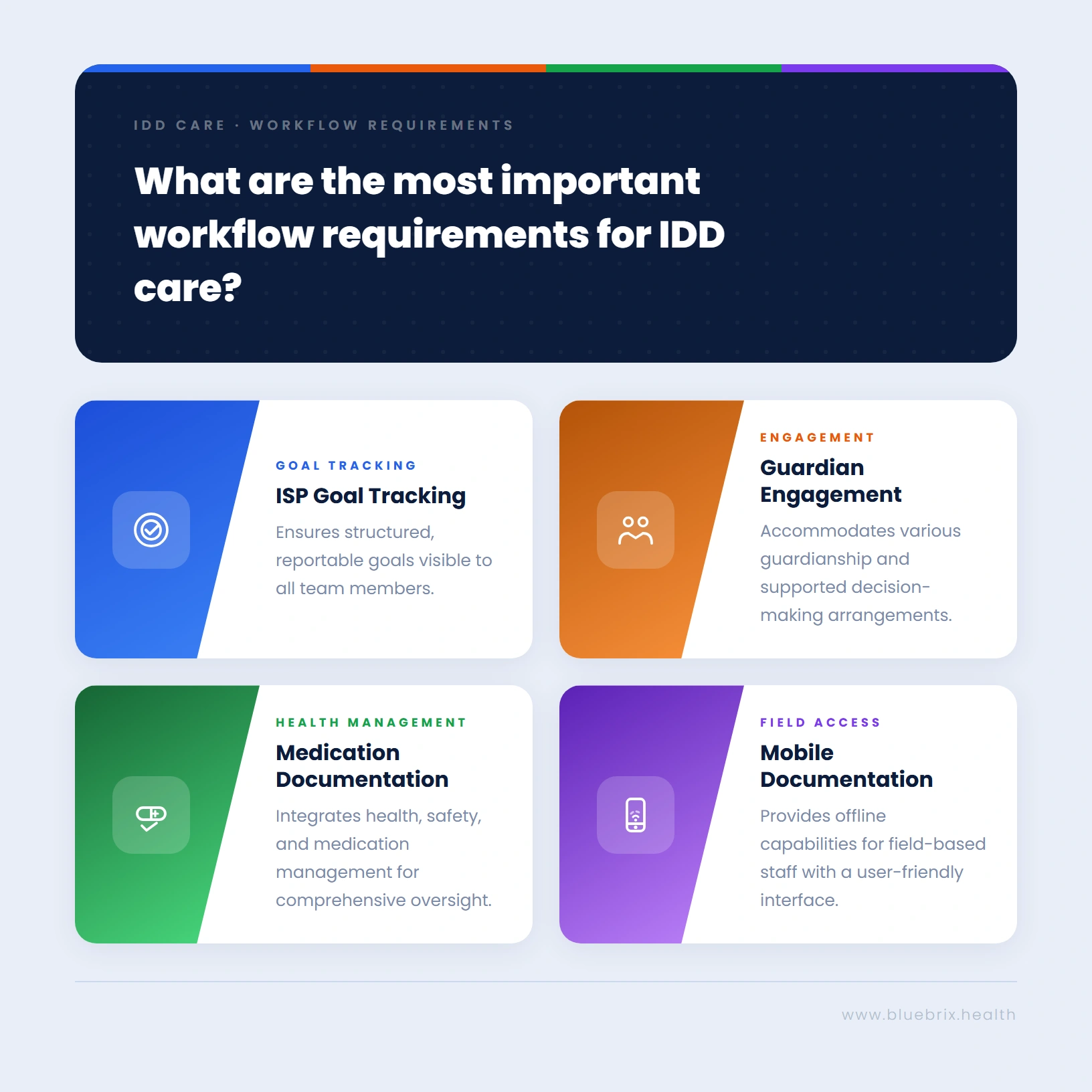
IDD-specific workflow requirements include structured ISP goal tracking, medication administration under state-specific nurse delegation rules, guardianship and supported decision-making documentation, and mobile, offline-capable charting for staff working in homes and the community.
ISP creation and person-centered documentation the way regulators expect
Goal tracking needs to be a structured, reportable field, not a paragraph buried in a note. It needs to be visible to every team member touching the case, and its review cycle needs to surface before it lapses, not after an auditor or a state reviewer notices first. A goal set by a behavioral clinician, tracked by a DSP during a community outing, and reviewed by a case manager at the next ISP meeting has to be the same record across all three, not three separate descriptions that quietly drift apart over a few months.
Alongside that structure, the documentation itself needs to show the individual’s stated preferences, the choices actually offered, and community-integration goals, not just a list of services delivered. That distinction is precisely what the HCBS Settings Rule is checking for, and CMS’s own PERM analysis of habilitation and waiver claims backs up why it matters financially as well as ethically: CMS’s most recent data puts the FY2025 Medicaid improper payment rate at 6.12%, with 77.17% of that tied to insufficient documentation, services billed that weren’t authorized in the plan, and documentation that didn’t support the plan’s stated necessity.[10]
Health, safety, and medication documentation
Incident and behavioral data tracking, restrictive interventions, injuries, elopement, needs to sit alongside medication management and eMAR: PRNs, controlled substances, pharmacy integration, and administration tracking. Treating these as two separate systems is how a safety pattern goes unnoticed until it’s already an incident report.
The harder design problem is medication administration by unlicensed direct support staff under nurse delegation. Whether and how a DSP can administer medication at all, and what documentation that delegation requires, is governed by each state’s nursing practice act, and practice acts vary widely on which health maintenance activities can be delegated to unlicensed staff and under what supervision.[11]
An eMAR built only around licensed-nurse workflows will either block legitimate DSP administration or, worse, let it through without the delegation-specific checks, delegating nurse of record, competency verification, supervision interval, that a state surveyor will look for. This is one of the clearest places where a behavioral health EHR extended into IDD has to actually extend, not just relabel, its medication module.
Guardian and family engagement across the care team
Many individuals served rely on a guardian or family member as primary contact and decision-maker, but not every arrangement looks the same. Guardianship can be full or limited to specific decision areas, and a growing number of individuals use supported decision-making instead, an arrangement where the individual keeps the legal right to decide and simply receives support from people they’ve chosen.[12]
That variability has direct implications for consent documentation, communication logs, and portal access. A system that records only “has a guardian: yes or no” can’t show what a guardian, or a supported decision-making team, is actually authorized to weigh in on, which is exactly the distinction a chart needs to hold correctly rather than defaulting to the most restrictive assumption or the most permissive one.
Mobile and offline documentation for field-based staff
IDD services happen in homes, group settings, job sites, and the community, not in an office with reliable Wi-Fi. Mobile, offline-capable documentation is a baseline requirement, not an add-on, and it has to be built around offline sync and a non-clinical-staff-friendly interface, which is a distinct design problem from what gets documented. Most DSPs were not hired for their comfort with clinical software, so an interface designed with a clinician’s mental model, dense fields, clinical shorthand, multi-click navigation, will get worked around in the field regardless of what it’s technically capable of capturing.
Offline capability also has to survive the handoff back online. A shift note entered at a job site with no signal needs to sync cleanly once connectivity returns, without creating a duplicate entry, overwriting a supervisor’s concurrent edit, or silently dropping a field the app couldn’t validate offline. A system that handles the field entry well but fumbles that reconciliation just moves the documentation gap from the point of care to the point of sync, where it’s harder to notice until a claim or an audit surfaces it.
What operational and revenue requirements should an IDD EHR meet?
An IDD-capable system needs to hold multiple programs and funders on one individual record, track authorizations and unit limits inside the charting workflow itself, and generate claims from documented, authorized services rather than a separate billing spreadsheet.
Multi-program, multi-funder configuration on one record
An individual served is often enrolled in more than one program at once, residential, day services, supported employment, each with a different funder. The record needs to hold all of it without duplicating the person’s chart across systems.
The failure mode is familiar to anyone who’s watched a provider grow past its original setup. Day services goes live on the EHR first. Residential gets added later as a second, separately configured instance because the first setup had no residential workflow. Supported employment starts as a spreadsheet because nobody wants to configure a third program under deadline pressure. Two years on, one individual has three partial charts, none of which reflects the whole picture, and every audit, every ISP review, every guardian question about the person’s overall plan requires someone to reconstruct that picture by hand.
Authorization and unit tracking before the claim is ever filed
Unit and authorization tracking needs to sit inside the documentation workflow itself, flagging an approaching limit while a shift is still being charted, rather than being discovered as a denial weeks later. This is also where EVV data earns its keep: the visit time and location an EVV system captures should run through the same pre-submission check as the unit count and authorization status, not sit in a separate system that only gets reconciled if something already went wrong.
Turning documented services into clean claims: a worked example
An individual attends a day habilitation program funded through a state IDD waiver, and separately receives a few hours of in-home personal care funded through a different HCBS authority. On a single Tuesday, the day program bills four units of T2021 against the day hab authorization, and the in-home visit bills two units of T1019 against the personal care authorization, verified through the state’s EVV system. Both services touch the same individual record, but each draws against a different authorization, a different funder, and a different unit cap, and the EVV data for the in-home visit has to reconcile against the personal care claim specifically, not the day program claim.
A system built for one payer and one program would need a manual workaround to keep those two authorizations, two unit caps, and one EVV feed straight without either service quietly borrowing units from the other’s cap. A system built for multi-funder IDD billing treats this as the normal case rather than the edge case, generating both claims from the documented, authorized service itself, with a pre-billing scrub layer checking unit limits, codes, and authorization status before either one goes out the door.
What do generic systems actually cost providers?
The cost shows up in three places: denied claims traced to documentation and unit-count errors (per CMS’s own PERM data), staff hours lost to manual compliance tracking, and turnover risk, since DSP turnover runs near 40% nationally and documentation burden is one driver a provider can act on directly.
Denied and delayed claims from rate and code mismatches
CMS doesn’t have to guess at why habilitation and waiver claims get denied, its own Payment Error Rate Measurement analysis already traced the pattern to three root causes: insufficient documentation that doesn’t fully support the billed code, missing documentation entirely, and number-of-units errors, where the billed count doesn’t match what’s authorized or what was actually delivered.
For the Econ/Ops Owner, the number that matters isn’t any single denied claim, it’s the pattern. A mismatch that denies once, a T2021 claim missing an authorization link, a unit cap crossed because two programs drew against the same authorization, will deny again on every claim carrying the same root cause until the workflow itself changes, not the individual claim gets appealed.
The staff time lost to manual compliance tracking
Tracking ISP review dates, authorization renewals, and incident reports outside the EHR is a real labor cost, even when no single claim is denied because of it. It’s the quiet version of the same problem: staff hours spent holding a compliance picture in a spreadsheet that the system of record should have been holding natively.
Turnover risk from documentation burden on DSPs and clinicians
National DSP turnover has held near 40%, with vacancy rates commonly running between 12% and 15%, and most providers report that staffing challenges are directly undermining their ability to meet quality standards.[13]
Documentation burden is not the only driver of that turnover, but it’s one of the few a provider can act on directly. One recent academic analysis estimated the cost of a single direct care worker’s turnover at roughly $4,200 once recruitment, training, and downstream service disruption are counted, with workforce instability also linked to measurable increases in preventable emergency visits and hospitalizations.[14]
Turnover compounds compliance risk in a second way, too: every new hire onboards into a state-specific, waiver-specific environment that takes real time to learn, and a system that makes documentation harder rather than easier extends that ramp-up window on every replacement.
Building the business case for the Econ/Ops Owner
Put together, these aren’t separate problems. They’re one number: the dollar exposure and staff-hour cost of running IDD documentation and billing on a system that wasn’t built for it, measured against what a system built for HCBS billing would cost to implement and maintain instead.
What are the three categories of IDD EHR solutions?
IDD EHR platforms fall into three categories: dedicated waiver-management platforms, behavioral health EHRs extended into IDD, and generic or enterprise EHRs with IDD features bolted on. Each trades off differently between waiver-specific depth and general clinical breadth.
Dedicated waiver-management platforms
Built specifically for HCBS and waiver documentation and billing. Strong on waiver-specific workflows, unit-based rate logic, and authorization tracking, since those requirements shaped the product from the start rather than being added to something else.
The tradeoff shows up on the clinical side and, later, on the growth side. General clinical documentation and behavioral health depth are often narrower here, so a provider that also runs a behavioral health or primary care line, or plans to, may find itself running a second system alongside the first. That recreates the exact interoperability gap section I opened with, just with the roles reversed: waiver documentation is native, everything else is the workaround.
Behavioral health EHRs extended into IDD
Platforms built originally for behavioral health, with IDD modules added on top. Typically strong on clinical documentation and billing flexibility, since IDD support extends an existing configurable architecture rather than bolting onto one that was never meant to hold it.
The real diligence question here isn’t whether a vendor has an “IDD module,” almost every vendor in this category now claims one. It’s how long that module has existed and how much of the ISP-to-claim workflow it actually completes end to end, goal tracking, waiver-linked documentation, unit-based rate logic, EVV reconciliation, versus how much still routes around it manually. A live demo of a full day habilitation billing cycle answers that question faster than a features list does.
Generic or enterprise EHRs with bolted-on modules
The category most likely to reproduce the workaround problem described in section I, since IDD-specific logic, unit-based rate tables, waiver-linked documentation, ISP goal structures, was never part of the original architecture and has to be layered on afterward.
This category also carries a specific budgeting trap. Because the system is already paid for, already known by IT, and already familiar to staff, the case for keeping it can look stronger than it is. The workaround tax from section I is diffuse, spread across staff hours that never appear as a line item, while the cost of switching systems is concentrated and visible on day one. Both costs are real; only one of them shows up on a budget request, which is exactly why this category tends to persist past the point where it’s actually the cheaper option.
How the three IDD EHR categories compare.
| Category | Where it’s strong | Where to look closer |
|---|---|---|
| Dedicated waiver-management platforms | Waiver-specific documentation and billing workflows built in from the start | General clinical charting and behavioral health depth outside waiver scope |
| Behavioral health EHRs extended into IDD | Configurable clinical documentation, billing flexibility, an architecture built to extend | How deep the IDD-specific modules actually go versus how recently they were added |
| Generic or enterprise EHRs with bolted-on modules | Broad enterprise features, familiar to IT and compliance teams already using the platform | IDD-specific rate logic and ISP structures usually layered on, not designed in |
None of the three categories is universally correct, the right starting question isn’t which category sounds best, it’s how many of the requirements in sections I through IV a provider is already handling through a workaround, and whether that cost has actually been measured the way section V lays out, or just felt without ever being put into a number.
What belongs on a 2026 checklist for the best EHR for IDD providers?
A 2026 evaluation checklist should cover person-centered planning and clinical documentation, compliance and regulatory reporting, and billing and revenue integrity, with EVV integration, waiver-specific rate configuration, and ISP goal reporting demonstrated live in any vendor demo.
Person-centered planning and clinical documentation capabilities
- ISP creation and person-centered planning tools: structured, reportable goal fields tied to every discipline that touches the case, not narrative notes a case manager has to rebuild into a report before an auditor can use it.
- eMAR and medication management: built for DSP administration under nurse delegation, with the delegating nurse, competency verification, and supervision interval as native fields rather than bolted onto a licensed-nurse-only workflow.
- Mobile, offline-capable documentation: designed for a non-clinical, field-based user first, with sync that catches up once connectivity returns rather than blocking a shift’s charting entirely.
Compliance and regulatory reporting capabilities
- Automated compliance reporting: mapped to state and federal HCBS requirements, including the HCBS Quality Measure Set and the annual person-centered plan review cycle covered in section II, so a rule that’s still moving doesn’t require a manual workaround to track.
- Configurable role-based access: distinct permissions for clinical, DSP, guardian, and billing users, reflecting that a guardian’s access needs differ from a case manager’s, and a supported decision-making arrangement differs again from either.
- Audit-ready documentation trails: records that hold up against a state reviewer, not just an internal one, the same standard CMS’s own PERM analysis is checking claims against in section V.
Billing and revenue integrity capabilities
- Multi-funder, multi-program billing configuration: one individual record supporting multiple authorizations, funders, and unit caps at once, without duplicating the person’s chart the way section IV’s worked example describes.
- Authorization and unit tracking: built into the charting workflow itself, flagging an approaching limit while a shift is still being documented, not after the claim comes back.
- A pre-billing scrub layer: checking code, modifier, and authorization logic, and reconciling EVV data, before a claim goes out rather than after it’s denied.
Questions to ask, and demand a live demo of, during vendor evaluation
Three things are worth seeing demonstrated live rather than described on a slide: EVV integration and how it reconciles against documentation, state-specific waiver rate configuration, and ISP goal reporting that a case manager could actually hand to an auditor without rebuilding it first.
Where does blueBriX map to this checklist, and what should you verify?
blueBriX supports individualized care plans, multi-funder billing, and HIPAA/42 CFR Part 2/HITRUST compliance for IDD providers. blueBriX falls in the second category described above: a behavioral health EHR architecture extended into IDD. State-by-state EVV integration and waiver-specific rate configuration aren’t publicly documented and are worth confirming directly in a vendor conversation. blueBriX’s behavioral health EHR includes individualized care plans, program management tools, progress tracking, and family engagement built for person-centered care, features designed specifically to support IDD providers rather than added as an afterthought.
On the billing side, the platform supports fee-for-service, per diem, capitation, and value-based billing across multiple funders on one record, with automated claims, denials, and accounts receivable management built in, the same multi-program and multi-funder configuration that IDD billing requires.
On compliance, blueBriX is built around HIPAA, 42 CFR Part 2, and HITRUST requirements, with HL7, FHIR, and CCDA interoperability for exchanging records with other systems, states, and payers. The platform’s configuration-first, no-code approach is the piece most relevant to the state-by-state variability covered in section II: it’s designed to support rate tables, service codes, and documentation rules configured per waiver and per funder rather than hard-coded into the product.
What isn’t published, and is worth bringing directly into a vendor conversation rather than assuming either way, is the specific state-by-state EVV integration list, exactly how waiver-specific rate configuration is handled out of the box versus through professional services, and how IDD-specific billing codes like T2020, T2021, T1019, and H2015 are handled in the claims engine. Those are the same three questions this article raised in section VII, and they apply to any vendor, blueBriX included.
What drives the cost and timeline of switching to an IDD-capable EHR?
Migration cost and timeline scale with how many states and waivers a provider bills across, how many disconnected systems need consolidating, and how much staff retraining a field-based workforce needs, more than with any vendor’s list price.
The variables that actually move the number
Implementation cost and timeline for an HCBS-focused EHR migration aren’t fixed, they scale with a small number of variables an Econ/Ops Owner can size up before ever talking to a vendor: how many states and waivers the organization bills across, how many disconnected systems, spreadsheets, paper logs, a legacy EHR, have to be reconciled and migrated, how many programs need distinct rate logic configured, and how much retraining a non-clinical, field-based workforce needs before go-live.
How to size your own workaround tax before you buy
Before comparing vendor quotes, total up what running the current system actually costs: staff hours spent reconciling spreadsheets against the chart, hours spent manually resubmitting denied claims traced to the documentation and unit-count errors described in section V, and the onboarding time every new hire loses learning a state-specific workaround that a system built for waiver billing would have handled natively. That number, not the sticker price of a new system, is the real baseline to measure any vendor’s proposal against.