
What EVV actually requires, and where the real exposure sits
Electronic visit verification, or EVV, is the federal Medicaid mandate created under Section 12006(a) of the 21st Century Cures Act[1]. It requires states to electronically verify six data points on every in-home Medicaid visit for personal care and home health services: type of service, individual receiving it, date, location, individual providing it, and the time it begins and ends. States that don’t implement it face a graduated reduction in federal Medicaid match, so every state has built some version of this infrastructure, and the penalty only grows the longer a state delays. It’s where its edges sit for your specific service lines, and that’s a harder question than the statute makes it sound.
The mandate was written around one shape: a single caregiver, a single recipient, a fixed home address, a task list, a predictable start and stop time. Personal care aides and home health nurses fit that shape cleanly. A meaningful share of behavioral health and intellectual and developmental disabilities, or IDD, service delivery doesn’t, and that mismatch, not the six data points themselves, is where most of the compliance and revenue risk in this space actually lives.
One more thing worth flagging before we get into where states diverge: the Centers for Medicare & Medicaid Services, or CMS, already closed off the obvious workaround. A web-based timesheet, where a caregiver logs start and stop times and the individual confirms the entry through the same portal, doesn’t satisfy the requirement on its own, since CMS found this dual-verification approach doesn’t give the state auditable, electronically verified confirmation of what was entered.[2]
That’s the federal floor. Where things actually get complicated is what each state has built on top of it, and that’s where your specific service lines either land cleanly in scope or fall into gray areas nobody’s fully mapped yet.
Which behavioral health and IDD services actually fall under the mandate
The federal statute covers Personal Care Services, or PCS, delivered under state plan authority or under 1915(c), 1915(i), 1915(j), 1915(k), or Section 1115 waivers, and Home Health Care Services, or HHCS, delivered under the state plan or a waiver, where the service requires an in-home visit. It doesn’t name behavioral health services, and it wasn’t written with day habilitation, mobile crisis response, or team-based community behavioral health in mind. What determines your actual exposure is how far each state has extended that floor, and the answer varies enough that a one-size-fits-all policy doesn’t hold up.
One boundary worth settling early: telehealth. Since the federal mandate covers personal care and home health services that require an in-home visit by a provider, a session delivered remotely by video or phone falls outside EVV’s scope by definition — there’s no in-home visit to verify. This matters for behavioral health specifically, since many services blend in-person and telehealth delivery for the same client. Track which modality each encounter actually used, since misclassifying a telehealth session as an in-home visit, or the reverse, creates its own documentation mismatch.
A few real examples show how differently this plays out:
- Missouri: The Department of Social Services is rolling out EVV claims validation in phases. Personal care, advanced personal care, consumer-directed services, homemaker, chore, and respite claims from Division of Senior and Disability Services providers moved to hard-edit denials for dates of service on or after April 1, 2026.[3] A separate, later phase is scheduled specifically for home health providers and for the Department of Mental Health’s Division of Developmental Disabilities (provider type 85), signaling that IDD-funded services in Missouri are being pulled into the same enforcement system on a delayed timeline.[4]
- Illinois: EVV covers personal support worker (PSW) services and occupational, physical, and speech therapy delivered under the Division of Developmental Disabilities’ 1915(c) waivers, with a 75 percent compliance threshold that triggers escalating penalties, starting with mandatory training modules, for agencies that fall short.[5] At the same time, Illinois has explicitly stated that residential habilitation providers, including Community Integrated Living Arrangement (CILA) and Community Day Service providers, are not currently in scope. That single distinction, in-home PSW services in scope, CILA and day services not yet in scope, is exactly the kind of boundary line that trips up multi-service IDD organizations operating across program types.
- Texas: The Health and Human Services Commission tightened EVV enforcement in early 2026, ending compliance grace periods under Revision 26-1 to its EVV Policy Handbook, effective January 30, 2026, for personal care and home health claims statewide.[6] Missouri, Illinois, and Texas represent three different points on the same trajectory, and providers in other states should expect their own state’s timeline to follow a similar arc, not assume the pattern stops at these examples.
- Beyond the federal floor: Colorado has extended EVV to behavioral therapies, including pediatric behavioral therapy delivered in the home or community, using the same required-services framework originally built around personal care.[7]
The pattern across all of this: the federal mandate sets a floor. States have wide discretion to decide which additional service types, waiver populations, and provider types get pulled into EVV enforcement, on their own timeline, with their own thresholds. There is no single national answer to “does EVV apply to my service line.” There is only your state’s current answer, and it can change.
That state-by-state patchwork is a practical reality. But zoom out from the specifics and a bigger question surfaces: why do behavioral health and IDD services keep landing in this same ambiguous territory, state after state? The answer traces back to what EVV was actually built to track in the first place.
Why the EVV model breaks down for community-based behavioral health and IDD care
A few concrete mismatches show up again and again once you compare how EVV is supposed to work against how care actually gets delivered in the field.
Variable location
Community-based services, including many IDD habilitation supports and mobile behavioral health interventions, happen wherever the individual is that day: a grocery store, a job site, a relative’s home, a park. EVV location capture assumes a fixed point, usually the individual’s home address, and flags anything outside a defined radius as an exception, even when the visit was entirely legitimate and clinically appropriate.
Capturing a community location also raises a privacy question that a fixed home address doesn’t: a GPS ping at a specific address can reveal where an individual receives behavioral health or SUD-related services to anyone who later sees that record. Organizations should treat community-location EVV data with the same care as other sensitive service-location information and confirm with compliance counsel how it fits alongside existing confidentiality obligations for behavioral health records.
Clinically driven session length
A skilled home health visit has a task list that predicts duration. A behavioral health session or a habilitation activity is often driven by the individual’s presentation that day, not a fixed schedule. A session that runs long because a client is in crisis, or ends early because engagement isn’t working, looks like a documentation anomaly to a system built around predictable task time.
No obvious visit boundary
Some services, day habilitation programs and certain group-based behavioral health interventions among them, don’t have a single “provider enters home, provider leaves home” event to verify. They involve group settings, rotating staff, and attendance tracked differently than a one-to-one visit.
Group and clinic-adjacent delivery
Where personal care assumes a single worker with a single recipient, many IDD day services and some behavioral health group interventions involve one staff member supporting multiple individuals at once, a structure the standard six-element model wasn’t built to capture cleanly.
None of this means these services are exempt from documentation requirements. It means a tool built for one service model is being applied, unevenly across states, to a different one. Organizations end up choosing between two bad options: forcing the service into an EVV structure that misrepresents how care was actually delivered, or documenting accurately and falling outside the system’s expectations, which is what triggers denials. Care was provided. It just wasn’t provided in the shape the system expected.
That shape mismatch has real financial teeth now, which is the part that should have your finance team’s attention as much as compliance.
What changes when your state moves to hard-edit EVV denials
For years, EVV compliance in most states functioned more like a scorecard than a gate. States tracked compliance percentages, sent notices, and required corrective action plans, but claims still got paid even when the EVV record was incomplete or missing. That is changing, and the change matters more to your finance team than any other development in this space.
A growing number of states have moved, or are actively moving, to hard-edit enforcement, where a claim without a matching, verified EVV record simply denies submission. Missouri is a clear, documented example: personal care claims without a corresponding verified visit in the state’s EVV Aggregator Solution, the centralized system that collects visit data from providers’ EVV vendors and matches it against submitted claims before payment, began denying for dates of service on or after April 1, 2026, with the state explicitly warning providers in advance that non-compliant claims would not be paid. Illinois pairs its compliance threshold with escalating consequences that move from training requirements toward closer monitoring for agencies that don’t improve.
The stakes behind this shift are not abstract. An audit by the New York State Comptroller found that the state had paid $14.5 billion for Medicaid-funded personal care services without the electronic visit verification the Cures Act requires and flagged that submitters could manually adjust EVV records before submission without the health department’s knowledge.[8] Findings like that are exactly what accelerates states toward stricter, automated claim-level enforcement, since manual review and self-reported compliance percentages clearly weren’t closing the gap regulators were looking for.
For a revenue cycle or finance leader, the practical translation is this: EVV compliance is no longer just a documentation quality metric you report on periodically. In states that have flipped to hard edits, it is a real-time gate on whether a clean claim gets paid at all. A visit delivered exactly as planned, documented thoroughly in your clinical record, and billed correctly can still deny if the EVV data behind it doesn’t match, wasn’t transmitted on time, or wasn’t verified before submission.
So the compliance conversation and the cash-flow conversation are now the same conversation. Once you see that, the next question is where these breakdowns actually start inside your own organization, because most of them are more mundane, and more fixable, than they first appear.
The EVV compliance gaps we see most often in behavioral health and IDD organizations
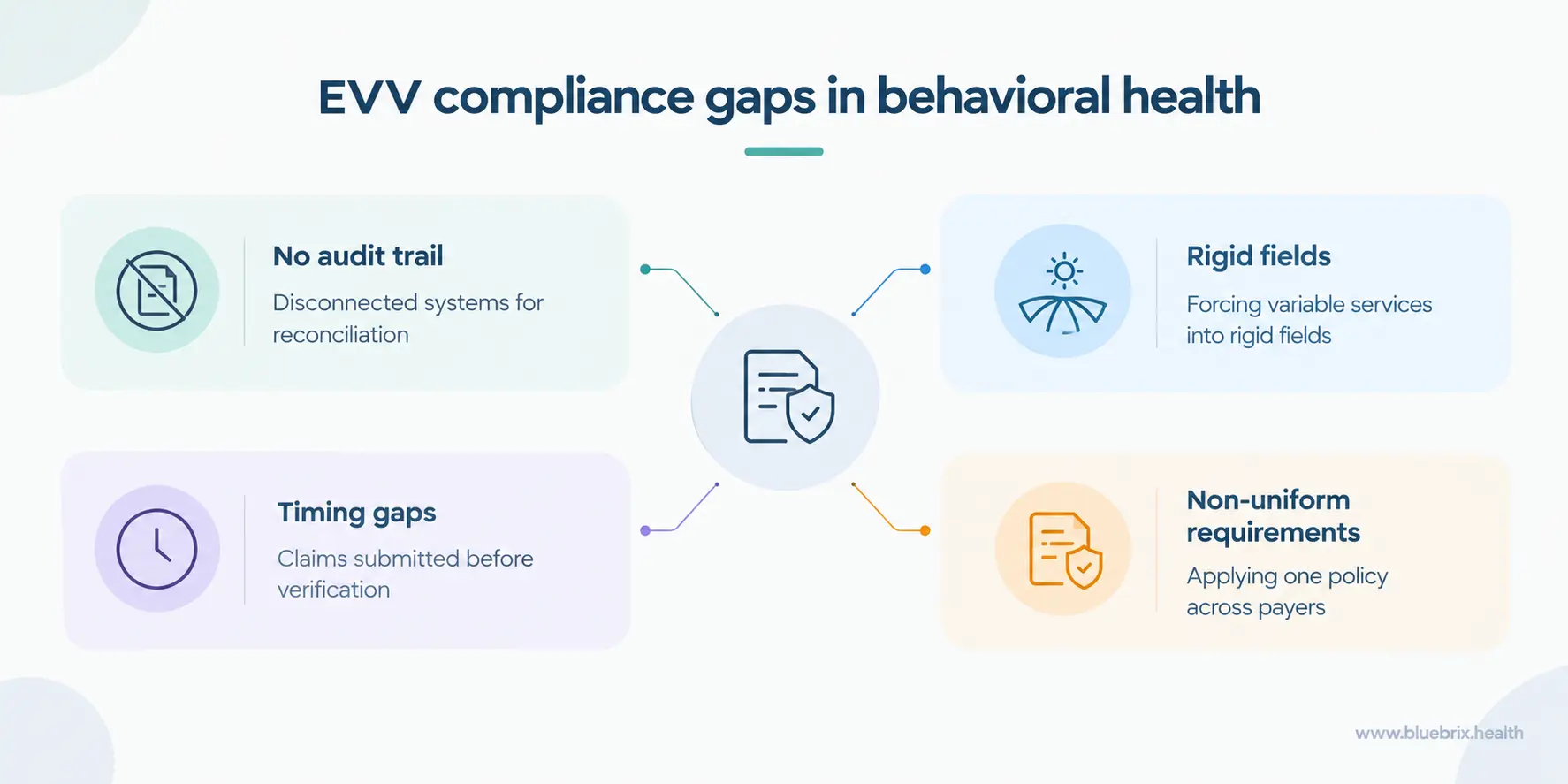
Across the examples above, a handful of failure patterns show up repeatedly, and most are fixable well before your state moves to hard edits.
Treating EVV scope as static
Compliance teams that mapped their in-scope services once, at initial rollout, and haven’t revisited the list since are the most likely to be caught off guard. Illinois adding new populations and Missouri phasing in Department of Mental Health, Division of Developmental Disabilities provider types on a delayed timeline are ongoing processes, not one-time launches. Your scope determination needs a recurring review, not a one-time checklist.
Assuming EVV requirements are uniform across the waivers you operate under
A single IDD organization often holds multiple waiver authorities, a Home and Community-Based Services, or HCBS, waiver for adults, a different one for children, and state plan personal care, and each can carry a different EVV posture, a different vendor requirement, and a different compliance threshold. Applying one policy across all of them tends to under-comply somewhere.
Timing gaps between service delivery and visit verification
Missouri’s own soft-launch findings point to claims submitted before the EVV vendor transmits the visit, or visits sitting in an unverified status when the claim goes out. This is a timing and system-integration issue: staff are delivering and recording care correctly, but the data isn’t reaching the state’s aggregator, or reaching a verified status, before billing happens.
Forcing variable-location or group services into rigid location and time fields
A crisis intervention, a community-based session, or group attendance can all produce a legitimate location or duration exception, but many organizations don’t flag it as one. Some record an inaccurate fixed location to avoid triggering a flag, which creates its own compliance exposure. Others accept a high exception rate that draws audit attention on its own.
No clean audit trail connecting the clinical record, the EVV record, and the claim
When these three live in disconnected systems, reconciling a denial or responding to an audit request becomes a manual, multi-system exercise, exactly when your team has the least time to spend on it.
These gaps aren’t exotic. They’re mostly workflow and timing issues hiding behind what looks like a documentation problem, which raises the practical question every compliance and finance leader eventually asks: what do you actually do about it?
How behavioral health and IDD organizations are getting ahead of EVV compliance
Given where enforcement is heading, an approach that treats EVV as a documentation add-on isn’t going to hold up. A few practical shifts make a meaningful difference.
Start with a current, service-by-service scope determination for every state and waiver authority you operate under, not a single organization-wide answer. Document which services are in scope, which are explicitly excluded (as Illinois has done with CILA and Community Day Service programs), and which sit in a gray area where state guidance hasn’t caught up to your service model. That gray-area list deserves a direct conversation with your state Medicaid agency or managed care contact. An internal assumption isn’t enough to settle it.
Second, look at where the actual failure points sit in your current workflow. Most of the compliance gaps described above trace back to a timing or system-integration problem, not a clinical documentation problem. If your EVV data lives in one system, your clinical documentation in another, and your billing in a third, every handoff between them is a place a visit can fail to verify before a claim goes out.
This is where the underlying electronic health record, or EHR, foundation matters. A behavioral health EHR with billing built in as a native module, not bolted on through a separate revenue cycle management, or RCM, vendor, gives compliance and finance teams a single, connected record of the encounter, the documentation supporting it, and the claim generated from it. The blueBriX platform is configured to support behavioral health and IDD organizations as a combined EHR and RCM system, with configurable encounter and documentation structures designed to adapt to variable-location and group-based service delivery without locking every service type into one rigid template. Exactly where your state’s EVV aggregator or your existing EVV vendor should sit in that workflow is worth mapping out specifically with your compliance and IT teams, since the right integration point is what closes the timing gaps that turn accurate documentation into a denied claim.
What getting ahead of EVV compliance actually looks like
If EVV-related claim denials have become a recurring conversation on your team, it’s worth walking through your current documentation-to-billing workflow with someone who understands both the behavioral health and IDD service model and the compliance requirements layered on top of it.
Schedule a demoThe questions worth asking your EHR or EVV vendor before your state’s next deadline
A short list of direct questions will tell you more about a system than a vendor’s feature list. That applies to your current setup and to any new one you’re sizing up, and it matters most right before a renewal or an RFP.
- How does the system handle visits with variable or community-based locations, and what does an exception look like when the location doesn’t match a fixed address?
- Can the system accommodate group-based service delivery and non-standard visit durations without forcing a workaround?
- What is the actual data path between a completed encounter, EVV verification status, and claim submission, and where are the points where a claim could go out before verification completes?
- How does the system flag a visit that hasn’t reached verified status in the state’s aggregator before a claim is generated?
- If your state changes its EVV scope, adds a service type, or moves to hard edits, how much configuration work is required to adapt, and who does that work?
- Can compliance and finance both see the same audit trail, from clinical documentation through EVV status to claim outcome, without exporting data across systems?
Any vendor conversation that can’t answer these clearly, or that answers them only in terms of a future roadmap, deserves a harder look before you commit. Get straight answers to those six, and you’ll know more about how a vendor holds up under pressure than any product demo will tell you.
The last piece worth understanding is where all of this is heading, because EVV enforcement isn’t standing still.
Where EVV enforcement is headed next for behavioral health and IDD providers
A few developments are worth watching over the next year. States that have moved to hard-edit enforcement for personal care and home health are, based on the pattern in Missouri and elsewhere, phasing that same enforcement toward IDD-specific provider types next. Few states, on that trajectory, appear likely to stop at the federal floor. State audit findings, like New York’s, also tend to accelerate stricter oversight elsewhere as other state Medicaid agencies and auditors take notice.
Based on current CMS and state enforcement trends, EVV requirements are unlikely to loosen or become simpler for behavioral health and IDD providers anytime soon. The direction is toward more service types in scope, more automated enforcement, and less tolerance for the workarounds that got organizations through the early years of the mandate. Building a compliance approach now that treats your EVV scope as something you revisit regularly, and that connects your clinical, compliance, and billing data, so they don’t sit in separate systems, puts you ahead of where enforcement is headed. That beats finding out after a claim denies.