
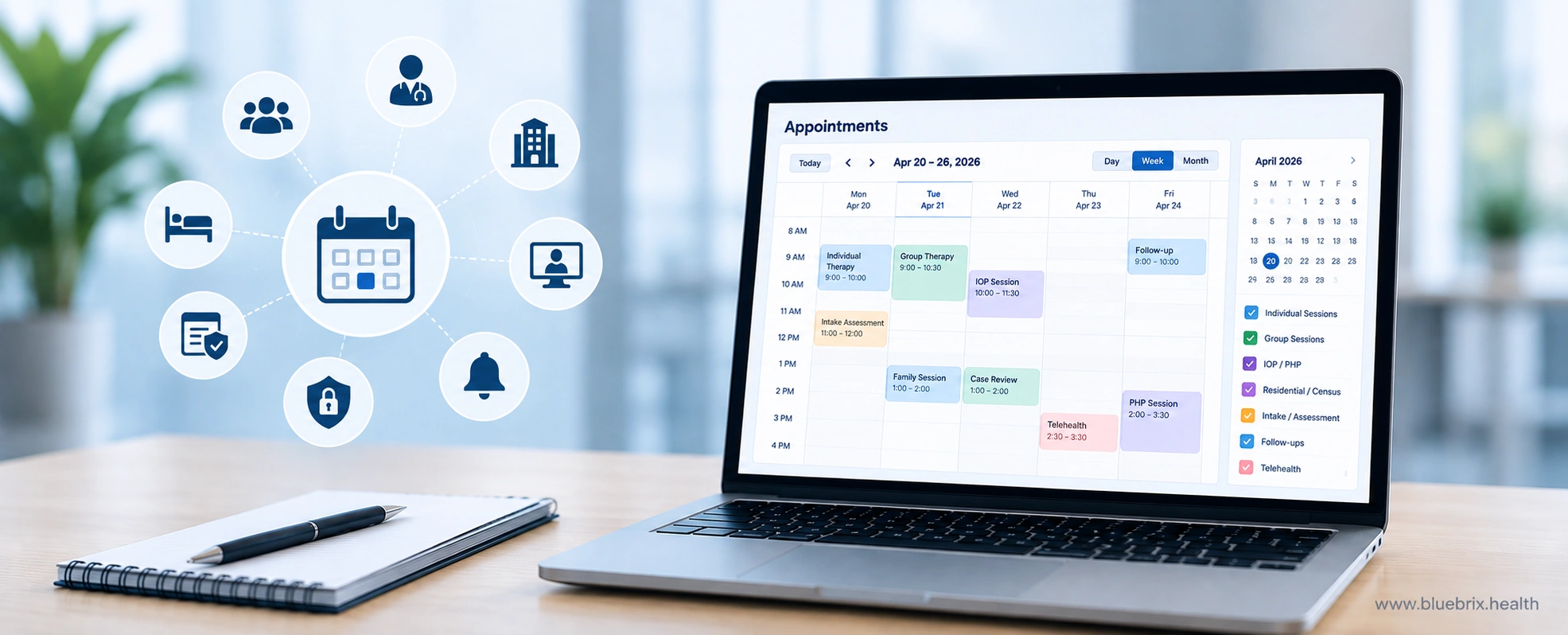
Behavioral health appointment scheduling software is a category of clinical operations technology that manages appointment booking, provider coordination, session planning, and patient engagement workflows specifically for mental health, substance use disorder, and related behavioral health programs. Unlike general medical scheduling, these systems are designed to handle the operational complexity of group therapy sessions, recurring treatment schedules across multiple levels of care, multi-provider and multi-site coordination, census and bed management in residential settings, and patient communication that complies with federal confidentiality requirements including 42 CFR Part 2.
The operational cost of scheduling dysfunction in behavioral health is well documented. The operational cost of scheduling dysfunction in behavioral health is well documented. No-show rates in outpatient behavioral health can range from roughly 13%–17% [1], while outpatient substance use disorder programs report no-show rates around 12%–14% in one study—and substantially higher dropout rates of 20%–50% [2]. An MGMA Stat poll from August 2026 found that 32% of medical groups reported rising no-show rates [3], and behavioral health consistently sits at the high end of that distribution. Each missed appointment is not only lost revenue — in behavioral health, it is a disruption to treatment continuity that can affect clinical outcomes.
The eight solutions evaluated below were selected specifically because they serve mid-to-large behavioral health organizations with scheduling complexity that extends beyond simple calendar management. None are general-purpose schedulers retrofitted for healthcare.
Top 8 behavioral health appointment scheduling software: a detailed comparison
| Product | Best suited for | Key scheduling strength | Key consideration |
|---|---|---|---|
| blueBriX | CCBHCs, CMHCs, PRTFs, multi-location BH enterprises, IDD and SUD providers | Multi-facility call center scheduling; adaptive scheduling for structured care (individual, group, telehealth); live waitlist; third-party calendar sync; digital intake | Configurable across organization types from community behavioral health to residential treatment, with scheduling rules that adapt to program-level requirements |
| Qualifacts (CareLogic / InSync) | Enterprise CMHCs, CCBHCs, multi-state agencies, SUD and IDD providers | Client self-scheduling portal; automated reminders; enterprise multi-site calendar management; integrated intake workflows | Three separate EHR architectures (CareLogic, Credible, InSync) with different scheduling interfaces; implementation timelines of 9–18 months for enterprise |
| Netsmart (myAvatar) | Large state-funded CMHCs, public sector BH agencies, multi-site enterprises | Enterprise-scale scheduling across 500K+ users in all 50 states; multi-program calendar coordination; integrated with Bells Virtual Scribe documentation | Capterra rating of 2.3/5 [4] reflects a complex interface; steep learning curve and significant implementation investment |
| NextGen Healthcare | Integrated care orgs (BH + primary care + oral health), CCBHCs, residential, IDD | Unified scheduling across behavioral health, primary care, and oral health; mobile field scheduling for community-based teams | Feature density may exceed what specialized BH-only organizations need; G2 rating of 3.7/5 [5], lower than BH-native competitors |
| Core Solutions (Cx360) | Mid-to-large BH, SUD, and IDD providers; community-based care organizations | Criteria-based appointment scheduling; workflow-driven call center management; configurable scheduling rules per program type | Limited public review data on G2/Capterra for scheduling-specific evaluation; enterprise implementation requires dedicated configuration effort |
| Valant | Mid-to-large outpatient BH; psychiatry, therapy, IOP/PHP programs | Group therapy scheduling; recurring individual and group appointment management; patient portal self-booking; outcome measurement tied to session data | Capterra reviews note occasional scheduling bugs after system updates; platform reliability concerns flagged by some users [6] |
| AdvancedMD | Multi-location BH practices; practices needing strong patient engagement workflows | Automated patient journey from self-scheduling through kiosk check-in; next-day eligibility auto-verification; SMS/email reminders with confirm/cancel; group-level coding (July 2026 release) | Not behavioral health-exclusive — built for multi-specialty use; lacks 42 CFR Part 2-specific architecture |
| Alleva | Residential treatment centers; PHP/IOP programs; SUD and addiction treatment facilities | Census and bed management tied to scheduling; group therapy rosters; level-of-care transition scheduling; admissions-to-discharge workflow integration | Focused on treatment center operations — may lack depth for outpatient-only or community BH organizations; some users report template customization challenges |
1. blueBriX
blueBriX behavioral health EHR provides scheduling as a core capability within its EHR, designed around the operational reality that scheduling in behavioral health cannot be separated from clinical workflows, eligibility verification, and billing. The scheduling module supports organizations ranging from community mental health centers to multi-facility residential treatment programs, with configuration that adapts to how each organization actually operates.
Key scheduling features:
- Multi-facility and call center scheduling: A centralized dashboard enables staff to manage appointments across multiple locations, with call center workflows that route scheduling through a single coordination point — critical for organizations managing referral intake across sites.
- Adaptive scheduling for structured care: Scheduling rules can be configured by provider specialty, patient needs, and treatment program. Individual sessions, group therapy, and telehealth appointments are managed from a single calendar, with session planning optimized for both individual and group formats.
- Third-party calendar integration and website booking: Patients can schedule appointments online, and provider schedules sync with external calendars (Google, Outlook) for real-time availability management without double-entry.
- Automated reminders and digital intake: SMS, email, and voice reminders reduce no-shows, while secure digital intake forms eliminate pre-visit paperwork — both feeding directly into the patient record without manual data transfer.
- Live waitlist management: Open slots from cancellations are filled through a live waitlist, protecting billable hours that would otherwise be lost.
- Patient engagement integration: Scheduling connects directly to the patient portal, enabling self-service booking, appointment confirmations, and text-based engagement for notifications — simplifying communication without requiring a portal login.
- Program-level scheduling rules: Hard stop settings can be configured to prevent scheduling when a patient does not meet program enrollment criteria, enforcing program integrity at the point of booking.
Best suited for:
- Multi-location behavioral health enterprises requiring centralized scheduling across sites and programs.
- CCBHCs and CMHCs managing multiple service lines (outpatient, crisis, SUD, care coordination) under one scheduling infrastructure.
- Psychiatric residential treatment facilities (PRTFs) needing scheduling tied to treatment program rules, milieu therapy coordination, and multi-disciplinary team availability.
- IDD and SUD providers requiring configurable scheduling workflows that reflect program-specific requirements.
- Organizations transitioning from fragmented systems (separate scheduler, EHR, and billing) to a unified workflow.
2. Qualifacts (CareLogic / InSync)
The scheduling capabilities of Qualifacts sit within the CareLogic (enterprise) and InSync (small-to-mid) EHR architectures, offering appointment management integrated with clinical documentation, intake workflows, and billing.
Key scheduling features:
- Client self-scheduling portal: Clients can book appointments through a secure portal, reducing phone-based scheduling burden on front desk staff.
- Automated form assignment and reminders: Intake forms are assigned automatically at the point of scheduling, and automated reminders reduce missed appointments via text and email.
- Enterprise multi-site calendar management: CareLogic supports multi-location and multi-state scheduling with centralized visibility across programs and providers.
- Integrated intake-to-scheduling workflow: Scheduling connects directly to clinical intake, documentation, and billing, ensuring that the appointment record flows through to the service note and the claim without re-entry.
- E-signature collection at scheduling: Consent and intake forms can be completed and signed electronically before the first appointment.
Best suited for:
- Enterprise community mental health centers and CCBHCs with complex program structures across multiple sites.
- Multi-state agencies needing centralized scheduling visibility with state-specific compliance workflows.
- SUD and IDD providers requiring integrated ASAM assessment, MAT support, and EPCS/PDMP compliance tied to scheduled appointments.
Note: Qualifacts operates three separate EHR architectures — CareLogic, Credible, and InSync — each with its own scheduling interface and implementation path. Organizations should evaluate which architecture matches their scale, and should plan for implementation timelines of 9–18 months at the enterprise level. Some user reviews note that advancing integrations or feature enhancements comes at significant additional cost.
3. Netsmart (myAvatar)
Netsmart’s myAvatar is the most widely deployed behavioral health EHR in the United States, serving over 500,000 users across all 50 states. Its scheduling capabilities are embedded within an enterprise clinical and administrative infrastructure designed for large, state-funded community mental health systems and public sector behavioral health agencies.
Key scheduling features:
- Enterprise-scale appointment management: Scheduling across large multi-site organizations with centralized calendar visibility, supporting programs that span outpatient, residential, crisis, and community-based care.
- Multi-program calendar coordination: Scheduling workflows are designed for organizations running multiple concurrent service lines under a single operational umbrella.
- Integrated with AI documentation: Scheduling connects to the Bells Virtual Scribe, allowing session documentation to begin from the scheduled appointment context with AI-assisted note generation using the GIRPP template.
- Patient portal access: 24/7 portal access for appointment management, secure messaging, and engagement.
- Comprehensive compliance and reporting: Scheduling data feeds directly into value-based care reporting, CCBHC quality measure tracking, and state-level reporting requirements.
Best suited for:
- Large, state-funded CMHCs and public sector behavioral health agencies managing high patient volumes across multiple sites.
- Health homes, ACOs, and organizations delivering integrated behavioral health and social services.
- Multi-site enterprises that require scheduling infrastructure capable of scaling to hundreds of providers across geographically dispersed locations.
Note: Netsmart’s enterprise capabilities come with a corresponding learning curve. The platform carries a Capterra rating of 2.3/5, with user feedback consistently citing a complex interface and steep onboarding requirements. Implementation cost and timeline reflect the platform’s enterprise scope — this is not a rapid-deployment option.
4. NextGen Healthcare
NextGen Healthcare’s Behavioral Health Suite is distinctive for its ability to unify behavioral health, primary care, oral health, addiction treatment, and human services scheduling within a single system. For organizations delivering integrated care across multiple disciplines, this eliminates the need for separate scheduling platforms for each care type.
Key scheduling features:
- Unified cross-discipline scheduling: A single scheduling interface manages behavioral health, primary care, oral health, and human services appointments — the only platform in this comparison offering this breadth natively.
- Mobile field scheduling: Clinicians and direct support professionals can view, update, and manage schedules from mobile devices, supporting community-based and field-based care delivery.
- Ambient documentation integration: NextGen Ambient Assist connects to scheduled appointments, enabling hands-free documentation that begins from the session context without manual note initiation.
- Configurable reporting tied to scheduling: Scheduling data feeds into compliance reporting for UDS, CMS, PQRS, MIPS/MACRA, and value-based payment models.
- Residential and eMAR support: Scheduling for residential settings includes shift notes, electronic medication administration records, and discharge management tied to the care schedule.
Best suited for:
- Integrated care organizations that deliver behavioral health alongside primary care, oral health, or human services and need a single scheduling system across all disciplines.
- CCBHCs with co-located or integrated primary care programs.
- Residential treatment centers and IDD providers requiring eMAR and shift-based scheduling.
- Mobile and community-based care teams that need field-accessible scheduling.
Note: NextGen’s breadth of integrated capabilities means the feature set is substantial. Specialized behavioral health-only organizations may find the system includes more than they need, with some capabilities going unused. The G2 rating of 3.7/5 is lower than BH-native competitors, reflecting this trade-off between breadth and focused simplicity.
5. Core Solutions (Cx360)
Core Solutions’ Cx360 is a behavioral health and IDD-focused EHR with over 25 years of development history, serving over 500,000 lives. The platform’s scheduling capabilities are built around criteria-based logic and call center workflows, reflecting its enterprise community behavioral health roots.
Key scheduling features:
- Criteria-based appointment scheduling: Scheduling rules can be configured based on clinical criteria, program requirements, and provider qualifications — matching the right patient to the right provider and session type at the point of booking.
- Workflow-driven call center management: Scheduling workflows are designed for centralized call center operations, supporting organizations that manage intake and appointment coordination through a single point of contact.
- Configurable scheduling by program type: Scheduling rules adapt to the specific requirements of mental health, SUD, and IDD programs, each of which operates under different session structures and documentation requirements.
- Integrated client portal scheduling: Clients can request or manage appointments through a secure portal, with scheduling connected to clinical documentation, billing, and care coordination.
- AI-informed scheduling (Cx360 Intelligence): The recently launched Cx360 Intelligence layer brings AI-assisted workflow support that can inform scheduling decisions based on clinical context and resource availability.
Best suited for:
- Mid-to-large community behavioral health organizations managing multiple program types (mental health, SUD, IDD) under a single system.
- Organizations with centralized intake operations that route scheduling through a call center model.
- Providers focused on measurement-based care who need scheduling data connected to outcome tracking and clinical decision support.
Note: As an enterprise SaaS with extensive configurability, Cx360 requires dedicated implementation effort. Limited public review data on G2 and Capterra makes independent scheduling-specific evaluation difficult — organizations should request reference calls with current clients running similar scheduling workflows.
6. Valant
Valant is a behavioral health-exclusive EHR and practice management system designed for outpatient practices, with recent expansion into IOP and PHP program support. Its scheduling capabilities are closely tied to its clinical documentation and outcome measurement tools, creating a workflow where each scheduled session connects directly to the clinical record.
Key scheduling features:
- Group therapy scheduling: Dedicated group scheduling module that manages session rosters, attendance, and documentation for group therapy sessions.
- Recurring appointment management: Individual and group appointments can be set as recurring, with the ability to edit individual instances without disrupting the series — important for long-term treatment plans.
- Patient portal self-booking: Clients can view availability and book or manage appointments through the Valant patient portal.
- Outcome measurement tied to sessions: Scheduling connects to integrated outcome measures (PHQ-9, GAD-7, PCL-5), enabling measurement-based care workflows where assessment administration is triggered by the scheduled session.
- Multi-provider calendar management: Scheduling supports multiple providers with individual availability rules, enabling efficient coordination across larger outpatient teams.
- Eligibility checking and utilization review: Insurance eligibility can be verified in the context of scheduling, and utilization review tools support authorization tracking for IOP/PHP programs.
Best suited for:
- Mid-to-large outpatient behavioral health practices, particularly psychiatry clinics and therapy practices with multiple providers.
- IOP and PHP programs that need group scheduling, attendance tracking, and per-session documentation tied to the calendar.
- Practices prioritizing measurement-based care workflows where outcome data is collected systematically at each scheduled session.
Note: Valant carries a Capterra appointment scheduling feature rating of 4.7/5 from 72 reviewers, while the overall product rating is 4.1/5 across 333 verified users. However, some users report occasional scheduling bugs following system updates, and reliability concerns have been flagged in individual reviews. Organizations should evaluate current platform stability during the demo process.
7. AdvancedMD
AdvancedMD is a multi-specialty practice management and EHR system with behavioral health as one of several supported specialties. Its scheduling capabilities are built around an automated patient journey — from self-scheduling through kiosk check-in to post-visit billing — with strong patient engagement features that reduce front-desk administrative burden.
Key scheduling features:
- Automated patient journey: An integrated workflow automates the path from self-scheduling (online or in-office) through reminders, digital check-in, eligibility verification, and intake form collection — all feeding into the patient chart without manual data transfer.
- Next-day eligibility auto-verification: The system automatically runs insurance eligibility checks for the next day’s scheduled patients and alerts staff to potential coverage issues before the visit.
- SMS/email reminders with confirm/cancel: Patients receive automated reminders and can confirm or cancel via text or email, with cancellations updating the calendar in real time.
- Patient kiosk app: iOS and Android kiosk apps allow patients to check in, update demographics, and complete consent forms from a tablet in the waiting area.
- Group-level coding (2026 release): A July 2026 feature release introduced group-level CPT and ICD-10 coding, allowing codes to be assigned once per group session and applied to every participant — reducing per-patient billing setup for group therapy.
- Multi-location scheduling: Supports scheduling across multiple offices with provider-specific availability rules and location-based calendar views.
Best suited for:
- Multi-location behavioral health practices that also deliver primary care, psychiatric services, or other specialties and need a single scheduling system across disciplines.
- Practices prioritizing digital patient engagement workflows — self-scheduling, kiosk check-in, automated reminders, portal access.
- Organizations that need strong revenue cycle management integration with scheduling, particularly for commercial payer billing.
Note: AdvancedMD is not behavioral health-exclusive — it is a multi-specialty system with behavioral health templates and workflows. This means it handles BH scheduling competently but does not offer BH-specific architectural features like native 42 CFR Part 2 compliance, CCBHC quality measure integration, or ASAM-linked scheduling workflows.
8. Alleva
Alleva is a behavioral health operations system built specifically for treatment centers operating across the residential, PHP, IOP, and outpatient continuum. Its scheduling capabilities are tightly integrated with admissions, census management, and clinical documentation — reflecting a workflow where scheduling in residential and structured day-treatment settings is inseparable from bed management and program operations.
Key scheduling features:
- Census and bed management tied to scheduling: Scheduling connects directly to facility census, enabling real-time visibility into bed availability, patient placement, and capacity across residential programs.
- Group therapy rosters and day-treatment scheduling: Dedicated support for the roster-based scheduling that PHP and IOP programs require, where daily group sessions, psychoeducation blocks, and individual sessions must be coordinated across clinical teams.
- Level-of-care transition scheduling: Scheduling workflows support step-down transitions (residential to PHP, PHP to IOP, IOP to outpatient), with documentation and billing updating to reflect the new level of care.
- Admissions-to-discharge workflow integration: Scheduling is embedded within the full admissions-to-discharge arc — from prospect management and intake through treatment planning, session scheduling, and discharge planning.
- AI-assisted session documentation (Echo): Alleva’s ambient AI scribe, Echo, captures session content during scheduled appointments and generates structured, audit-ready notes in real time, supporting DAP, SOAP, and utilization review formats.
- Google Calendar integration: Provider schedules sync with Google Calendar for external availability management.
Best suited for:
- Residential treatment centers (SUD, mental health) that need scheduling tied to census, bed management, and shift-based clinical operations.
- PHP and IOP programs requiring roster-driven group scheduling with attendance tracking that flows directly into billing.
- Multi-level-of-care organizations managing step-down transitions where the scheduling system must reflect changes in program enrollment, provider assignment, and billing level.
Note: Alleva’s strength is treatment center operations — admissions, residential, PHP, IOP, and the transitions between them. Organizations operating exclusively in outpatient or community behavioral health settings (CMHCs, CCBHCs, outpatient-only group practices) may find the platform’s scheduling architecture oriented toward a treatment center workflow that does not match their operational model. Some users have reported challenges with template customization and module interaction.
Evaluation criteria
The above comparison evaluates scheduling capabilities specifically — not overall EHR functionality, clinical documentation depth, or billing features, except where those capabilities directly intersect with scheduling workflows. Eight vendors were selected based on four criteria:
(1) the product must serve mid-to-large behavioral health organizations with multi-provider, multi-program, or multi-site scheduling needs;
(2) scheduling must be a core, integrated capability within the product — not a third-party add-on or marketplace integration;
(3) the vendor must have a publicly documented track record serving behavioral health as a primary or named specialty vertical, with verifiable client references or published case studies; and
(4) product information must be publicly available in sufficient detail to evaluate scheduling-specific features without relying solely on vendor sales claims.
Solo-practice tools (such as those designed primarily for individual therapists or small group practices) were excluded because their scheduling architecture does not address the multi-program, multi-site, and census-level coordination complexity that defines scheduling in mid-to-large behavioral health organizations. General-purpose scheduling platforms without a documented behavioral health vertical were also excluded.
Vendor ratings referenced in individual evaluations are sourced from G2 and Capterra as of September 2026 and reflect aggregate user reviews, not editorial scoring by blueBriX.
Why behavioral health appointment scheduling is different from general practice scheduling
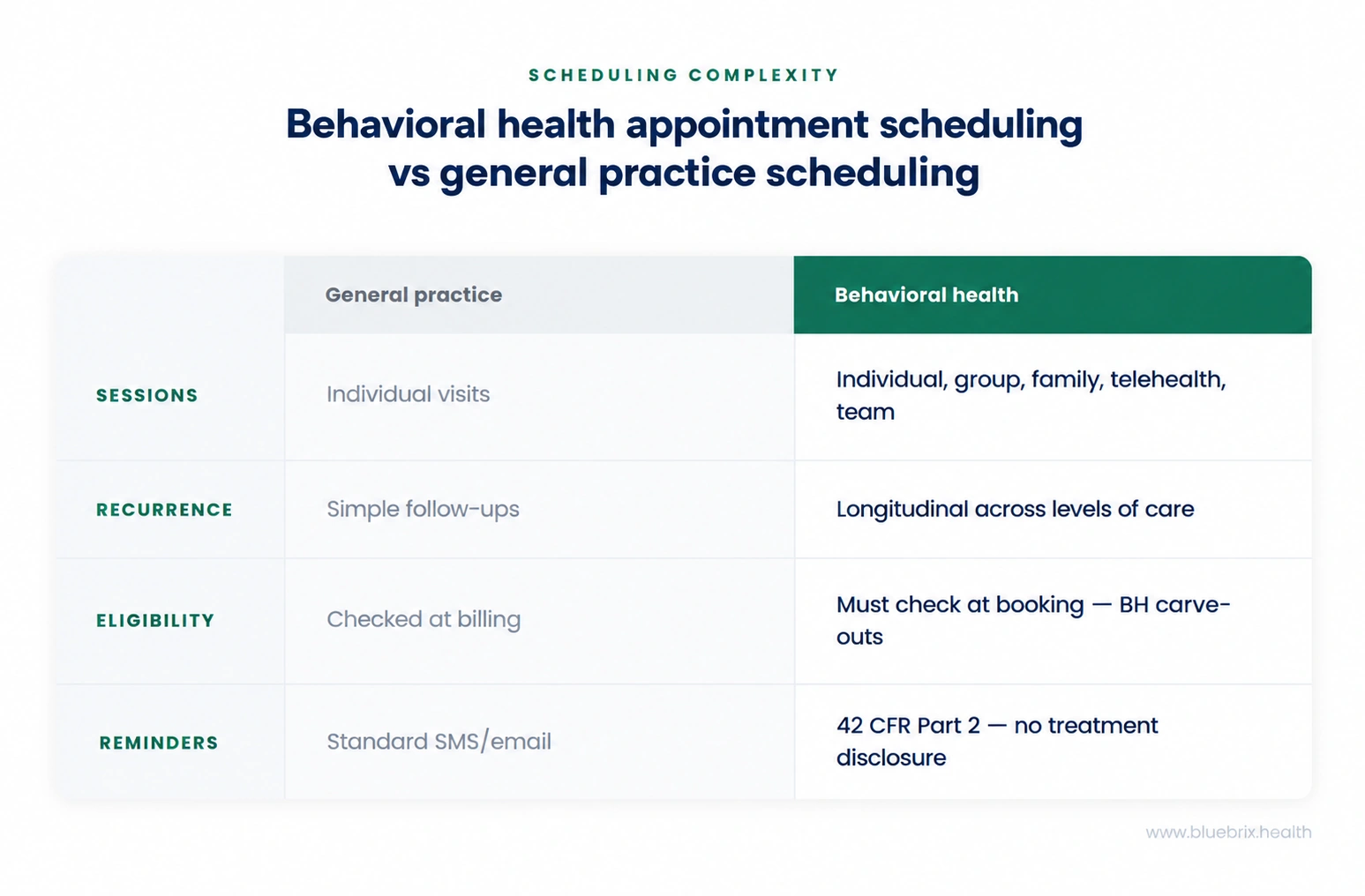
The most frequent mistake behavioral health organizations make when evaluating scheduling tools is assuming that scheduling is a solved problem that any HIPAA-compliant calendar with reminders will suffice. It will not. Behavioral health scheduling operates under five constraints that general practice scheduling does not.
Group therapy and program-level scheduling complexity.
A psychiatry practice scheduling individual 50-minute sessions has a calendar problem. A CCBHC scheduling individual therapy, group therapy, psychiatric evaluations, crisis intervention, care coordination meetings, and psycho-education sessions across multiple clinicians, rooms, and programs has an operational coordination problem. PHP programs typically operate 4–6 hours per day to meet the 20-hour weekly minimum required for billing [7]. Falling short on any given day can mean the day is not billable. A scheduling tool that cannot enforce program-level time rules creates billing risk every day it operates.
Recurring sessions across levels of care.
Behavioral health treatment relationships are longitudinal. A patient in an outpatient therapy program may have a recurring weekly session for months or years. A patient stepping down from residential to PHP to IOP needs their schedule to reflect each transition — different session types, different frequencies, different providers, different billing codes — without requiring manual reconstruction of the calendar at each step.
Eligibility verification at the point of scheduling.
In behavioral health, insurance coverage verification is not a billing-office-only task. It belongs at the point of scheduling. Behavioral health services are frequently carved out to separate entities (Optum Behavioral Health, Carelon, etc.), and submitting claims to the wrong entity is a common, avoidable denial cause. A scheduling system that verifies coverage before the appointment is booked — and alerts staff to carve-out routing — prevents denials that a post-visit check cannot.
No-show dynamics unique to behavioral health.
No-show rates in outpatient behavioral health run 20–30%, with SUD programs reaching 30–50% in some settings. The drivers are different from general medical no-shows: stigma, motivation fluctuation, crisis episodes, co-occurring conditions, and transportation barriers all play a role. Automated reminders reduce no-shows, but the type of reminder matters. A text message that says “Reminder: your appointment at [Behavioral Health Clinic Name] is tomorrow” may disclose the nature of treatment to anyone who sees the patient’s phone — a potential violation of 42 CFR Part 2 confidentiality requirements for SUD treatment records and a trust-damaging disclosure for any behavioral health patient. Scheduling tools must support configurable reminder content that complies with these constraints.
Multi-site coordination.
A behavioral health enterprise operating across five locations with 40 providers cannot manage scheduling in five separate calendars. Centralized scheduling dashboards, call center routing, cross-site provider visibility, and resource allocation (rooms, telehealth slots, specialized equipment) must operate from a single view.
What to look for when evaluating behavioral health appointment scheduling software
If your organization is evaluating appointment scheduling tools as a standalone decision or as part of an EHR evaluation, these are the questions that separate solutions built for behavioral health operations from those that merely offer a calendar with reminders.
EHR integration vs. standalone.
Does the scheduling tool connect to clinical documentation and billing, or does it operate as an isolated calendar? In behavioral health, a scheduled appointment should flow into a progress note, a treatment plan update, a billing charge, and a compliance report without re-entry. Standalone schedulers that require staff to manually bridge the gap between the calendar and the EHR create data silos, are associated with higher error rates, and may add administrative time per appointment.
42 CFR Part 2-compliant patient communication.
If your organization treats patients with substance use disorders, every automated reminder, confirmation message, and patient-facing communication must comply with Part 2 confidentiality requirements. The scheduling tool must allow customization of message content, sender identification, and communication channel to prevent inadvertent disclosure of SUD treatment status.
Note: The 2024 HHS final rule modifying 42 CFR Part 2 (effective for compliance by April 2026) aligned several Part 2 provisions with HIPAA while maintaining stricter protections for SUD records, including consent requirements for most disclosures.
Group, individual, and telehealth in one view.
Behavioral health organizations rarely offer only one session type. The scheduling system must handle individual sessions, group therapy (with roster management and attendance tracking), telehealth sessions (with integrated video launch), and multi-disciplinary team meetings from a single calendar interface — not separate modules that require switching between views.
Real-time eligibility at booking.
Coverage verification should run at the point of scheduling, not the day before the appointment. This is especially critical for Medicaid managed care and behavioral health carve-out arrangements where coverage details change frequently and where routing the claim to the wrong entity creates avoidable denials.
Scalability.
A scheduling system that works for 5 providers at one location must work for 50 providers across five locations without architectural changes. Evaluate whether the system supports centralized multi-site scheduling, call center workflows, role-based calendar access, and resource allocation across locations.
Ready to see how blueBriX scheduling works for your organization?
Whether you are evaluating your first behavioral health EHR or looking to replace a scheduling workflow that is not keeping up with your program complexity, see how blueBriX scheduling adapts to your operations.
Schedule a demo