Behavioral health EHR migrations carry higher privacy and continuity stakes
A general EHR migration typically focuses on demographics, medications, diagnoses, encounters, clinical notes, integrations, and user access. Behavioral health organizations have another layer to protect: the context that determines how sensitive information is accessed, shared, documented, and used.
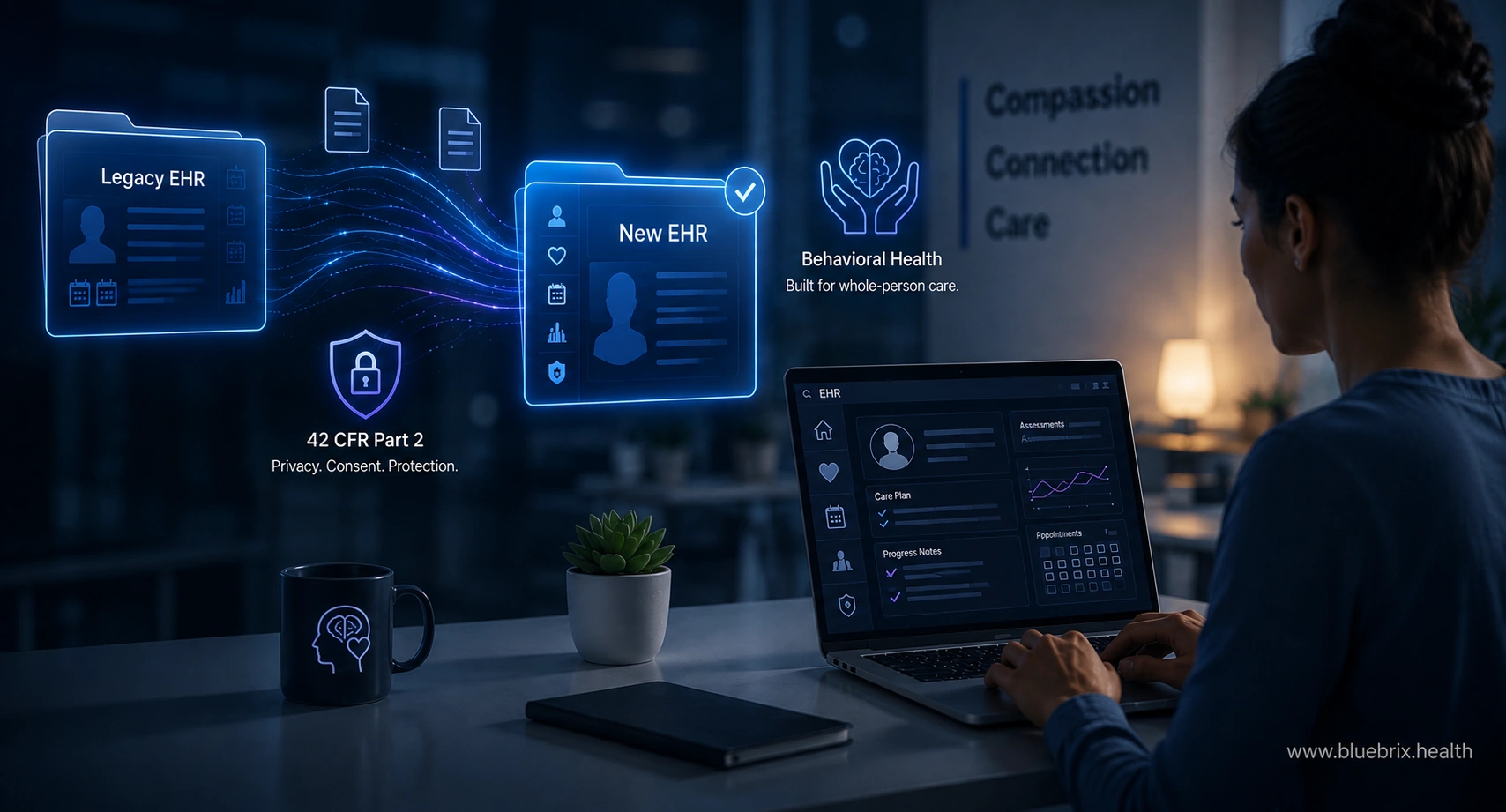
42 CFR Part 2 is the clearest example. Part 2 protects qualifying substance use disorder records and continues to impose specific rules on how that information can be used and disclosed. Current federal policy has moved Part 2 closer to HIPAA in several areas, but behavioral health organizations still need reliable consent management and technical controls around sensitive information.
ASTP/ONC specifically identifies consent management and data segmentation approaches[1] as important to electronic behavioral health information exchange because privacy and confidentiality concerns can limit how behavioral health data moves between organizations.
The gap is well documented. ONC’s analysis of SAMHSA’s 2024 National Substance Use and Mental Health Services Survey found that most substance use and mental health treatment facilities were either unfamiliar with health information exchanges (HIEs) or unaware that one was available in their area.[2] Adoption and exchange capabilities also varied significantly by ownership type. Any migration that fails to account for these realities, assuming standard interoperability tools will move behavioral health data as seamlessly as general medical records, risks carrying the same information-sharing gaps into the new system.
That becomes a migration problem when data changes systems.
A clinical note may transfer correctly while the information needed to apply the organization’s privacy rules does not. Consent history may be stored differently. Access roles may not map cleanly. Sensitive information may lose the metadata or workflow context that previously controlled how staff used it.
The same issue applies to treatment continuity. Behavioral health records are deeply longitudinal. Current treatment plans, assessments, PHQ-9 and GAD-7 trends, group documentation, medication history, safety-related information, authorizations, and review dates all have relationships that matter after the move.
Billing continuity is equally important. Medicaid and managed care workflows can involve payer-specific eligibility, authorization, coding, and claim requirements. CCBHCs also have to preserve the operational data supporting their state’s prospective payment methodology. CMS currently recognizes multiple CCBHC PPS[3] approaches, including daily and monthly methodologies with different payment and quality structures.
For an IT director, this is a data integrity and integration problem. For a COO, it is a care and revenue continuity problem. A successful behavioral health migration has to solve both.
The real cost of not switching can exceed the temporary cost of migration
Migration risk feels large because it is concentrated around a defined project. The cost of staying with a failing EHR is easier to tolerate because it arrives in smaller amounts every day.
Clinicians document around inefficient templates. Billing teams manually fix data that should flow automatically. IT maintains fragile interfaces. Operations builds spreadsheets to compensate for missing workflows. Compliance teams add manual checks when the system cannot enforce the process reliably.
Those workarounds become part of normal operating expense.
Recent peer-reviewed research continues to link EHR usability issues and poor workflow alignment to greater documentation and cognitive burden. A 2025 scoping review in the Journal of Evaluation in Clinical Practice found that poorly designed interfaces and misaligned workflows contribute to task-switching, fragmented information, and workarounds that lengthen documentation time.[4] Similarly, a November 2024 Health Affairs study found that every additional hour physicians spent on documentation was associated with a 7.1% reduction in the likelihood of viewing an outside patient record through health information exchange[5] — suggesting that documentation demands can directly displace other high-value uses of the EHR.
The more useful exercise for a behavioral health organization is to quantify its own cost of staying:
| Current-system problem | How to calculate the exposure |
|---|---|
| Documentation burden | Extra minutes per encounter × monthly encounters × loaded clinician labor cost |
| Billing rework | Extra minutes per encounter × monthly encounters × loaded clinician labor cost |
| Preventable denials | EHR-related denials × average net reimbursement at risk |
| Interface instability | Monthly interface incidents × average resolution hours × IT labor cost |
| Manual reporting | Staff hours spent rebuilding Medicaid, CCBHC, or quality reports each month |
| Compliance remediation | Consent, access, or documentation exceptions requiring manual review |
| Productivity loss | Visits or other billable activity constrained by inefficient workflows |
This creates a more useful comparison than “migration is expensive.”
The executive question is whether the organization wants to pay a temporary, controlled migration cost or continue paying recurring operational debt to preserve the current system.
A phased migration keeps clinical, technical, and revenue risk under control
The safest migration plan is built around validation gates rather than a single go-live date.
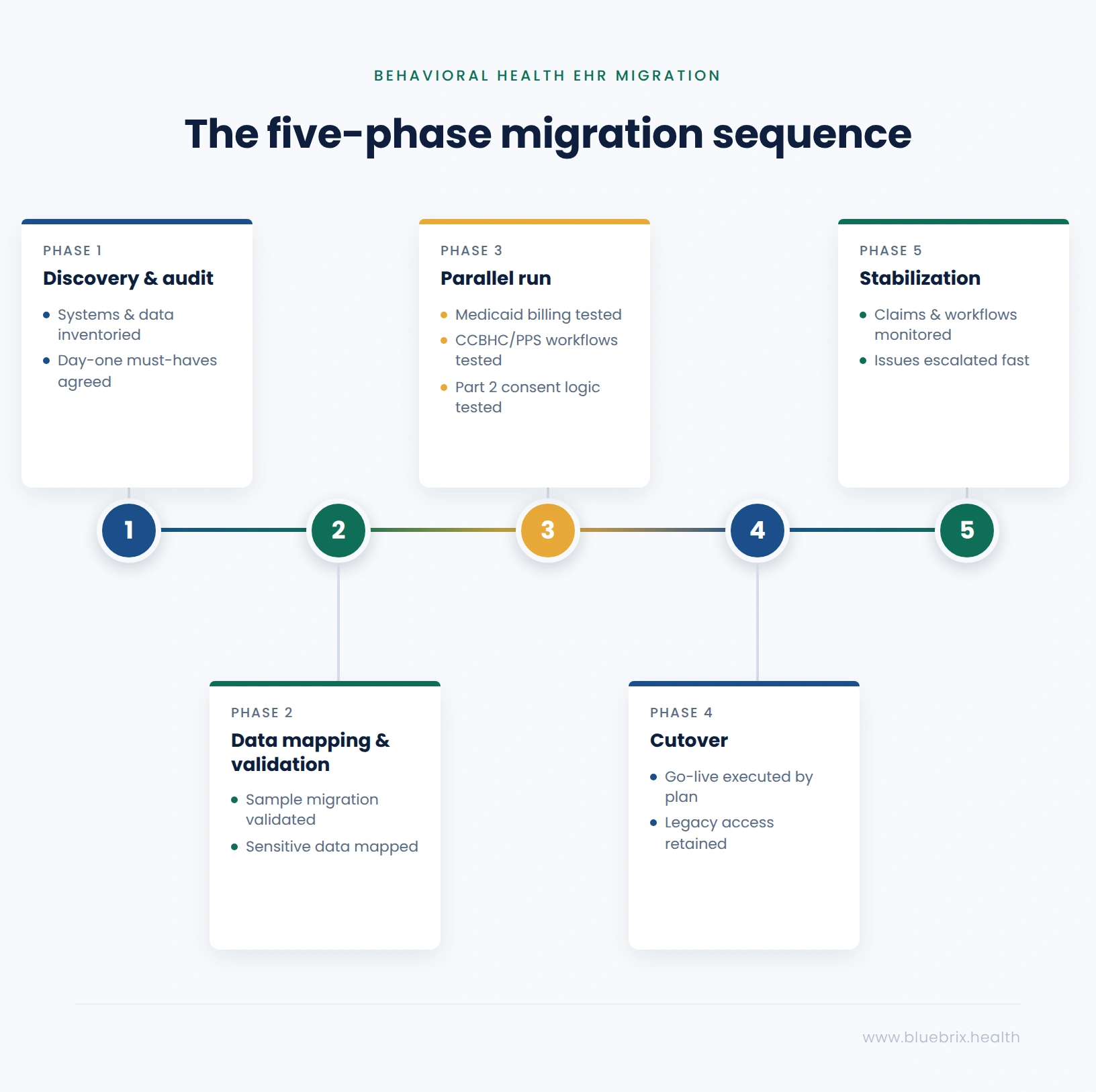
Phase 1: Discovery and audit
Start by documenting what exists today.
Inventory patient data, clinical templates, treatment plans, consent workflows, user roles, payer rules, reports, lab and pharmacy connections, clearinghouse interfaces, APIs, patient engagement tools, analytics systems, and any custom scripts or external databases.
This phase should also identify what should not be reproduced. If clinicians are already using manual workarounds or billing staff are fixing recurring system defects, moving those problems into a new EHR defeats the purpose of switching.
Clinical, IT, compliance, operations, and revenue cycle leaders should agree on what must function on day one.
Phase 2: Data mapping and validation
Map the source data to the new environment and identify where translation is required.
High-priority behavioral health data should include current treatment plans, diagnoses, medications, assessments, consent information, sensitive SUD information, active authorizations, payer data, outcomes, upcoming appointments, and other information needed for ongoing treatment.
Historical information can then be classified according to whether it must remain structured, searchable, or available through an archive.
Do sample migrations before moving the full population.
Clinicians should validate clinical records. Compliance staff should validate consent and privacy behavior. Billing staff should verify payer, authorization, coding, and claim information. IT should reconcile record counts and interface behavior.
Phase 3: Parallel run
A parallel run reveals problems before they reach production.
Test actual workflows across both environments:
- New patient intake
- Individual and group documentation
- Treatment-plan creation and review
- Medication management
- Consent changes
- Eligibility verification
- Prior authorization
- Claim generation
- Claim submission
- Remittance posting
- CCBHC/PPS workflows
- External data exchange
Integration errors should be tracked by severity and owner. Revenue-cycle testing should follow representative claims through the expected workflow rather than stopping after claim creation.
The new environment should demonstrate that critical workflows work under realistic conditions before cutover is approved.
Phase 4: Cutover
The cutover plan should define exactly when production activity moves and who owns every high-risk dependency.
That includes the final data load, user provisioning, security validation, interface activation, clearinghouse connectivity, payer checks, clinical escalation, and legacy access.
Read-only access to the former EHR may remain necessary for historical information that is retained rather than fully reconstructed.
A contingency plan should also define what happens if a critical interface or workflow fails during the cutover window.
Phase 5: Post-go-live stabilization
Go-live is followed by stabilization.
For the first several weeks, leadership should monitor:
- Interface failures
- Note completion
- Consent and access issues
- Authorization workflows
- Claim acceptance
- Rejections and denials
- Payment posting
- CCBHC/PPS workflows
- Help-desk volume
- Staff workarounds
Issues affecting patient safety, privacy, or revenue should have a rapid escalation path. Lower-priority optimization can follow after the environment is stable.
Know your migration risk before you commit
Thinking about switching but unsure how much migration risk is hiding in your current environment? A blueBriX migration readiness assessment can map your data, interfaces, workflows, payer dependencies, and operational risks before you commit to a cutover plan.
Schedule a demoData migration succeeds only when the information still works after the move
ASTP/ONC’s Electronic Health Information export requirements illustrate why the distinction matters. Certified health IT can support EHI exports in documented formats, and standardized APIs provide another route for structured interoperability. Export capability alone does not guarantee that local workflows, custom fields, relationships, privacy context, or business rules will reconstruct correctly in another product.
FHIR-based exchange helps reduce ambiguity for standardized health data because resources have defined structures and relationships. Legacy flat-file exports can also move significant amounts of information, but they typically require more mapping to preserve terminology, status values, relationships, timestamps, and provenance.
Neither approach eliminates validation.
Focus on, “What will that data still be able to do when it arrives?” instead of “How much data can the vendor move?”
For behavioral health, migration data should be divided into four groups.
- Operational data required on day one: active medications, diagnoses, allergies, treatment plans, payer information, consent status, active authorizations, schedules, and other data needed for immediate care.
- Historical data that must remain clinically usable: prior notes, assessments, outcomes, treatment plans, referral history, discharge information, and other longitudinal records.
- Sensitive information requiring privacy controls: Part 2-related information, consent history, access permissions, audit information, and other data needed to maintain the organization’s privacy processes.
- Information that can remain archived: historical configuration or older material that must be retained but does not need to drive the current workflow.
- Validation then needs three levels: record completeness, field-level accuracy, and workflow usability.
Staff adoption works when training follows the migration
Training should begin before the new EHR is finished.
During discovery, clinical and billing power users should identify the workflows that create the most friction today. That allows the migration team to distinguish between workflows worth preserving and habits created by limitations in the old system.
During data validation, clinicians should review migrated treatment plans, assessments, medication information, notes, and patient histories. Billing staff should validate payer information, authorizations, coding behavior, and claim data.
During the parallel run, training should become role-specific.
A therapist should document the encounters they actually perform. A utilization review specialist should complete a real authorization workflow. Billing staff should create, scrub, submit, and correct test claims. A CCBHC team should verify the data capture and billing process associated with its applicable PPS methodology.
Before cutover, each role needs a concise go-live playbook covering what changes, what stays the same, where to get help, and which problems require immediate escalation.
Training success should be measured after go-live through behavior, not attendance.
If clinicians are taking longer to complete notes, billing exceptions are increasing, or staff immediately recreate old spreadsheets, those signals should feed back into workflow optimization.
Behavioral health EHR vendors should be evaluated on migration evidence, not feature lists
Decision-stage evaluation should focus on whether the vendor can prove that it can protect the workflows at risk during migration.
Behavioral health EHR migration checklist
- Open interoperability: Does the platform support standards-based APIs and existing HL7/FHIR integrations without requiring a custom connector for every system?
- Data portability: Will the vendor document migration formats, mapping, reconciliation, archival strategy, and your future exit path?
- Part 2 and consent management: Can the platform preserve the consent, access, disclosure, and audit workflows used for sensitive SUD information?
- Behavioral health clinical workflows: Can treatment plans, assessments, group documentation, outcomes, and recurring reviews move without being flattened into generic medical forms?
- Medicaid and MCO billing logic: Can payer-specific eligibility, authorization, coding, claims, and remittance workflows continue through migration?
- CCBHC/PPS readiness: Can the system maintain the clinical, encounter, quality, and billing information required for your state’s CCBHC model?
- Parallel testing: Will the vendor support converted-data testing, interface testing, and representative clinical and billing workflows before cutover?
- Integration monitoring: Can IT identify interface failures and message errors before they become clinical or revenue problems?
- Role-based training: Does implementation cover the actual work performed by clinicians, billing staff, compliance, and administrators?
- Post-go-live accountability: Who owns migration defects after launch, and what escalation standards apply?
Ask the vendor to demonstrate these capabilities. For a more detailed view of the migration process, use this behavioral health billing system migration checklist to evaluate data, integrations, billing, testing, and post-go-live readiness. A roadmap is not evidence that the workflow will be ready when your organization needs it.
blueBriX keeps behavioral health migration focused on continuity
blueBriX uses a FHIR R5-native architecture and open APIs, giving integration teams a standards-based foundation for connecting the new EHR with systems that are staying in place.
That matters because a migration should reduce integration debt rather than replace one closed dependency with another.
Behavioral health clinical and financial workflows also remain connected inside the blueBriX environment. Treatment planning, behavioral health documentation, SUD workflows, scheduling, patient engagement, care coordination, payer processes, and revenue cycle functions can move into the same operating environment without requiring a series of bolt-on products to recreate core workflows.
Part 2-sensitive information and consent workflows are included in migration planning rather than handled as a final compliance exercise.
Revenue continuity receives the same attention. Medicaid and managed care configuration, authorization workflows, claim validation, denial routing, payment posting, and A/R activity can be tested before the old system is retired. For CCBHC organizations, the migration can also validate the clinical, encounter, quality, and billing data required to continue the organization’s applicable PPS workflow.
Organizations evaluating the clinical platform can explore the blueBriX behavioral health EHR, while teams assessing billing continuity can review blueBriX revenue cycle management alongside the migration plan.