
Why compliance reporting breaks in multi-program organizations
Compliance reporting breaks when the same event means different things in different programs. Your residential program may log a restraint on one form. Your outpatient clinic may capture a crisis in a progress note. Your foster care team may record a placement disruption somewhere else entirely.
Each program built its documentation around its own license, and that made sense at the time. The trouble starts when a regulator, payer, or accreditor asks a question that cuts across programs. Someone then has to pull records from several places, translate each program’s terms, and reconcile the gaps before the deadline.
That work grows with every program you add. It also tends to fall on a small quality or compliance team that doesn’t own the forms where the data is first captured.
Three patterns show up again and again:
- Different definitions. Programs use different terms, categories, and severity levels for the same kind of event.
- Missing timestamps. Notes record what happened but not when staff learned of it or when each notification went out, which is what most reporting clocks measure.
- Free text where structure is needed. Key facts sit inside narrative notes, so every report means reading and retyping.
These gaps would be easier to live with if regulators gave you time to work around them. They don’t. Every rule in the next section runs on a short clock, and several start from the moment staff learn of an event, which is the timestamp programs most often fail to record.
What are the incident reporting requirements for behavioral health providers?
Regulators set short, fixed reporting clocks, and those clocks keep getting shorter. Here is what applies to PRTFs federally, and what two large states, Pennsylvania and New York, ask of behavioral health providers.
Federal rules for PRTFs
If you run a psychiatric residential treatment facility (PRTF), federal rules require you to report every serious occurrence.[1] A serious occurrence is a resident’s death, a serious injury, or a suicide attempt.
You must report each one to two places by close of business on the next business day:
- Your state Medicaid agency
- Your state’s Protection and Advocacy (P&A) organization, an independent group that protects the rights of people with disabilities, unless your state’s law prohibits this report
The same rules also require you to:
- For a minor, the facility must notify parents or legal guardians as soon as possible, and no later than 24 hours after the serious occurrence.
- A resident’s death must also be reported to the CMS regional office by close of business the next business day.
- Staff must document in the resident’s record that each report was made.
- Facilities must attest to their compliance with Subpart G.
Pennsylvania: proposed Chapter 5330
Pennsylvania has proposed Chapter 5330, a new set of licensing standards for PRTFs (Regulation #14-555, IRRC #3417). The proposal would require PRTFs to report all incidents to the Department, and to parents, legal guardians, and caregivers, within 12 hours after the PRTF learns of the incident.[2] It also adds reportable and recordable incidents beyond those in the current Chapter 3800 rules, and it permits only manual restraint.
As of November 2026, the rule is still at the proposed stage. The IRRC lists its final-form deadline as December 2, 2026, and shows no final-form regulation received yet.[3] Once the final rule is published, currently licensed RTFs would have 12 months to obtain a new license under Chapter 5330.[4]
New York: OMH and OASAS
New York splits incident reporting by licensing agency, so a provider with both mental health and addiction programs follows two sets of rules.
- OMH (14 NYCRR Part 524). Mental health providers must notify OMH immediately, within 24 hours of occurrence or discovery, whichever comes first.[5] Incidents are entered in the New York State Incident Management and Reporting System (NIMRS), and OMH’s workflow calls for closing the investigation within 45 days of the incident’s creation.
- OASAS (14 NYCRR Part 836). Addiction service providers need written policies for responding to, reporting, and evaluating incidents, plus an incident review committee.[6] Significant incidents go to the Justice Center, and providers must also keep internal records of all incidents.[7]
What every compliance reporting rule has in common
Every one of these rules asks for the same core facts: what happened, to whom, when staff learned of it, who was notified and when, and what you did next. The deadlines and recipients differ, but the underlying data is the same. If you capture those facts once, in a consistent structure, you can answer any of these rules from one set of records.
Reporting across several programs and licenses?
Talk to blueBriX about mapping your compliance reporting requirements to the data your teams already capture.
Book a demoEHR optimization or replacement: what fixes compliance reporting first
Optimize first. For most multi-program organizations, the fastest fix for compliance reporting is to get more out of the EHR they already have, because a new EHR inherits whatever definitions you bring to it. If three programs mean three different things by “incident,” a migration moves that mismatch into the new system. The reconciliation work continues, now inside a project that also has to train staff and convert historical data.
Replacement can still be the right call. It is worth considering when your current system:
- Can’t add the required fields or pick lists your reporting rules depend on
- Can’t get structured data out through reports, exports, or an interface
- Can’t support the forms or reporting a new state rule requires
That decision is easier and less risky once you know exactly what your compliance data has to look like. So the order matters:
- Define the compliance data you need across every program.
- Capture and report it with the systems you have today.
- Decide whether your current EHR can keep up, based on what you learned.
The first two steps pay off whatever you decide in the third.
How to build audit-ready reporting on the EHR you already have
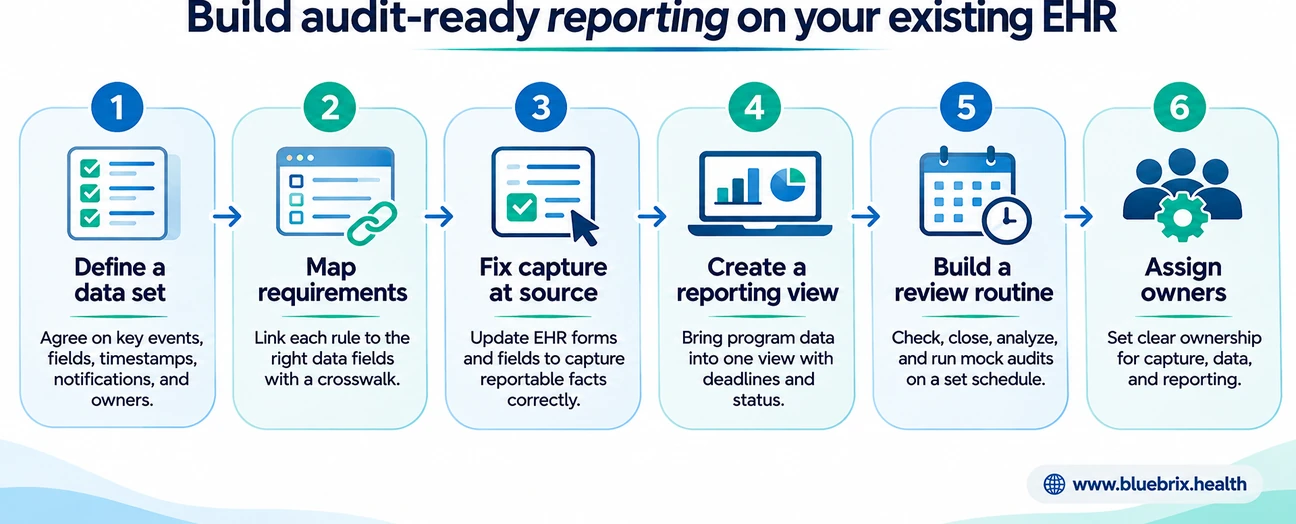
You build audit-ready reporting in six steps, and none of them needs a new system. The work is mostly agreement on definitions, followed by small changes to forms and a steady review routine.
1. Define a common compliance data set
Start with the events every regulator asks about: incidents, serious occurrences, restraints, deaths, and changes to plans of care. For each one, agree across programs on:
- One name and one definition, with the same severity levels everywhere
- The required fields, such as who was involved, where, and what happened
- The timestamps that start each reporting clock, including when the event happened and when staff learned of it
- Who must be notified, and a timestamp for each notification
- Who owns the record from capture to closure
Keep the list short. A data set that covers your most-reported events well is more useful than one that covers everything loosely.
2. Map every requirement to that data set once
Build a crosswalk. List each federal, state, payer, and accreditation requirement, then point it at the fields in your data set that answer it. When a rule changes, as Pennsylvania’s PRTF rules are expected to, you update one row of the crosswalk instead of retraining every program.
3. Fix capture at the source
Most EHRs let you adjust forms, templates, and required fields. Use that to make the data set part of daily documentation:
- Make the fields that drive reporting clocks required
- Use pick lists for event types and severity in place of free text
- Add the same incident template to every program that can have that event
- Record each notification as a structured entry with its own timestamp
The goal is for frontline staff to capture reportable facts once, in the shift note or incident form they already use.
4. Bring the data into one reporting view
Once programs capture the same fields, you can pull them into a single reporting view. Depending on your EHR, that may mean standard exports, scheduled reports, or an integration through APIs or HL7 and FHIR interfaces. Your compliance team should be able to see every open incident, across every program, with its deadline, in one place.
5. Build review into the week
Audit readiness is a routine. A workable rhythm looks like this:
- Daily: review new incidents and check every reporting clock that is running
- Weekly: close out open notifications and missing fields
- Monthly: look at trends by program, event type, and shift
- Quarterly: run a mock audit, pulling a sample of records the way a regulator would
6. Assign clear owners
Give each part of the process a named owner. Program leaders own capture in their programs. Your quality or compliance lead owns the data set, the crosswalk, and the review routine. IT owns the forms, the extracts, and the reporting view.
Sample compliance crosswalk for behavioral health incident reporting
A crosswalk shows, for every requirement, the deadline, the data that answers it, and who owns it. Here is a starting version built from the rules above. Check each row against current state guidance before you rely on it.
| Requirement | Who gets the report | Deadline | Data you need | Owner |
|---|---|---|---|---|
| Federal PRTF serious occurrence | State Medicaid agency and Protection and Advocacy system | Close of business, next business day | Event type, resident, time of event, time reported, recipients | Compliance lead |
| Federal PRTF parent notification | Parents or legal guardians of a minor | As soon as possible, no later than 24 hours | Guardian contact, time of notification, staff who notified | Program director |
| Federal PRTF resident death | CMS regional office | Close of business, next business day | Time of death, time reported, note in resident record | Compliance lead |
| Pennsylvania PRTF incident (proposed) | Department, and parents, guardians, and caregivers | 12 hours after the PRTF learns of the incident | Time staff learned of it, incident type, notification times | Program director |
| New York OMH incident | OMH, through NIMRS | Within 24 hours of occurrence or discovery | Incident type, time of occurrence or discovery, NIMRS entry | Quality lead |
| New York OASAS incident | Justice Center for significant incidents; internal record for all | Per Part 836 | Incident type, internal record, review committee outcome | Quality lead |
Note: Owners in this table are examples. Assign them to match your own structure.
Where AI fits, with people in charge
AI can take some of the checking work off your compliance team, as long as people stay accountable for every report. Useful, low-risk uses include:
- Flagging incident records with missing required fields or missing notification times
- Alerting staff when a reporting clock is close to running out
- Drafting a first summary of an incident for a reviewer to edit and approve
- Spotting patterns across programs that a monthly review might miss
Keep a person in the loop for every decision about what is reportable and every submission to a regulator. Set governance rules before you start: what data the tool can see, who reviews its output, and how you record that review. These guardrails matter most with behavioral health records, which carry strict privacy protections.
How blueBriX helps you build audit-ready compliance reporting
blueBriX works with multi-program behavioral health organizations to put this approach into practice, starting from the EHR you already use. Every organization’s licenses, programs, and reporting rules are different, so the work starts with yours.
- Starting from your current systems. blueBriX connects to existing systems through standard interfaces, including FHIR, HL7, CSV, and REST APIs, so you don’t have to replace your EHR to get started.
- Reporting built around your rules. The blueBriX team works with your compliance lead to define your compliance data set and map it to the federal, state, and accreditation requirements that apply to you.
- Configured to how your programs work. Forms, required fields, and notification tracking are set up around your programs’ workflows, so staff capture reportable facts once.
- One view of what’s due. The goal is a single place where your compliance team can see open incidents and reporting deadlines across programs.
- Ready as rules change. When a rule like Pennsylvania’s proposed Chapter 5330 is finalized, your crosswalk and reporting can be updated to match.