
New York’s Office of Mental Health (OMH) oversight tends to land one program at a time. A survey cites a program, that program’s leaders work through the findings, and a corrective plan goes back to the Field Office. Inside the organization, the issue usually stays with that one program.
The consequences don’t. Every program’s record counts toward the organization’s standing with OMH, and OMH checks that standing when the organization applies for new funding or a new program. OMH’s proposed replacement for Part 551, published in the State Register on September 16, 2026, goes further. A currently licensed applicant would have to be in good standing, and show it can comply in its existing programs, before OMH approves a new project.[1]
For behavioral health executives and boards in New York, standing takes shape in the record every program produces between surveys, long before the next survey arrives.
Good standing with OMH is a gate for growth
Before OMH funds or certifies a new program, it looks at the provider’s standing, and the bar is set procurement by procurement.
The three conditions behind OMH good standing
If you plan to compete for new programs in New York, your standing with OMH needs to be in order before you apply. In its 2023 procurement for Certified Community Behavioral Health Clinics, OMH made good standing an eligibility requirement.[2] For OMH-licensed programs, it spelled out three conditions: satisfactory compliance with applicable laws, rules, and regulations; an OMH-accepted Performance Improvement Plan; and no active Enhanced Provider Monitoring.
What standing decides before a new program opens
The application isn’t the only checkpoint. In its procurement for Comprehensive Psychiatric Emergency Programs, presented to bidders in January 2024, OMH required applicants to be in good standing at the time of certification approval.[3] There, it defined good standing as an accepted Performance Improvement Plan with no active Enhanced Provider Monitoring. Between them, the two procurements checked standing at two points: the CCBHC procurement at eligibility, before funding is awarded, and the Comprehensive Psychiatric Emergency Programs (CPEP) procurement at certification approval, before a new program opens.
The second check is where you have the most at stake. By then, you may already have committed capital and started recruiting staff, and the program still can’t open unless your standing holds.
It helps to think of standing as credit. You need it in place before you grow, and the track record behind it can’t be built in the weeks before an application. It comes from how your existing programs have been performing all along.
Every program’s record comes up when you apply for the next one
OMH’s Adult Assertive Community Treatment (ACT) procurement released December 11, 2025, for one new team in Rockland County, shows how far an application reaches.[4] Applicants without an existing ACT team had to attach the most recent government-issued monitoring report for every mental health program they operate. Those reports, along with their recertification monitoring reports, were scored under Agency Performance, a 9-point section of the 100-point evaluation. OMH also reserved the right to disqualify any applicant whose conduct as a provider fell short of applicable standards, and to rescind an award already made on the same grounds.
None of those provisions are limited to programs like the one being procured. An organization applying to run an ACT team submits the record of its other programs, and that record is scored alongside the proposal.
OMH’s integrated outpatient services rules apply similar logic to licensing. To be approved for an integrated outpatient services (IOS) license, a provider has to be in good standing at the time of approval, which for OMH-licensed clinic sites means each one holds an operating certificate of a year or longer. One site on a shorter certificate can hold up the application, though OMH’s streamlined IOS guidance describes a waiver request for that requirement.[5]
Across these documents, OMH evaluates the organization through its programs, all of them. The program with the heaviest oversight record travels into the applications that follow, whichever service line the organization is trying to build. For a board, that changes what a problem in one program costs. The price includes the next expansion, wherever that expansion happens to be.
That record builds up in the reporting a compliance team handles every week.
How OMH sees a residential program between surveys
OMH doesn’t wait for the next licensing survey to form a view of a residential program. Its picture of the program keeps building between visits, through channels that stay open all year.
Incidents, investigations, and complaints as review triggers
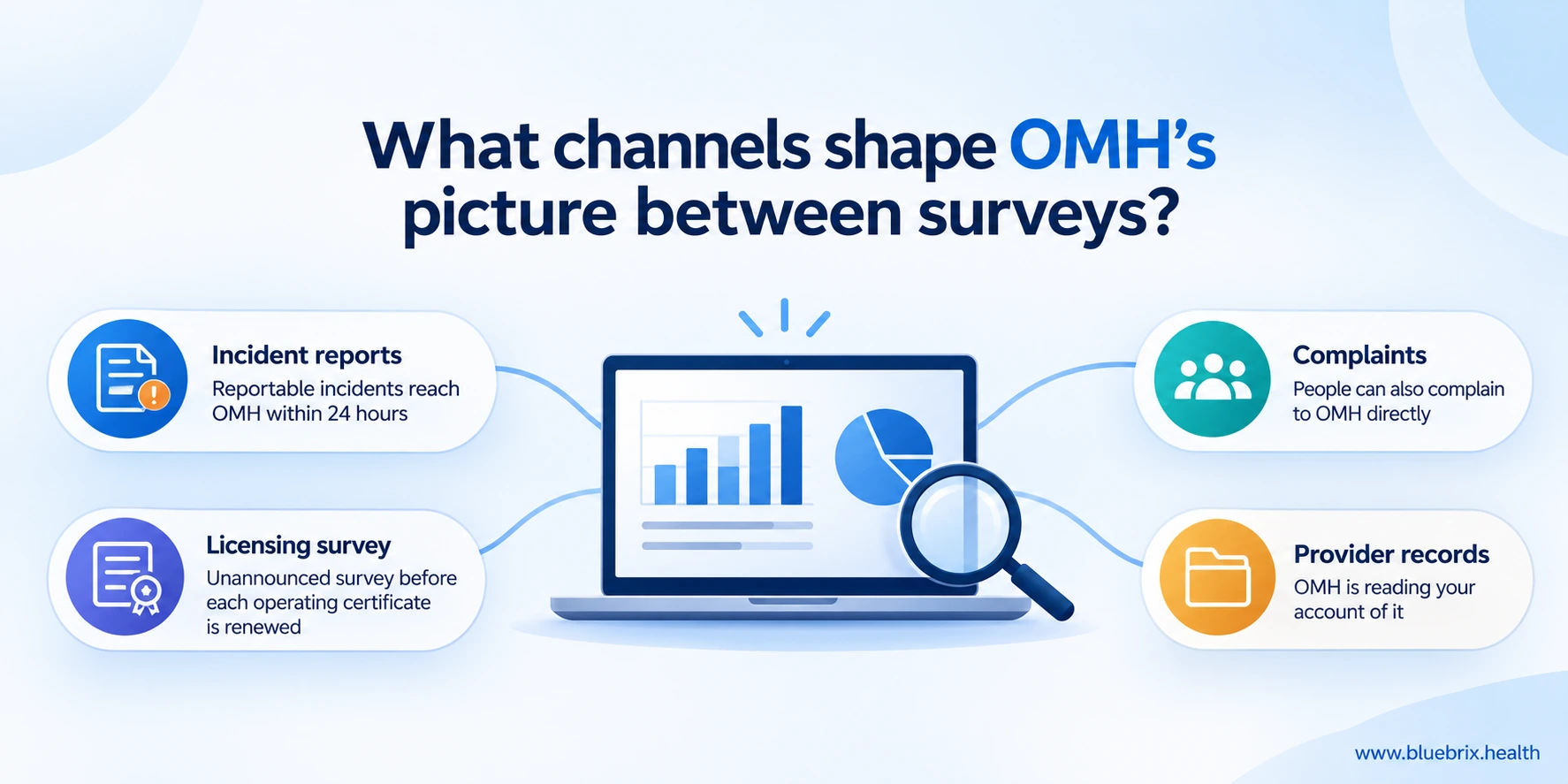
The channels are familiar. Field Office staff run an unannounced licensing survey before each operating certificate is renewed. Under Part 524, reportable incidents reach OMH within 24 hours of discovery, and OMH can investigate any of them.[6] Allegations of abuse or neglect and significant incidents are also reported to the Justice Center’s Vulnerable Persons’ Central Register, and the Justice Center can delegate an investigation to OMH, which can delegate it to the provider. People can also complain to OMH directly, and a Field Office looking into an unresolved complaint can ask you for a corrective plan. What’s worth a closer look is who supplies much of what moves through those channels.
How OMH sees a residential program between surveys?
Apart from the survey, much of it comes from you. Your programs report their own incidents. When OMH delegates an investigation, your team runs it and submits the findings. When a complaint comes in through OMH, your written determination and its supporting documentation go back to OMH staff. The survey is OMH’s own look at the program, on one visit. The rest of the year, OMH is reading your account of it.
Much of that account wasn’t written with OMH in mind. Shift notes are written for the next shift. Staff statements get taken in the middle of a hard night. A complaint determination is written for the person who complained. When these end up in what you submit, OMH reads them as one organization’s record, even though different staff wrote them at different sites without seeing each other’s work.
Read as a set, the record shows things that don’t surface when you close reports one at a time. Comparable events classified differently at two sites make your data look unreliable. Investigations that stop at one staff member’s conduct leave the system around that person unexamined, and when the same kind of event happens again with someone else, the record shows it. Corrective actions are the most exposed. “Staff retrained” closes an incident in March, but it’s also a claim, and a similar incident in May tests that claim in writing.
A program can meet every reporting deadline and still produce a record that reads as unmanaged. Over time, the record as a whole, not just any single report, can shape the regulator’s picture of the program
What an OMH performance improvement plan has to prove
For a cited program, the Performance Improvement Plan is tested twice: once when OMH accepts it, and again in the record that follows.
How an accepted PIP counts toward good standing
You know the mechanics. Deficiencies from recertification land in a Monitoring Outcome Report, and your corrective plan is the Performance Improvement Plan.[7] What’s easier to miss is where the Performance Improvement Plan (PIP) sits in your standing. OMH procurements have defined good standing as an accepted PIP with no active Enhanced Provider Monitoring, so getting your plan accepted counts toward your standing.[8]
The distance between an accepted plan and a correction that holds
OMH’s 2023 definition paired the accepted plan with maintaining satisfactory compliance, and renewal of your operating certificate turns on substantial compliance at the unannounced survey before it.[9] OMH accepts the PIP as a plan. Whether the correction holds shows up afterward, in your program’s record and at the next survey.
That gap is where corrections can slip. A plan written mainly to get accepted can answer each citation with a revised policy, a round of retraining, or a signed attestation. Those close the finding on paper. Whether they change practice depends on whether the plan reached what caused the deficiency, like the staffing pattern behind a supervision lapse or the documentation workflow behind a missing note.
Patient-safety guidance draws the same line. The action hierarchy in the Institute for Healthcare Improvement’s RCA² (Root Cause Analyses and Actions) framework ranks training and new policies as weaker actions, and redesigned processes and systems as stronger ones.[10] A stronger correction changes a process or a system instead of relying on a reminder to the people inside it. It also generates evidence on its own: a measure someone outside the program reviews, which would show a slip before a surveyor or an incident does. Attestation tells OMH what the program did. Evidence shows whether it worked.
A PIP is a route back to standing. What separates a recovery from a repeat finding can show up in your record well before the next survey.
Pattern detection sits on the provider’s side of the table
OMH can investigate any single incident, but the trend across many of them is the provider’s to find. The same goes for complaints.
What Part 524 and OMH’s complaint guidance ask providers to analyze
Part 524 puts the pattern-finding on you. It sets the minimum cuts for incident data: type, patient involvement, location, date and time, and employee involvement. It also treats a review as complete only once you’ve identified improvement opportunities, implemented any needed correction plans, and monitored them for efficacy. OMH’s July 2025 complaint guidance asks you to do the same with aggregate complaint data, looking for systemic trends.[11]
The governing body’s line of sight
Part 524 requires each incident review committee to include members of your governing body. OMH’s complaint guidance says your aggregate complaint analysis should go into the annual report to the governing body, which it holds responsible for the complaint process. In both cases, what your board knows about patterns is largely what your analysis shows it.
That makes the way you cut the data a board matter. A trend cut only by program shows each program its own numbers, and nobody sees the pattern across them. That gap is widest for anything that crosses program lines: float and agency staff, shared supervisors, a policy rolled out everywhere at once. Part 524 lets you organize incident review committees provider-wide, across several programs, or program by program, and that choice decides what the board members on each committee can see. And if complaint data gets counted but never set beside incident data, the same board can end up looking at what seem like two different organizations.
If a pattern first reaches your board through a regulator’s letter or a family’s complaint, the board’s next question is a fair one: why didn’t the analysis it receives show it?
Producing that analysis across many programs depends on systems and staffing that operations leadership controls.
Why multi-program providers can see their own patterns last?
In a multi-program organization, leadership can see a pattern for the first time in a regulator’s request. Effort is rarely a problem. Behavioral health compliance in New York can be staffed and documented program by program, and the evidence for a cross-program pattern may not sit in one place.
Where the evidence sits when OMH asks for it
The record behind a single residential program is already spread out:
- NIMRS (New York State Incident Management and Reporting System) entries and internal incident logs
- Restraint and seclusion documentation inside clinical notes
- Staffing and training records in HR
- Complaint logs
- Committee minutes
Building a Part 524 trend from that means joining them by hand. Incident type and location come from the incident system, patient involvement from the clinical record, employee involvement from schedules and personnel files, and date and time from all of them, often recorded differently in each. Multiply that by every program, and a cross-program trend becomes a project someone starts after the request arrives.
OMH’s December 2025 ACT procurement stated the expectation directly: providers should have the quality, supervisory, operational, and data infrastructure to monitor their own services routinely. The language was written for an ACT team, but in our reading, it’s hard to see that expectation stopping there.
Continuous visibility across programs, in practice
The alternative is less a reporting project than a change in where the record lives. Each incident can be linked to the clinical documentation, staffing, and training data around it, so the Part 524 dimensions are captured when the incident is recorded. The incident file stays separate from the clinical chart, as Part 524 requires, while any clinical impact on the patient is still described in the chart. Trend views can run at two levels: by program for program leadership, and across programs for the compliance team. Committee and board reporting can draw on the same data, so a governing-body member and a program director see the same numbers. Open corrective plans can be tracked as data, each tied to the measure that would show whether it is holding.
The difference is timing. Analysis that depends on a few people reconciling five sources by hand runs when they have time, which often means survey time. Analysis built into the record can run continuously and help leadership see patterns earlier.
Whether that visibility exists is something the CEO and board can test directly.