
Growth feels exciting until manual care coordination starts slowing everything down. More patients come in. More programs are added. Workflows get complicated. And suddenly those old methods you once trusted start falling apart.
Teams are jumping between disconnected EHR screens. Referrals disappear in voicemail. Follow-ups slip through the cracks. Care gaps grow wider, and both outcomes and reimbursement feel the impact.
This is the inflection point: Not “Should we change?” But “What do we change to?”
A modern care coordination platform becomes the engine behind every referral, every update, every alert. It pulls data from every system you already use, highlights which patients need urgent attention, and triggers the right care actions automatically.
- Repetitive work runs in the background.
- Your teams get their time back.
- Patients feel the difference.
Healthcare organizations that reach this moment can clearly see the signs:
- Rising administrative overload
- Higher error rates
- Difficulty engaging high-risk patients consistently
- Increasing pressure from value-based models
Tools built for a smaller program simply can’t handle this phase of growth.
The care coordination platform that is truly built for how you want to scale should have these essentials:
- Smooth integration with the EHRs you already use
- Security and scalability that offer zero worries
- Workflows that make your team say “finally”
- Tools that help stratify patients, measure progress, and keep them engaged
The best solution removes silos entirely. A single, unified view of each patient. A team that feels supported instead of stretched. Better outcomes that are actually measurable. It’s not just evolving your processes. It’s protecting your growth strategy, your compliance posture, and the value your organization delivers.
Once you shift from “if we should” to “which solution fits us best,” you’re already one step ahead of the challenges most growing organizations struggle with. To understand why traditional methods break so quickly, it helps to see how fragmentation silently impacts daily coordination.
The hidden costs of fragmented growth
Picture this: your care team is juggling three different systems just to track one patient’s journey. Data lives in one EHR. Notes are stuck in another. And referrals? They are somewhere inside someone’s paper notebook or a forgotten email thread.
Everything takes longer than it should. Mistakes creep in. The team feels stretched thin. And growth, instead of feeling like progress, starts creating chaos.
Here’s where fragmentation quietly hits hardest:
Too many systems, not enough clarity
When patient information lives across multiple EHRs, spreadsheets, and portals, care teams spend more time chasing data than coordinating care. Productivity drops not because the team lacks skill, but because the information they need isn’t in one place.
Example scenario: A care manager trying to coordinate a follow-up for a diabetic patient has to open one EHR for lab results, another portal for discharge summaries, and a separate messaging inbox where the referral was originally sent. By the time she pieces the story together, the slot she planned to book is gone, and the patient waits another week.
This level of fragmentation slows down every step. Manual data entry becomes a daily bottleneck. Task switching introduces errors. And the only thing that scales reliably is frustration.
Quality drops when data isn’t unified
Without a single coordinated system, programs can’t standardize care pathways or automate quality checks. Reporting becomes slower, audits become stressful, and gaps quietly grow.
What this looks like in real life:
A behavioral health program adds a new screening requirement, but since data is scattered, coordinators submit inconsistent documentation. When the payer requests evidence for outcomes, the team spends days reconstructing patient histories from multiple systems.
What you don’t see is what hurts you most:
- Increased audit risk
- Missed metrics
- Slower improvement cycles
It’s like trying to run a marathon while tied to your old office filing cabinet.
Hiring alone won’t fix manual work
Many organizations assume that growing teams will solve growing workload problems. But when 60 percent of a care manager’s day is spent typing, reconciling, re-checking, and digging for information, adding more people only adds more cost.
Example scenario: Even after hiring three new coordinators, a multi-location clinic still struggles with delayed follow-ups because everyone is manually reconciling data that should already be automated. As volumes grow, so does the backlog. Teams feel busier, but outcomes don’t improve.
Technology, not headcount, is what removes the true barriers. Automating data flows and eliminating duplicate entry frees clinicians to focus on what they were actually hired to do: care for patients.
Growth should amplify impact, not multiply inefficiencies. Which brings us to the next question: What kind of platform can actually scale with growing care teams and programs?
What makes a care coordination platform truly scalable for care teams
Care coordination shouldn’t feel like a daily struggle with technology. A scalable care coordination platform must actually make work easier for the people on the front line. That is why the foundation of modern growth is built on three essential strengths: flexibility, speed, and intelligent support.
These are the practical enablers that help your team do their best work at scale.
A care coordination system that adapts as fast as your programs evolve
Growth often means new care lines, new locations, and new compliance rules. With a modular, API-first design, you can plug in new service lines or devices without tearing down what already works. Teams experience continuity. IT avoids reworking. Every expansion feels smooth instead of disruptive.
Workflows you can shape without IT delays
Care isn’t static, so workflows can’t be either. When platforms let coordinators edit care pathways, documentation, and task routing themselves, scaling becomes simple. Instead of waiting weeks for technical updates, teams adjust pathways for the same day operations shift. Agility becomes your default.
Intelligence that guides better decisions, not more clicks
If your system only reacts to risks, burnout will always be one step behind. Predictive analytics change the game. Teams see who needs help first and why. Routine alerts automate themselves. High-risk patients get care sooner. Preventable events become truly preventable.
Technology shouldn’t just support growth. It should unlock better care. And now that we’ve looked at the pillars behind scalable success, let’s connect that to the real challenges healthcare organizations face when they grow.
The real roadblock: growth without fixing fragmentation
Without solving data silos, every growth plan eventually hits a wall. These breakdowns appear in three major areas that become harder to control as organizations expand.
Data stuck in silos slows down care
When multiple EHRs and third-party systems can’t talk to each other, every referral turns into detective work. Staff spend hours rebuilding the patient’s story. Care decisions wait. That is not sustainable when your patient’s volume doubles. A scalable care coordination platform must unify data, not multiply entry points.
Inflexible workflows break as services expand
Care coordination changes constantly. New quality metrics. New payer rules. New documentation. But many systems lock workflows in place. Even adding one new screening can take weeks. A scalable platform lets teams adjust processes quickly, so growth does not mean operational disruption.
Compliance risk rises with every new location
More teams and more patient types mean more chances for errors. Missing audit trials or outdated privacy safeguards can lead to fines, delays, and reputational damage. If technology does not keep compliance tight while you scale, growth becomes a liability instead of a win.
In short: If fragmentation grows faster than your technology evolves, scalability fails. And that leads every growing organization to the same essential question: What features make a platform truly scale-ready from day one?
The essential features every scalable care coordination platform must have
Once you’re ready to move beyond manual coordination, the next step is choosing a platform that can truly support growth. These are the must-have features that ensure your investment keeps paying off as your programs expand and evolve.
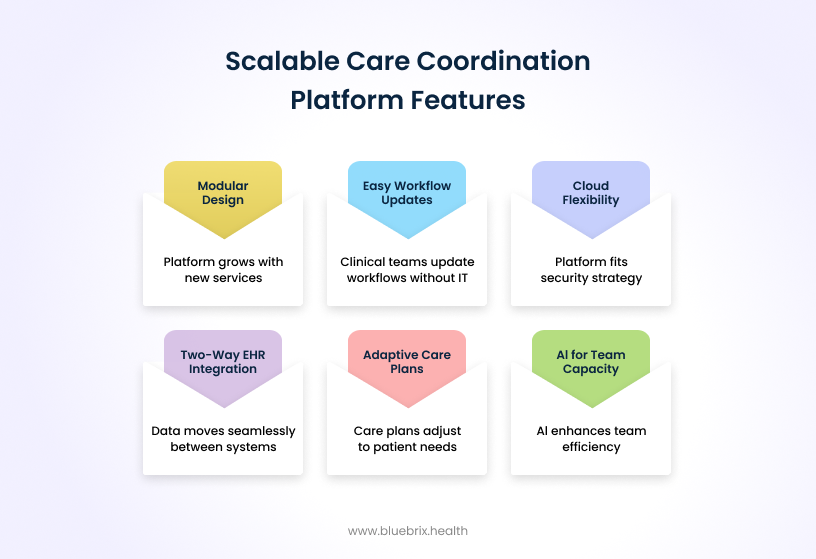
- Modular design that grows with you – You shouldn’t have to replace your entire system just because you added behavioral health or remote patient monitoring. A modular, API-first architecture allows new services, tools, and integrations to plug in quickly without disruption.
- Easy workflow updates without IT help – Scaling care models mean workflows must adapt fast. Low-code or no-code configurability lets clinical teams update routing, documentation, and care pathways themselves instead of waiting for technical tickets to be resolved.
- Cloud flexibility for security and control – Whether your organization uses private, public, or hybrid cloud, the platform should fit your security strategy; not force you into one. This protects long-term investments while keeping compliance strong.
- True two-way integration with EHRs – Data should move seamlessly in both directions. Teams shouldn’t re-enter the same information twice. A scalable solution unifies patient data into one source of truth and keeps every care team aligned in real time.
- Care plans that adapt to patient needs automatically – When vitals spike or risk scores change, care pathways must change too. Dynamic care plans keep interventions proactive instead of reactive, especially critical as patient volume grows.
- AI that expands team capacity – Predictive intelligence helps focus care teams on the patients who need attention first, reducing preventable events and maximizing clinical impact at scale.
A scalable platform removes the barriers, not the people. It gives your teams technology that moves with them, not against them.