
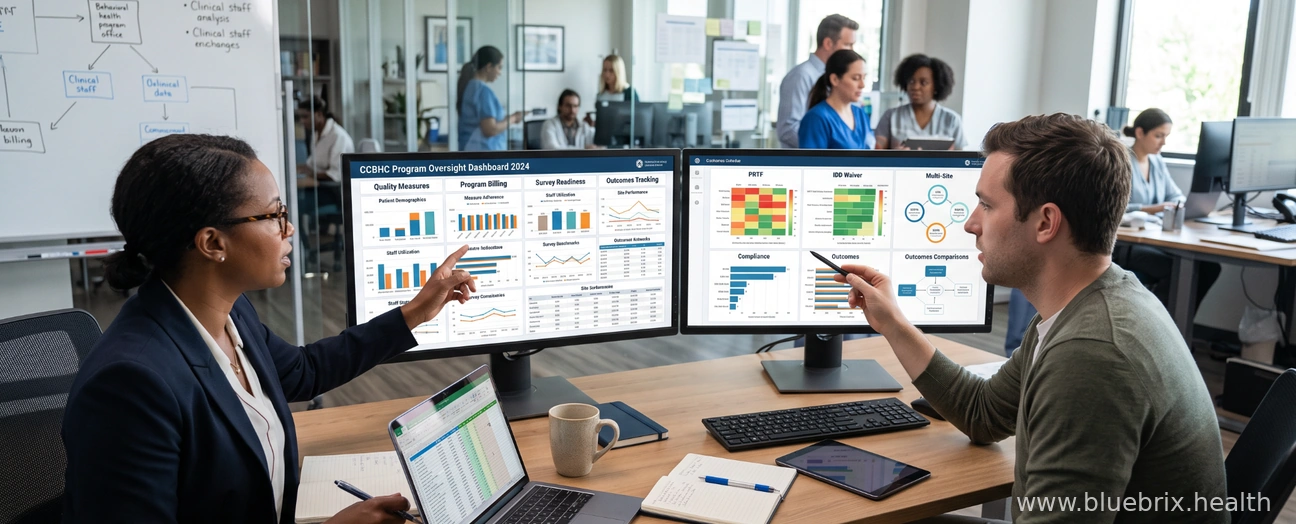
The week before a CCBHC quality measure submission usually looks the same everywhere: someone on the quality team is pulling exports from the EHR, reconciling them against data from a designated collaborating organization that runs on its own schedule, and rebuilding the same spreadsheet they rebuilt last quarter. On the residential side, the same week is a different scramble: reconciling bed logs against per-diem claims, chasing down utilization numbers before a state auditor’s request lands.
In the U.S., behavioral health EHRs vary widely in how deeply they handle quality measure reporting, survey-readiness tracking, program-specific billing, outcomes measurement, and multi-site oversight. Most platforms are stronger at some of those five jobs than others, so the more useful decision at this stage is which combination of jobs your organization needs in one system and which one you can split off to a specialist layer.
This blog unpacks how to test a behavioral health EHR’s reporting against your own recurring reports, where that reporting tends to break after go-live, and how eight platforms compare across five reporting jobs, so compliance officers, quality directors, and operations leaders at certified community behavioral health clinics (CCBHCs), community mental health centers (CMHCs), psychiatric residential treatment facilities (PRTFs), intellectual and developmental disability (IDD) waiver programs, and multi-program agencies can decide which jobs one system needs to carry.
How can you test a vendor’s reporting capabilities against your own reports?
A vendor demo built around their own sample dashboards will always look clean. Test it against your own reports instead, and against your own deadlines.
Pull the ten reports your team actually produces on a recurring basis. For a CCBHC or CMHC, that’s likely your state’s quality measure submission package, QBP-threshold tracking for the measures tied to bonus payment, and CARF or Joint Commission survey-readiness documentation. QBPs are state-designed: CMS requires them in states using a monthly CCBHC PPS rate and leaves them optional in daily-rate states, so confirm whether your state pays them and which measures it uses.[1] For a PRTF, QRTP, group home, or IDD-waiver program, it’s more likely your bed logs and occupancy reports, per-diem or capitated claims generated from those logs, waiver unit caps and utilization alerts, and licensing or facility-survey documentation. Whichever list is yours, require every vendor to build or pull each report live, using your program types and your state’s specific requirements — not a generic dashboard demoed with sample data.
Three questions separate a real capability from a polished demo:
Data freshness behind each dashboard. Real-time, daily batch, or weekly batch produce very different answers depending on what’s riding on the number. For an outpatient program, that’s where a quality measure stands the week before attestation. For a residential program, it’s whether today’s bed log has actually generated today’s claim, or whether occupancy data is a day behind when a surveyor asks for it. Get the specific refresh cycle for each dashboard in writing.
Who builds a new report when requirements change, and how fast. SAMHSA’s March 2025 errata to the February 2024 CCBHC quality measure specifications removed the depression-diagnosis denominator exclusion from Screening for Depression and Follow-Up Plan (CDF-AD and CDF-CH), clarified that Time to Services (I-SERV) counts business days, replaced HBD-AD with the Glycemic Status Assessment measure (GSD-AD) for Measurement Year 2025, and dropped Antidepressant Medication Management (AMM-AD) from required reporting starting Measurement Year 2026.[2]States layer their own updates on top: Alabama’s CCBHC Quality Reporting Manual, first published in October 2025, was revised in April 2026 and again in July 2026.[3] Residential and IDD programs face the same exposure from a different direction: a state changes its waiver unit definitions, its per-diem rate methodology, or its licensing survey checklist, and the reporting has to follow. Either way, does your own staff update it with a no-code tool, does it require a SQL analyst you don’t have on staff, or does it become a paid services ticket with the vendor’s own turnaround time? Ask each vendor for a concrete, recent example, such as how they handled the clinic-collected changes in the 2025 SAMHSA errata (I-SERV business days and the CDF-AD/CH denominator exclusions) if you’re outpatient. A vendor that can’t name a specific instance is asking you to take this on faith during survey season, or mid-audit.
Total stack cost, priced against your reporting calendar. Price the whole stack: the base license, any analytics add-on, a third-party MBC platform for PHQ-9 or GAD-7 tracking, and professional-services fees for custom report requests. That last one is a real, recurring cost if your team doesn’t have in-house SQL or BI staff. Every ad hoc request from a surveyor or auditor becomes a paid ticket instead of something you pull yourself.
What actually breaks in behavioral health reporting after go-live
The demo shows the reporting layer working with the vendor’s data. Three risks show up later, and none of them are visible in a scheduled walkthrough. Each is worth naming in vendor conversations before the contract is signed.
Whether your team will trust the numbers
A quality director signing off on a quality measure submission or a state auditor’s data pull is putting their own name on the report. That trust depends on whether the platform shows how each measure is calculated (visible numerator and denominator logic, which records are included and excluded, how missing or incomplete data is handled) or whether the calculation is a black box the vendor won’t explain. Ask each vendor to walk through the logic behind one of your own required measures, end to end, including which encounters get excluded and why. If they can’t, or if the answer is “our team maintains that,” the number your team is asked to certify is one your team can’t defend.
Whether the platform keeps up with measure-spec changes over a 3–5 year contract
Measure definitions, value sets, and stratification requirements change periodically, and states layer their own revisions on top. Over a multi-year contract, the test is whether new measure logic ships within weeks of a federal or state change, and whether deprecated measures are retired cleanly without breaking the dashboards your team already built around them. Ask for the vendor’s release cadence for measure updates over the past two years, not a promise about future turnaround.
Who owns the reporting layer day-to-day
After go-live, someone maintains the dashboards, builds new reports when a state adds a requirement, and rebuilds when a platform upgrade changes the underlying data model. That someone is either your staff (using a no-code report builder or the vendor’s BI tools), a SQL analyst you employ, or a paid ticket to the vendor’s professional services team. The choice is a real one, and it changes both your operating cost and how fast your team can respond when something changes. Confirm during vendor conversations which model each platform actually supports, whether custom reports carry across platform upgrades, and what happens to your dashboard library if the vendor deprecates or replaces the underlying reporting engine.
Each of these questions applies to every platform below. The comparison maps eight EHRs against the five reporting jobs.
Eight behavioral health EHR reporting and analytics platforms to consider
This comparison covers eight EHRs used by certified community behavioral health clinics (CCBHCs), community mental health centers (CMHCs), psychiatric residential treatment facilities (PRTFs), IDD-serving organizations, and multi-program agencies, evaluated against the five reporting jobs.
| Platform | Quality measures | Survey readiness | Program billing | Outcomes | Multi-site oversight |
|---|---|---|---|---|---|
| blueBriX | CCBHC measure dashboards tracked against state QBP thresholds | CARF, Joint Commission, and CCBHC documentation completeness across full client population | Per-diem, bed-hold, capitated, and PPS on one record | PHQ-9 trending per client, program, and site | Census and occupancy across residential and outpatient locations |
| Core Solutions (Cx360) | SAMHSA-aligned reports, state reporting configured by Core | Not documented | PPS and cost-based billing via Revenue Cycle Command Center | PHQ-9, GAD-7, CANS | Not documented |
| Kipu Health | SUD-focused reporting library | Not documented | RCM reporting library (billing, authorizations, AR) | SUD episode-of-care outcomes | Multi-site view within SUD continuum |
| Netsmart | CarePathways runs SAMHSA CCBHC measures | Not documented | Role-based dashboards for compliance and revenue | Population-level via CarePathways/CareManager | Aggregates across EHR, MMIS, HIE data |
| Qualifacts | CQMsolution via Dynamic Health IT partnership (ONC-certified) | Not documented | Standard reporting library | Via Greenspace partnership, not native | Varies by platform (Credible/CareLogic/InSync) |
| Streamline Healthcare (SmartCare) | CCBHC and state measures (CSI, CalOMS, BH-TEDS) | Not documented | Single-database across residential, outpatient, crisis, SUD | Not documented | Cross-program roll-up in one database |
| Alleva | Alleva Insights dashboards | InCheck with preloaded CARF and Joint Commission standards | Alleva Billing (RCM) tied to encounter notes | PHQ-9, GAD-7 trendlines at clinician and cohort level | Multi-site executive dashboards |
| Therap Services | Not documented | Not documented | Waiver unit caps and utilization alerts in BI | ISP goal tracking per person | BI dashboards filterable at agency, program, individual |
blueBriX
Built for behavioral health organizations that need one EHR to carry all five reporting jobs — CCBHC quality measures, survey readiness, program-specific billing, outcomes, and multi-site oversight — across both outpatient and residential programs on the same record. Strongest fit for CCBHCs, CMHCs, PRTFs, IDD-waiver programs, and multi-program agencies running clinical and residential services under one roof.
Key features
- CCBHC quality dashboards are designed to calculate the five clinic-collected required measures (I-SERV, DEP-REM-6, ASC, SDOH, and CDF-AD/CDF-CH) as documentation is entered, and to track clinic-side indicators for state-collected measures such as FUH, FUM, FUA, and IET. Where a state sets QBP thresholds, dashboards can be configured to show performance against them before the submission deadline.
- Survey-readiness dashboards track documentation completeness against CARF, Joint Commission, and CCBHC requirements, such as treatment plan review timeliness, QI element completion, care coordination documentation, and outcomes tracking, across the full client population, flagging gaps ahead of a survey date rather than requiring chart-by-chart review to find them.
- Per-diem, hold-bed, and capitated claims generate directly from bed logs for PRTF, QRTP, and group home programs, with PPS billing and GPRA reporting for CCBHC and outpatient operations on the same record.
- Outcomes dashboards trend PHQ-9 scores per client and roll them up to program and site level, benchmarked against prior periods.
- Multi-site dashboards consolidate census and occupancy across residential and outpatient locations, with role-based access by site and by role.
Best suited for:
- CCBHCs and CMHCs reporting clinic-collected and state-collected measures against QBP thresholds.
- PRTFs, QRTPs, and group home programs where census, bed logs, and per-diem billing need to sit on the same record.
- IDD-waiver programs and multi-program agencies running residential and outpatient services under one roof.
- Organizations that want to keep their own BI tooling (Power BI, Tableau) rather than adopt a vendor’s closed dashboard set.
- Mid-size to enterprise; solo providers may find the program management and analytics scope broader than they need.
See how blueBriX handles your reporting
Share the reports your team produces on a recurring basis, and we’ll show how blueBriX approaches them in a demo.
Core Solutions (Cx360)
A CCBHC-oriented EHR that ships SAMHSA-aligned quality reports out of the box and consolidates billing and revenue-cycle work in a single view. Widely deployed among mid-size CCBHCs and IDD-serving agencies; enterprise-scale references may be worth requesting during evaluation.
Key features
- Built-in CCBHC reports aligned to SAMHSA’s core quality measures populate automatically from routine workflows, with state-specific reporting configured directly by Core for each organization rather than built manually.
- Tracks PHQ-9, GAD-7, and CANS through real-time dashboards, covering both general behavioral health and SUD-adjacent outcome instruments in one place.
- PPS and cost-based billing run through a Revenue Cycle Command Center that consolidates eligibility verification, claim scrubbing, authorization tracking, denial management, and AR reporting in one view.
Best suited for:
- CCBHCs that also serve IDD populations.
- Agencies that want quality reporting built into everyday clinical workflows rather than assembled after the fact.
Kipu Health
Built for SUD treatment organizations tracking a client across the full episode of care, from detox through aftercare. Fit is strongest for single-site or multi-site SUD groups specifically, and less established for CCBHC, CMHC, or IDD use cases.
Key features:
- Combined EMR, CRM, and RCM so admissions, clinical documentation, and billing data sit in one place; RCM includes a dedicated reporting library (billing, authorizations, self-pay vs insurance, period-close snapshots, trend comparisons), while executive-level financial analytics beyond RCM are not clearly detailed.
- Longitudinal view across programs, levels of care, and locations, built around the SUD episode-of-care model.
- Outcomes tracking aggregated across the full SUD continuum (detox through outpatient) rather than per single encounter, matching how episode-based treatment actually works.
Best suited for:
- SUD organizations measuring outcomes across a full episode rather than per encounter.
- Multi-site SUD groups needing one view across levels of care and locations.
- Less established for CCBHC, CMHC, or IDD reporting.
Netsmart
A portfolio of platforms aimed at large community behavioral health organizations and state or regional networks, with a population-health layer (CareManager, CarePathways) that can sit on top of other vendors’ EHRs. Strongest where a state has already deployed the population-health layer at scale; the individual EHR products (myAvatar, myEvolv) fit different segments and are evaluated separately in vendor conversations.
Key features
- Built-in role-based dashboards and KPI tracking handle compliance and revenue, while myEvolv analyzes service effectiveness by individual, program, provider, or location.
- CarePathways provides KPI dashboards and measures reporting built to run SAMHSA CCBHC measures.
- CareManager and CarePathways sit across any vendor’s EHR, aggregating EHR, MMIS, and HIE data into a central CareManager repository so clinics can keep their existing systems
- myEvolv delivers operational effectiveness reporting across individuals, programs, and locations; population-level outcomes live in CarePathways/CareManager, and dedicated MBC depth in myEvolv isn’t clearly documented.
Best suited for:
- Large community behavioral health organizations, public-sector providers, and state or regional networks.
- Strongest where a state has already deployed Netsmart’s population health layer, as Alabama has for its CCBHCs.
Qualifacts
A three-platform portfolio serving a range from solo practices to large CCBHC-serving agencies, with reporting depth that scales from standard dashboards up through self-service BI. Because capabilities differ meaningfully across Credible, CareLogic, and InSync, enterprise fit depends on which specific platform is being evaluated.
Key features:
- CQMsolution is an ONC-certified clinical quality measure tool built to automate reporting from data already inside the EHR, eliminating manual report generation for participating organizations. State and CCBHC reporting support documented.
- Standard report and dashboard library ships out of the box.
- Measurement-based care runs through a Greenspace partnership rather than natively; Greenspace is a separate MBC platform integrated with Credible and CareLogic, so organizations should confirm procurement and billing terms directly.
- Population-health capabilities are available, but are implemented differently across Credible, CareLogic, and InSync rather than as a single, uniform module.
- An advanced report and dashboard builder plus API-based data access exist, with advanced/self-service capabilities typically offered beyond the base reporting library.
Best suited for:
- Organizations that want a tiered path, starting with standard dashboards and growing into self-service BI as reporting needs mature.
- Portfolio spans solo practices to large CCBHC-serving agencies, but enterprise fit depends on which of the three platforms is being evaluated, not the Qualifacts name alone.
Streamline Healthcare
Used by state-funded and county behavioral health systems with heavy state reporting obligations. Its architecture supports residential, outpatient, crisis, and SUD workflows in one platform.
Key features:
- Captures CCBHC-required and state measures, with the ability to stratify and define quality metrics. State reporting such as CSI, CalOMS, and BH-TEDS runs through SmartCare’s reporting constructs.
- Residential-specific tools including bed boards, eMAR, and vitals flow sheets built into the same platform as outpatient and crisis workflows.
- A single database spanning residential, outpatient, crisis, and SUD programs supports cross-program roll-up without a second system. This is a real structural advantage for organizations running multiple levels of care.
- SQL Server backend gives organizations with in-house BI or data staff direct access to their own data. Real advantage for organizations with SQL/SSRS expertise; may be a limitation for those without it.
Best suited for:
- Complex, state-funded, multi-program organizations with heavy state reporting obligations, including county behavioral health systems.
- Organizations running residential, outpatient, crisis, and SUD programs that need cross-program roll-up from a single database.
Alleva
Positioned for addiction and mental health treatment centers running detox, residential, PHP, IOP, and outpatient programs, from single-site operators to multi-location groups.
Key features:
- Alleva Insights aggregates clinical, financial, and operational data into real-time dashboards with census trend analysis, clinician KPI tracking, and multi-site visibility, supporting executive reporting workflows.
- Alleva Billing (RCM) keeps denial and claims reporting tied to the encounter note and clinical documentation that produced them.
- Outcomes tracking through Alleva Insights delivers PHQ-9 and GAD-7 trendlines at the clinician and cohort level, with referral-to-start visibility tracking drop-off from referral to first appointment.
Best suited for:
- Addiction and mental health treatment organizations running detox, residential, PHP, IOP, and outpatient programs under one entity.
- Multi-site operators that need census, clinician productivity, and revenue reporting tied back to the records that produced them.
- Organizations wanting admissions, clinical documentation, billing, and accreditation compliance feeding one reporting layer rather than separate systems.
Therap Services
Built for IDD-serving organizations, with incident, ISP goal tracking, and waiver-unit reporting depth tied directly to service records and billing. Less established outside the IDD segment; CCBHCs or SUD-only providers should evaluate whether the platform’s IDD-centric design maps to their reporting needs.
Key features
- GER module with point-of-service submission, abuse/neglect/exploitation tracking, investigation management, and BI dashboards at provider, program, and individual levels.
- ISP Data and goal tracking measure progress against each person’s individual support plan goals, with data-driven outcomes reporting connected directly to the service record and to billing.
- BI dashboards cover demographics, health services, incident reports, case management, employment, goal and progress tracking, and billing, filterable at agency, program, or individual level.
- Claims and authorization data (including waiver unit caps and utilization alerts) flow into BI dashboards for financial, compliance, and operational reporting.
Best suited for:
- IDD, HCBS, and long-term services and supports providers, from small agencies through large multi-state organizations.
- State and local government agencies using the platform for oversight and quality reporting; Therap reports 15,000+ provider agencies across all 50 states and 20+ government contracts.
- Organizations in states where the program has already standardized on Therap, since state reporting connections and waiver documentation are built around that relationship.