

Your coders are switching between two completely different rulebooks every day. Medicare’s MS-DRG system pays based on one set of severity criteria, while your Medicaid and commercial contracts use APR-DRG with entirely different logic. That pneumonia case with diabetes? It might qualify as a CC in MS-DRG but not move the needle in APR-DRG. Your team codes it wrong, and you’re either leaving $3,000 on the table or setting yourself up for a takedown when auditors arrive.
This guide breaks down the key differences between MS-DRG and APR-DRG and explores what it takes to handle both systems without losing your mind or your revenue. The goal is simple: accurate coding that maximizes appropriate reimbursement while keeping you compliant. Understanding these differences isn’t just about avoiding mistakes—it’s about ensuring your hospital gets fairly paid for the care you provide.
What makes DRG coding in mixed-payer facilities so complex?
A mixed-payer healthcare facility serves patients covered by a variety of insurance types: Medicare, Medicaid, private plans, and self-pay. This payer mix shapes the facility’s finances and operations, as each payer comes with its own rules for coverage, reimbursement, and billing. In other words, a mixed-payer environment means coding professionals must navigate a landscape where “one size fits all” simply does not apply.
Because each payer program (like Medicare’s MS-DRG and Medicaid’s or commercial insurer’s APR-DRG) uses different reimbursement criteria and coding requirements, coders must demonstrate dual (or even multiple) competency:
- They must understand the specifics of each DRG system, recognizing differences in grouping logic, severity adjustments, and documentation demands.
- Coders must ensure accurate, payer-specific documentation and code assignment—mistakes here can lead to denied claims, revenue loss, compliance issues, or regulatory penalties.
- The constant switching between systems requires ongoing education and a strong grasp of updates and payer policies, making the coder’s role at a mixed-payer facility both challenging and uniquely valuable.
Common DRG coding mistakes in mixed-payer environments
Operating in a mixed-payer environment can easily lead to several pitfalls as follows:
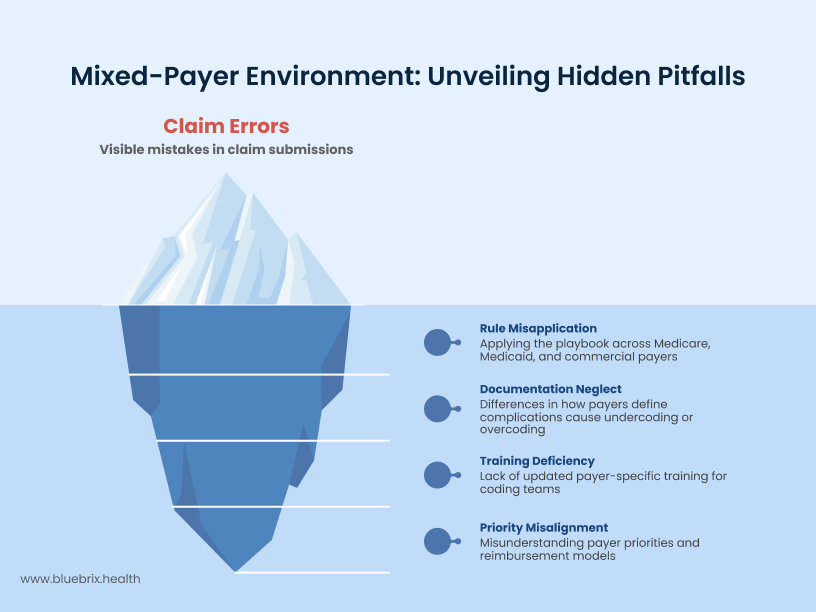
- Assuming “one set of rules”: Applying Medicare rules to commercial or Medicaid cases (or vice versa) is a common error that can result in misgrouped claims and lost revenue.
- Overlooking documentation details: What’s considered a complication or comorbidity (CC/MCC) in one system may not be recognized in another, leading to unintentional undercoding or overcoding.
- Neglecting payer-specific training: With DRG systems evolving and payer contracts frequently updating requirements, failing to stay current can leave coding teams unprepared.
- Misunderstanding payer priorities: For example, commercial insurers may focus more on cost containment, whereas government payers may emphasize compliance or risk adjustment.
What are MS-DRG and APR-DRG?
This primer outlines the fundamental differences between MS-DRG and APR-DRG, explaining how these distinct systems are used to group patient cases and determine payment with their own playbook.
What is MS-DRG?
The current operative MS-DRG version for FY2026 is Version 43 (effective October 1, 2025), with Version 43.1 effective April 1, 2026 following an update introducing 80 new ICD-10-PCS procedure codes [1]. CMS publishes a test Version 44 grouper for FY2027 for provider planning. Facilities should verify their grouper software reflects the current version for the fiscal year of the discharge being coded.
Purpose and Primary Users
MS-DRG is Medicare’s primary payment system for hospital inpatient stays. Many commercial insurers also use this system. Instead of paying based on length of stay or individual services, MS-DRG groups similar cases together and pays a set amount for each group.
Resource-based payment and severity
The system recognizes that patients with similar diagnoses don’t always need the same resources. A heart attack patient who recovers quickly requires different care than one who develops complications. MS-DRG accounts for this by grouping patients based on their condition, Severity of Illness (SOI), and expected resource use. More complex cases with higher severity levels get higher payments.
Complications and Comorbidities Impact
MS-DRG considers additional health conditions that make care more challenging. These include complications that develop during the stay and existing conditions patients bring with them. The system classifies these as Complications/Comorbidities (CCs) or Major Complications/Comorbidities (MCCs). When patients have CCs or MCCs, their case moves to a higher-paying category because these conditions require more resources and attention.
What is APR-DRG?
PR-DRG is a proprietary grouper developed and maintained by 3M Health Information Systems, now part of Solventum following the 2024 spin-off of 3M’s health division[3]. Unlike MS-DRG, which is a federal standard published freely by CMS, APR-DRG requires a commercial licence from Solventum. Facilities implementing APR-DRG-based contracting or quality reporting should factor licensing and integration costs into their evaluation. Most major EHR and coding software vendors include APR-DRG grouper access as part of their platform, but the underlying logic is maintained and updated by Solventum, not by CMS.
Purpose and primary users
APR-DRG serves a broader patient population than MS-DRG. While Medicare focuses primarily on elderly patients, APR-DRG is designed for Medicaid programs, commercial insurance plans, and state-specific healthcare programs. This system handles the full spectrum of patients—from pediatric cases to complex adult conditions across different insurance types. The “All Patient” designation reflects its ability to appropriately group and price cases regardless of patient age or payer type.
Dual assessment framework
APR-DRG goes beyond traditional severity measures by incorporating two critical factors: Severity of Illness (SOI) and Risk of Mortality (ROM). While SOI measures how sick the patient is and what resources they’ll likely need, ROM estimates the probability of death during the hospital stay. This dual assessment provides a more complete picture of patient complexity and helps predict both resource consumption and clinical outcomes.
Four-level severity and risk scale
Both SOI and ROM are measured on four-point scales ranging from minor to extreme. A patient might have moderate severity of illness but low mortality risk, or high severity with high mortality risk. This granular classification creates more precise payment categories. Instead of broad groupings, hospitals receive reimbursement that reflects the true complexity of each case. The result is a more accurate match between patient needs, resource consumption, and payment levels.
MS-DRG vs. APR-DRG: key differences in coding, severity, and payment
Here’s a breakdown of the key differences between MS-DRG and APR-DRG—who uses them, how they measure patient severity, how they classify cases, and what that means for hospital payments. Understanding these differences helps hospitals ensure accurate coding and billing, especially when working with multiple insurance types.
| Category | MS-DRG Medicare severity DRG |
APR-DRG All patient refined DRG |
What it means for billing |
|---|---|---|---|
| Purpose and primary users | Used by CMS to reimburse acute inpatient hospital stays for Medicare beneficiaries. Many commercial insurers also base their inpatient payment contracts on this system. | Designed for all patients including Medicaid, commercial plans, and state programs. Covers the full spectrum from pediatric to complex adult cases. | Knowing which system applies before coding begins is non-negotiable. Applying Medicare rules to a Medicaid claim, or vice versa, causes misgroups and lost revenue from day one. |
| Classification approach | Groups patients by principal diagnosis, procedures, age, discharge status, and CC/MCC flags. | Takes a base DRG and subdivides it into 4 severity-of-illness (SOI) and 4 risk-of-mortality (ROM) subclasses. | A case that lands in one MS-DRG group may split into 16 possible APR-DRG subclasses. Incomplete documentation collapses cases into lower subclasses, directly reducing the payment weight assigned. |
| Severity and risk modeling | Groups patients by principal diagnosis, procedures, age, discharge status, and CC/MCC flags. | Takes a base DRG and subdivides it into 4 severity-of-illness (SOI) and 4 risk-of-mortality (ROM) subclasses. | A case that lands in one MS-DRG group may split into 16 possible APR-DRG subclasses. Incomplete documentation collapses cases into lower subclasses, directly reducing the payment weight assigned. |
| Severity and risk modeling | Measures severity of illness but with limited granularity. Does not explicitly model risk of mortality. | Provides explicit four-level SOI and ROM scores for each case, giving a more complete clinical picture. | APR-DRG’s dual scoring means a single missed secondary diagnosis can drop both the SOI and ROM subclass, a double hit to reimbursement. MS-DRG carries less downside risk from a single omission but also captures less nuance. |
| System size and scope | Approximately 750 groups. Primarily covers hospital inpatient services for Medicare-eligible patients. | More than 3,000 groups (4 SOI x 4 ROM subclasses per base group). Applies across all payers, settings, and age groups including neonatal. | APR-DRG’s dual scoring means a single missed secondary diagnosis can drop both the SOI and ROM subclass, a double hit to reimbursement. MS-DRG carries less downside risk from a single omission but also captures less nuance. |
| Comorbidity handling | Classifies secondary diagnoses as CC (complication/comorbidity) or MCC (major CC). Moderate granularity. | Extensively incorporates comorbidities and complications for risk adjustment. High granularity, where the same condition may carry different weight depending on the overall clinical picture. | A diagnosis coded as an MCC under MS-DRG may not shift the APR-DRG subclass at all, and vice versa. Coders working across both systems cannot rely on memorised CC/MCC lists; each payer’s grouper logic must be applied independently. |
| Usage and adoption | Mandated by CMS for Medicare billing. Widely adopted as the standard for Medicare inpatient reimbursement. | Increasingly adopted for quality measurement, outcomes research, and payment across clinical, research, and commercial payer settings. | APR-DRG’s expanding footprint in commercial contracts means facilities that historically optimised only for MS-DRG are now exposed to APR-DRG audit risk. Staying current on payer contract updates is critical to avoid coding to the wrong standard. |
Key MS-DRG changes for FY2026 that affect mixed-payer coding
The FY2026 IPPS Final Rule, published August 4, 2025, introduced the following changes that directly affect DRG assignment in mixed-payer facilities[2].
New MS-DRG assignments: New codes were created for percutaneous coronary atherectomy and complex aortic arch procedures. Facilities performing these procedures need updated coding workflows to ensure correct MS-DRG assignment.
Deleted MS-DRGs 077-079: Hypertensive encephalopathy was removed as a standalone DRG grouping. Cases previously assigned to MS-DRGs 077, 078, or 079 will now group differently. Coders should verify their current mapping logic reflects this deletion.
CC/MCC list updates: New diagnosis code titles and updated coding order for the CC/MCC lists may shift how severity is captured in MS-DRG assignment for specific conditions. Coders should review updated CC/MCC exclusion tables for any conditions frequently appearing in their case mix.
April 2026 update (Version 43.1): Effective April 1, 2026, CMS introduced 80 new ICD-10-PCS procedure codes into the MS-DRG grouper. Claims for discharges on or after April 1, 2026 should be processed using the Version 43.1 grouper software and the updated Medicare Code Editor (MCE) Version 43.1.
DRG coding in behavioral health: what psychiatric and SUD facilities need to know
Behavioral health facilities face a distinct set of coding challenges that set them apart from general acute-care hospitals. Psychiatric and substance use disorder (SUD) cases are governed by their own DRG logic, and the stakes of getting it wrong are just as high.
Why is DRG coding different for behavioral health and psychiatric facilities?
Most inpatient behavioral health stays are reimbursed under the Psychiatric Facility Prospective Payment System (PPS), which operates separately from the standard MS-DRG framework used for general acute care. However, facilities that operate distinct-part psychiatric units, or that bill under commercial and Medicaid contracts, frequently encounter APR-DRG grouping logic applied to behavioral health cases, making dual-system fluency just as critical here as in any mixed-payer environment.
- Psychiatric DRGs hinge on primary psychiatric diagnosis, but comorbid medical conditions such as diabetes, cardiovascular disease, or substance use can significantly affect both the DRG assignment and the SOI/ROM subclass under APR-DRG.
- Secondary diagnoses like suicidal ideation, self-harm history, or co-occurring substance use disorders must be captured with precision. Omitting them does not just affect reimbursement; it distorts quality and outcomes data used in value-based programs.
- Substance use disorder coding requires specificity around the substance type, severity (mild, moderate, severe), and any documented physiological dependence. Vague documentation collapses cases into lower-weighted DRGs.
- For facilities serving pediatric or adolescent psychiatric populations, APR-DRG’s age-sensitive grouping logic adds another layer of complexity that MS-DRG simply does not address with the same granularity.
Common DRG coding errors in behavioral health facilities
- Undercoding psychiatric severity: Conditions such as treatment-resistant depression, acute psychosis, or high-acuity bipolar disorder carry MCC-level weight in many groupers, but only if documented to that level of specificity.
- Missing medical comorbidities: A patient admitted for a psychiatric crisis who also has uncontrolled hypertension or COPD may qualify for a higher SOI/ROM subclass, but only if those conditions are clearly documented as clinically managed during the stay.
- Sequencing errors: The principal diagnosis in behavioral health cases must reflect the condition chiefly responsible for the admission. Incorrect sequencing between a psychiatric diagnosis and a medical comorbidity can shift the case to the wrong DRG base entirely.
- Ignoring payer-specific behavioral health carve-outs: Some commercial payers carve out behavioral health benefits to separate managed care organizations with their own reimbursement structures. Coding to the wrong standard for these plans results in systemic underpayment.
When to use MS-DRG vs. APR-DRG?
Let’s take a closer look at key concepts—like different payers’ rule books, the role of data analytics, and the importance of accurate documentation—that shape how hospitals manage coding and payments, especially when navigating multiple insurance plans.
Payer-specific rules
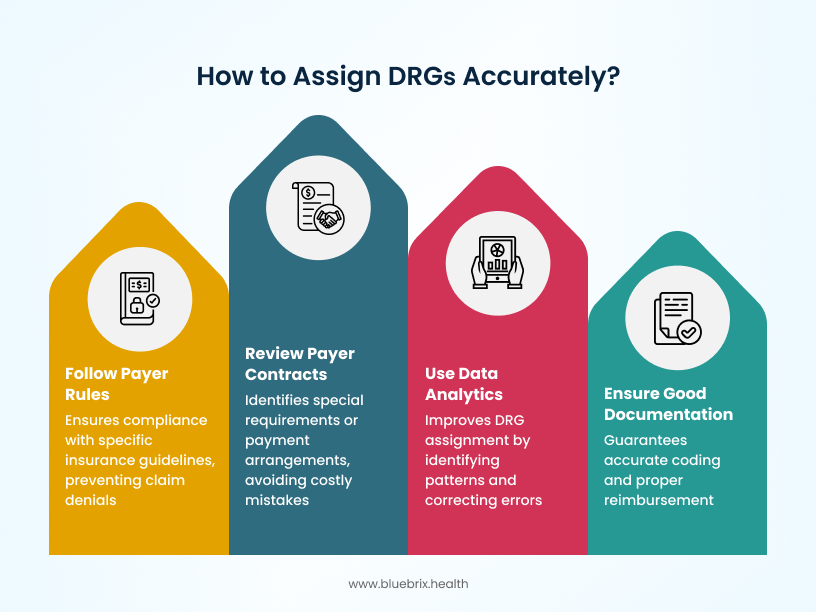
Different insurance companies—like Medicare, Medicaid, or private insurers—set their own rules for how medical cases should be grouped and billed. Whenever you assign a DRG, you start by following the specific guidelines for that payer. For example, what counts as a complication or how you sort diagnoses might differ between Medicare and a commercial insurer, so knowing which payer will cover the bill always comes first.
Know your payer contracts
Beyond payer rules, hospitals often have contracts with insurers that spell out special requirements or payment arrangements. These contracts can affect how cases are coded, which DRG is assigned, and what is reimbursed. Knowing the details—sometimes hidden in the “fine print”—can prevent costly mistakes or lost payments. In short, always check for any extra rules in your hospital’s contracts with payers.
Data analytics for better DRGs
Hospitals use data analysis tools to spot patterns in how DRGs are assigned, paid, or denied. By looking at past cases and trends, teams can improve how they group cases, catch mistakes early, and maximize correct payments. For instance, if the data shows certain diagnoses are often under-documented, coders can focus on getting better information up front.
Good documentation means accurate coding
Getting the right DRG and therefore the right payment depends on clear, complete, and accurate documentation in the patient’s medical record. This means all diagnoses, complications, procedures, and relevant details must be written down carefully by doctors and nurses. Good notes lead to accurate coding; missing or unclear information can cause underpayment or even rejected claims.
Industry data indicates that hospitals lose 3%–7% of net patient revenue annually due to coding and documentation inaccuracies. For a mid-size hospital with $500 million in annual revenue, this translates to a loss of $15–$35 million every year.
DRG coding misalignment: revenue loss, audit risk, and operational consequences
Coding misalignment can lead to under-reimbursement, compliance risks, bad data, and wasted resources. We’ll quickly walk through how each of these can impact a hospital’s finances, reputation, and day-to-day operations.
Under-reimbursement and missed revenue
When coding doesn’t match what actually happened in the patient’s care, the hospital might get paid less than it should. For example, if a treatment or complication isn’t coded properly, insurance companies may pay only part of the bill or deny it altogether. This means the hospital loses money it has already spent on care. Even small mistakes add up—denied or underpaid claims can cost hospitals millions every year, making it harder to keep up with expenses and invest in better patient services.
Compliance risks and regulatory penalties
Inaccurate coding or billing can trigger audits (deep reviews) by insurance companies or government agencies. If auditors find mistakes—especially if they look like fraud or if the hospital has overbilled—there can be severe consequences: financial penalties, demands to pay back money, or even legal trouble. Repeated coding problems can lead to increased attention from regulators, putting hospital operations and reputation at risk.
Data integrity issues and skewed performance data
Good data depends on accurate coding. If codes are wrong, it affects reports on hospital quality, infection rates, or patient outcomes can also be wrong. This can make the hospital look better or worse than it really is, affecting its reputation with patients, business partners, and government programs. Poor data can also mess up planning and may result in public ratings that discourage patients from coming to the hospital.
Rework and resource drain
When claims are denied or payments delayed because of coding errors, hospital staff must go back to fix and resubmit the paperwork. This “rework” takes time and energy away from patient care and other important jobs. If coding problems happen a lot, it can lead to a constant drain on resources, lower staff morale, and overall inefficiency in how the hospital runs.
How to improve DRG coding accuracy in mixed-payer facilities: 4 core strategies
Getting DRG coding right takes more than just skilled coders—it requires strong documentation, smart tools, and continuous improvement. We will explore practical strategies like coder training, CDI programs, tech tools, and audits that help hospitals stay accurate, compliant, and financially healthy.
Building specialist and cross-trained coding teams
Getting DRG coding right starts with having coders who actually know what they’re doing. Some hospitals go deep—they train coders to become specialists in specific areas like cardiology or surgery. These experts can catch the subtle details that make the difference between accurate and inaccurate coding.
Other hospitals prefer the cross-training approach, where coders learn multiple areas so they can jump in wherever help is needed. The smart move? Most successful hospitals use both strategies. They have specialists for complex cases and cross-trained coders for flexibility. Either way, ongoing training isn’t optional—DRG rules change, medical terminology evolves, and coders need to stay current.
Robust clinical documentation improvement (CDI) programs
Doctors and nurses document everything they need for excellent patient care, but the coding world has its own specific requirements that don’t always align with clinical documentation needs. Clinical Documentation Improvement programs solve this problem by creating a bridge between clinical care and accurate coding. CDI teams work directly with physicians to clarify documentation—was this condition present when the patient arrived, or did it develop during the stay? Is this a complication or an existing chronic condition? These distinctions directly impact DRG assignment and payment. When documentation is clear and complete, coders can do their job accurately.
DRG validation software and analytics tools that reduce coding errors
Technology isn’t replacing human coders, but it’s making them more accurate and efficient. DRG validation software acts like an intelligent assistant, double-checking code assignments and flagging potential errors before claims go out the door. Think of it as spellcheck for medical coding—it catches mistakes that human eyes might miss.
Analytics tools take this further by tracking patterns across thousands of cases. If certain types of diagnoses are consistently under-documented or specific DRGs are frequently denied, the data reveals these trends. Hospitals can then address systemic issues rather than fixing problems one case at a time.
Regular auditing for continuous improvement
Smart hospitals don’t wait for payers to find their mistakes—they find them first. Regular internal audits review coding accuracy, looking for missed opportunities and potential errors. Maybe coders are consistently missing secondary diagnoses that could bump cases into higher-paying DRGs. Maybe certain types of complications aren’t being captured properly.
When auditors find these patterns, they create feedback loops with coders and clinical staff. This isn’t about blame—it’s about improvement. The goal is catching and fixing problems before they impact revenue or compliance. Hospitals that audit regularly stay ahead of issues rather than constantly reacting to them.
How blueBriX improves DRG coding accuracy for mixed-payer facilities
Precision in DRG coding takes the right mix of expertise, technology, and timing and that’s exactly where blueBriX comes in. With specialized coders, real-time checks, and seamless support, we help hospitals boost accuracy, protect revenue, and stay ahead of compliance risks.
Let’s dive in!
Expert coders for all kinds of payers
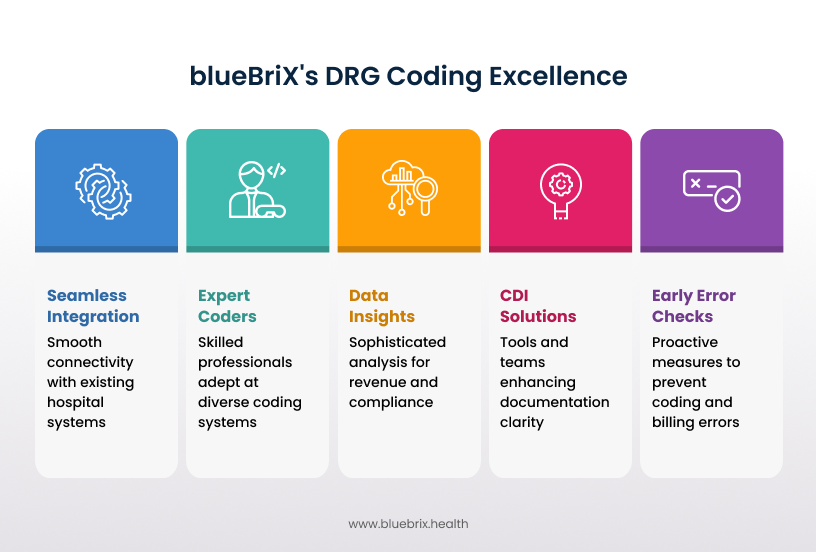
blueBriX has a team of coding experts who know all the different coding systems insurance companies use—including both Medicare (MS-DRG) and commercial/Medicaid (APR-DRG) rules. No matter what type of insurance your patients have, we make sure every case is coded correctly, so your hospital gets paid what it deserves and avoids headaches with denied claims.
Advanced CDI solutions for enhanced documentation
Sometimes, medical records are missing important details or are unclear, which can cause coding mistakes. blueBriX brings in special tools and teams to help doctors and nurses document every detail clearly and completely. This way, coders can do their job accurately, reducing missed revenue and ensuring insurance pays out properly.
Early coding and billing error checks
blueBriX doesn’t wait for problems to show up after the fact. We actively check coding and billing as cases happen like catching errors or missing information early. By fixing issues before claims go out the door, we help you avoid delays, denials, or lost payments.
Data-driven insights to optimize reimbursement and compliance
Our sophisticated data tools look at your hospital’s coding and billing trends. We spot patterns—like common mistakes or potential areas for more revenue—so your team can work smarter and improve over time. This also helps make sure you’re following all the latest rules, avoiding compliance risks.
Seamless integration with your system
blueBriX isn’t just an outside service—we connect directly with your team, systems, and workflows, so everything runs smoothly. Our support feels like having extra skilled hands-on deck, freeing up your staff and boosting efficiency without any extra hassle.