
It is no secret that providers (and their staff) are experiencing mental burnout and feeling overwhelmed under the current healthcare system. A quick Google search will give you thousands of articles citing shockingly high figures illustrating this issue.
In previous write-up, we’ve discussed the very worrisome future that we’re looking at: an aged population, in need of care, unable to receive it, due to dwindling resources.
At the present time, we are not aware of a method to increase our resources, nor do we know of a solution to our society’s demographic shift. What we do know of, from success stories that we’ve personally been involved in making a reality , and from paying attention to others in the healthcare ecosystem, is that the value-based care model of treatment (focusing on quality, outcomes and effectiveness) is leading to better outcomes from the perspective of the patient, the provider, and the payer.
The typical healthcare workflow
Let’s illustrate it with an example. Under the old, outdated method of care provision, a patient would need to call or visit in person to make an appointment or to schedule a follow-up. Then the front office staff would have to manually figure out a time that is best suited for both the patient and the provider to meet. Before the actual interaction takes place, the patient would need to fill-out, in person or online, a medical history and information form, which would need to be verified by the front office staff for insurance coverage purposes, before the patient can finally meet the provider and receive care.
Once this interaction is over, then comes the follow-up processes:
- The patient is responsible for scheduling their follow-ups and sticking to their treatment plan.
- The front-office staff are left to wade through the confusing and complicated processes involved with handling billing and coding (without making any mistakes and while meeting all of the requirements and regulations).
- The provider is left feeling uncertain about both the prognosis of their patient and the certainty of their reimbursement.
How AI optimizes value-based care workflow?
Under the “new” value-based care model, which is expected to become the norm for 90% of the healthcare industry by 2030, the follow up system has become simple, concise, and most importantly, efficient. Let’s look at how AI helps in the process, step-by-step:
- Automated Scheduling & Virtual Assistants: AI integration reduces the time spent by both patient and front-office staff making calls:
- By analyzing the calendars and schedules of the provider and providing appropriate options for times that would be best suited for an appointment.
- By answering patient inquiries (such as questions about how to access treatment history, where to make payments, hours of business, etc.)
- By providing patients with personalized reminders about their treatment plan, which would lead to more patient engagement.
- Document Management: By automating data extraction, organizing records, and streamlining workflows, AI can help convert unstructured data into structured formats for seamless integration into EHRs, categorizes documents for easy access, and reduces errors in data entry and billing
- Predictive Analysis: AI can analyze and compare patient health records to accurately predict the patient’s future health needs, outcomes, and possible issues. This can help both the patient, and their provider (along with any other caregivers) better prepare or even take preventative measures to improve the patient’s health outcomes.
- More Accurate Diagnosis: For the same reasons that AI can predict future health outcomes, it is also able to more accurately diagnose a patient’s health problems and suggest a treatment plan that is personalized for them.
- Billing and Coding: Revenue-cycle management companies exist, and the industry is highly lucrative, for a reason. Because both of those tasks are very important in healthcare, while often being the most frustrating and difficult to complete without fault. AI can ensure that billing and coding are done correctly and quickly, while meeting compliance, so that you receive reimbursement in a reasonable period of time.
Integrating AI and streamlining the workflow leads to both provider and their staff being able to greatly reduce the stress and burnout they would otherwise experience, while improving their financials in both revenue and expenses, while honoring their ultimate responsibility: providing the best care possible for their patients.
The Transformative power of AI in healthcare
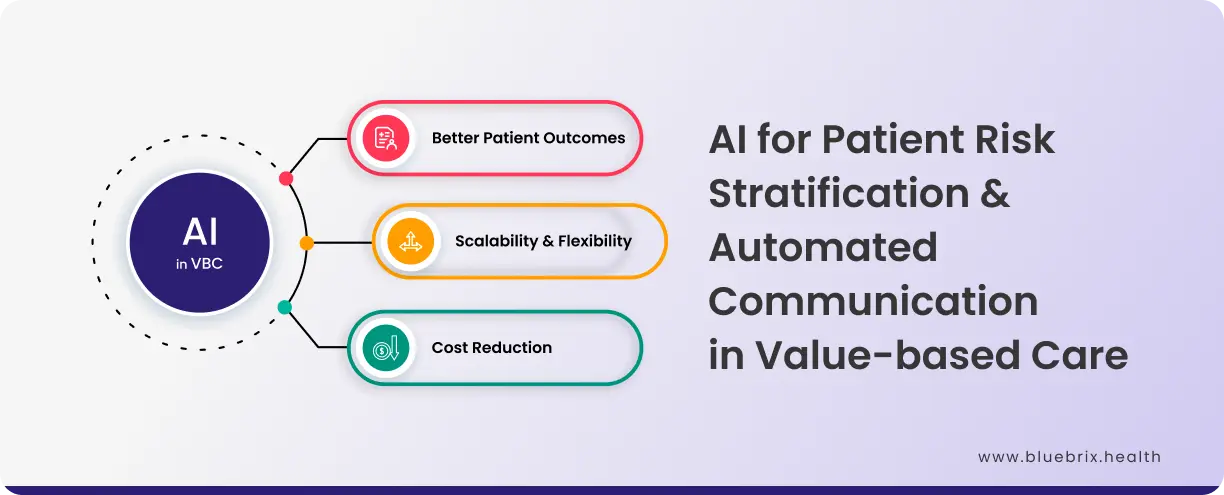
Artificial Intelligence is not just a tool for the future—it is reshaping the present of value-based care (VBC). By streamlining workflows, optimizing resource allocation, and enabling personalized patient interventions, AI empowers healthcare providers to focus on what truly matters: delivering better outcomes while controlling costs. From predictive analytics to automated administrative processes, AI unlocks efficiencies across care delivery systems, ensuring healthcare organizations can meet the demands of value-based care with confidence.
Balancing automation with human oversight
While AI plays a transformative role in streamlining healthcare workflows, critical decisions will remain in the hands of humans. Automation is designed to assist, not replace, providers. For instance, healthcare organizations can configure AI systems to include checkpoints where processes pause for human review before progressing to the next step. These checkpoints can be tailored based on the severity or potential impact on patient outcomes, ensuring both efficiency and safety.
This human-in-the-loop approach allows providers to maintain control over decision-making while leveraging AI to reduce administrative burdens, improve accuracy, and expedite workflows. By blending automation with human oversight, blueBriX enables ethical, reliable, and outcome-focused care delivery.