

What F41.9 really costs when it goes wrong
F41.9 sits in a complicated spot in behavioral health billing. It is valid, it is billable, and there are legitimate clinical situations where it is exactly the right code. But it is also the code that gets reached for when an intake is rushed, when documentation is thin, or when a clinician just does not want to make a diagnostic call before they feel ready. That habit, repeated across a team of clinicians over hundreds of claims, is what turns a coding question into a revenue cycle problem.
Payers know what overuse looks like. In one OIG audit of a single behavioral health practice, documentation failures alone led to an estimated $1.1 million overpayment demand – with no fraud involved, just non-compliant notes[1]. And unspecified diagnosis codes are consistently among the first things auditors look for. The financial exposure is real, and it tends to surface long after the clinical encounters that caused it.
This guide is not about whether you should use F41.9. You should, when it fits. It is about understanding the conditions where it fits, the documentation that protects you when you use it, and the organizational patterns that make it a risk when it shows up too often.
What is F41.9 in ICD-10-CM
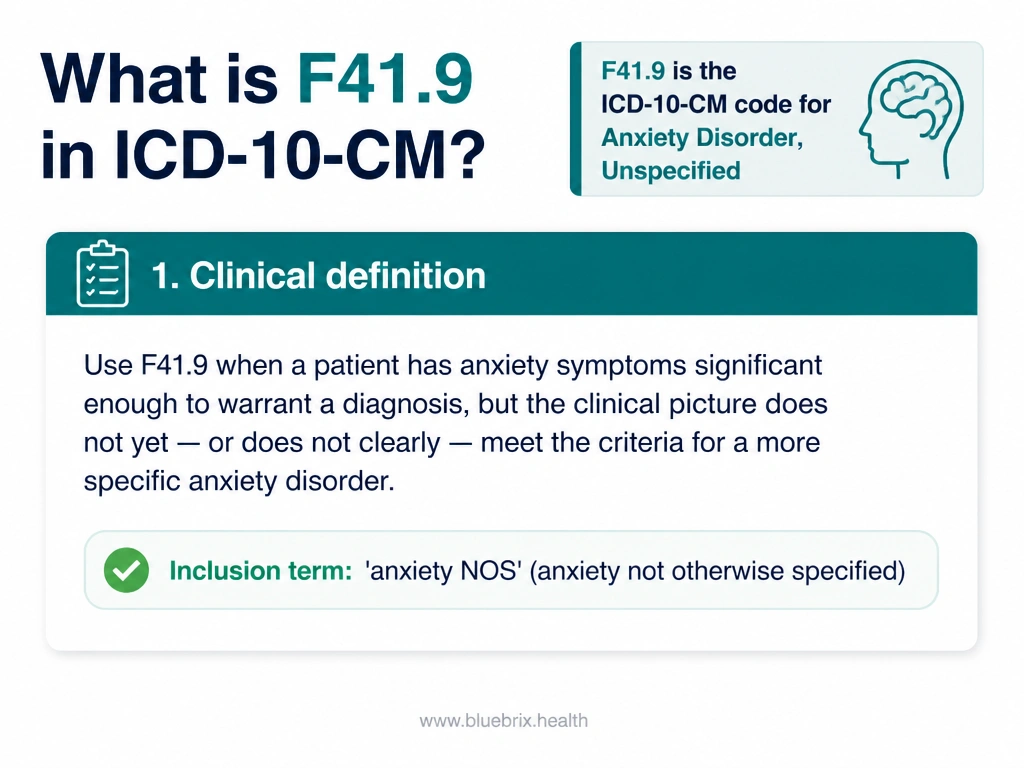
The clinical definition of anxiety disorder unspecified
F41.9 is the ICD-10-CM code for anxiety disorder, unspecified. It applies when a patient presents with anxiety symptoms significant enough to warrant a diagnosis, but the clinical picture does not yet – or does not clearly – meet the criteria for a more specific anxiety disorder. The inclusion term under F41.9 is “anxiety NOS,” meaning anxiety not otherwise specified[2].
It is worth being clear about what the word “unspecified” actually means here. It does not mean the patient’s anxiety is mild or questionable. It means the type has not been determined – either because the evaluation is still in progress, because symptoms do not map cleanly to a single category, or because the clinician has chosen not to specify further and has documented why. The diagnosis can be clinically valid and the note can still be entirely insufficient for billing. Those are two separate problems, and conflating them is where most F41.9 errors begin.
Where F41.9 sits in the ICD-10-CM classification system
Anxiety disorders in ICD-10-CM fall under Chapter 5 – Mental, Behavioral and Neurodevelopmental Disorders – within the F40-F48 block, which covers neurotic, stress-related, and somatoform disorders. F41.9 sits at the end of the F41 subblock, which groups the non-phobic anxiety disorders together. The FY2026 ICD-10-CM code set, effective October 1, 2025, made no additions, deletions, or revisions to the F40-F41 block – so F41.9 carries forward unchanged and remains fully billable as a principal diagnosis through September 30, 2026.
What “billable but scrutinized” means for your practice
Billable means a claim with F41.9 as the principal diagnosis will not be automatically rejected on the basis of the code alone. Scrutinized means payers have learned to look for it – and when they find it frequently, or without supporting documentation, the response ranges from denial on that claim to a broader audit of your coding patterns.
Anxiety disorders are among the most common mental health conditions in the U.S. — an estimated 19.1% of adults experience one in a given year, and nearly a third will at some point in their lives[3]. That population-level prevalence is a large part of why F41.9 shows up so often in behavioral health claims data, and why it draws payer attention when it appears without supporting specificity.
That volume, combined with the ease of reaching for an unspecified code, has made F41.9 one of the most flagged codes in behavioral health billing reviews. Commercial payers are increasingly reducing reimbursement or outright denying claims that rely on unspecified codes when more specific options exist and the documentation does not explain why they were not used. For organizations billing at scale, that scrutiny escalates to the practice level.
The F41.x anxiety code family at a glance
F41.9 does not exist in isolation. It sits at the end of a structured code family, and knowing where it lands relative to the others is what separates a defensible coding decision from a default one. Here is the full picture[4]:
| ICD-10 Code | Diagnosis | When it applies |
|---|---|---|
| F40.00 | Agoraphobia, unspecified | Anxiety in situations where escape feels difficult or help unavailable |
| F40.10 | Social phobia, unspecified | Anxiety triggered by social situations or performance |
| F41.0 | Panic disorder | Recurrent unexpected panic attacks with persistent concern about future attacks |
| F41.1 | Generalized anxiety disorder (GAD) | Excessive, uncontrollable worry across multiple areas for six or more months |
| F41.2 | Mixed anxiety and depressive disorder | Anxiety and depression symptoms present together, neither dominant enough for a standalone diagnosis |
| F41.3 | Other mixed anxiety disorders | Anxiety alongside symptoms from F42-F48, none severe enough individually to justify a separate code |
| F41.8 | Other specified anxiety disorders | Anxiety presentations that do not fit the above but have enough clinical specificity to name |
| F41.9 | Anxiety disorder, unspecified | Anxiety is present but the type has not been or cannot yet be determined |
Note: The descriptions above reflect ICD-10-CM coding application guidance. Clinical diagnosis follows DSM-5 criteria, which your documentation must reflect before a code is assigned.
Codes frequently billed alongside the F41 block
Anxiety rarely presents alone in behavioral health settings. The codes below commonly appear on the same claim or in the same patient record:
| ICD-10 Code | Diagnosis |
|---|---|
| F32.x / F33.x | Major depressive disorder (single episode or recurrent |
| F43.10 | Post-traumatic stress disorder, unspecified |
| F10.x – F19.x | Substance use disorders |
| F10.x – F19.x | Substance use disorders |
| F42.x | Obsessive-compulsive disorder |
| F06.4 | Anxiety disorder due to another medical condition |
Note that OCD (F42.x) and PTSD (F43.x) were moved out of the anxiety chapter in DSM-5, so they carry their own ICD-10 blocks – but they surface frequently alongside F41 codes in comorbid presentations and require separate sequencing logic when billed together.
3 situations when F41.9 is the right code to use
F41.9 is a valid, billable code with specific clinical situations where it is the right call. Those situations are narrower than how the code tends to get used in practice – but they are real, and it helps to know exactly what they look like.
1. At intake when the clinical picture is still developing
A first encounter is rarely the right moment to commit to a specific anxiety diagnosis. The patient is new, the history is incomplete, and a thorough assessment may take more than one session to produce a defensible diagnostic impression. Using F41.9 at intake while that picture develops is clinically appropriate – provided the note reflects that the evaluation is in progress and includes a documented plan to reassess. What makes this defensible is not the code. It is the note. Payers understand provisional diagnoses at intake. What they do not accept is a provisional diagnosis that never gets revisited.
2. When symptoms do not meet criteria for a more specific diagnosis
Not every anxious patient fits cleanly into a named category. A patient may present with persistent worry, sleep disruption, and physical tension but not meet the six-month duration threshold for GAD. Another may experience episodes of acute anxiety that do not fully meet the frequency or behavioral criteria for panic disorder. In these cases, F41.9 reflects the clinical reality accurately – and that is exactly what it is designed for. The documentation here needs to show that you considered the specific codes and explain why they were not supported. That is what separates appropriate use from a documentation gap.
3. When clinical information is genuinely unavailable
Emergency presentations, crisis evaluations, and settings where a full psychiatric history cannot be obtained at the time of service are situations where F41.9 serves a real function. When a patient arrives in acute distress and the information needed to assign a specific diagnosis simply is not available, F41.9 is the appropriate placeholder – again, with documentation noting the circumstances and a clear plan for follow-up assessment. The through-line across all three scenarios is the same: F41.9 is appropriate when the clinical situation genuinely does not yet support specificity, and the note says so explicitly.
3 situations when F41.9 is not the right code to use
If the previous section covers the legitimate use cases, this one covers where things quietly go wrong – not through intent, but through habit.
1. Using it as a shortcut when a specific diagnosis is clinically supported
If your documentation already reflects six months of excessive worry across multiple life domains, sleep disturbance, difficulty concentrating, and functional impairment – that is GAD. The clinical picture supports F41.1, and submitting F41.9 instead is an undercoding error. It does not protect you from scrutiny; it invites it, because the mismatch between what the note says and what the claim shows is exactly what payer auditors are trained to look for. The same logic applies across the F41 block. If the documentation supports a specific code, that is the code that should appear on the claim.
2. Leaving it unchanged across multiple encounters without reassessment
A diagnosis that made sense at intake needs to be revisited as the clinical picture develops. If a patient has been seen six, eight, or ten times and F41.9 is still the only code on the claim with no documented reassessment, that is a problem – clinically and from a billing standpoint. Payers conducting concurrent reviews expect to see diagnostic progression or a documented rationale for why the presentation remains unspecified. An unchanged F41.9 across a long treatment history signals that nobody looked.
3. Applying it to avoid working through comorbidity sequencing
Comorbidity sequencing is genuinely complex, and it takes time that busy clinicians often do not have at the point of documentation. But using F41.9 to sidestep that complexity – when a patient clearly has both anxiety and depression, or anxiety alongside a substance use disorder – creates a claim that does not reflect the clinical reality. That gap affects reimbursement, authorization decisions, and your exposure if the record is ever reviewed.
F41.9 vs F41.1 - choosing the right anxiety code
This is the most common decision point in anxiety coding, and it is where the most consequential errors happen. F41.1 – generalized anxiety disorder – is the code that should be replacing F41.9 most often in behavioral health billing, and the gap between them is not as wide as it might seem.
How to know when your DSM-5 documentation actually supports F41.1 instead of F41.9
GAD has a specific diagnostic threshold in DSM-5. The patient must show persistent, hard-to-control worry lasting six months or more, across multiple areas of life, plus at least three accompanying symptoms – restlessness, fatigue, poor concentration, irritability, muscle tension, or disrupted sleep – severe enough to affect how they function day to day[5].
That threshold is not abstract. If your note documents duration, names the symptoms present, and reflects functional impact – you already have what F41.1 requires. Submitting F41.9 on that claim is not a conservative choice. It is an undercode.
Documentation differences between F41.9 and F41.1
| Documentation element | F41.9 | F41.1 |
|---|---|---|
| Symptom description | Anxiety symptoms are present | Worry is excessive, persistent, and hard to control |
| Duration | Not required at initial encounter | Six or more months, documented explicitly |
| Symptom count | Not required | Three or more from the DSM-5 list documented by name |
| Functional impairment | Note should reflect impact on daily functioning | Must be documented – work, relationships, or daily activities affected |
| Diagnostic rationale | Explain why a specific type could not be determined | Document the clinical reasoning that led to GAD |
| Reassessment plan | Must be present – when and how the diagnosis will be revisited | Recommended as good practice |
A well-documented F41.1 claim is harder to deny and harder to audit successfully than an F41.9 claim with thin supporting notes – and the table above shows exactly why.
Why payers treat the two codes differently at authorization
For routine outpatient claims, the reimbursement difference between the two codes is often minimal. The real gap shows up when a patient needs a higher level of care. When you submit a prior authorization request for PHP or IOP with F41.9 as the primary diagnosis, payers have grounds to question whether the level of care is justified – because the diagnosis itself does not yet confirm severity. F41.1, backed by documented functional impairment, makes that case far more clearly.
A practical decision framework for clinicians at the point of care
Before defaulting to F41.9, run through three questions:
- Has the patient described worry that is persistent, difficult to control, and present across more than one area of life?
- Has it been going on for close to or more than six months?
- Are there at least three accompanying physical or cognitive symptoms documented in the note?
If the answer to all three is yes, the documentation supports F41.1 and that is the code that should go on the claim. If one or more answers are unclear or the picture is still developing, F41.9 is appropriate – with a note that says so and a plan to reassess.
How long can F41.9 be billed
There is no hard federal rule that sets an expiration date on F41.9. But that does not mean payers treat it as an indefinitely renewable diagnosis. In practice, how long F41.9 holds up depends on what your documentation shows at each stage of the billing cycle.
- What payers accept at first submission and why F41.9 is not a safe default even then – At initial claim submission, F41.9 will generally pass without an automatic denial. Payers understand that a first or second encounter may not produce enough clinical information for a specific diagnosis. What they are looking for is evidence that the assessment is active – that the clinician is working toward a clearer picture, not parking the patient under a convenient code.
- What happens to an unchanged F41.9 when concurrent review comes around – Concurrent review is where an unchanged F41.9 starts to create real problems. When a payer is deciding whether to authorize continued care, they are looking at whether the treatment is producing results and whether the diagnosis still reflects the clinical picture accurately.
Where F41.9 creates the most downstream risk
Used correctly, F41.9 is a routine code. Used habitually, it creates friction at three specific points that are worth knowing before they show up as denied claims or failed authorizations.
Prior authorization for higher levels of care
When a patient needs PHP, IOP, or residential treatment, the authorization request has to make a clinical case for that level of care. F41.9 makes that case harder because an unspecified diagnosis does not communicate severity, functional impairment, or acuity – the three things payers are weighing when they review a higher level of care request. Organizations that routinely submit F41.9 at intake and then request intensive services shortly after see higher initial denial rates as a direct result.
Comorbidity sequencing with depression, substance use, and PTSD
When anxiety appears alongside a depressive disorder, a substance use disorder, or PTSD, sequencing errors do not stay invisible for long. The wrong principal diagnosis affects which reimbursement rate applies, which medical necessity criteria the payer evaluates against, and in some cases whether a claim is payable at all under a given benefit category. The financial impact compounds across a high-volume claim mix.
Concurrent review when the diagnosis has not progressed
At concurrent review, an unchanged F41.9 does not just raise a coding question – it raises a treatment effectiveness question. Payers use diagnostic progression as a proxy for whether the treatment plan is working. A stalled diagnosis reads as a stalled treatment, and that is the point where continued authorization for any level of care becomes difficult to secure regardless of what the clinical notes say.
The organizational risk most clinical directors do not track
Everything covered so far applies at the individual claim level. This section is about what happens when you zoom out and look at the pattern across your entire organization.
Unspecified-code rate as a compliance metric worth monitoring
Most behavioral health organizations track denial rates, clean claim percentages, and days in AR. Very few track their unspecified-code rate – the proportion of claims where F41.9 or another unspecified diagnosis appears as the principal code. That number is worth pulling. A high unspecified-code rate is a signal that documentation standards, intake workflows, or clinician training has a gap somewhere upstream. Knowing the number is the first step to knowing where the gap is.
How payers flag practices where F41.9 dominates the claim mix
Payers analyze billing patterns across their provider networks. A practice where F41.9 accounts for a disproportionately high share of anxiety-related claims stands out in that analysis – not necessarily as fraud, but as a target for medical necessity review. Once a practice is flagged at that level, the scrutiny does not stay on F41.9 claims alone. It tends to expand to the broader record, which means claims that were clean on their own can get pulled into a wider audit.
Annual ICD-10 updates and the silent risk that hits every October 1
Every October 1, a new ICD-10-CM code set takes effect. For the F41 block specifically, FY2026 carried no changes – but that will not always be the case. Organizations without a workflow for reviewing and implementing annual code updates are exposed to a specific kind of risk: submitting claims with deleted or revised codes after the effective date. Those claims do not fail because of poor documentation. They fail because nobody checked. For behavioral health organizations billing at volume, that is a preventable revenue loss that tends to go unnoticed until it accumulates.
See how integrated EHR and RCM workflows close the gap
When documentation and billing operate in the same system, unspecified-code patterns become visible before they become denials. See how an integrated behavioral health platform keeps your coding accurate, your records audit-ready, and your revenue cycle running clean.
Schedule a personalized demoWhat compliant F41.9 coding looks like at scale
Here is what organizations that get this right actually have in place.
Intake templates that prompt for diagnostic specificity
A well-structured intake template does more than collect demographic information. It prompts clinicians to document symptom duration, functional impairment, and the clinical reasoning behind a diagnosis – or behind the decision to leave one unspecified. When those elements are built into the template, clinicians do not have to remember to include them. The workflow does it for them, and the documentation that comes out the other end is coding-ready from the first encounter.
Pre-claim validation that catches diagnosis-to-level-of-care mismatches
Before a claim goes out, there should be a validation step that checks whether the diagnosis on the claim is consistent with the level of care being billed. An F41.9 on a routine outpatient claim is one thing. An F41.9 heading a PHP authorization request is a different situation that should be flagged before submission, not after denial. Organizations with integrated EHR and RCM systems can build that check into the workflow so it happens automatically rather than depending on a coder to catch it manually.
Audit-ready documentation standards across a multi-clinician team
Individual clinicians who understand documentation requirements write good notes. The challenge at scale is consistency – making sure that standard holds across every clinician, every site, and every level of care. That requires documented standards, regular internal audits against those standards, and a feedback loop that gets findings back to clinicians in a way they can act on. Organizations that do this systematically have records that hold up when payers come looking.