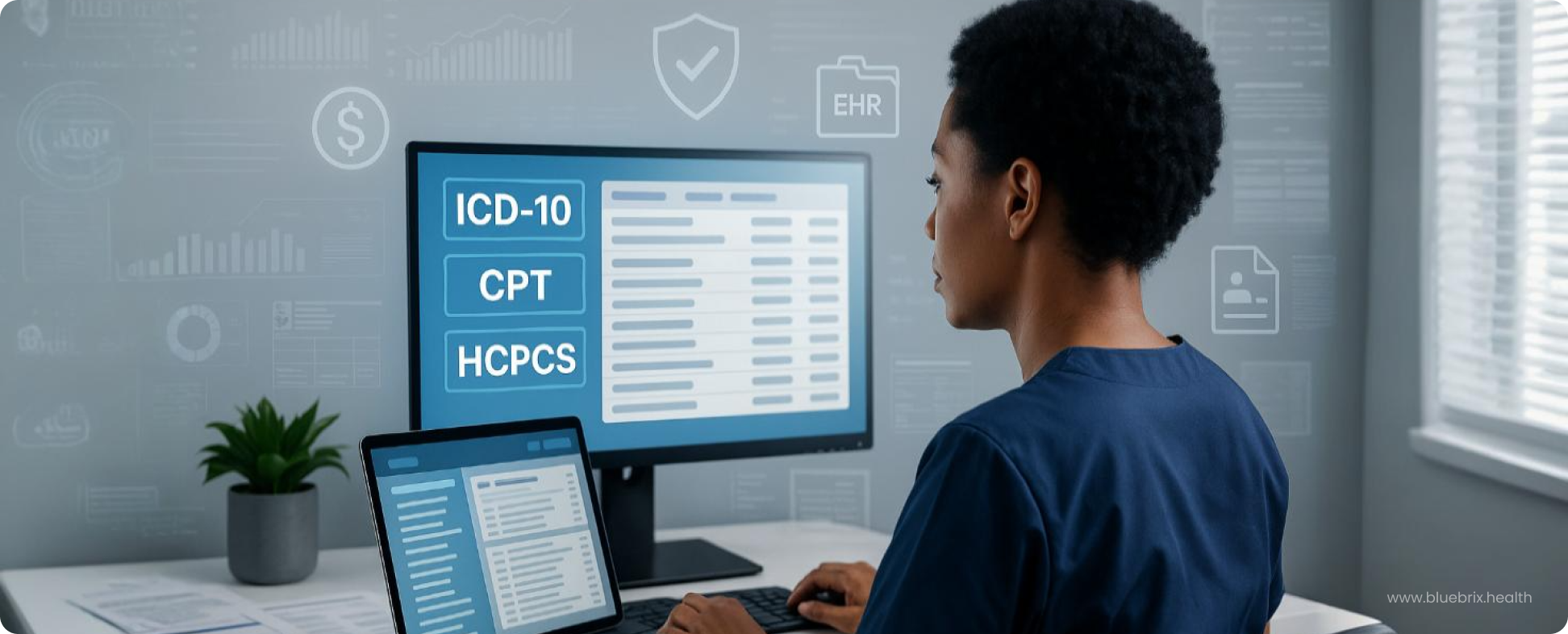
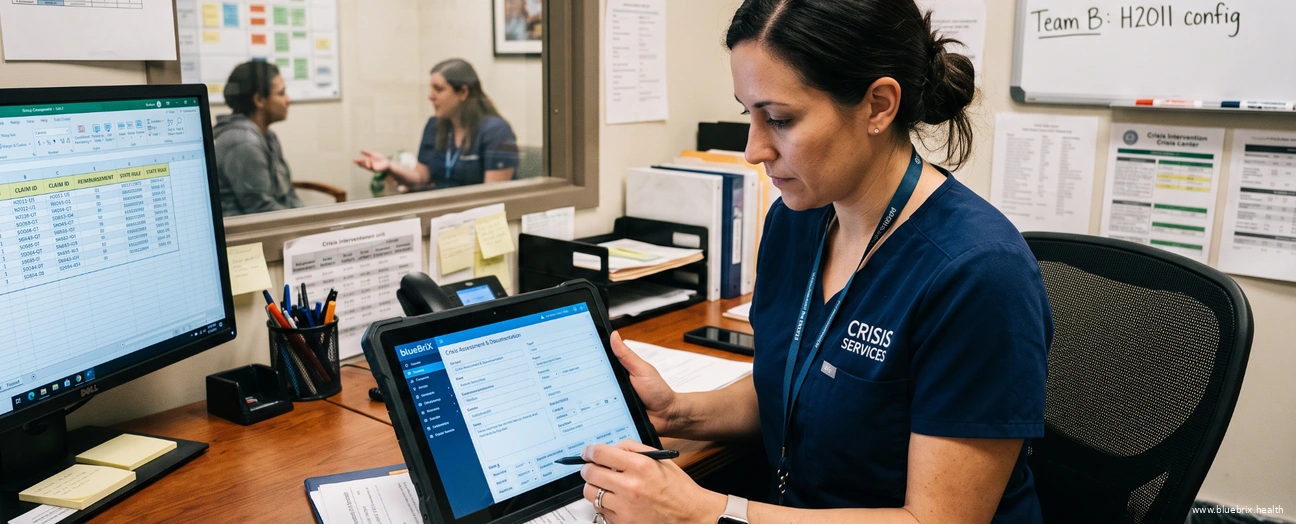
A crisis stabilization stay can be paid by the hour in one state, as a single per diem in the next, and not at all when a mobile team bills a code the payer has limited to facilities. Across U.S. healthcare, crisis intervention billing codes carry national descriptors, but state Medicaid agencies and other payers decide which setting, team, and unit each code will pay. Code selection is therefore a revenue and compliance decision for the leaders who own crisis programs, and they make it together with the billing office.
A common pattern gives billing teams a starting point. H2011 bills mobile crisis response in 15-minute units. S9484 bills brief or 23-hour stabilization by the hour, and S9485 bills stabilization per diem. CPT 90839 and the add-on 90840 bill psychotherapy for crisis by time, and Medicare routes sessions outside the office to G0017 and G0018. Each code also has documented state exceptions, which the sections below map by setting.
The rules continue to change. Nebraska’s Provider Bulletin 26-07, dated June 15, 2026, ends coverage of S9484 with the 52 modifier for dates of service on and after July 1, 2026, and clarifies that S9484 and S9485 are facility-only and may not be used for mobile crisis response. Wisconsin began paying crisis stabilization at three per diem rates tied to location and intensity on January 1, 2026.
This blog maps each crisis code to the settings, units, and payers that pay it, covers Medicare’s G-code routing and CCBHC claim structure, and turns those rules into documentation requirements, charge master rules, and pre-submission edits.
Crisis intervention billing codes mapped to setting, time unit, and payer
SAMHSA’s national crisis care guidance builds the crisis continuum on three elements. Someone to contact covers 988 and other hotlines. Someone to respond covers mobile crisis teams. A safe place for help covers stabilization services. Billing follows the same structure. Hotline, response, and stabilization services each have a commonly used code family, and psychotherapy for crisis can happen in any of the three settings. The H2011 vs 90839 choice depends on who delivered the service and what was delivered. H2011 covers a team’s crisis intervention time, usually under Medicaid. 90839 covers psychotherapy for crisis delivered by a qualified practitioner.
| Code | Descriptor unit | Common setting | State variations and exceptions | Medicare | Documentation anchors |
|---|---|---|---|---|---|
| H2011 | 15 minutes | Mobile crisis response | Modifier sets rate tier (MT); HT required (NV); staff-level split (MassHealth) | Not payable (coverage code I) | Per-responder minutes, team, disposition, linkage |
| S9484 | Hour | Brief and 23-hour facility stabilization | Mobile response up to 3 hours (IN), paid per day (MT), $0 shadow line (NV), barred from mobile response (NE) | Not payable (S code) | Arrival and discharge times, hourly caps |
| S9485 | Day | Crisis stabilization units and centers | Mobile response of 3+ hours (IN), adult ED mobile crisis per diem (MassHealth), one unit per episode (NV), tiered by setting (WI) | Not payable (S code) | Daily necessity, tier, episode count |
| 90839 / 90840 | First 60 minutes / each added 30 minutes | Crisis psychotherapy by a qualified practitioner, any setting | G0017/G0018 on some state schedules (MT state-funded) | Payable under the PFS; G0017/G0018 at non-office sites where the non-facility rate applies | CMS-described components, total time, credential |
State Medicaid agencies set the setting, and sometimes the unit
CMS describes HCPCS as a system for identifying items and services. CMS states that it is not a methodology for coverage or payment determinations, which each payer makes outside the coding process. For crisis services, that payer latitude extends past coverage to setting, team, and unit. The descriptor names the service. The state manual decides who may bill it, where, with which modifiers, and sometimes in what unit.
Montana’s adult Medicaid fee schedule pays S9484, an hourly code by descriptor, at a daily rate for its crisis receiving program.[1] Nevada pays S9485 once per crisis episode and requires S9484 on the same claim as a $0 shadow line that records the hours of care.[2] A charge master built only from descriptors would misprice both programs. When an organization copies one state’s crisis rules into a program in another state, the matching descriptor hides the payment mismatch. Build each program’s rules from that state’s current manual and bulletins.
Payer type determines which crisis code family applies
CMS’s HCPCS Level II procedures describe S codes as mainly private-payer codes that Medicaid programs may also use and that Medicare does not pay. The same document notes that certain H codes exist for state Medicaid agencies that state law requires to identify mental health services with separate codes. H2011 carries Medicare coverage code I, meaning not payable by Medicare, in the HCPCS file.[3] Medicare crisis billing uses CPT 90839 and 90840, or G0017 and G0018 outside the office. For members with both Medicare and Medicaid, the Medicare claim goes first under codes Medicare recognizes, and each state’s crossover rules determine what Medicaid adds.
In some states, insurance regulators have brought commercial plans into the same code set. California’s Department of Managed Health Care has issued guidance to commercial plans on paying for mobile crisis services that 988 centers and mobile crisis teams provide to enrollees.[4] Its sample billing codes include H2011, S9484, S9485, 90839, 90840, G0017, and G0018. Washington’s insurance commissioner directs commercial carriers to HCA’s encounter reporting codes for behavioral health crisis services.[5] Crisis programs that have billed only Medicaid may now see those H and S codes on commercial claims, each with plan-specific edits.
Adjacent codes that open and close a crisis episode
Boundary services determine where an episode starts and ends, which matters for bundled rates and for audits. Washington’s encounter guidance includes H0030, the behavioral health hotline code, among its crisis intervention codes.[6] On the follow-up side, Montana pays H2011 without a modifier as mobile crisis care coordination for up to 14 days after a response, and Nevada’s stabilization bundle includes a follow-up contact within 72 hours of discharge. Medicare’s CY 2025 fee schedule added G0560 for safety planning interventions and G0544 for telephonic follow-up after an emergency department discharge, covering up to four calls a month.7 [7] Link each follow-up service to the index crisis in the record, because payers that bundle follow-up into an episode will look for that connection.
H2011 billing code for mobile crisis response in 15-minute units
Among mobile crisis billing codes, the modifier on H2011 often sets the price, because one code can describe several different teams. Montana’s adult Medicaid fee schedule effective July 1, 2025 pays H2011 at $116.58 per 15 minutes with U1 for an ARPA-model multidisciplinary team, $77.44 with U2 for a multidisciplinary team, and $49.15 with U3 for an individual responder. With no modifier, the same code is mobile crisis care coordination at $17.01. Over six units, a U1 line pays $699.48 and an unmodified line pays $102.06. H2011 is often searched as a CPT code, but it is a HCPCS Level II code, so its rules are set in payer manuals.[8]
State Medicaid patterns for attaching H2011 to mobile crisis teams
In an ASPE study of eight state Medicaid programs, six authorized H2011 for mobile crisis teams, and Utah and Ohio used state-specific codes (H2000 and H2019).[9] Where H2011 is the mobile crisis code, states use modifiers and provider enrollment to show which team responded and for whom.
Washington: HCA uses H2011 for crisis intervention by the mobile crisis response team, at one unit per 15 minutes. Its encounter instructions add HA for child and youth mobile crisis teams, HB for adult teams, and HK when multiple staff deliver the service.[10]
Nevada: Designated mobile crisis teams, CCBHCs operating as designated teams, and community mobile crisis teams all bill H2011 with the HT modifier per 15 minutes, and each crisis specialty requires its own NPI.[11]
Massachusetts: MassHealth bills mobile crisis as an S9485 per diem (HE at a CBHC site, U1 at a community site), with H2011 follow-up using staff-level modifiers (HN bachelor’s/paraprofessional, HO master’s) plus HB (adult) or HA (youth). Transmittal CBHC-4 removed the ED S9485 HB code and the non-community H2011 HN/HO lines effective August 15, 2025.[12]
The modifier carries credential, team type, and population. That detail has to come from the dispatch and staffing record, because a biller working from a progress note days later cannot reliably reconstruct who was on scene.
Team-composition modifiers and ARPA-model mobile crisis teams
ARPA Section 9813 established section 1947 of the Social Security Act. CMS explained the resulting state option in SHO #21-008, issued December 28, 2021. States can cover qualifying community-based mobile crisis services for up to five years and receive an 85 percent federal match for the first 12 fiscal quarters within that window.[13] Qualifying services come from a multidisciplinary team that includes at least one behavioral health professional who can assess the person within state scope of practice. They must also be delivered in community settings by trained staff available 24 hours a day, 7 days a week, every day of the year.[14]
Team-tier modifiers are how a claim shows that a response met the model, and Montana labels its U1 tier as the ARPA model. Three operational controls follow:
- Credential mapping: each responder’s license or certification maps to the team roles the state recognizes.
- Roster at dispatch: the record captures who actually responded, since the scheduled team and the responding team can differ.
- Modifier logic: when a qualifying member leaves early or never arrives, the claim drops to the tier that matches who was present.
H2011 documentation requirements for time, team, and disposition
An H2011 claim depends on time and team, so the note has to prove both. A defensible mobile crisis note records:
- Per-responder face-to-face time with start and stop times, since units and team modifiers depend on who was present and for how long
- Team composition at arrival and departure, tied to credentials
- Assessment and intervention, including risk screening and de-escalation
- Disposition, such as resolved in place, transported to stabilization, or referred to emergency care
- Linkage, including the follow-up appointment, warm handoff, or referral made before the team left
How minutes turn into billable units varies by state, and California’s mobile crisis benefit doesn’t pay by time at all. Washington’s encounter reporting guidance allows the first H2011 unit to be reported for 1 to 22 minutes of service [15], with standard rounding after that. California’s Medi-Cal billing manual reserves H2011 with place of service 15 for mobile crisis [16], and DHCS pays each mobile crisis encounter at a county-specific bundled rate.17 An encounter is reimbursable only when it includes a face-to-face crisis assessment, the mobile crisis response, crisis planning as appropriate, and a follow-up check-in or documentation that the person could not be reached. Unit logic therefore has to be set by payer and by service, because the same code is billed in 15-minute units in one state and per encounter in another.
S9484 vs S9485: hourly and per diem crisis stabilization billing
Consider a ten-hour stabilization stay billed as ten S9484 units. Wisconsin reimburses no more than eight hours of hourly stabilization per date of service, and stays past that point must bill per diem under S9485 with the appropriate service-level modifier.18 [17] That stay belonged on a single per diem line. Each payer sets its own conversion point, and identifying it is the first step in any S9484 vs S9485 decision.
S9484 hourly billing for brief and 23-hour stabilization
S9484’s descriptor says per hour, but payers apply that unit in different ways.
- New York: a brief crisis stabilization center visit of up to three hours bills as one S9484 unit, with HK added at intensive centers. [18]
- South Carolina: hospital-based units bill S9484 per hour for up to 23 hours per crisis episode when the person is stabilized and discharged before 24 hours, at $38.17 per hour.[19]
- Nebraska: S9484 is capped at 10 units per day and cannot be billed on the same day as S9485.[20]
Rounding rules and caps determine the paid amount on every hourly claim. Record arrival and discharge times to the minute and let payer-specific rules calculate the units.
S9485 per diem billing for crisis stabilization units
S9485 is the per diem code, and payers define a day differently.
- New York: a full visit bills as one S9485 unit, and the state reimburses one center claim, brief or full, per person in a 24-hour period.
- South Carolina: S9485 applies once the stay reaches 24 hours, for up to three per diem days per crisis episode, at $458 per day.
- Nevada: one S9485 unit covers the whole crisis episode however many hours it runs, and S9484 is billed on the same claim as a $0 shadow line recording hours (up to 24 units per episode).
- Wisconsin: per diem tiers use no modifier for community-based stabilization, TF for crisis-dedicated settings, and HA for youth crisis stabilization facilities.
The per diem definition also shapes the economics of crisis stabilization unit billing. Under a per-episode rate, each additional hour adds cost without adding revenue. A per day rate with an episode cap has the same effect once the cap is reached.
Facility-only and mobile uses of the same S codes
The largest exceptions involve mobile crisis. Nebraska’s Provider Bulletin 26-07 limits both S codes to facility-based care and bars them from mobile crisis response. Indiana did the opposite. Under Indiana’s December 2023 bulletin, DMHA-designated mobile crisis units bill S9484 for responses up to three hours and S9485 for responses of three hours or longer. They add UB when transportation is included and use H2011 UA for follow-up crisis assessment and planning.22 [21] MassHealth bills the initial mobile crisis evaluation and first-day interventions as an S9485 per diem, with HE at a CBHC site or U1 at a community-based site, and removed the emergency department version, S9485 HB, effective August 15, 2025.[22]
Facility programs vary as well. Montana pays S9484 for its crisis receiving program and S9485 for its crisis stabilization program at the same daily rate of $412.91. A provider running mobile teams in both Indiana and Nebraska needs the same S code to post as mobile revenue in one state and to fail a mobile-setting edit in the other.
Hospital-based stabilization on the institutional claim
When stabilization is hospital-based, the service moves to the institutional claim, where revenue codes are reported with HCPCS codes. South Carolina bills hospital-based crisis stabilization in EmPATH or EmPATH-like units as an outpatient hospital service on an institutional claim. It pairs revenue code 919 with S9484 or S9485 and pays the procedure code as an add-on that is not subject to the outpatient hospital multiplier. Only hospitals awarded the state’s infrastructure grant funding qualify for this reimbursement, and their units must meet the bulletin’s EmPATH facility criteria. Its state plan sets the per diem at 75 percent of the inpatient psychiatric daily rate and the hourly rate at twice the per diem divided by 24. [23] At those rates, 23 billed hours pay $877.91, nearly twice a single $458 per diem day, so the 24-hour mark changes revenue materially.25 [24]
Revenue code pairings differ by payer. Washington’s encounter instructions require 837I submitters to report revenue codes with the HCPCS codes listed in its coding instructions. Nevada lets hospital-endorsed crisis stabilization centers bill on either an institutional or a professional claim. California’s commercial plan guidance gives revenue code 900 paired with S9484 and S9485 as examples. Teams that bill the same service on both the 837P and the 837I need claim templates set by payer.
S9484 and S9485 documentation requirements for stays and episodes
Stabilization records have to prove time, necessity, and where each episode begins and ends:
- Admission and discharge times to the minute, since hourly caps, rounding, and the 24-hour conversion depend on them
- Daily medical necessity for each per diem day billed
- Intensity tier or program type that matches the claim modifier
- Episode count and start date for payers that cap units or days per episode
- Bundled service components where the rate requires them. Nevada’s bundled rate requires a defined service set, and providers that cannot deliver all of it bill the individual crisis services they did provide.
- One-claim-per-day logic for payers such as New York
Wisconsin’s update also reminds providers that the state may deny or recoup payment when records do not support the claim. The same standard applies to every program in this section.
The point at which an hourly stay converts to per diem differs by payer, and so do episode caps and same-day exclusions. The blueBriX platform is configured to support per diem and professional billing by program and payer, and our team can walk through how your stabilization payers’ rules would fit into that setup.
CPT 90839 and 90840 billing guidelines for psychotherapy for crisis
Two coding patterns put crisis psychotherapy claims at risk. In the first, a long, high-acuity routine session is coded as crisis even though the note lacks the crisis elements. In the second, 90840 is added before the session reaches the time that supports it. CMS describes psychotherapy for crisis as appropriate for patients in high distress with complex, life-threatening problems that need immediate attention, and the note has to document that presentation.[25]
90839 time requirements and the 90840 add-on code
Under CPT time rules, 90839 covers 30 to 74 minutes, and each additional block of up to 30 minutes beyond 74 adds one unit of 90840. Washington HCA’s code selection algorithm, which reproduces the CPT time rules, lists 30 to 74 minutes for 90839 and each added 30 minutes for 90840.27 [26] CMS allows practitioners to report crisis psychotherapy time on the date of service even when that time is not continuous.
| Total crisis psychotherapy time on the date of service | Report |
|---|---|
| Under 30 minutes | Not reportable as crisis psychotherapy |
| 30–74 minutes | 90839 (1 unit) |
| 75–104 minutes | 90839 (1) + 90840 (1) |
| 105–134 minutes | 90839 (1) + 90840 (2) |
| Each additional block of up to 30 minutes | One more unit of 90840 |
Because CMS counts crisis psychotherapy time across the whole date of service, separate segments roll into one daily total, and codes are selected from that total. Two claim edits follow from the ladder. The first blocks 90839 when the documented total falls under 30 minutes, and it holds back the first 90840 unit until the total reaches 75 minutes. The second confirms that each 90840 line sits on the same claim as a 90839 line for the same member, date, and practitioner, since an add-on code cannot be billed alone. When both edits run off the documented minutes, a unit count changed by hand on the claim still gets caught.
What a crisis psychotherapy note should show?
CMS describes the service as an urgent assessment and history of the crisis state, a mental status exam and psychotherapy, mobilization of resources to defuse the crisis and restore safety, and interventions that minimize the potential for psychological trauma, followed by a disposition. A note that supports 90839 records each of these components, the total time with start and stop times for any separate segments, and the practitioner’s credential. Medicare recognizes physicians, clinical psychologists, clinical social workers, clinical nurse specialists, nurse practitioners, physician assistants, certified nurse-midwives, marriage and family therapists, and mental health counselors as practitioners for these services. A note template that prompts for each element reduces the chance that a high-acuity routine session is coded as crisis.
What codes can’t be billed with 90839 and 90840?
CMS lists 90791, 90792, 90785–90899 and 90832–90838 as codes not to bill with crisis psychotherapy. Confirm same-day handling with your MAC and NCCI edits before building the edit. When both occur, the practitioner reports the day under one code family, and the note must support that choice. Build this as a same-day, same-practitioner edit.
G0017 and G0018 for Medicare crisis psychotherapy outside the office
CMS allows crisis psychotherapy in hospitals, skilled nursing facilities, offices, and patients’ homes, and within Medicare the setting changes the code. CMS directs practitioners to bill G0017 and G0018 when the service is furnished at a place of service where the non-facility rate applies, other than the office, and pays those services at 150 percent of the non-facility fee schedule amount. An office session bills 90839 and 90840. A session in a hospital or other facility bills the CPT codes at the facility rate. A home visit goes to the G-codes. Because place of service now selects the code, it has to be captured at the encounter.
Some state programs list the G-codes as well. Montana’s state-funded crisis services fee schedule includes G0017 and G0018 for non-facility crisis psychotherapy. Treat G-code acceptance as a setting you configure for each payer.
CCBHC crisis services billing under the prospective payment system
A CCBHC can deliver a day of crisis care and still collect nothing for it if the claim structure fails. Iowa denies a CCBHC claim that carries allowed services without a threshold service to trigger the clinic’s PPS rate. Kentucky rejects an entire fee-for-service CCBHC claim when one service line fails, and the provider must correct that line and resubmit every line.[27] Platforms like blueBriX are configurable to link Medicaid PPS encounters to the clinical documentation behind them, so the threshold service and its supporting note are submitted together.
The three crisis services CCBHC certification requires
Under SAMHSA’s criteria, a CCBHC provides crisis services either directly or through a DCO agreement with a state-sanctioned crisis system.[28] All three must be available: emergency crisis intervention services, 24-hour mobile crisis teams, and crisis receiving and stabilization. Under SAMHSA’s 2023 criteria, mobile crisis teams are expected to arrive within one hour of dispatch (two hours in rural and frontier areas), with response time not to exceed three hours.[29] Each standard becomes a documentation requirement, because response time, team, and disposition have to be provable in certification reviews and on claims.
T1040 claims and the crisis service lines beneath them
CMS created T1040 for CCBHC services per diem, T1041 for a monthly rate, and the Q2 modifier for service-level detail on each demonstration encounter, effective January 1, 2017.[30] CMS also notes that CCBHC claims data support enhanced federal match claiming as well as quality measure calculation. States structure their claims around those codes differently:
- Iowa: T1040 goes on the first line and a threshold service on the second, and every Medicaid service that day is shadow-claimed. H2011 and S9484 count as crisis threshold services, and Z-series screening diagnoses are accepted only for H2011 mobile crisis response.
- Kentucky: Kentucky’s 2021 billing guidance has providers enter a billed amount above $0 on the T1040 line, which itself pays $0 and triggers the separate wrap payment.[31]
- Indiana: claims carry exactly one unit of T1040, and CCBHC claims submitted without it deny under EOB 4288. [32]
- New York: claims use the 837I institutional format, with U1 or U2 showing whether the service was delivered at a CCBHC location.[33]
A crisis line that breaks a state’s format rule can cost the whole PPS day, so claim-structure checks belong in the same edit set as code checks.
DCO-delivered crisis services and encounter attribution
SAMHSA’s 2023 criteria require a CCBHC to deliver directly at least 51 percent of encounters across required services, and crisis services are excluded from that count. A CCBHC can therefore rely on a DCO for crisis response without affecting its direct-delivery threshold. The billing question is where those encounters are claimed. Nevada enrolls a CCBHC that delivers mobile crisis as a designated mobile crisis team under its crisis provider type, with a separate NPI, billing H2011 with HT, so crisis claims in that state can be billed entirely outside the T1040 claim. Before go-live, document which crisis encounters belong on the PPS claim, which bill under a separate enrollment, and how DCO encounter data comes back to the CCBHC for quality reporting.
Crisis billing controls for multi-payer, multi-state behavioral health organizations
Every failure point in this guide comes from a rule that differs by state, payer, or setting. A single charge master applied across all of them will apply the wrong rule somewhere, and the resulting behavioral health crisis billing errors appear as denials, underpayments, or recoupments. The controls below turn the earlier sections into checks.
Charge master rules by state, payer, and setting
Key each crisis charge to state, payer, program type, setting, and team or staff level, and store the source document and effective date with every rule. Effective dates matter because MassHealth (August 15, 2025), Wisconsin (January 1, 2026), and Nebraska (July 1, 2026) each changed crisis coding within about a year. Assign an owner to track each state’s bulletins.
Payer routing belongs in the same rule table. Wisconsin bills all crisis services fee-for-service even for managed care members. The state pays county crisis programs its maximum allowable rates and leaves counties to negotiate rates with subcontracted stabilization providers. Under that structure, a subcontracted provider’s rates come from its county contract.
Unit, cap, and place-of-service edits before submission
Each edit below comes from a rule covered earlier:
- H2011 modifier presence by team type and payer (H2011 section)
- Hourly ceilings and daily caps, such as Wisconsin’s eight hours and Nebraska’s 10 units (S9484 section)
- S9484 and S9485 exclusions on the same day or within the same episode (S9484 and S9485 sections)
- Episode limits on per diem days and per-episode bundles (S9485 section)
- One claim per person per day where the payer requires it (S9485 section)
- Time floors for H2011 and 90839, plus the 75-minute floor for the first 90840 unit (H2011 and 90839 sections)
- Same-day bundling blocks on 90839 with 90791, 90792, and 90832 through 90838 (90839 section)
- Place-of-service routing of Medicare crisis psychotherapy to G0017 and G0018 (G-code section)
- CCBHC structure checks for a single T1040, Q2 where required, and a threshold service (CCBHC section)
Set hard stops for errors that will deny. Route judgment calls, such as a borderline crisis note, to a coder work queue.
Enhanced federal match timing and mobile crisis rate planning
Federal law authorizes qualifying mobile crisis services for a five-year period running April 1, 2022 through March 31, 2027, with an 85 percent FMAP for the first 12 fiscal quarters in which a state offers them. Each state’s 12 quarters fall at different times. California’s enhanced period covers dates of service January 1, 2024 through December 31, 2026. California’s enhanced 85 percent match covers dates of service January 1, 2024 through December 31, 2026. DHCS proposed redesigning the benefit as a county opt-in service after March 31, 2027; the 2026 Budget Act instead funds the existing benefit through June 30, 2027. [34]
For mobile crisis reimbursement planning, confirm three things with each state or county partner. First, which quarters the state claims the enhanced match. Second, which contract rates assume that match. Third, what changes to rates and qualifying-team requirements after the window closes. Carry those as scenario assumptions in the budget, and review any contract that runs past the enhanced quarters.
Crisis documentation and billing workflows in blueBriX
Crisis billing is most defensible when the record created during the response already contains what the claim needs. The blueBriX platform is configured with billing as a native module of the behavioral health EHR, so the people serving individuals in crisis document once and the claim draws on that record.
Crisis documentation from screening through disposition
The blueBriX platform is configurable to support:
- C-SSRS screening that triggers safety protocols when risk is identified
- Safety plans developed with the person and kept in the record
- Mobile crisis documentation covering dispatch, response, and follow-up, with 42 CFR Part 2 protections
- Stabilization, walk-in, and warm-handoff tracking, so disposition and linkage are part of the encounter
For CCBHCs, these workflows sit alongside the clinic’s other services, which keeps each crisis encounter connected to the person’s ongoing care.
Billing configuration by program and payer
The blueBriX platform is configurable to support per diem, PPS, attendance-based, and professional billing by program and payer, producing UB-04 and CMS-1500 claims with payer-specific rules. For CCBHCs, it supports PPS daily and monthly billing alongside fee-for-service, managed care, and commercial claims. The payer rules described in this guide, including unit caps, per diem conversion points, modifier logic, and CCBHC claim structure, are the items to map and test with our team for your state and payer mix.