

When has a CCBHC outgrown its EHR?
A CCBHC may start to outgrow its EHR as its programs, reporting requirements, and service delivery become more complex. Warning signs often show up in day-to-day operations. Staff may need spreadsheets or separate systems to complete PPS cost reporting, calculate quality measures, exchange data with DCOs, or document care across multiple services. Over time, these extra processes can create duplicate work, increase the risk of errors, and make it harder for the organization to manage its operations from a single system. The EHR may still be functioning to an extent. But the cost of maintaining it, including every workaround propping it up, would have exceeded the cost of fixing or replacing it.
In March 2025, the National Council for Mental Wellbeing, together with RSM US LLP, published the CCBHC Electronic Health Record Optimization or Selection Toolkit.[2] The toolkit gives CCBHCs a practical way to evaluate their existing EHR and determine whether changes to the current system can address their needs or if a new EHR should be considered. This article applies those considerations to the regulatory requirements, financial pressures, and operational realities facing community behavioral health organizations in 2026.
Five signs the EHR is the bottleneck
Before we begin, make sure you separate a utilization gap from an architecture gap. A utilization gap means the EHR can do what’s needed — the team just isn’t using it that way. An architecture gap means the system cannot do what a CCBHC requires, regardless of configuration. These five indicators point to the second problem.
- The PPS cost report depends on data assembled outside the EHR: Under PPS-1, the daily rate is calculated by dividing total annual allowable CCBHC costs by total annual CCBHC daily visits. [3] If encounter data has to be exported and service categories manually reconciled before the cost report can be compiled, errors in either number — costs or visits — distort both the rate and the revenue it produces.
- Quality measures require manual workarounds: CCBHC quality measures come in two categories: clinic-collected measures and state-collected measures. Measures such as depression screening and follow-up, depression remission, alcohol screening, social determinants of health screening, and time to services are those calculated and reported by the clinics. Follow-Up After Hospitalization for Mental Illness, Initiation and Engagement of SUD Treatment, and Use of Pharmacotherapy for Opioid Use Disorder are calculated by the State from Medicaid claims data. [4] If the clinic-collected measures are being built by pulling data from multiple sources and hand-validating before submission, or if the organization lacks visibility into the state-collected measures between state reports to monitor its own performance, the reporting infrastructure isn’t keeping pace with what quality bonus payment (QBP) eligibility — where applicable under the state’s PPS methodology — now requires. [3]
- DCO coordination runs on parallel systems: If clinical information exchange with DCO partners depends on faxes, phone calls, secure email, or a second system, the most important care coordination function in the organization is operating outside the system meant to support it. An ONC data brief published in 2026 using the Substance Abuse and Mental Health Services Administration’s (SAMHSA) 2024 National Substance Use and Mental Health Services Survey found that only 19% of substance use and mental health treatment facilities participate in a health information exchange. [5] While this includes the broader behavioral health sector as a whole, it also reflects a gap that becomes harder to sustain as providers face increasing obligations to respond to access and exchange requests under the 21st Century Cures Act’s information blocking provisions. [6]
- Crisis documentation relies on workarounds that create compliance exposure: Mobile crisis response, warm handoffs to stabilization, and follow-up across settings all require structured documentation that feeds both the clinical record and the cost report. If crisis encounters are captured through a different workflow or reconstructed after the fact, the documentation trail will have gaps that surface during audits.
- 42 CFR Part 2 consent management that’s bolted on: The 2024 final rule (89 FR 12472) brought the requirements of Part 2 closer to those under HIPAA. Covered entities were required to comply with the changes by February 16, 2026. On February 13, 2026, HHS’s Office for Civil Rights (OCR) announced its civil enforcement program. OCR began accepting complaints and breach notifications when the new compliance requirements took effect on February 16. The updated rule allows a single consent covering treatment, payment, and health care operations (TPO), with a separate consent required for SUD counseling notes. It also introduces breach notification obligations and updated privacy practice notice requirements. A consent workflow built for the pre-2024 model carries compliance risk, particularly now that OCR is accepting Part 2 complaints and has authority to investigate and impose penalties.
When optimizing the current CCBHC EHR is the right call
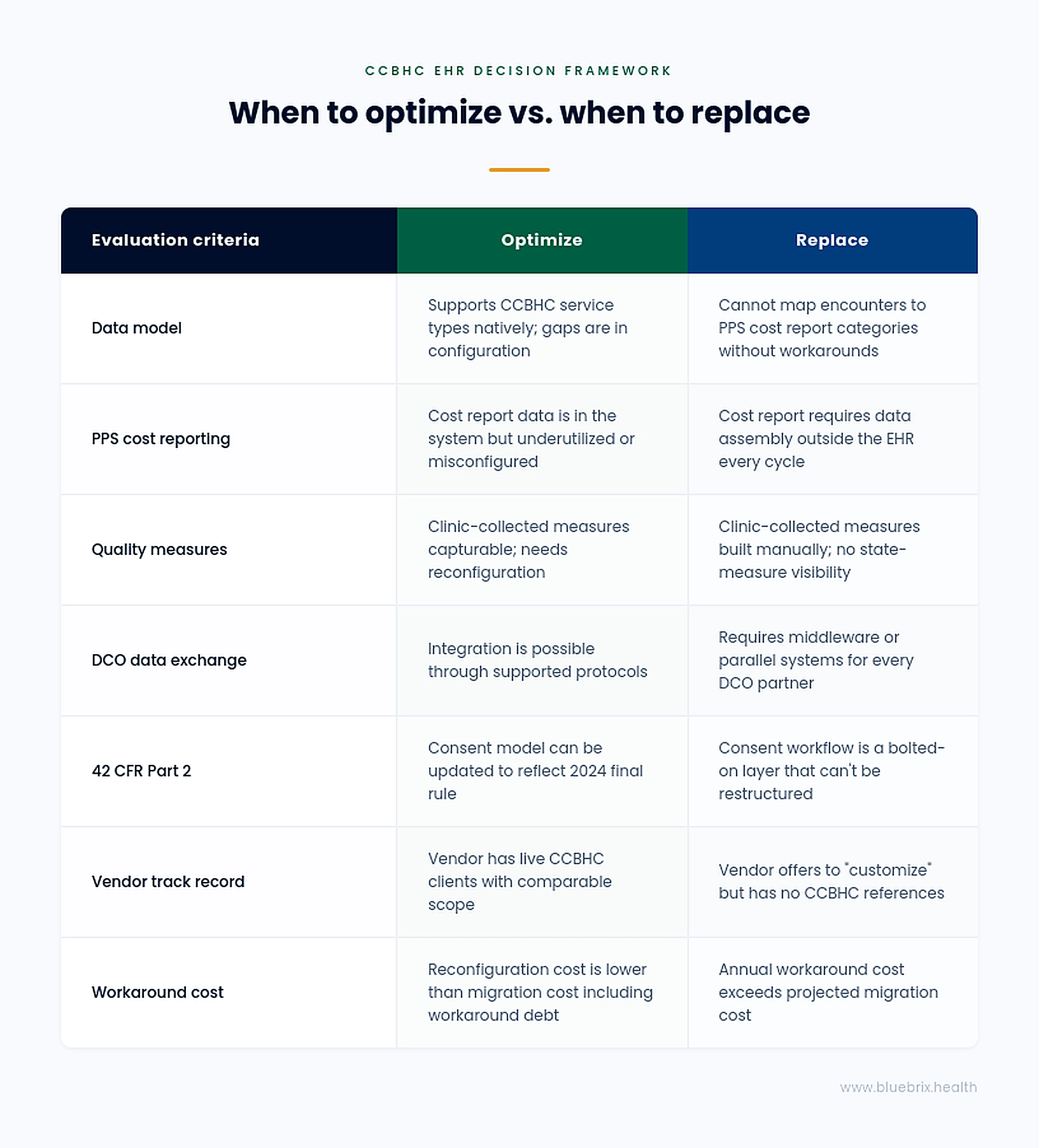
Replacing an EHR can be disruptive, expensive, and could take months. If the current system can be reconfigured to meet CCBHC demands, that’s the faster path. But “can be reconfigured” has to pass three tests.
- The underlying data model needs to support CCBHC service types without custom field workarounds. If the EHR can capture encounters for crisis, outpatient, SUD, rehabilitation, peer support, and care coordination in a way that maps cleanly to PPS cost report service categories, the architecture is sound. The problem is configuration, and that’s fixable.
- The vendor needs to have done this before — specifically for CCBHCs, not behavioral health generally. There’s a meaningful difference between “we can customize for CCBHC” and a vendor whose CCBHC clients are running live cost reporting, quality measures, and DCO workflows in production. Ask for references from organizations of comparable size and certification scope.
- The math has to work. Total cost of reconfiguration — staff retraining, workflow disruption during transition, any productivity dip — should come in lower than the cost of a full migration. But the comparison shouldn’t stop at the migration price tag. It needs to include the ongoing cost of every workaround that remains in place if optimization only partially closes the gaps.
The National Council’s toolkit includes a self-assessment checklist that maps EHR capabilities against CCBHC certification criteria. If the system scores well on structural requirements and falls short only on how it’s being used, optimization is the more efficient path.
When replacing the CCBHC EHR is the necessary path
Sometimes the architecture itself is the constraint. No amount of reconfiguration changes the underlying data model, and no combination of bolt-on tools turns a system designed for a narrower scope into one that can run a multi-service, multi-site CCBHC. When that’s the situation, delay compounds the cost.
The clearest signal is a PPS revenue problem. If the EHR can’t capture encounters across all nine service categories in a structure that feeds the cost report without manual assembly, optimization won’t fix it. The data model either supports it or it doesn’t. Under PPS-1, the rate is total allowable CCBHC costs divided by daily visits — errors on either side of that equation distort the rate. [3] A rate built on incomplete data starts out misaligned with actual costs, and that gap persists until the next rebasing, the timing of which varies by state methodology.
Interoperability is the second trigger. The 21st Century Cures Act’s information blocking provisions are in active enforcement. On the vendor side, ONC’s certification program continues to evolve around the United States Core Data for Interoperability (USCDI) standard and FHIR-based APIs.[7]
On the payer side, the Centers for Medicare and Medicaid Services’ (CMS) Interoperability and Prior Authorization Final Rule (CMS-0057-F) requires Medicaid managed care plans and other impacted payers to implement FHIR-based APIs for prior authorization and data exchange by January 1, 2027 (excluding drug prior authorizations, which matters for behavioral health prescribing). [8] That’s a payer mandate — but the practical effect is that providers with FHIR-native EHRs will be better positioned to connect to automated prior authorization and data exchange workflows as those APIs come online.
blueBriX’s FHIR R5-native architecture also supports R4 exchanges for compatibility with current payer and exchange partner APIs. Providers relying on middleware or manual processes may face growing administrative friction as the rest of the ecosystem moves toward standardized electronic exchange.
Then there’s scale. The model continues to expand — 539 CCBHCs serving an estimated 3.4 million people in 2025, nearly 13% more than in January 2024, according to the National Council’s 2026 CCBHC Impact Report. [2] Ten new states joined the Medicaid demonstration in May 2026. [9] Additional cohorts are scheduled every two years. Organizations on that growth trajectory need an EHR infrastructure that scales across locations, service lines, payer mixes, and DCO relationships and not parallel systems to keep up.
The hardest part of migration, in blueBriX’s experience working with mid-size community behavioral health organizations, isn’t the technology — it’s the clinical workflow disruption. Typical timelines run four to eight months with phased rollout. Any vendor promising significantly less should be able to demonstrate how, with reference clients of comparable scale.
Six questions to pressure-test before deciding
- These questions are built around the specific pressure points that determine a CCBHC’s financial sustainability and certification health.
- Does the current EHR capture encounters across all nine required service categories (as defined in SAMHSA’s 2023 CCBHC certification criteria [9]) in a structure that feeds the PPS cost report — without data assembly happening outside the system?
- Can it calculate the required clinic-collected CCBHC quality measures natively — time to services, depression remission, depression screening and follow-up, alcohol screening, social determinants of health screening — and track performance on the state-collected measures (FUH, FUA, FUM, IET, OUD, PCR-AD) between state reports? Or is the compliance team building those reports in Excel? [4]
- Does it support the 2024 Part 2 consent model — a single consent covering treatment, payment, and health care operations, plus a separate consent for SUD counseling notes — along with updated privacy notices and breach notification, or is Part 2 compliance a bolted-on process? [7]
- Can it exchange clinical data with DCO partners through standard interoperability protocols, without middleware in between?
- If the organization adds a new service line, a new site, or a new DCO partnership next year, does the system accommodate that within the existing configuration — or does it become a separate implementation project?
- What is the total annual cost of every workaround currently in place — staff time, bolt-on tools, manual reconciliation, compliance exposure — and how does that number compare to the cost of migration?
If the first four answers are “no” and the sixth produces a number that reframes the conversation, the optimize path is probably not sufficient.
If cost report data is being assembled outside the EHR, quality measures are reconciled manually, or DCO coordination runs through parallel systems, those aren’t just workflow problems — they’re compounding financial and compliance risks.
Your PPS rate is only as accurate as the system generating the data behind it
blueBriX works with community behavioral health organizations to evaluate whether the current EHR can meet CCBHC operational demands or whether migration is the stronger long-term path.
Schedule a CCBHC EHR evaluation →CCBHC EHR capability matrix: six platforms compared
The following matrix maps publicly documented capabilities of six EHR platforms serving community behavioral health organizations against the evaluation criteria above. Capabilities are classified as:
- Native — Built into the platform and documented for CCBHC use
- Supported — Available but not CCBHC-specific or requires configuration
- Via partners — Through marketplace or third-party integrations
- Undisclosed — Not publicly documented as of September 2026
| Capability | blueBriX | Core Solutions | Netsmart (myEvolv) | NextGen Healthcare] | Qualifacts (CareLogic / Credible) | Streamline (SmartCare) |
|---|---|---|---|---|---|---|
| Nine-service CCBHC documentation | Native | Supported | Native | Supported | Native | Native |
| PPS billing and cost report data | Native | Undisclosed | Supported | Supported | Native | Native |
| CCBHC quality measure tracking | Native | Native | Supported | Supported | Native | Native |
| DCO encounter tracking | Native | Undisclosed | Undisclosed | Undisclosed | Undisclosed | Supported |
| 42 CFR Part 2 (2024 final rule) | Native | Undisclosed | Supported | Undisclosed | Supported | Supported |
| Interoperability architecture | FHIR R5-native (R4-compatible) | Undisclosed | FHIR R4; QHIN (TEFCA) | ONC-certified | ONC-certified; via partners | Direct messaging; CCD exchange |
| Multi-site CCBHC operations | Native | Supported | Native | Supported | Native | Native |
Note: This matrix was not developed with vendor participation or sponsorship. Vendors are listed alphabetically. Per-cell sources are listed in the source appendix below. Please verify all claims directly with vendors during evaluation, request live demonstrations of CCBHC-specific workflows.
How blueBriX supports community behavioral health organizations making this transition
blueBriX’s community behavioral health EHR is configured around all six CCBHC program requirements, with dedicated documentation workflows per service category — peer support, psychiatric rehabilitation, crisis response, SUD treatment, targeted case management, primary care screening — each in its own workflow rather than adapted from a shared note template.
PPS billing connected to the services generating it
PPS encounter billing, cost reporting, and rate rebasing run from the same system clinicians use for documentation. Medicaid PPS encounters, managed care claims, and commercial fee-for-service claims are handled with separate billing configurations under one system — no parallel billing infrastructure required.
Eligibility verification runs at intake, during treatment, and before encounter submission. That check point carries more weight now — H.R. 1 requires six-month redetermination cycles for Medicaid expansion adults (for renewals scheduled on or after December 31, 2026) and community engagement requirements starting January 1, 2027. [10] States demonstrating good-faith compliance efforts can request an extension to December 31, 2028, and individuals with substance use disorders generally qualify as medically frail and are exempt from the work requirements.
Even so, expect more coverage churn across the broader populations CCBHCs serve, which makes eligibility verification at every encounter more valuable.
Quality measures captured during care delivery
Clinic-collected CCBHC measures — time to services (I-SERV), depression remission at six months (DEP-REM-6), alcohol screening and brief counseling (ASC), social determinants of health screening (SDOH), and depression screening and follow-up (CDF) — are captured as clinicians document, not extracted after the fact.
For state-collected measures (FUH, FUA, FUM, IET, OUD, PCR-AD, AMM, SAA, ADD, HBD, PEC, Y/FEC), performance tracking dashboards give the organization visibility into its own data between state report cycles. Clinic-collected measures are ready for state submission without a separate extraction-and-reconciliation step, and dashboards show where the organization stands against any state-set QBP thresholds (where applicable under the state’s PPS methodology). [4]
DCO coordination tracked in the clinical record
DCO-delivered encounters are documented and attributed separately from direct CCBHC services, with volume tracking for the 51% direct-service threshold across core services (excluding crisis services, per SAMHSA certification criterion 4.a.1). [4] Referral tracking between the CCBHC and its DCO partners is maintained in the patient’s clinical record.
blueBriX’s FHIR R5-native architecture supports clinical data exchange with DCO partners through standard interoperability protocols. The platform also supports FHIR R4 exchanges for compatibility with current payer APIs and health information exchange partners.
42 CFR Part 2 and crisis workflows handled natively
Consent management reflecting the 2024 final rule — single TPO consent, separate SUD counseling note consent, updated privacy practice notices, and breach notification workflows — is part of the system’s core architecture.
Crisis workflows operate within the same clinical environment: Columbia Suicide Severity Rating Scale (C-SSRS) screening triggers safety protocols in the documentation workflow, mobile crisis dispatch and field assessment are captured in the standard encounter flow, and warm handoffs to stabilization are tracked without switching systems.
Safety plans link to the treatment record with responsible parties, warning signs, coping strategies, and emergency contacts.
Scales from CMHC to certified CCBHC
Organizations can go live with standard community behavioral health workflows and add CCBHC-specific configurations — PPS billing, quality measure tracking, nine-service documentation, DCO coordination — when certification is in play. Multi-site operations, program hierarchies, and site-specific templates roll up to organization-wide dashboards and reporting. No re-implementation required when the organization grows.
The capabilities listed in this article — PPS cost reporting, quality measure tracking, DCO encounter attribution, 42 CFR Part 2 compliance, multi-site program management — are live in blueBriX’s community behavioral health EHR today.
See how blueBriX supports CCBHC operations in practice
If your organization is evaluating whether to optimize or replace its current system, a consultation can help map your specific certification scope, payer mix, and growth trajectory against what your EHR needs to support.
Schedule a consultation